
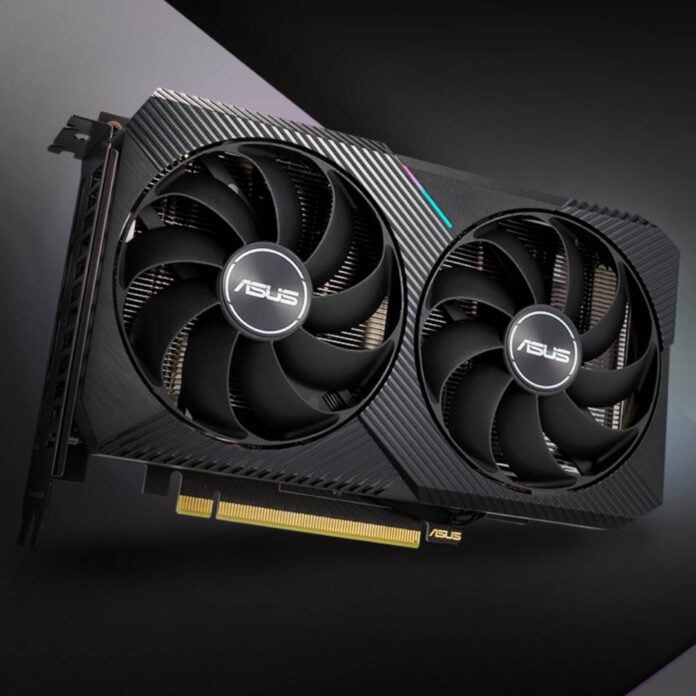
Nvidia is reportedly planning to revive its old GeForce RTX 3060 to cover the budget GPU segment and help satisfy demand. This five-year-old budget GPU still only sits slightly below the RTX 5050 in terms of overall performance, so it should still be capable of running many modern games at reasonable settings.
According to sources on Chinese tech industry forum Board Channels, Nvidia is planning to relaunch the RTX 3060 this month. Graphics card partners are expected to begin receiving GPU and memory bundles from Nvidia between 10-20 March, with cards reaching retailers as soon as they’re ready.
Unfortunately, the leak didn’t mention anything regarding specs, so we don’t know whether these cards will be based on the original 12GB RTX 3060 using a 192-bit bus, or the later 8GB variant using a 128-bit bus. Either way, it will use the two-generation-old Ampere architecture and is likely to pack 3,584 CUDA cores with a clock speed of up to 1,777MHz. If this ends up being the 12GB model, we should see 360GB/s of bandwidth thanks to the wider 192-bit bus and 15Gb/s GDDR6 combo. Otherwise, it will be 240GB/s using a 128-bit bus on the 8GB variant, which is less ideal, but more likely given current constraints on memory production.
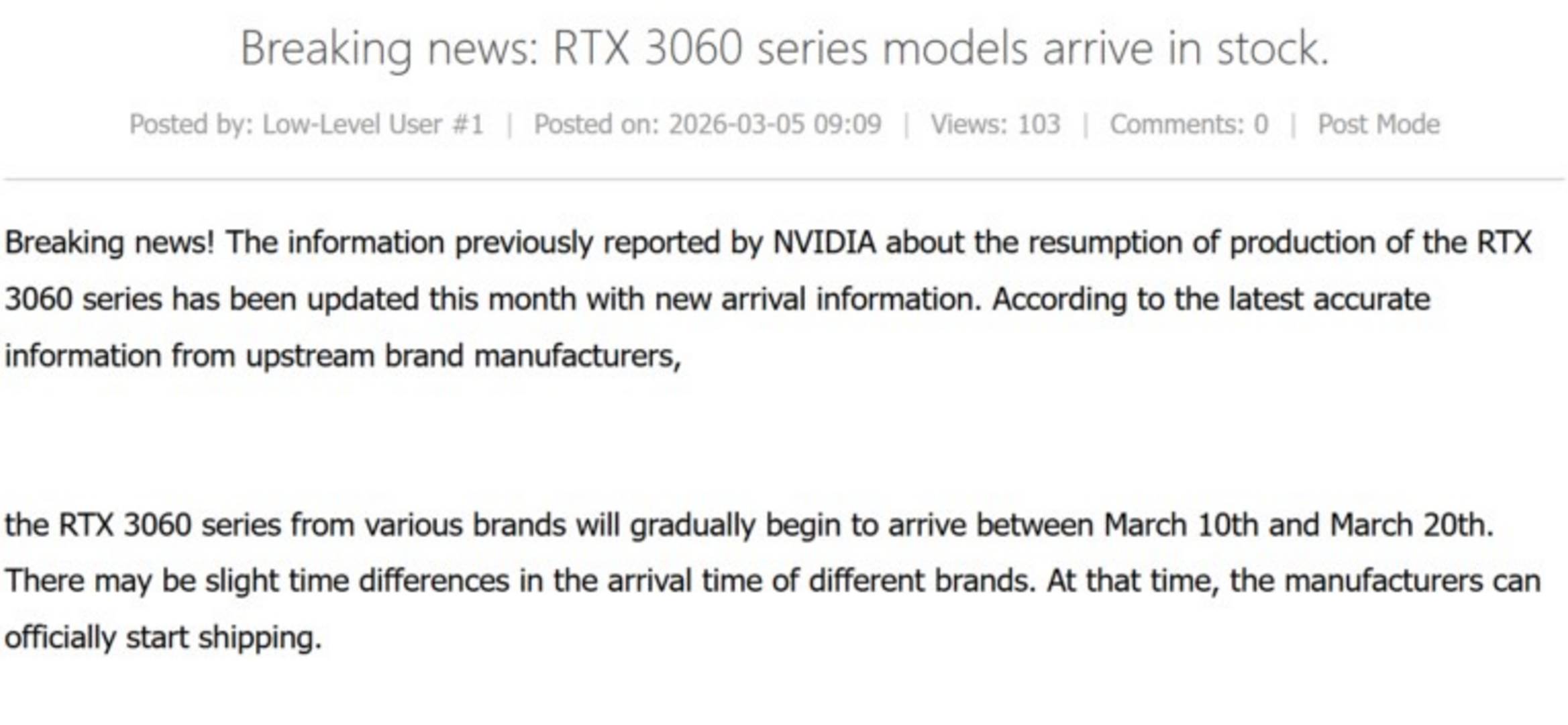
Why is Nvidia apparently planning to revive this old GPU, instead of the RTX 4060? One reason could be that the RTX 3060 GPU is made using an older Samsung 8nm manufacturing node, while the RTX 4060 shares the same TSMC 4N (5nm-class) node with Nvidia’s RTX 50 Series. In other words, it would be better to use the latter manufacturing capacity to make RTX 5050s instead of RTX 4060s.
Furthermore, since the RTX 3060 also has access to the latest DLSS transformer upscaling tech, users won’t be missing out on much. That said, DLSS transformer does run slower on Ampere Tensor cores than Ada and Blackwell cores, and there won’t be any DLSS frame gen support either.
Performance-wise, the RTX 3060 isn’t far behind the RTX 5050, with a relative performance difference of just 14%, at least in terms of basic raster speed, which isn’t bad for a five-year-old mid-range GPU. Better yet, in VRAM-heavy games, the 12GB version of the RTX 3060 may even beat the RTX 5050, as the latter’s 8GB frame buffer could struggle to feed the GPU.
In the end, pricing will decide whether this is a good move or a waste of resources. As a reminder, the RTX 3060 12GB launched at $329 MSRP before dropping below $270 with time. Nowadays, you can find it for around $339/£259 new or $200/£200 second-hand. With the RTX 5050 now costing $289/£279, Nvidia needs to drop the new RTX 3060 price below $250/£240 to make sense, although final pricing will undoubtedly be down to RAM availability in the current climate.