
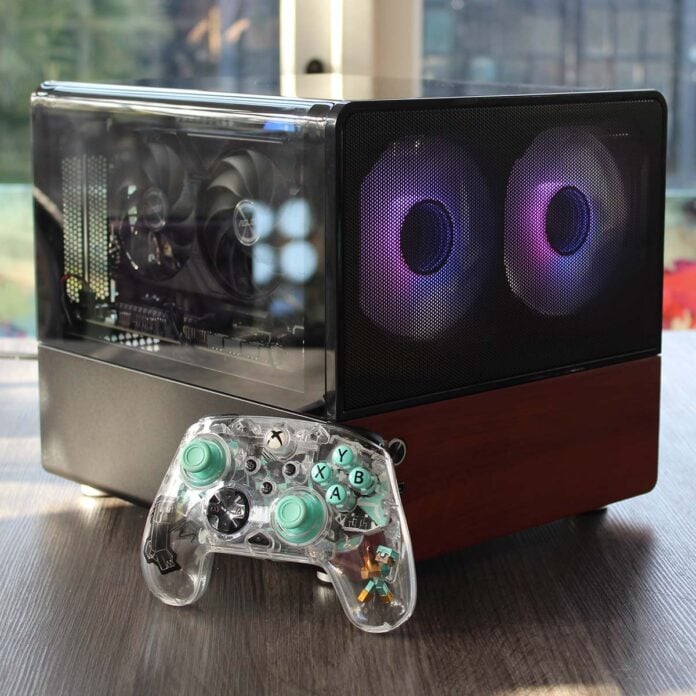
If you like the look of the Wired2Fire Haven Ember Pro 9060, and let’s face it, this is a lovely-looking PC, then you’ll need to get your order in quick. Right now, this gorgeous mini PC is being built with component stock that’s already in-house at Wired2Fire, and will set you back a very reasonable price of just £1,499. However, the company has warned us that once four weeks have passed, it will have to be built with components bought in at the going rate, which is likely to add at least another £300 to the price.
I almost want to 3D-print a little beak to complete the Bubo from Clash of the Titans owl look.
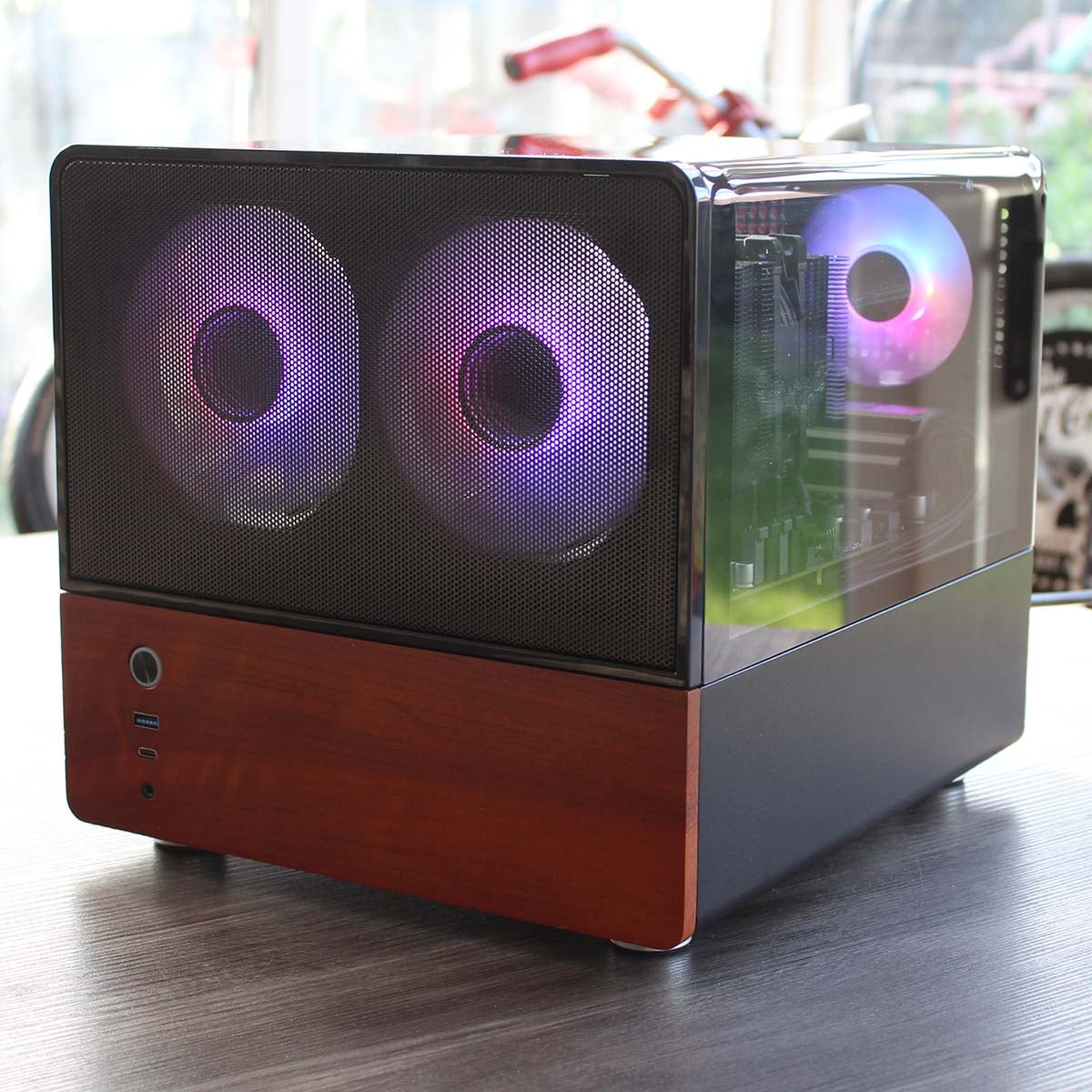
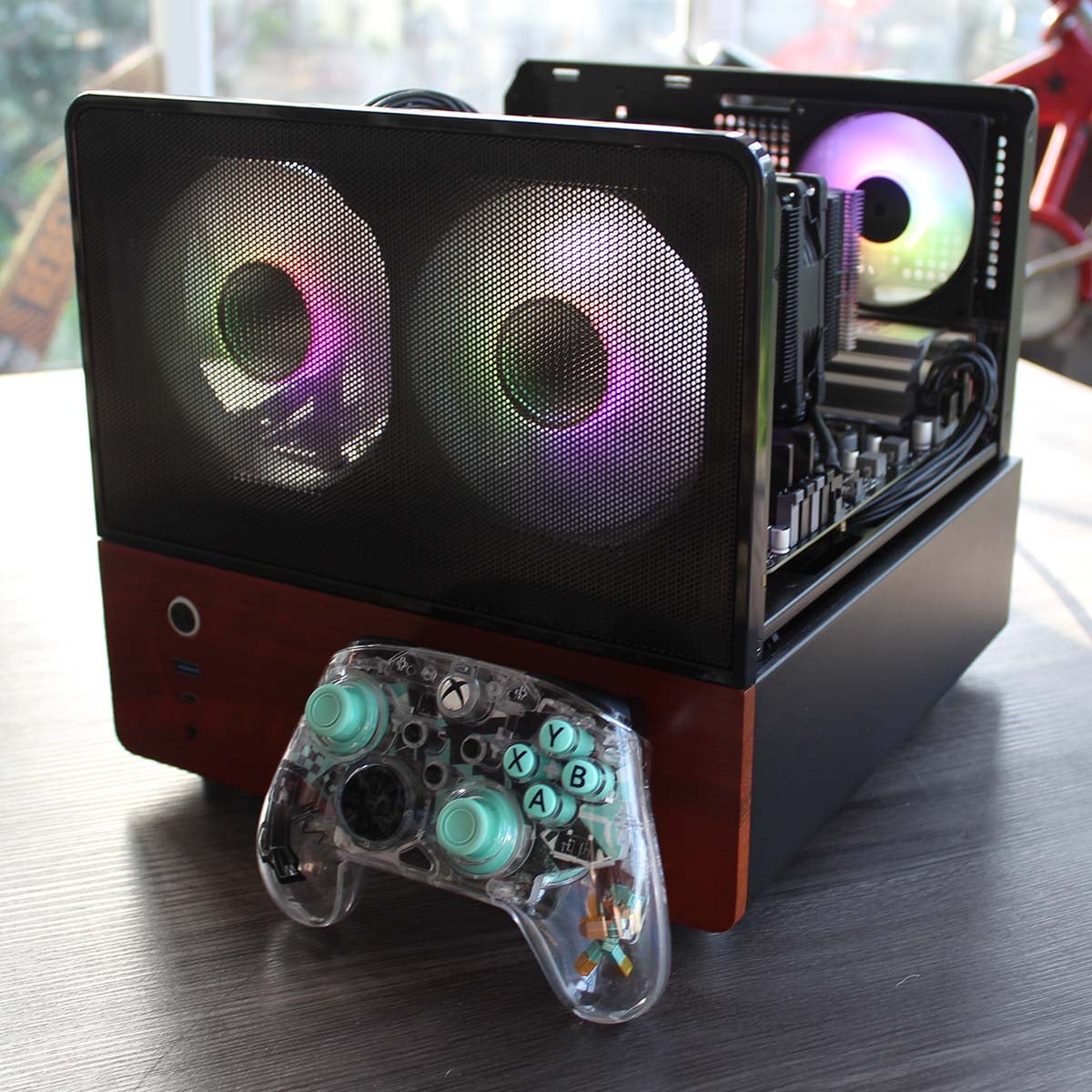
In this four-week window of opportunity, however, the Haven Ember Pro 9060 is a great little machine. Its micro-ATX chassis has a small footprint that takes up minimal desk space – we’ve used a gamepad for scale in our main image, and its wooden front and tinted, curved glass top give it a real touch of class.
This PC looks great on your computer desk, but it also wouldn’t look out of place in your living room. Its two front fans do make it look like it’s watching you, though – I almost want to 3D-print a little beak to mount under them and complete the Bubo from Clash of the Titans owl look.
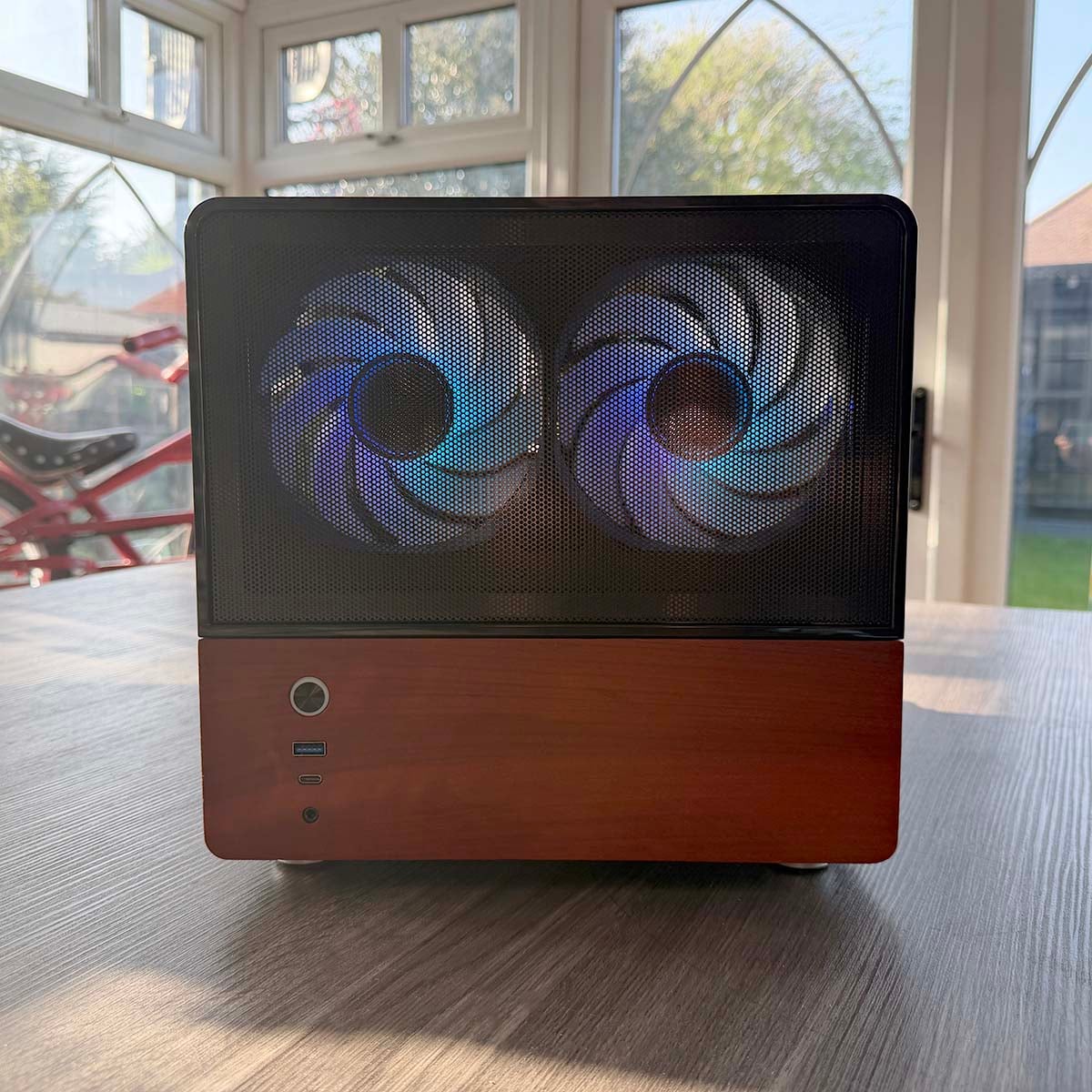

Wired2Fire Haven Ember Pro 9060
£1,499
Pros
- Gorgeous looks
- Fair price for now
- Solid 1080p gaming pace
- 16GB of VRAM
- Small footprint
- Plenty of memory and storage space
- Comprehensive warranty
Cons
- CPU gets hot at full load
- Limited multi-threaded speed
Club386 may earn an affiliate commission when you purchase products through links on our site.
How we test and review products.
There are some quality component choices here as well, with cost-cutting kept to a minimum. The end result is an attractive mini PC with genuinely solid performance, particularly in games, and with some decent upgrade potential as well. Most importantly, at £1,499, it has a surprisingly reasonable price in these inflationary times.
Specs
| Wired2Fire Haven Ember Pro 9060 | |
|---|---|
| CPU | AMD Ryzen 5 9600X |
| CPU cooler | Noctua NH-D9L chromax.black |
| Motherboard | Asus Prime B850M-A WiFi |
| GPU | Asus Dual AMD Radeon RX 9060 XT 16GB |
| RAM | 32GB (2x16GB) 6,000MT/s CL36 Crucial Pro DDR5 |
| SSD | ADATA Legend 860 2TB |
| PSU | Corsair 850W RMe (80 Plus Gold) |
| Other features | 2.5Gb Realtek Ethernet Wi-Fi 6E |
| Case | Jonsbo V12 (micro-ATX) |
| Operating system | Windows 11 Home |
| Warranty | Five years labour, two years parts, two years collect & return |
| Price | £1,499 |
Wired2Fire has focused on giving the Haven Ember Pro 9060 a solid core specs list for gamers, with every box ticked. That means there’s no reliance on last-gen components and DDR4 memory, as we’ve seen with some budget gaming PCs lately – it’s sadly the only way to build a genuinely low-price PC now. There are also no compromises on key quality-of-life specs. That means you get a full 32GB of DDR5 RAM, rather than just 16GB, and you also receive a decent 2TB of solid-state storage space.
There’s no reliance on last-gen components and DDR4 memory.
The latter comes courtesy of an ADATA PCIe Gen 4 drive in our sample, which isn’t going to be as quick as the latest PCIe Gen 5 SSDs, but it’s plenty fast enough for most people’s needs, and it has that all-important 2TB capacity.
At current storage prices, I’d much rather have a 2TB PCIe Gen 4 drive than a 1TB PCIe Gen 5 model – the speed advantage of the latter isn’t that large in real-world use, and an extra terabyte of storage space makes all the difference to convenience when you have a lot of the latest games to install.
Meanwhile, memory comes in the form of two 16GB Crucial Pro 6,000MT/s modules with CL36 latency timings. That’s ideal for an AMD Ryzen system, where 6,000MT/s is generally considered the sweet spot, and while the latency is a little higher than some kits, it’s great to see a full 32GB of DDR5 RAM included in a machine at this price right now.
Wired2Fire says it has enough stock of this ADATA SSD and Crucial memory to build this PC for the next four weeks, but after that point, the memory and SSD may be swapped for other models, due to current challenges with supply in the RAM and storage market. However, it assures us that, whatever RAM is used in this machine, it will run at 6,000MT/s, just like the Crucial memory we’ve tested, and that the SSD will be a PCIe Gen 4 model with speeds in the same league as the ADATA drive.
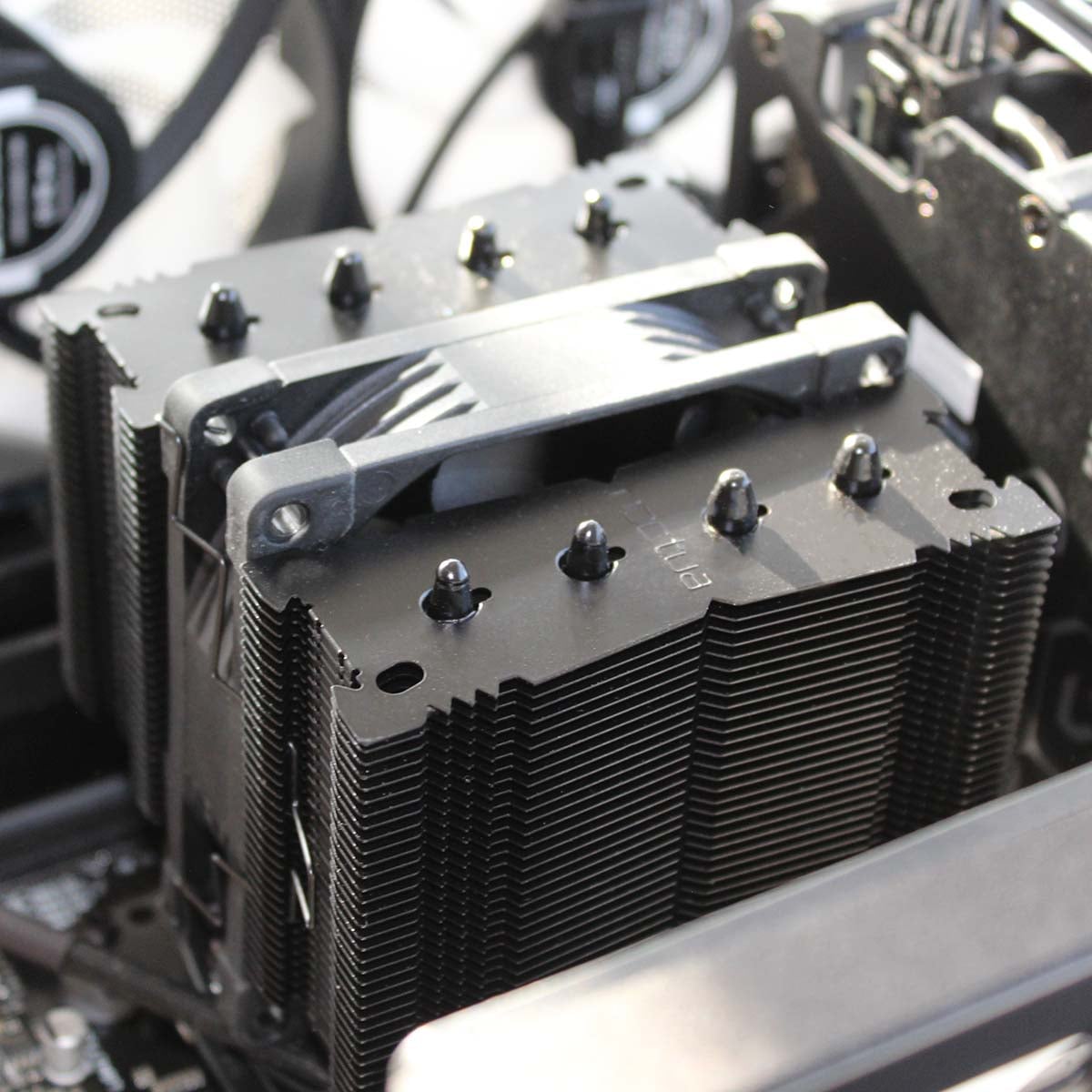
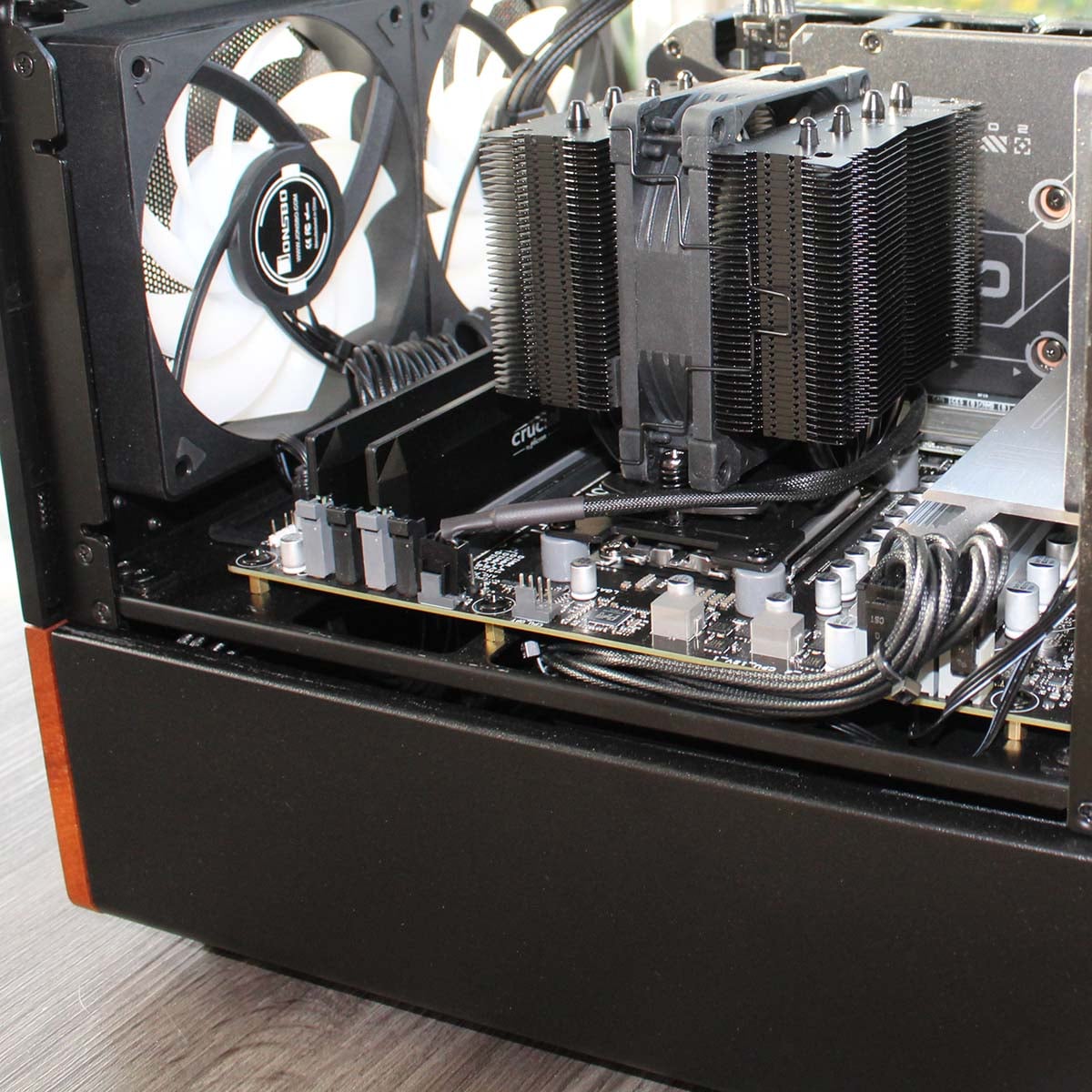
Back to the rest of the specs, you get an AMD Ryzen 5 9600X in the Haven Ember Pro 9060, which we list on our guide to buying the best CPU as the top budget gaming option. Based on AMD’s latest Zen 5 architecture, it has six cores and a top boost clock of 5.4GHz. It’s a much stronger chip than last-gen options such as the Ryzen 5 5500, and while it doesn’t have 3D V-cache, it has a much faster clock speed than the 4.2GHz Ryzen 5 7500X3D as well. With a TDP of just 65W, it’s ideal for a mini PC such as this one, with Wired2Fire topping it with a well-built Noctua NH-D9L air cooler – a solid choice.
I applaud Wired2Fire’s decision to kit out the Haven Ember Pro 9060 with a Radeon RX 9060 XT 16GB.
The other key core component is the graphics card, and I applaud Wired2Fire’s decision to kit out the Haven Ember Pro 9060 with a Radeon RX 9060 XT 16GB, again one of our favourites from our best GPU guide. In particular, I love the fact that you get a full 16GB of memory on this card, rather than the meagre 8GB on the RTX 5060, or even 12GB on the RTX 5070, for that matter. That means you won’t need to worry about a lack of VRAM holding back your graphics performance in the latest games, some of which we’ve found can quickly saturate 8GB in our tests.
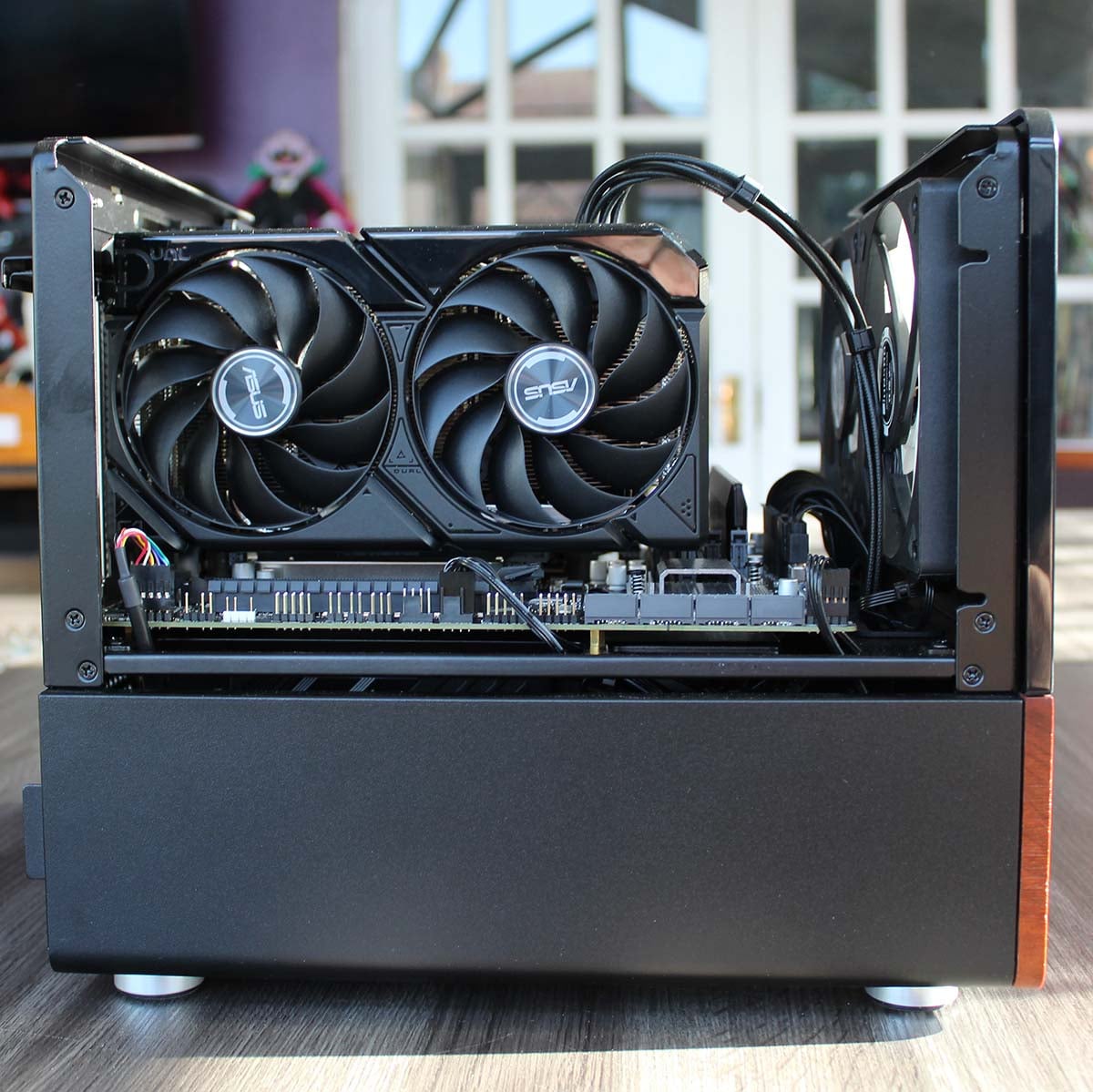
All this gear is plugged into an Asus Prime B850M-A WiFi motherboard, which doesn’t offer much in terms of RGB frills and fancy heatsinks, but does cover all the essentials. That includes a 16x PCIe Gen 5 slot for your graphics card, as well as a PCIe Gen 5 x4 M.2 connector, if you ever wanted to add a super-fast SSD later. AMD is widely expected to continue supporting the AM5 socket on this board for at least another generation, and possibly more, so you may well be able to upgrade to future CPUs as well.
There’s a solid PSU included in this build as well. Our sample came with a modular MSI unit, but Wired2Fire says final retail samples will feature an 850W Corsair RMe unit with 80 Plus Gold certification. That’s more than enough power for the included spec, and gives you some room to grow if you ever want to install a more powerful GPU or CPU as well.
Finally, I want to give a shout-out to Wired2Fire for going above and beyond the norm with its warranty coverage. Desktop PCs often come with the bare minimum of just one year of parts and labour coverage, with a return-to-base deal, especially if you buy one from a big manufacturer. Conversely, you get five years of labour and a solid two years of the all-important parts coverage from Wired2Fire, which is great peace of mind if anything breaks, plus you get two years of collect-and-return service, so you don’t need to worry about getting the machine back to the manufacturer yourself. Just bear in mind that Wired2Fire quotes a 10-20-day lead time for this system to be delivered once you’ve ordered it.
Design
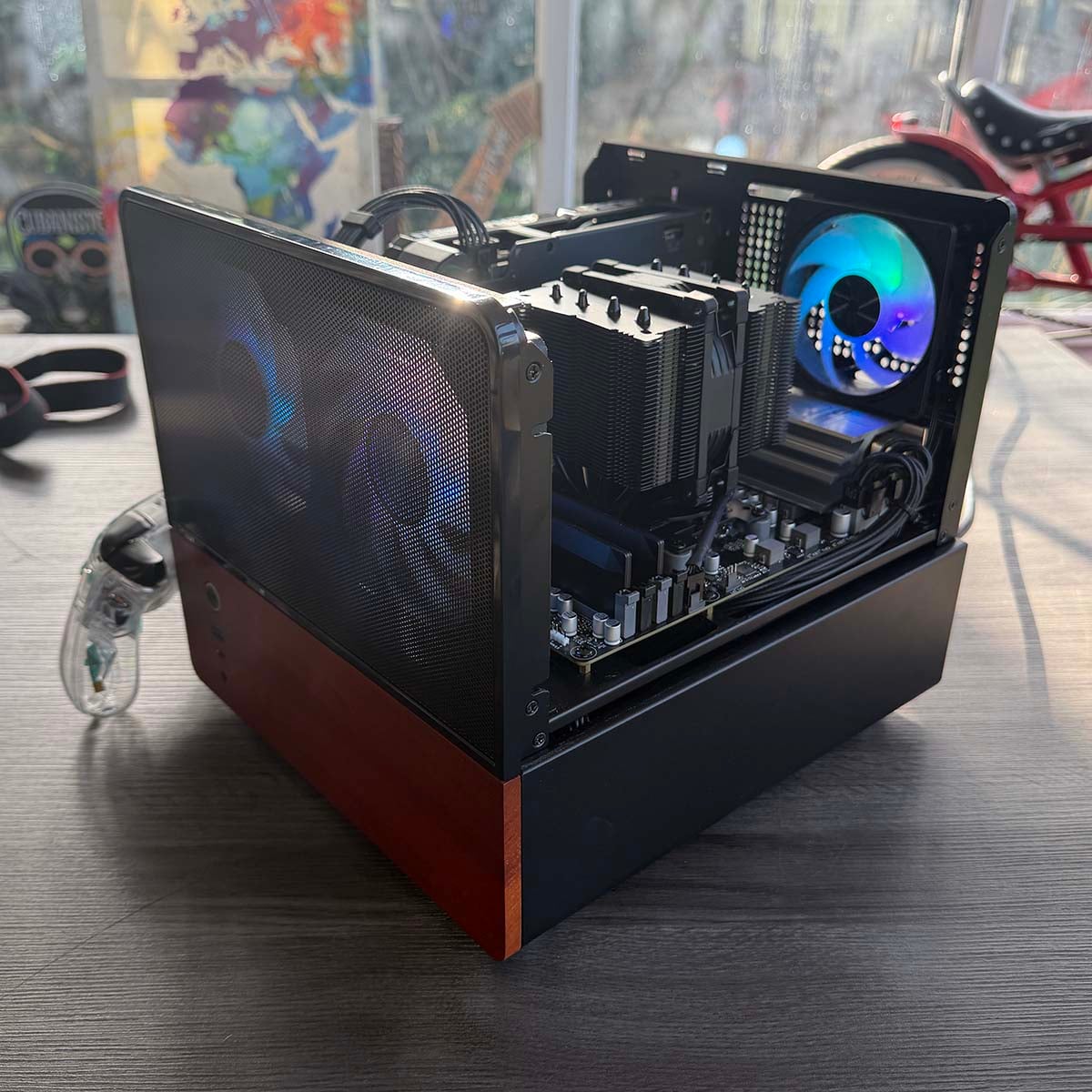
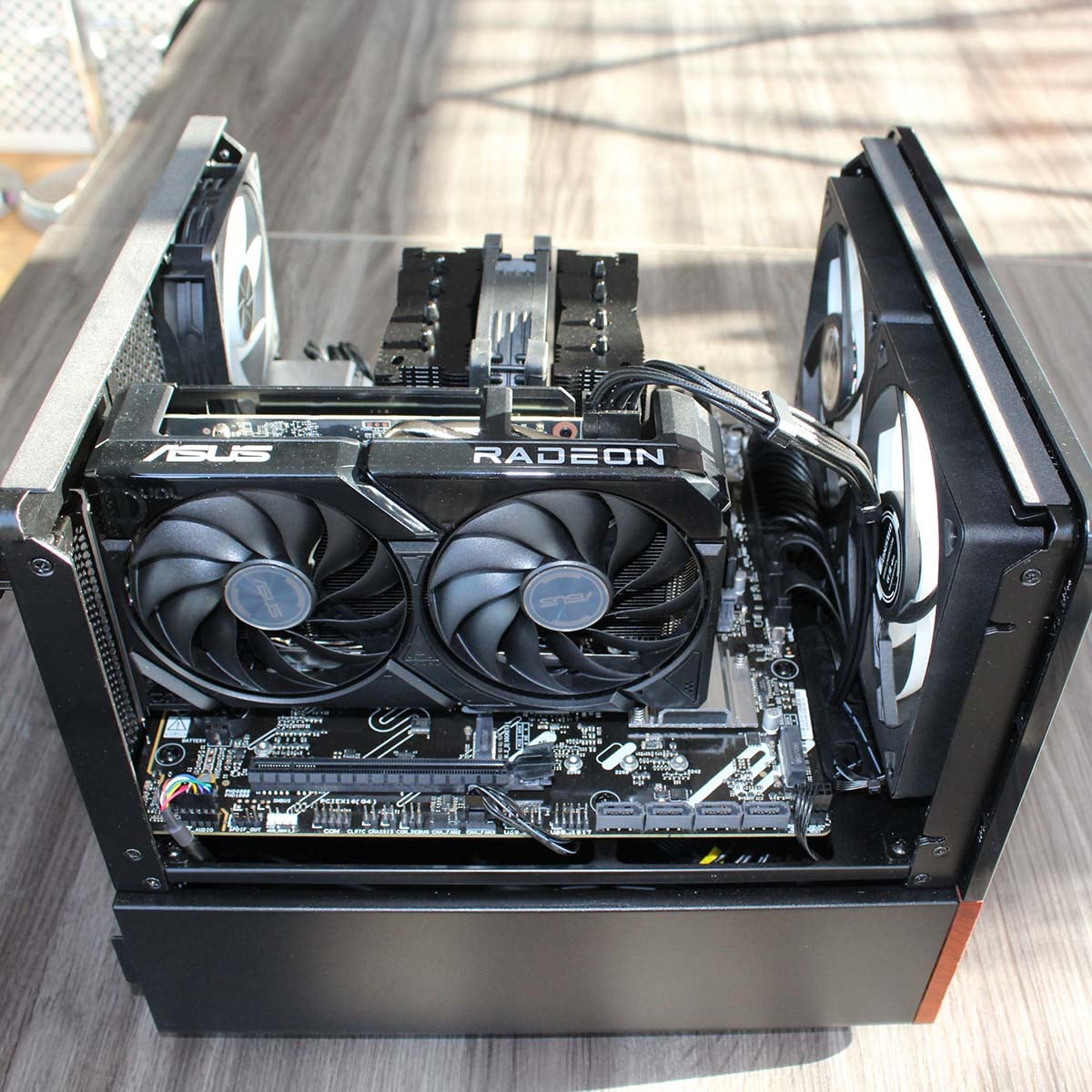
Aesthetics is the area where this machine really shines, as it does look the business. All the components are housed in a black Jonsbo V12 case, with a classy wooden front and a wraparound glass lid – the end result reminds me a bit of a record player. You can look down through the top and see the whole system laid out before you. It’s surprisingly small, as well, with dimensions measuring just 280 x 301 x 276mm (W x D x H). It’s basically a cube and its depth of just over a foot means it hardly takes up any space on your desk – it clears loads of room compared to my usual Fractal Define R6 rig, which isn’t far off being twice as deep at 243mm.
Wired2Fire has made a solid choice with the low-profile Noctua NH-D9L cooler.
The height of just 276mm makes for a really compact machine, especially compared to your average tower case. The limited height does result in a couple of compromises, though. One is that there’s no room for a 120mm exhaust fan at the back (although there are two 120mm RGB fans in the front), with Wired2Fire instead installing a 92mm Thermalright RGB spinner.
This looks good, and it’s at least better than no exhaust at all, but it does limit airflow compared to a larger fan. Likewise, there’s not much room for a large CPU cooler, but Wired2Fire has made a solid choice with the low-profile Noctua NH-D9L, which again sports a 92mm fan, sandwiched between two heatsink towers.
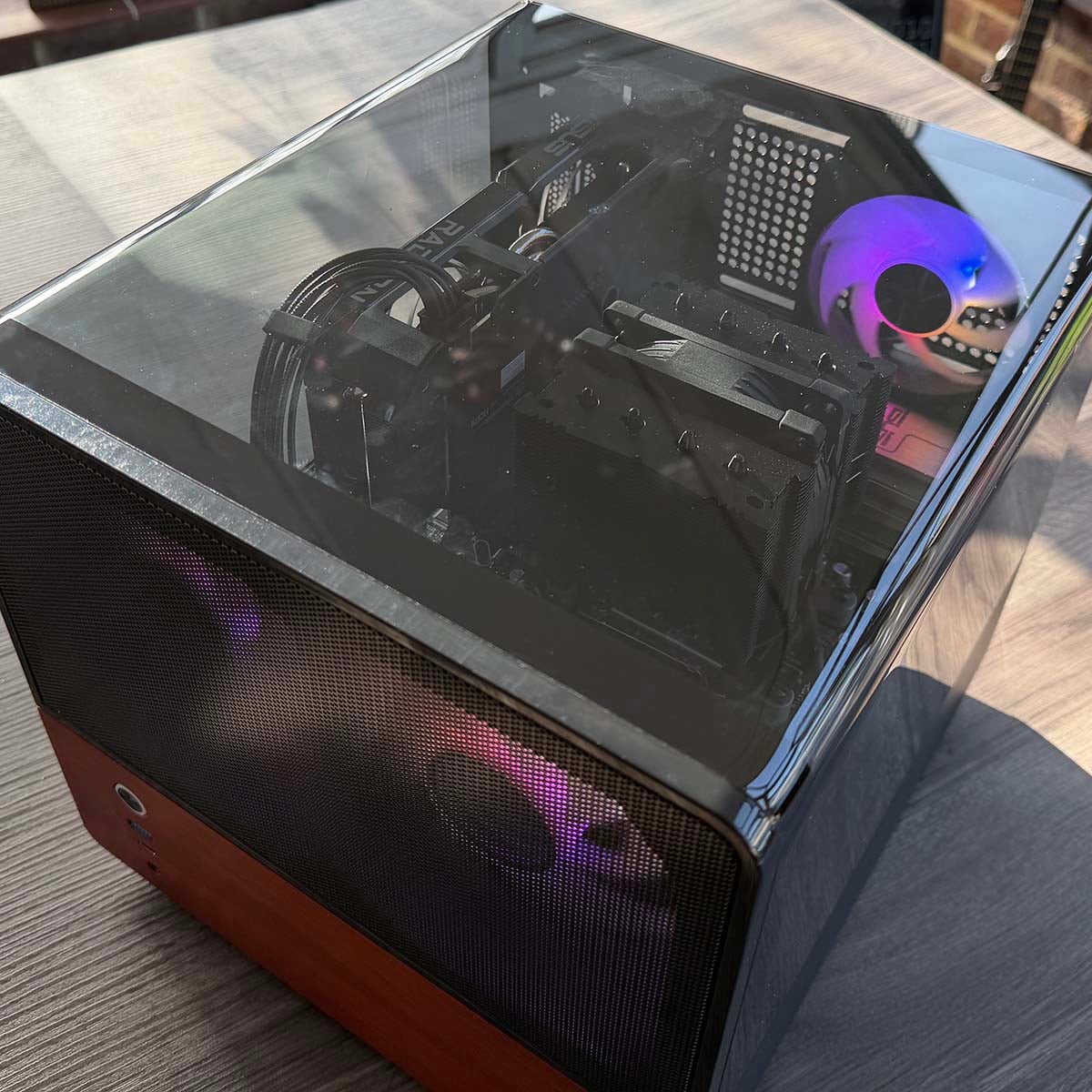
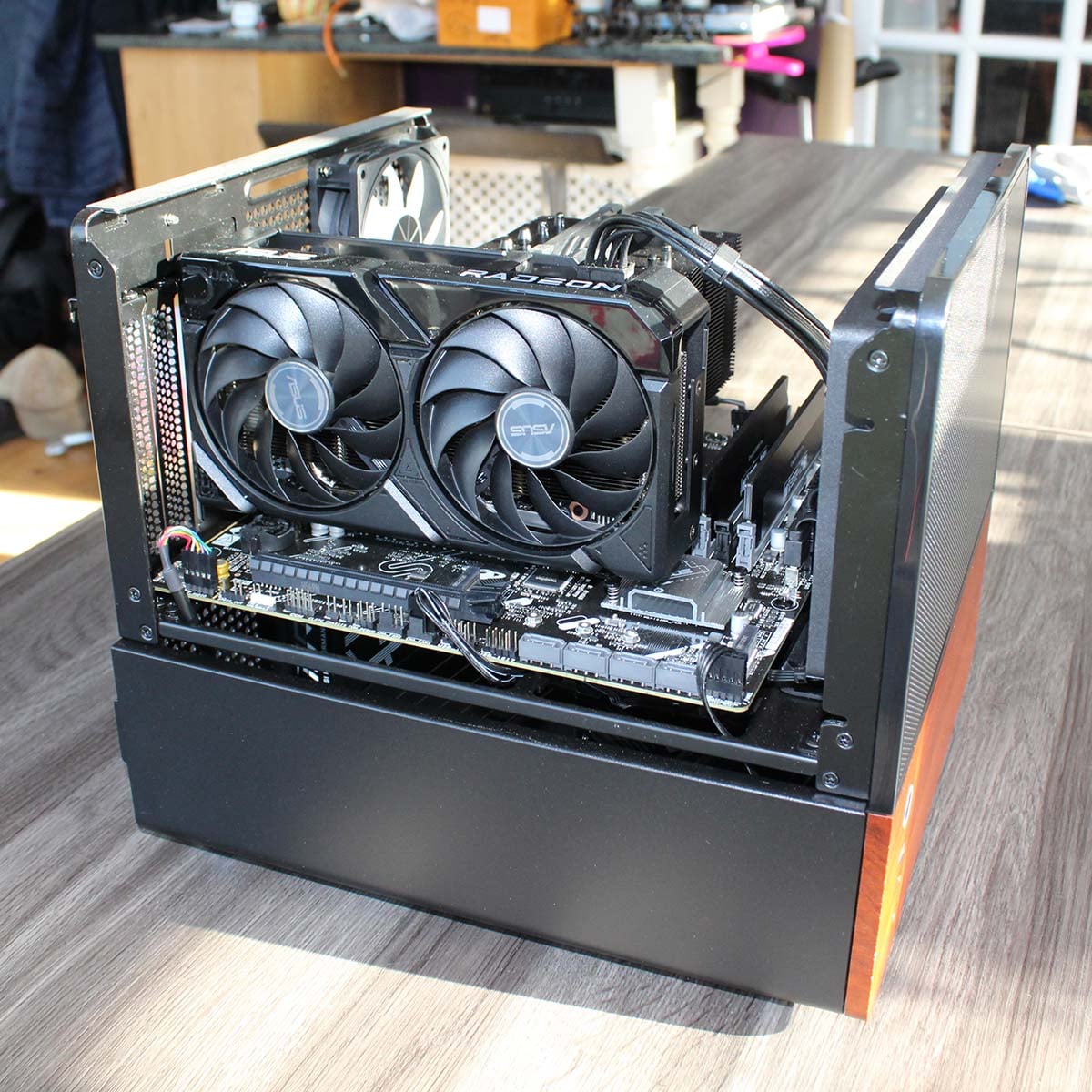
There’s also limited room to install a graphics card – the Asus Dual 9060 XT card fits nicely, but Wired2Fire tells me you won’t be able to shoehorn a 9070 XT card in there. You always make a few sacrifices by opting for a smaller rig, though, and Wired2Fire has generally done a fine job here, balancing the limited dimensions with a decent spec.
Individually-sleeved modular PSU cables are routed neatly into the interior, and tied down at regular intervals with sleeves to keep them together, so you can easily get to the motherboard’s bottom PCIe slot, and the memory slots are accessible as well. The whole interior is laid out flat under the glass, and you can easily access the insides by unscrewing four Philips screws on the back so you can remove the lid. It’s a really well-built chassis as well – it all feels solid, with no flimsiness or sharp edges.
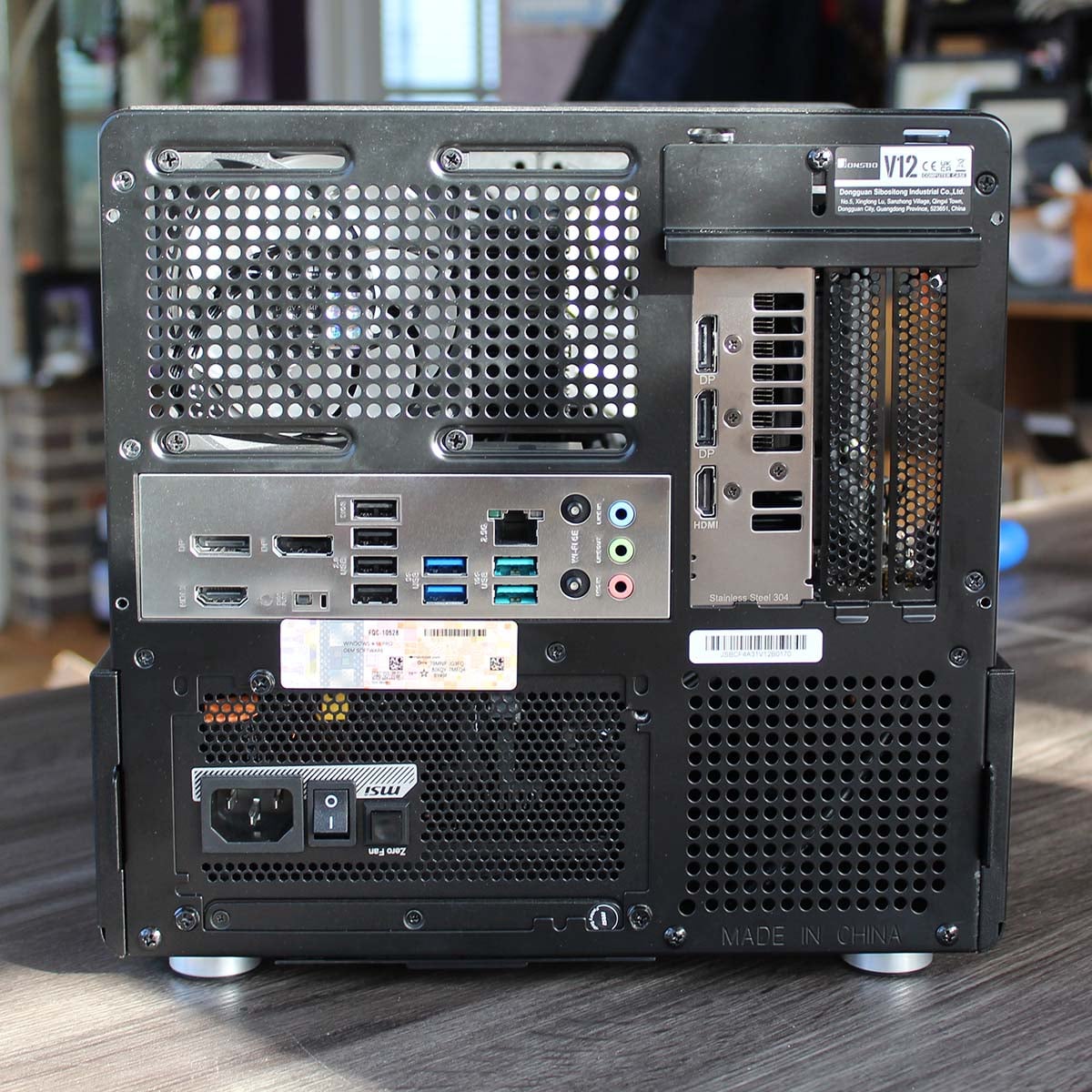
You get a decent selection of ports, too, including both USB-A and USB-C sockets on the front, although they both only offer 5Gb speeds, alongside the power button and audio jack. You get some high-speed ports on the back, though, including a pair of 10Gb USB-A ports (ideal for external SSDs), plus four USB 2 sockets and a pair of standard 5Gb USB-A ports.
You get both a 2.5Gb Ethernet port and integrated Wi-Fi 6E.
That’s plenty of ports for your average peripheral setup, although it’s a shame the speeds top out at 10Gb. That’s a limit of this particular motherboard, and it’s an understandable compromise on a machine at this price, but other boards offer 20Gb USB-C ports, as well as 40Gb ports with power delivery.
You can get solid speeds of up to 1,250MB/s from 10Gb USB, which is better than a 5Gb port for an external SSD, but you can definitely get faster speeds from other machines. On the plus side, you get both a 2.5Gb Ethernet port and integrated Wi-Fi 6E, so you get some decent networking options.

Performance
I’m comparing the Haven Ember Pro 9060 to a few other PCs we’ve recently reviewed, at various prices, so you can see how it stacks up. However, it’s worth bearing in mind that, because of the current chaos surrounding RAM and storage prices, some of these PCs are no longer available, and some command significantly higher premiums than when we first reviewed them. I’ve listed the current prices where applicable.
It’s also worth bearing in mind that the Ember Pro 9060 has a considerably lower price than some of these machines. I’ve included more expensive PCs so you can see what performance you lose or gain by going for a cheaper or pricier PC. Here are the six other systems I will be comparing to this one, complete with a summary of their core components and links to their reviews:
- OcUK Gaming Mach 3.1 (£1,349 when tested – £1,699 for new spec with 7500X3D)
- AMD Ryzen 7 5700X3D
- Nvidia GeForce RTX 5070
- MSI B550M Pro-VDH WiFi
- 32GB DDR4-3200 CL16
- 1TB MSI Spatium M450 V1
- AWD-IT Kalona (£839)
- AMD Ryzen 5 5500
- AMD Radeon RX 9060
- Asus Prime A520M-K
- 16GB DDR4-3200 CL16
- 1TB Crucial E110
- CyberpowerPC Ultra R87 Pro (£999 when tested – no longer available)
- AMD Ryzen 7 8700F
- AMD Radeon RX 9060 XT 16GB
- MSI Pro B650-S WiFi
- 32GB DDR5-6000 CL36
- 1TB WD_Black SN7100
- PCSpecialist Aegis Pro R (£999 when tested – no longer available)
- AMD Ryzen 5 7500X3D
- Nvidia GeForce RTX 5060
- Asus Prime B850-Plus WiFi
- 16GB DDR5-5600 CL40
- 1TB Crucial P310
- PCSpecialist Nebula Phantom (£2,349)
- Intel Core Ultra 7 270K Plus
- Nvidia GeForce RTX 5070 Ti
- Asus Prime Z890-P WiFi
- 32GB DDR5-6400 CL36
- 2TB Crucial T710
- PCSpecialist Cruiser iCue Stealth (£3,099)
- AMD Ryzen 7 9850X3D
- Nvidia GeForce RTX 5080
- Asus TUF Gaming X870-Plus WiFi
- 32GB DDR5-6000 CL30
- 4TB Corsair MP600 Pro
CPU
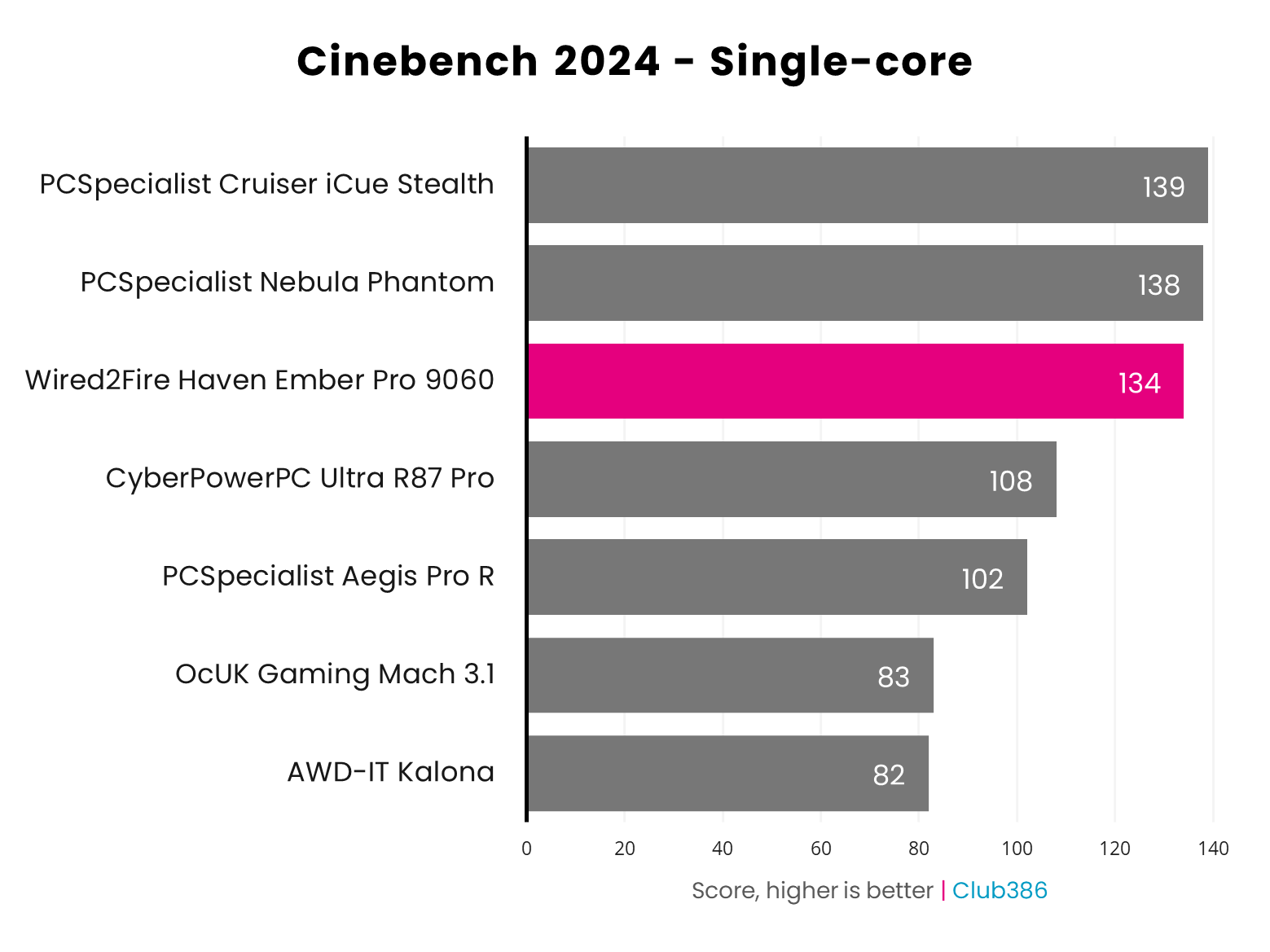
AMD’s Ryzen 5 9600X may only have a 65W TDP and six cores, but it still offers formidable single-threaded performance, thanks to that 5.4GHz boost clock. In Cinebench 24’s single-core test, this PC scores 134, just four points away from the PCSpecialist Nebula Phantom, with its Core Ultra 7 270K Plus. It’s also a long way in front of machines based on the Ryzen 5 7500X3D and 8700F, as well as last-gen AM4 systems. AMD’s Zen 5 architecture is strong.
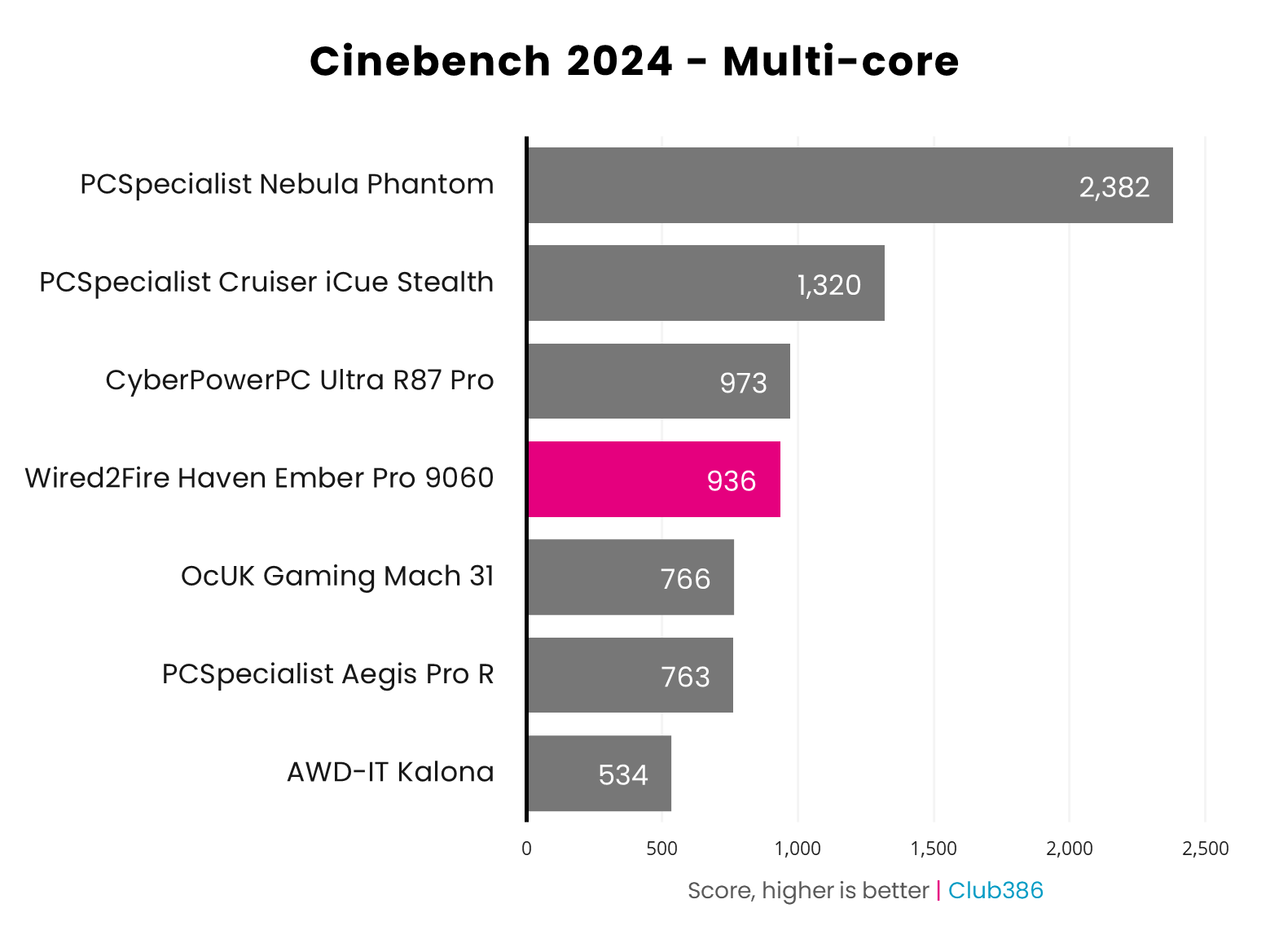
With only six cores at its disposal, it’s no surprise to see the Haven Ember Pro 9060 fall well behind the Nebula Phantom in Cinebench 24’s heavily multi-threaded test – the latter does have a 24-core CPU, after all. It also costs £850 more than the Wired2Fire rig we’re testing here.
We’re obviously not expecting a Ryzen 5 9600X to beat a 24-core Intel CPU, but it’s interesting to see how far it pulls ahead of other CPUs. In particular, the OCuK Gaming Mach 31 uses an 8-core Ryzen 7 5700X3D chip, but its older architecture and lack of clock speed puts it a fair way behind this 6-core rig. You can also see the benefit of opting for this machine over a lower-cost AM4 rig based on a last-gen Ryzen 5 5500, such as the AWD-IT Kalona – the Wired2Fire rig is 75% quicker!
RAM
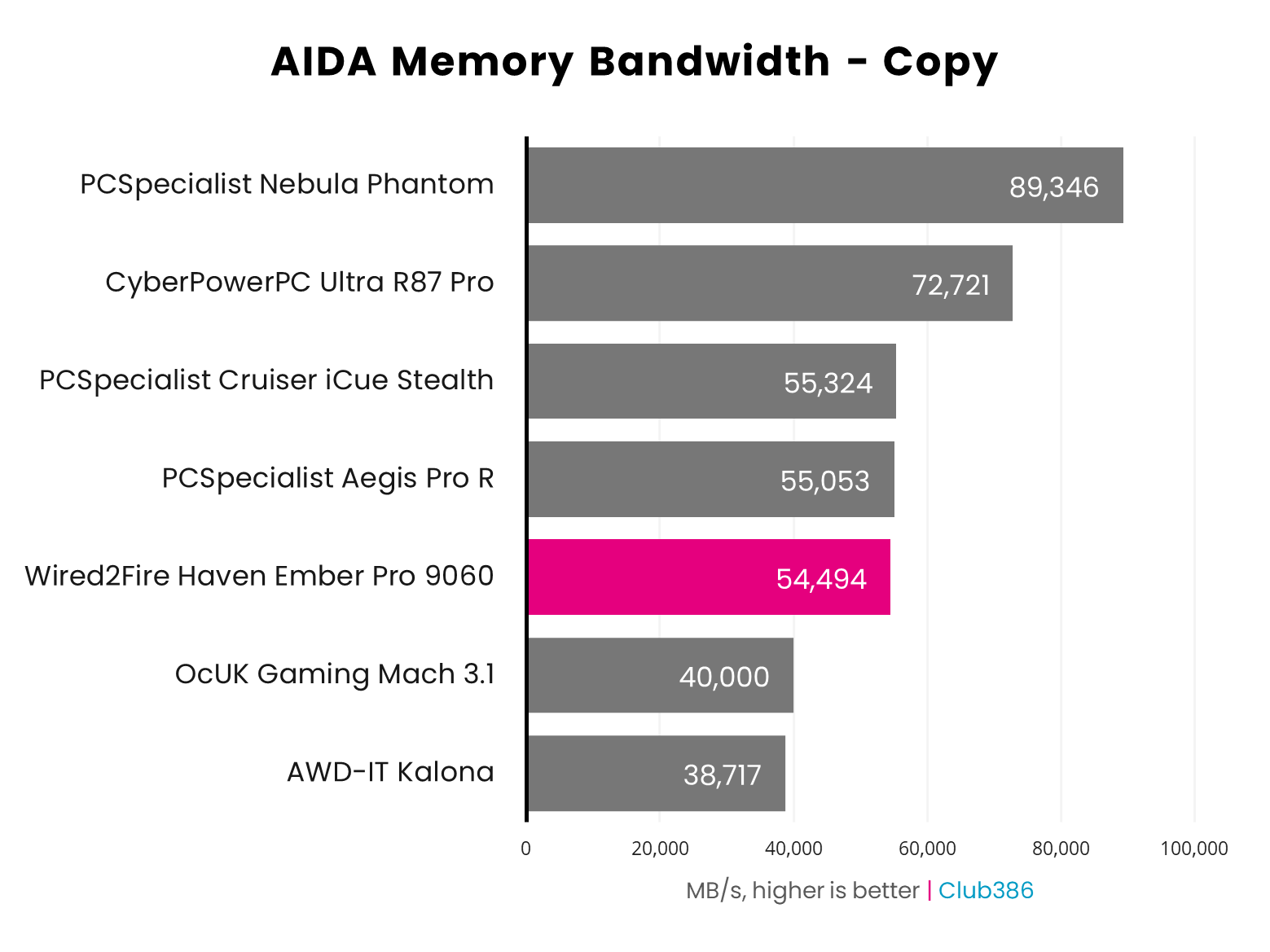
Memory bandwidth performance is in line with expectations for an AMD Ryzen 5 9600X machine with 6,000MT/s DDR5 RAM. It can’t catch the superior bandwidth of the PCSpecialist Nebula Phantom, thanks to its Intel CPU and faster 6,400MT/s memory, but it’s well ahead of the DDR4 rigs.
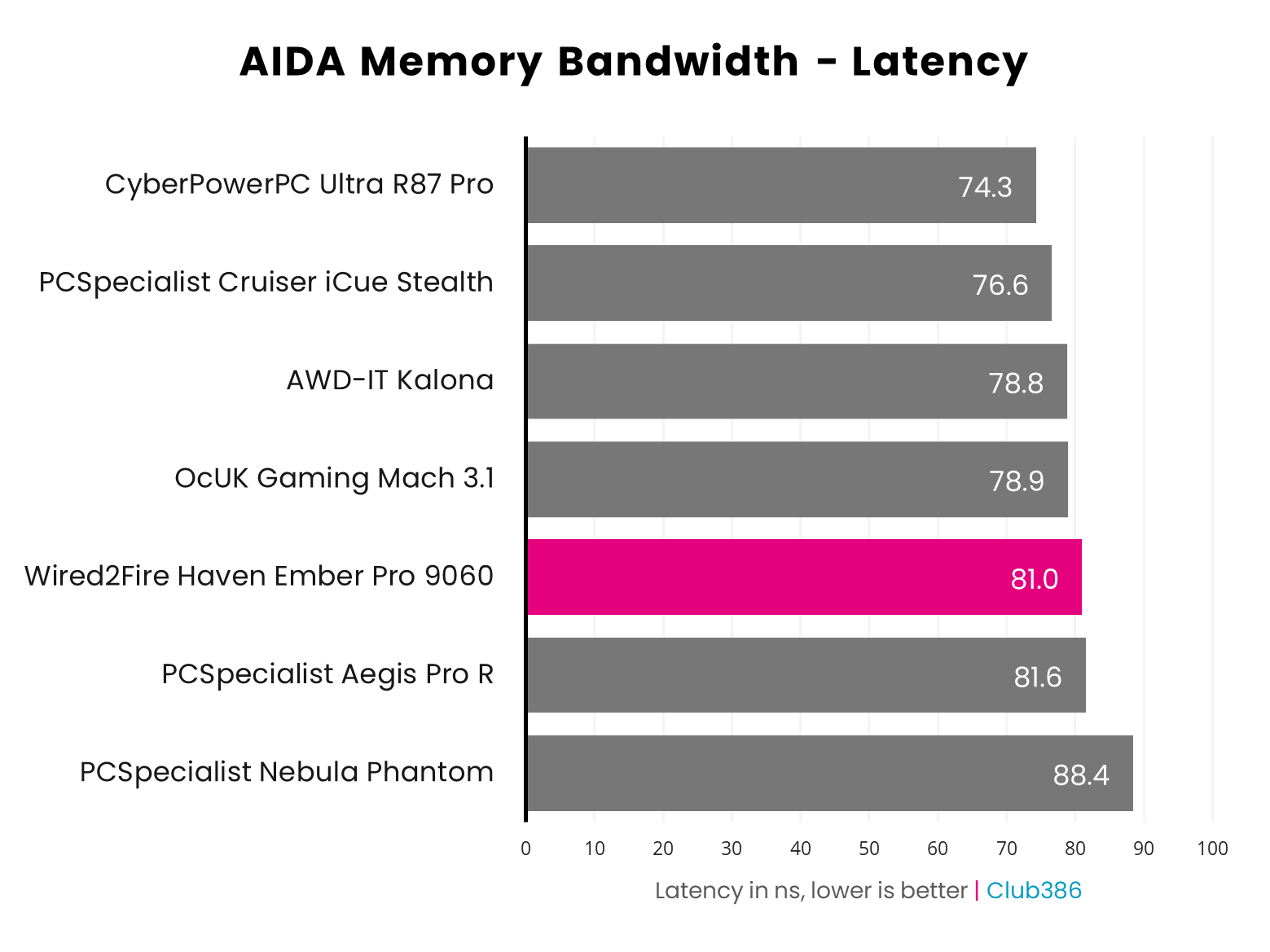
Likewise, latency is on point for the spec, and in this case the Nebula Phantom is right at the bottom of the chart. The recorded latency of 81ns beats the PCSpecialist Aegis Pro R, thanks to the Wired2Fire’s CL36 timings, compared to CL40 on the PCS machine. Other machines with tighter timings understandably record even lower latency figures, but 81ns is nothing to worry about here.
Storage
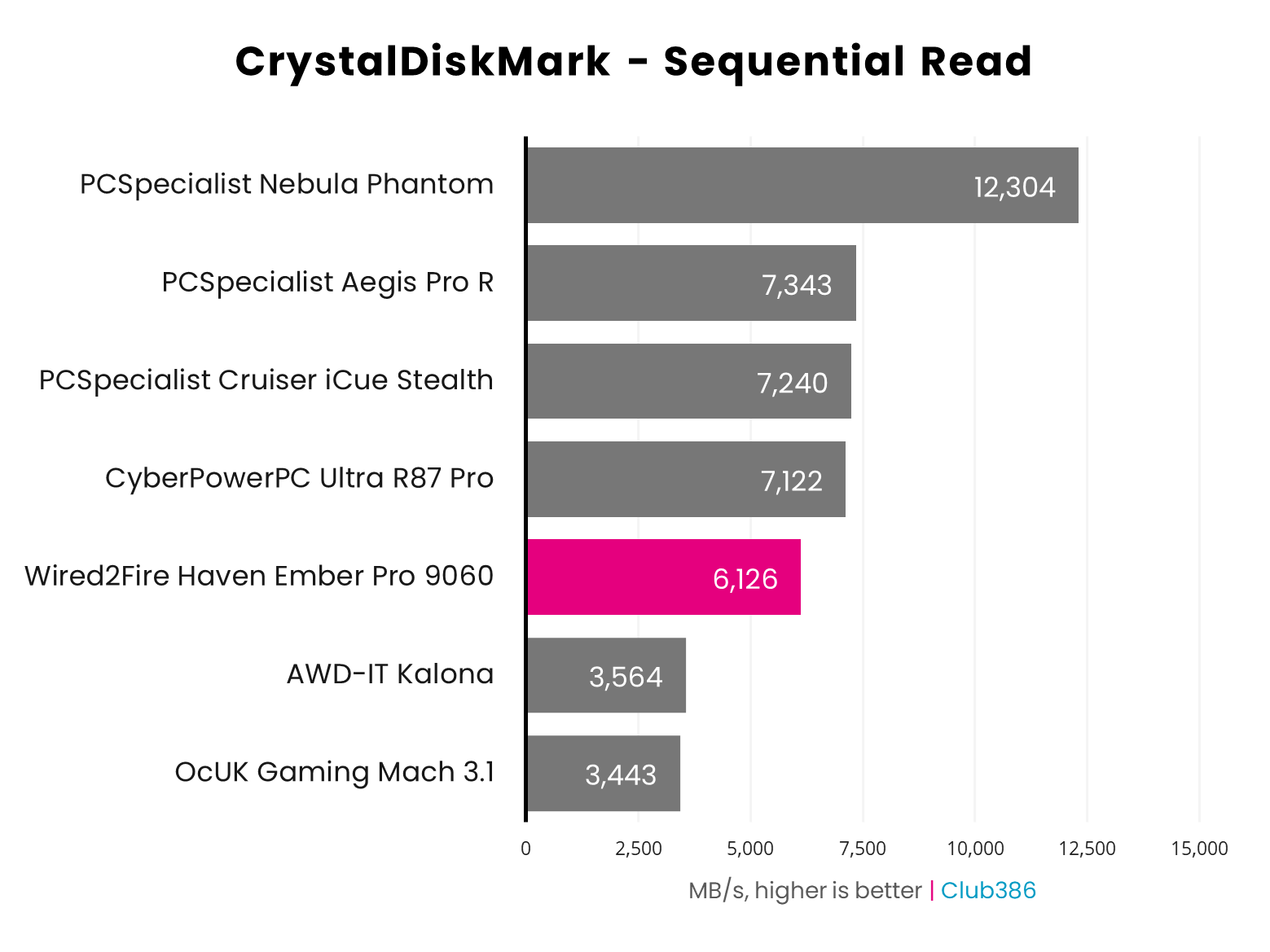
ADATA claims the Legend 860 can read at up to 6,000MB/s and write at 5,000MB/s, and it surpasses both figures in our CrystalDiskMark tests. The read speed of 6,126MB/s shows this drive is significantly quicker than the SSDs found in the OcUK and AWD-IT machines, both of which only have PCIe Gen 3 M.2 slots on their motherboards.
Unsurprisingly, it’s a long way behind the PCIe Gen 5 drive in the PCSpecialist Nebula Phantom, but bear in mind that you only see these peak figures in large-scale sequential file reads – the difference will be much smaller when it comes to real-world use such as game load times. There are three faster results from PCIe Gen 4 drives, showing that the ADATA SSD used here isn’t the quickest drive in its class. However, it has enough performance for most people’s needs, and more importantly, you get 2TB of space in this low-cost machine.
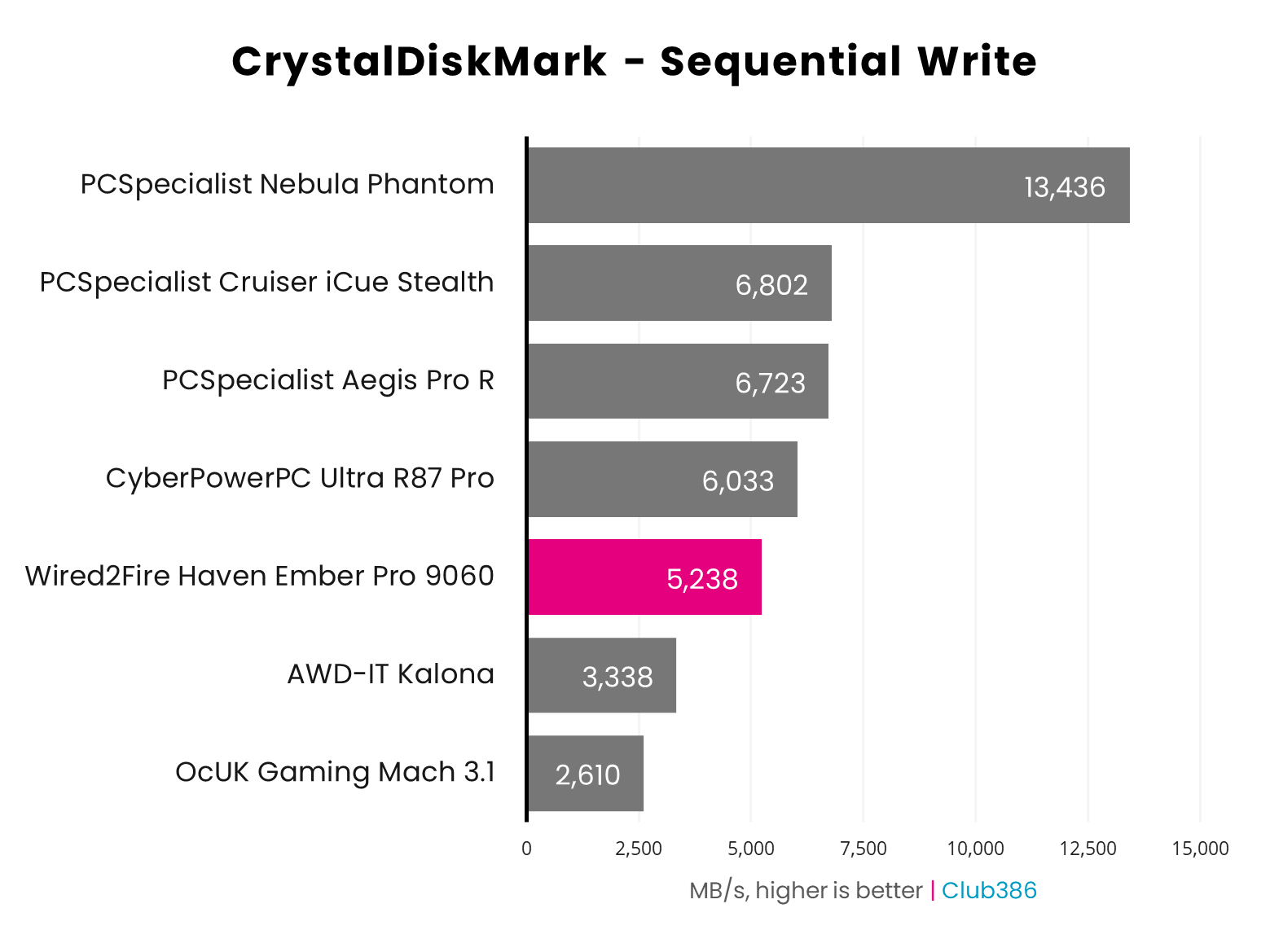
Likewise, our CrystalDiskMark write test shows this ADATA drive performing a good 238MB/s quicker than its claimed speed, and it’s well in front of the OCuK and AWD-IT machines, but behind other PCIe Gen 4 drives. Given current storage prices, this is a perfectly acceptable compromise, especially with so much space on tap.
Gaming
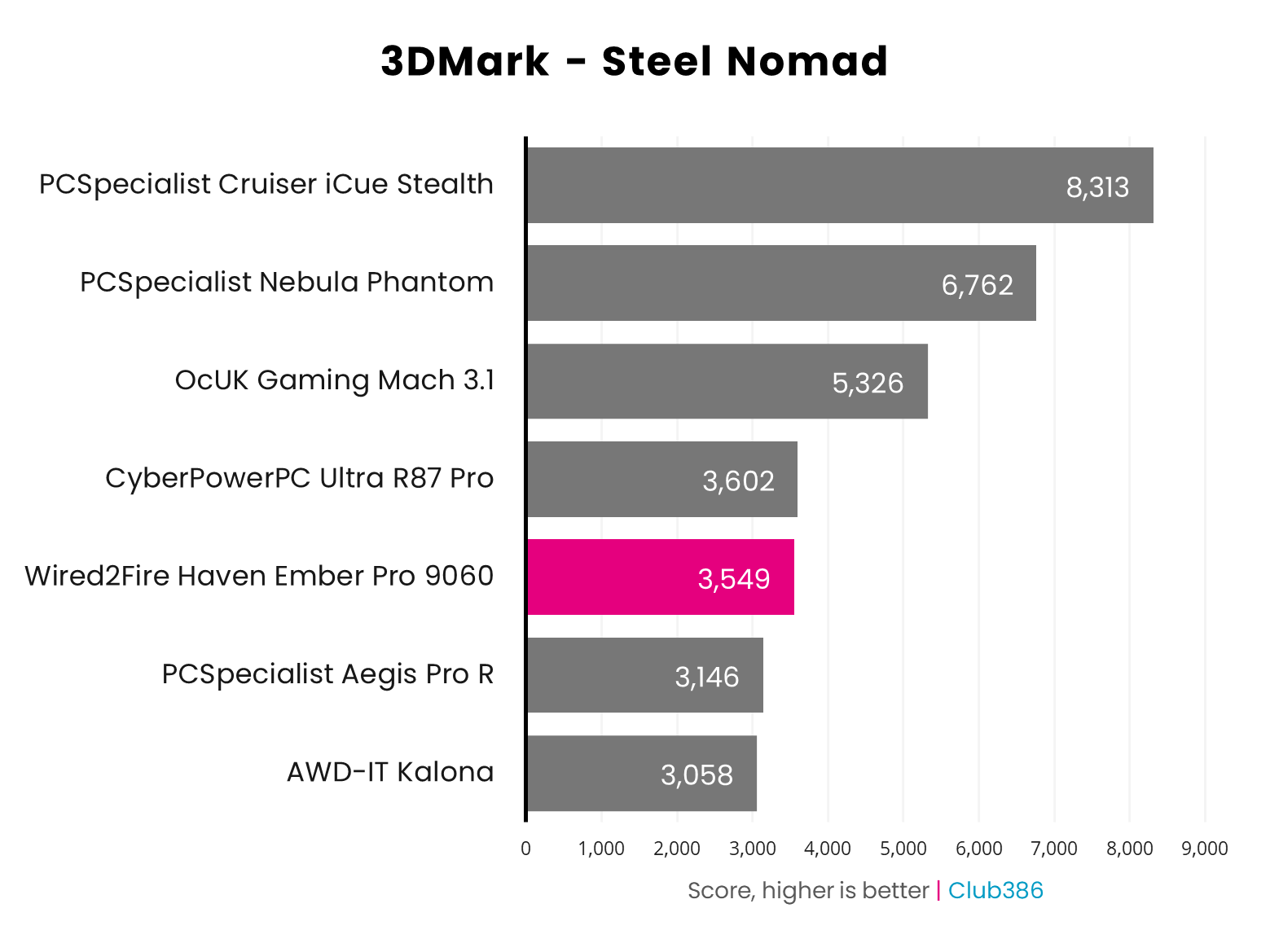
Let’s kick off our gaming performance analysis with 3DMark, which gives you a good at-a-glance idea of gaming pace. in Steel Nomad, which tests traditional rasterisation performance, we’re looking at a score of 3,549. That’s ahead of the RTX 5060-based PCSpecialist Aegis Pro R, and just over 50 points behind the CyberpowerPC Ultra R87 Pro, which uses the same GPU.
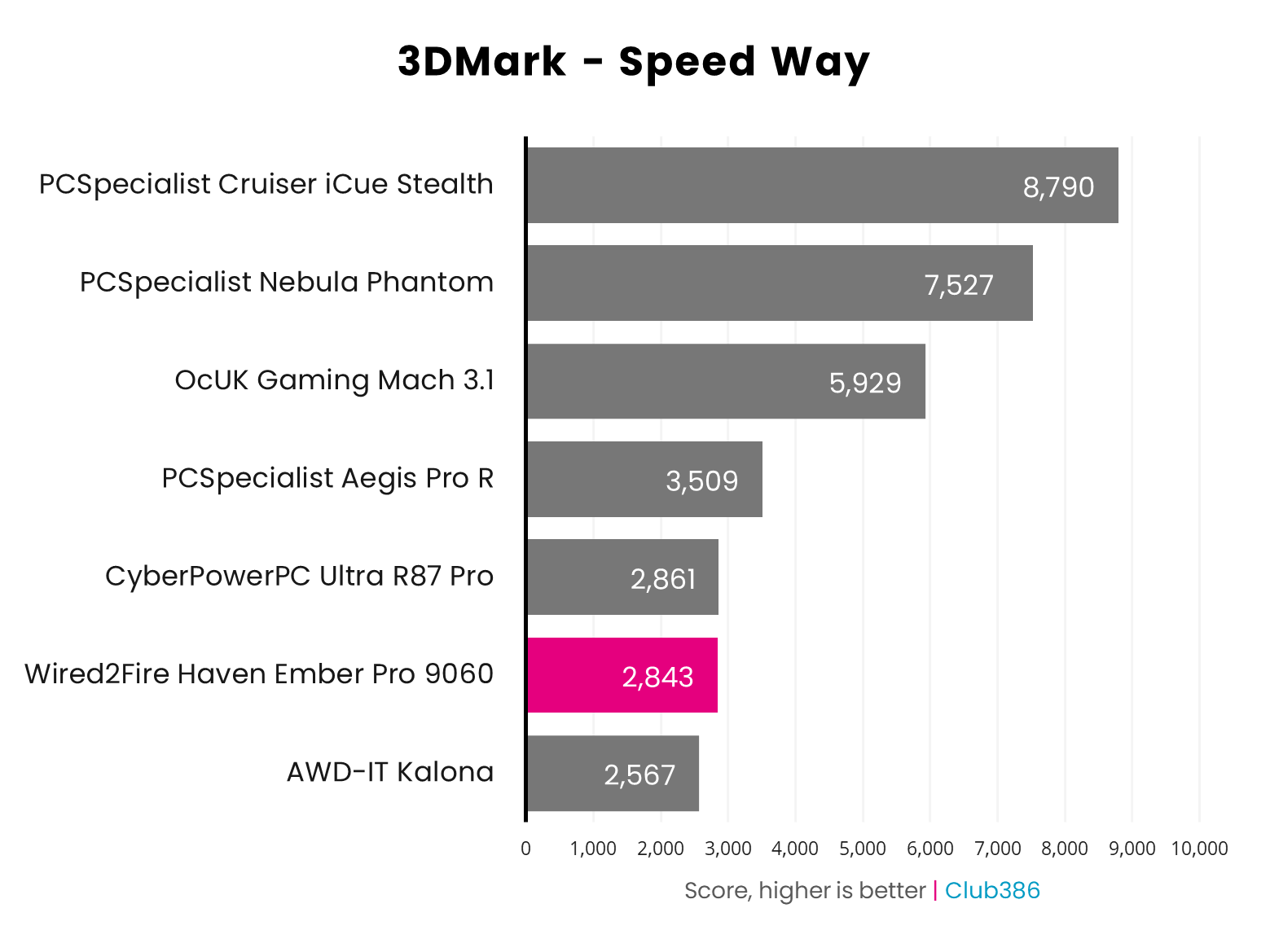
Next up, Speed Way pushes your GPU’s ray-tracing hardware, and shows this AMD 9060 XT rig falling behind the RTX 5060. However, as we’ll see in our real-world game tests, there’s more to performance than 3DMark scores, especially when you have 16GB of VRAM at your disposal.
I’m going to take Forza Motorsport as a solid example here, as it pushes VRAM hard when you max out all the settings. On the Wired2Fire Haven Ember Pro 9060, you can happily average 62fps in this game at 1920×1080 and 48fps at 2560×1440, but these figures fall all the way to 35fps and 26fps, respectively, on the RTX 5060-based PCSpecialist Aegis Pro R.
We saw other games using more than 8GB of VRAM during our tests as well, including Assassin’s Creed Shadows, which regularly pushed above 10GB during benchmarking. This is still a tough title at our brutal settings, but it’s playable at 1920×1080 with an average of 39fps and a 32fps minimum (the Aegis R averages 31fps with a 24fps minimum).
You can also get more performance by enabling FSR, netting you a 46fps average. What’s more, if you enable FSR ML in the AMD Radeon driver (press Shift R to access these settings), this game will run with AMD’s machine learning-based upscaling system (formerly called FSR 4), which looks great. These settings are also maxed out, and you can get more fps if you drop a little of the eye candy.
| Game | 1080p (Min / Avg) | 1440p (Min / Avg) |
|---|---|---|
| Assassin’s Creed Shadows (RT) | 32 / 39fps | 25 / 30fps |
| Assassin’s Creed Shadows (RT, FSR Q) | 36 / 46fps | 32 / 39fps |
| F1 25 (RT) | 42 / 68fps | 26 / 43fps |
| F1 25 (RT, FSR Q) | 64 / 100fps | 45 / 68fps |
| Final Fantasy XIV: Dawntrail | 83 / 141fps | 56 / 89fps |
| Forza Motorsport (RT) | 52 / 62fps | 39 / 48fps |
| Mount & Blade II | 123 / 202fps | 87 / 132fps |
| Rainbow Six Siege | 136 / 184fps | 85 / 111fps |
We’re looking at a very impressive set of performance results in all our other game tests. F1 25 looks fantastic at the Ultra High settings (with no path tracing), and it averages 68fps on the Haven Ember Pro 9060 at 1920×1080. Again, you can enable FSR ML in this game via the driver, which pushes up this figure to 100fps at 1920×1080, or 68fps at 2560×1440 – both decent results.
Meanwhile, Mount & Blade II performs great, with an average of 202fps at 1920×1080. This game is very dependent on CPU pace, as well as your GPU. For example, the AWD-IT Kalona, which uses a Radeon RX 9060 and Ryzen 5 5500, averages just 108fps in this test, and its 52fps minimum is well behind the 123fps of the Wired2Fire rig.
Impressively, several of our test games are playable at 2560×1440 as well as 1920×1080, especially if you enlist a helping hand from FSR. In fact, Final Fantasy XIV: Dawntrail, Rainbow Six Siege and Mount & Blade II are all perfectly playable at 2560×1440 without any upscaling.
| Cyberpunk 2077 | 1920×1080 (Min / Avg) | 2560×1440 (Min / Avg) |
|---|---|---|
| RT Ultra native | 39 / 45fps | 24 / 28fps |
| RT Ultra FSR 4 Quality | 65 / 76fps | 42 / 49fps |
| RT Ultra FSR 4 Q + FG x2 | 124 / 144fps | 80 / 90fps |
| RT Overdrive | 18 / 21fps | – |
| RT Overdrive, FSR 4 Quality | 34 / 39fps | – |
| RT Overdrive, FSR 4 Balanced | 41 / 47fps | – |
Finally, I took a look at the current flagship GPU punisher, Cyberpunk 2077. This game supports FSR 4 natively, which gives you an easy way to improve performance with minimal impact on visuals. What’s more, you can enable AMD’s latest version of machine-learning-based frame gen in the driver, as long as the basic version is enabled in the game. This is well worth doing, as it makes for much more stable visuals than AMD’s standard FSR frame gen tech.
At first, I tried the all-out, path-traced Overdrive mode, which looks fantastic, but is a bit too much for this comparatively low-cost machine. Even with FSR 4 on Balanced, it still only averages 47fps, which isn’t a high enough threshold to enable frame gen, in my opinion.
The Ultra ray tracing preset looks and performs great, though. At 1920×1080, the game averages 45fps natively, which increases all the way to 76fps with FSR 4 on the Quality setting. You can then enable frame gen and watch the frame rate climb to 144fps.
Nvidia’s current GPUs undoubtedly have the upper hand here, with multi-frame gen enabling super-smooth motion and sky-high frame rates, while its costlier GPUs can handle the Overdrive path-tracing mode, too. This AMD GPU can play Cyberpunk 2077 well, though, with fancy ray-traced graphics and smooth frame rates. At this price, I’d rather have a GPU with 16GB of VRAM than an 8GB card with multi-frame gen.
Vitals
The Haven Ember Pro 9060 is as quiet as a mouse when you boot it up, with so little noise that my sound detector couldn’t pick it up. It is audible to the human ear, but it’s just below the threshold for my meter.
| Idle | Load (CB) | Load (Game) | |
|---|---|---|---|
| CPU temp | 46°C | 95°C | 89°C |
| GPU temp | 41°C | 46°C | 64°C |
| Noise | – | 51dBA | 51dBA |
| Power draw | 86W | 229W | 353W |
This all changes once you load it with some hard work, however. I started by running the Cinebench multi-threaded test, resulting in a noise level of 51dBA and a toasty peak CPU temperature of 95°C. That’s the thermal limit of this 65W CPU, showing that it’s right on the edge with this cooling setup when all six cores are maxed out.
The clock speed sat at around 5.25GHz throughout this test across all six cores, so it can clearly maintain decent all-core performance with this cooling arrangement without throttling – it’s not a cause for concern, but it is pushing this chip to its thermal limit. Heavy multi-threaded work isn’t really the purpose of this machine, though, especially as its multi-threaded performance is limited by having only six cores.
It’s right on the edge with this cooling setup when all six cores are maxed out.
Thankfully, thermals are cooler under a gaming workload, running Cyberpunk 2077 at the Ultra ray tracing preset. We get the same peak level of noise here, although that’s only when the CPU is stressed – it quietened down to around 44dBA in several of our other game tests. Importantly, neither the GPU nor the CPU overheat during demanding gaming sessions, peaking at 64°C and 89°C, respectively.
Meanwhile, the peak gaming power draw of 353W shows this machine consumes relatively little juice compared to other PCs we’ve recently tested. The 850W Corsair PSU supplied with the final retail version has more than enough headroom for this level of power, and gives you a bit of headroom for future upgrades as well.
Conclusion
If you have £1,500 to spend on a PC, then the Wired2Fire Haven Ember Pro 9060 is a great option. It looks gorgeous, it takes up minimal space and, unlike many low-cost PCs in this climate, it still delivers 32GB of RAM, a 2TB SSD, and a 16GB graphics card. It’s a lovely, well-built machine, and it offers solid gaming performance for the money as well.
Going for a small PC inevitably involves some compromises, and in this case, cooling is the main one. The Ryzen 5 9600X doesn’t overheat or throttle, but it sails close to the wind when all its cores are maxed out at full load. It can still cope with these workloads, though, and the cooling system is perfectly up to the job when it comes to gaming.
You’ll want to get in quick, though, as brutal current market conditions mean this price won’t be around for more than four weeks. If you want it, buy it now before it’s too late.