
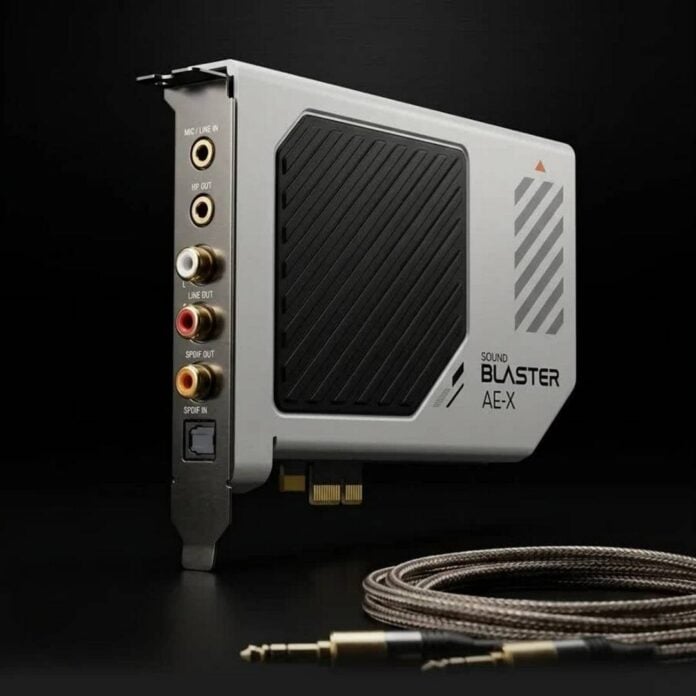
Creative has introduced a new dedicated Sound Blaster card for desktop PC users seeking high-resolution audio and strong headphone amplification capabilities. The Sound Blaster AE-X combines audiophile hardware and processing with gaming-focused software features to cater to Hi-Fi enthusiasts, creators/streamers, or anyone dissatisfied with their motherboard audio.
Costing ¥1,269 (£138) in China and €191,90 in France, the Sound Blaster AE-X comes equipped with an ESS ES9039Q2M dual-channel DAC. This uses ESS Technology’s HyperStream IV Dual DAC architecture, which Creative says delivers exceptional clarity, ultra-low distortion, and studio-grade audio.
The new Sound Blaster supports up to 32-bit/384kHz audio playback, while boasting a 130dB signal-to-noise ratio. It can also directly decode the DSD256 format for ultra-high-resolution digital audio, which samples at 11.2MHz. Needless to say, taking advantage of this format requires specialised equipment and very large files that contain all the details required for such an extreme sample rate.
The Sound Blaster AE-X also integrates Creative’s X-amp discrete headphone amplifier architecture, which gives it the ability to drive high-impedance headphones, up to 600ohms. For reference, typical consumer headphones hover between 16 and 80ohms. In the 600ohms territory, we find audiophile gear such as the Beyerdynamic DT 880. In other words, the AE-X can drive even the most demanding headphones.
Creative lists compatibility with the ASIO 2.3 API as well, which is a driver protocol that provides a high-fidelity, low-latency link between software such as Cubase and a computer’s audio hardware. This allows bypassing of Windows’ standard audio stack, communicating directly with the sound card to eliminate any delay caused by the operating system’s processing layers.
Connections-wise, the Sound Blaster AE-X offers less variety than its predecessor, but retains the most commonly used interfaces. These include left and right analogue phono outputs, an S/PDIF coaxial connector, an optical S/PDIF input, and a pair of 3.5mm audio jack sockets too.
While integrated motherboard audio codecs have improved in recent years, not to mention wireless headsets which now promise audiophile sound quality without encumbering cables, there is still a place for dedicated AMPs and DACs. Though it’s nearly seven years since Creative launched the AE-9, the AE-X is finally here for those chasing a lower noise floor, cleaner headphone amplification, or superior sampling.