

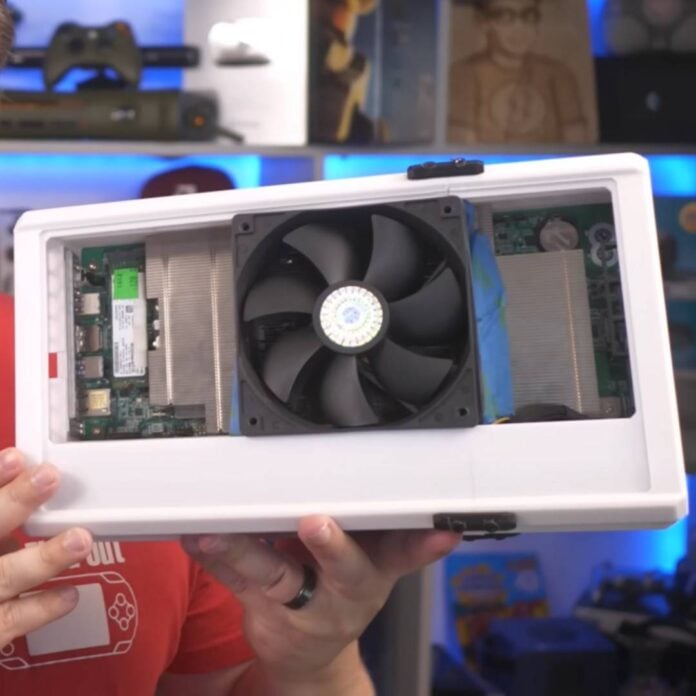
A modder has found a clever way to make a budget gaming PC for just $250, by unlocking a refurbished PlayStation 5 APU. YouTuber The Phawx used a Linux mod to unlock the inactive GPU compute units on a board based on a defective PS5 chip, called the AMD BC-250, and it appears to offer great value for gaming, if you don’t mind tinkering.
Originally used by crypto miners in late 2022, the BC-250 was created by combining leftover PS5 chips that didn’t fulfil Sony’s requirements, paired with 16GB of GDDR6 memory on a compact motherboard. The idea was to fit as many of these boards inside a single server rack as possible. However, due to their console origins, some modders started wondering if you could run games on these boards at acceptable frame rates.
While the first attempts were successful, they couldn’t take advantage of the entire chip. That’s because the APUs powering these boards aren’t fully unlocked; they only come with six active Zen 2 cores and 24 RDNA 2 compute units, despite physically carrying eight Zen 2 cores plus 40 RDNA 2 compute units.
This situation changed, thanks to a recent patch for the unlocking tool used by The Phawx, which allows you to unlock all 40 GPU compute units using a kernel module parameter. No firmware mods are required, and if you’re lucky enough to have 40 working compute units in your silicon, this means you can now unlock them.

With the six CPU cores set to 4.1GHz and the unlocked GPU running at 2.2GHz, The Phawx took the BC-250 for a spin in multiple games and found that performance exceeds 60fps at 1080p, as long as you don’t mind lowering some settings. The YouTuber tested the BC-250 in Deus Ex: Mankind Divided, God of War Ragnarök, Indiana Jones and the Great Circle, Resident Evil Requiem, Cyberpunk 2077, Returnal, and Doom: The Dark Ages, all of which ran above 70fps on average, with 1% lows between 40 and 50fps.
While the GPU was capable of handling high graphics settings, the older and still cut-down CPU held it back somewhat, which shows in the 1% lows. During these tests, the APU ran at 91°C and consumed about 170W, which isn’t bad considering that the cooling solution consisted of a compact fin stack and two 120mm fans. The Phawx indicated that you could install an AIO cooler to further improve performance, but that would hurt the value such a system.
For reference, The Phawx’s entire build, which includes the board with its soldered APU and memory, as well as the fans, case, PSU, and even storage, all came to just $250. According to him, anything above $300 wouldn’t be worth it, especially since you’re not guaranteed to have 40 functioning compute units. Not only that, but you need to do a fair bit of tinkering to get it to work in the first place.
If you’re happy to take that risk and put in the work, though, this looks like a really low-cost way to build your own DIY alternative Steam Machine.