
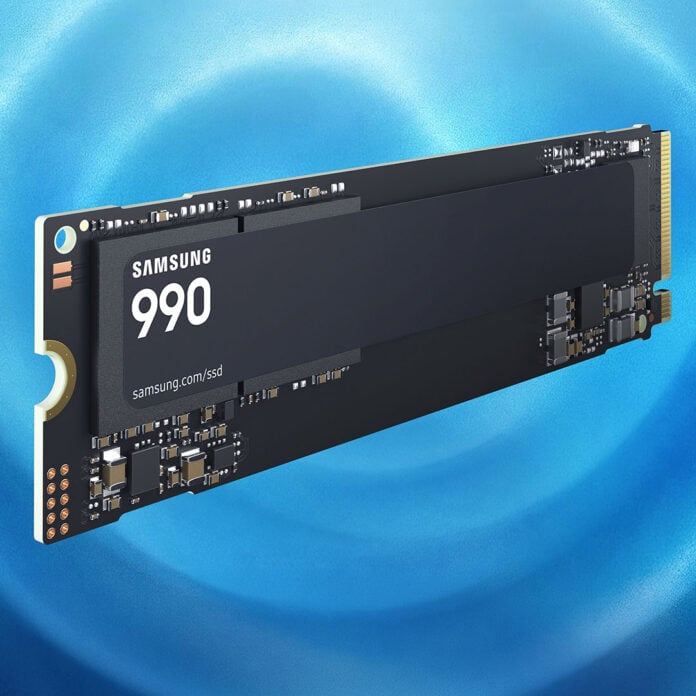
Samsung has launched a new PCIe Gen 4.0 SSD called the 990, but it has a disturbingly high price. In fact, its cost is exponentially higher than similarly-performing storage, and more expensive than PCIe Gen 5 alternatives. These are symptoms of the NAND flash shortage, and it’s a taster of what we can expect in the near future.
The Samsung 990 is launching in 1TB and 2TB capacities, respectively retailing for £212 / $269 and £412 / $529. For all that cash, the drives only offer up to 7,250MB/s sequential read performance, with peak sequential writes topping out at 6,450MB/s.
Those speeds are respectable for Gen 4 drives, but the 990 is several hundred MB/s short of the older 990 Pro. This comparison is doubly important to highlight, as you’ll actually find stock of the latter model at a lower price on Amazon, costing $239 / $388 for 1TB and 2TB models, but we shouldn’t expect this disparity to last.
Current Amazon prices reflect the cost of stock bought weeks, if not months, prior. Taking a look at Samsung’s website for the 990 Pro, fresh 1TB and 2TB drives now retail for $319 / $640. Comparatively, the 990 launch price doesn’t seem quite so terrible.
Of course, massive rises in storage prices aren’t a problem unique to Samsung, much as the 990 serves as a prime example of the squeezes facing the market. Like the ongoing DRAM crisis, manufacturers are similarly prioritising NAND flash for AI enterprise interests, pushing up the price of consumer SSDs in the process.
NAND producers such as Kioxia have declared the era of cheap SSDs is over, with SSD manufacturers such as Micron terminating its consumer business and pulling out of the market entirely. Such are the long-lasting effects of the current climate, with no quick and easy way to address shortages, as improving capacity requires years of construction and investment.
So, the Samsung 990 seems a poor-value purchase relative to immediate alternatives, even proving more expensive than the 9100 Pro. However, that situation won’t last forever. To draw wisdom from Homer Simpson, this new drive is one of the most expensive Gen 4 drives we’ve ever seen, but only so far.