
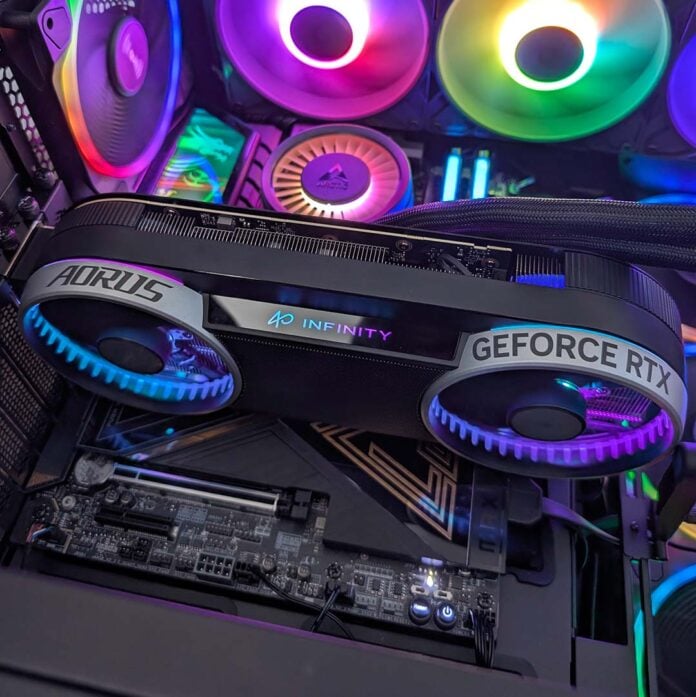
In celebration of Gigabyte’s 40th birthday, the company has launched an extravagant new series of boombox-style graphics cards, with the Aorus GeForce RTX 5070 Infinity serving as the most-affordable model of the family. This pixel pusher easily ranks among the most interesting designs I’ve ever seen when it comes to the cooler, and it’s certainly more than a pretty face. However, you’ll pay a kingly sum for the pleasure of having one in your PC.
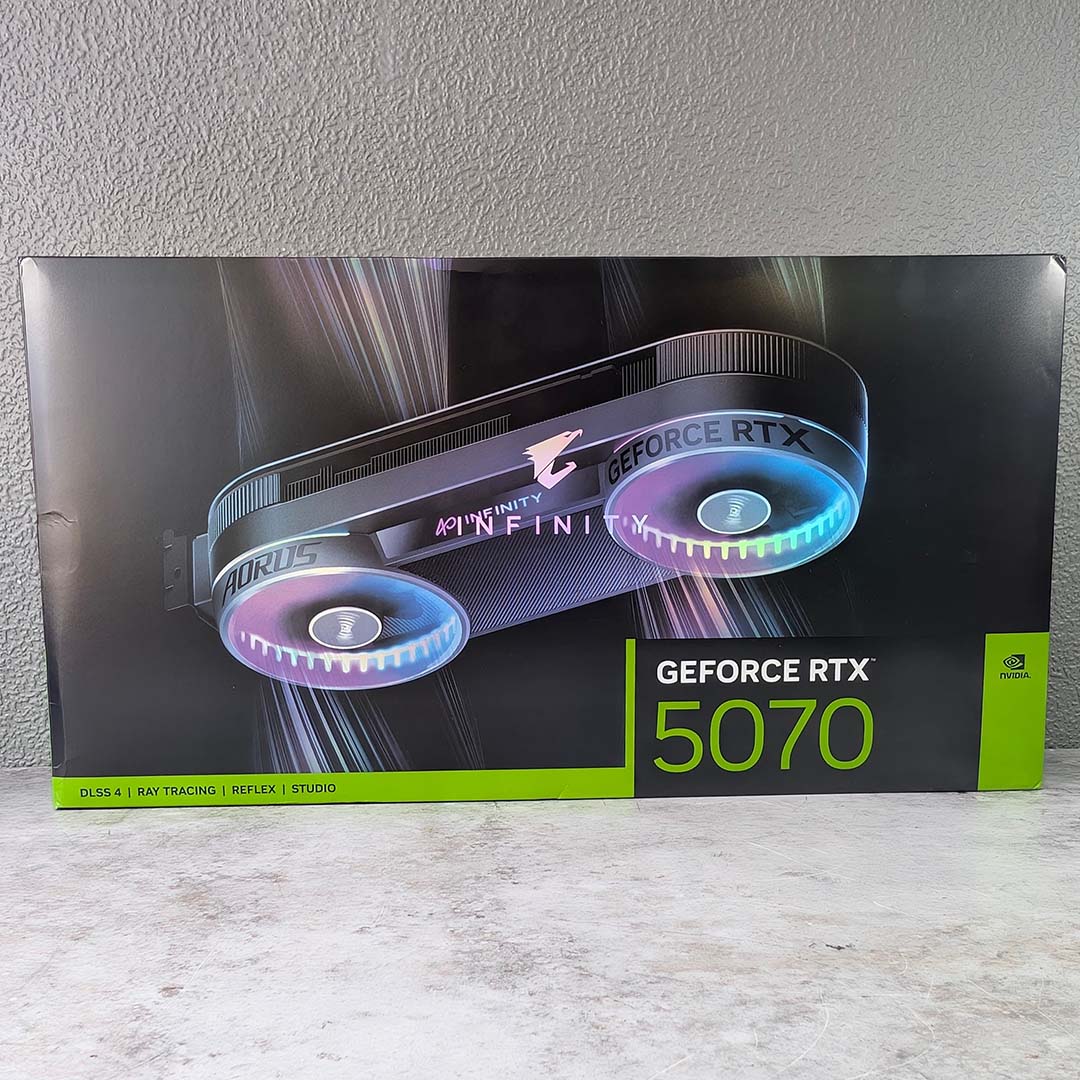

Gigabyte Aorus GeForce RTX 5070 Infinity
£799
Pros
- Gorgeous cooler design
- Solid FHD and QHD pace
- Cool and quiet under load
- Nvidia DLSS 4.5 suite
Cons
- Large premium over base MSRP
- Small performance uplift over stock
- RX 9070 is difficult to ignore
Club386 may earn an affiliate commission when you purchase products through links on our site.
How we test and review products.
Retailing for £799, this is one of the most expensive RTX 5070 examples you’ll find on the market. That’s a massive £260 above MSRP (+48.2%), and substantially higher than the lowest price you can pay for the GPU at current prices, which sits at £542 at the time of writing. While performance is higher than reference-class options, you also can’t expect a huge boost in frame rates from this card.
Design
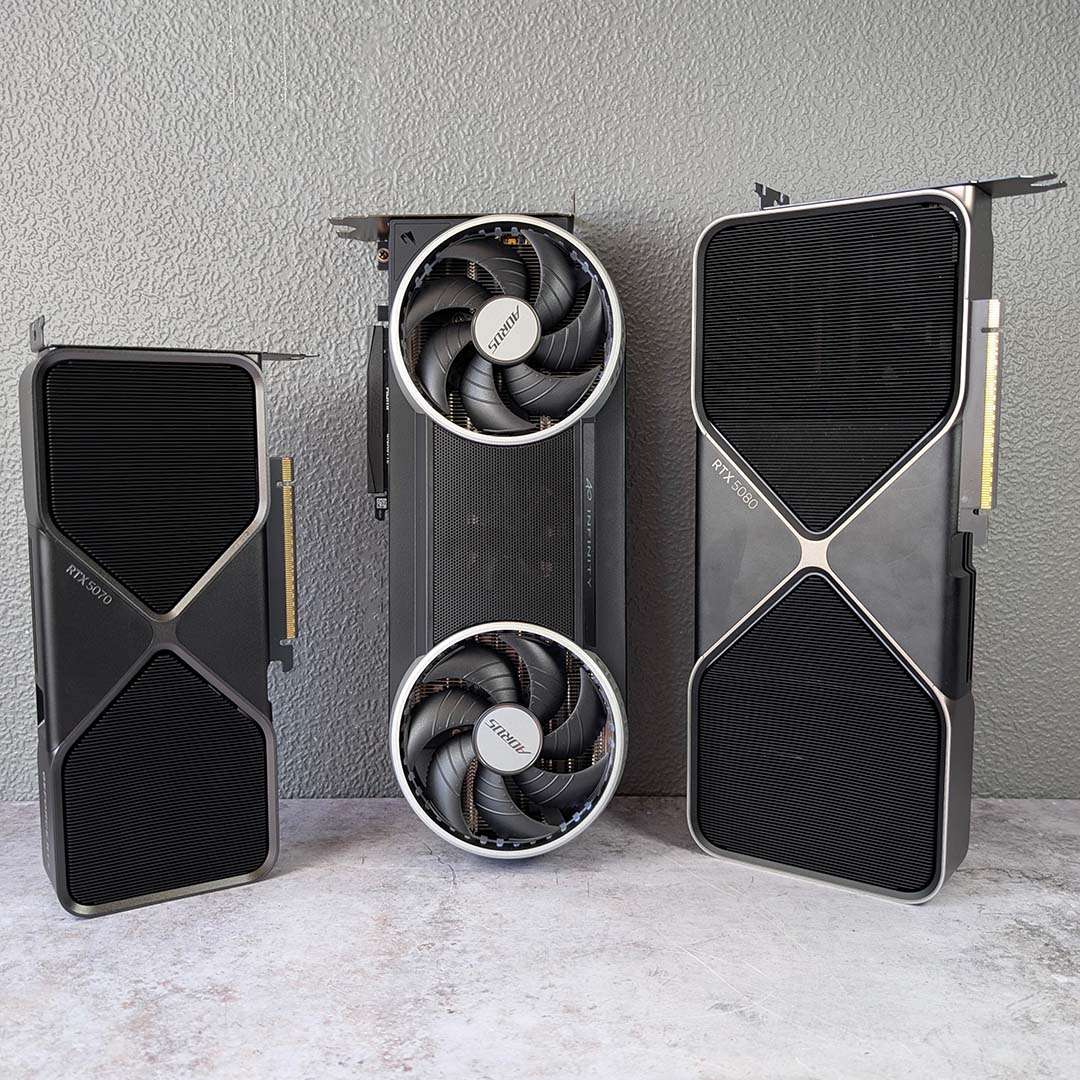
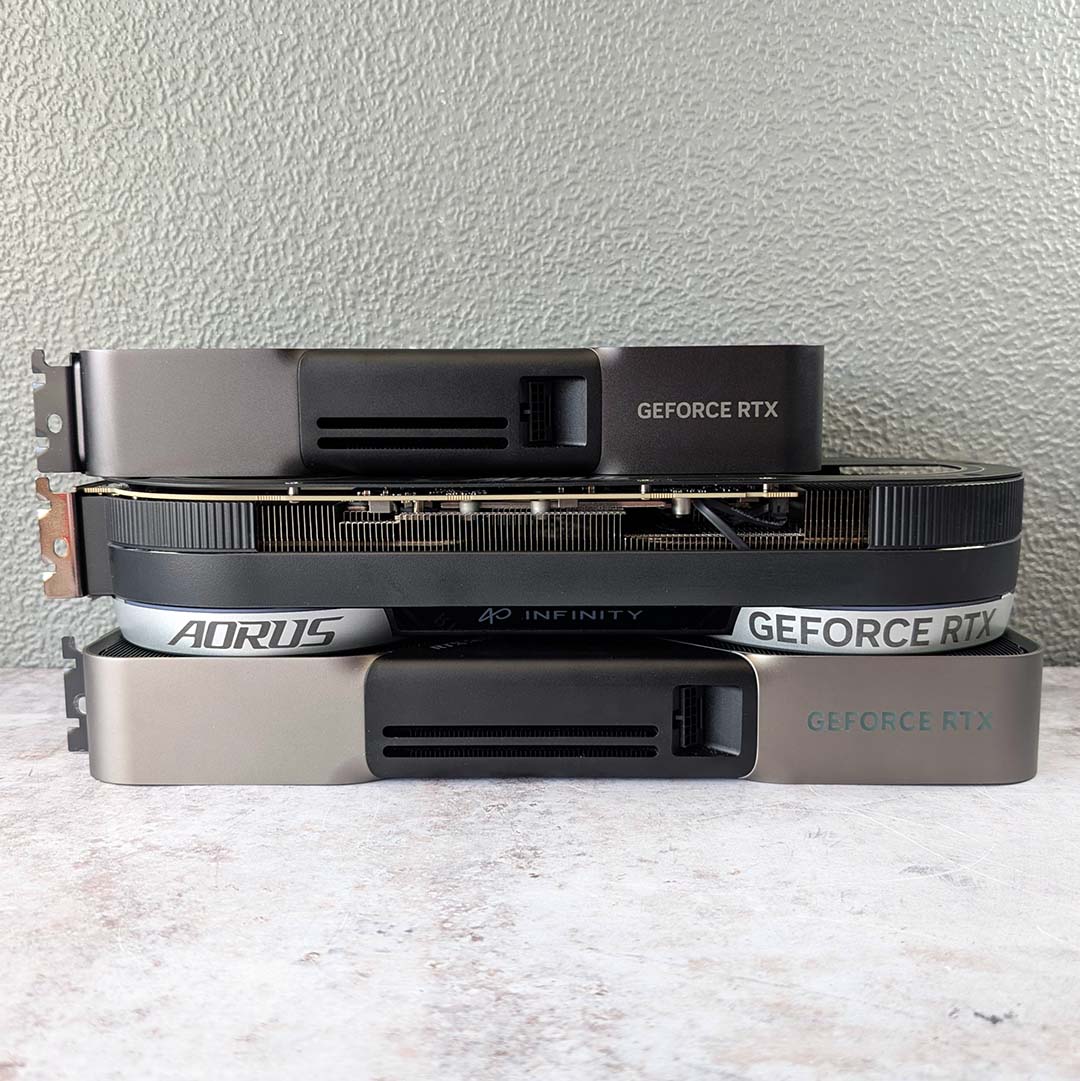
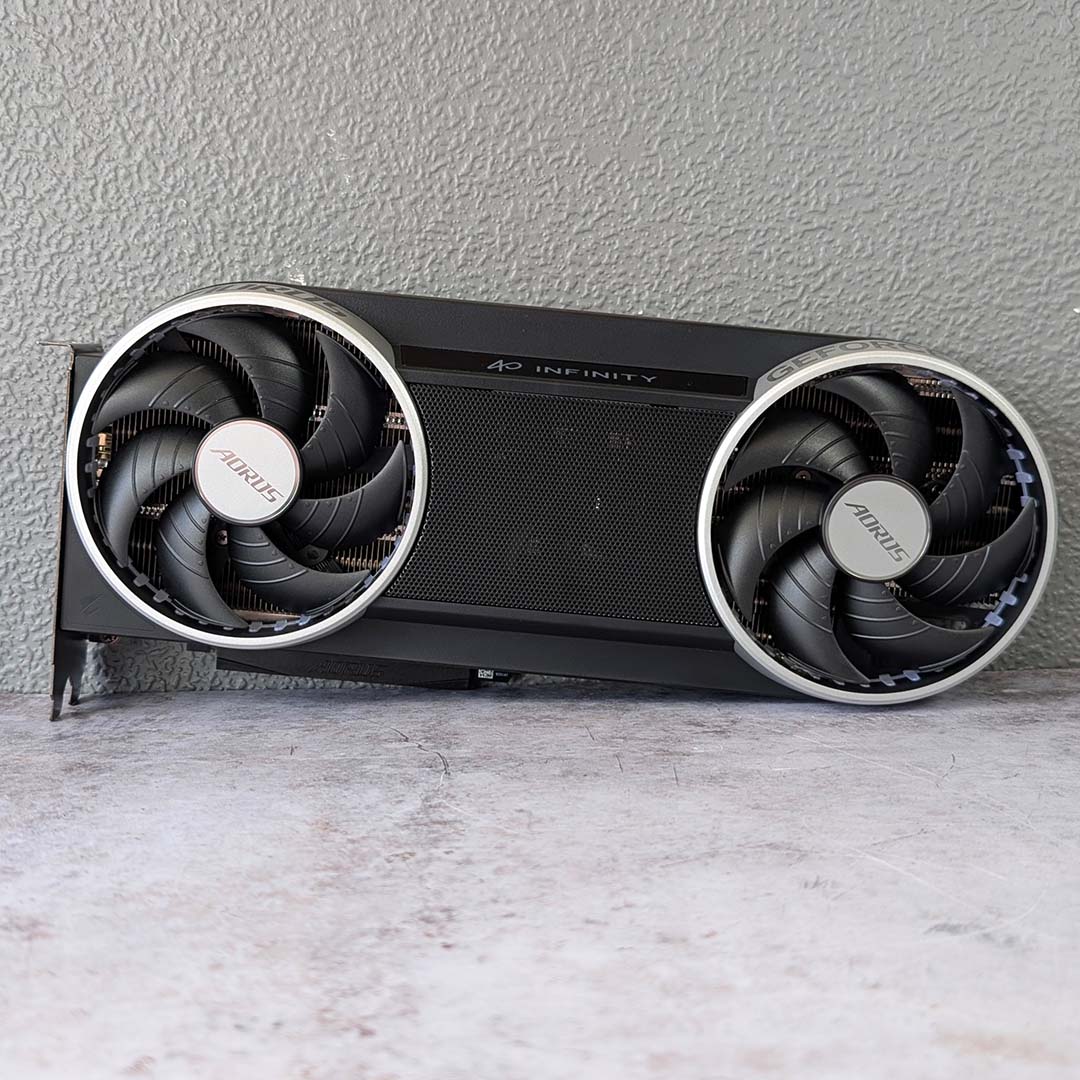
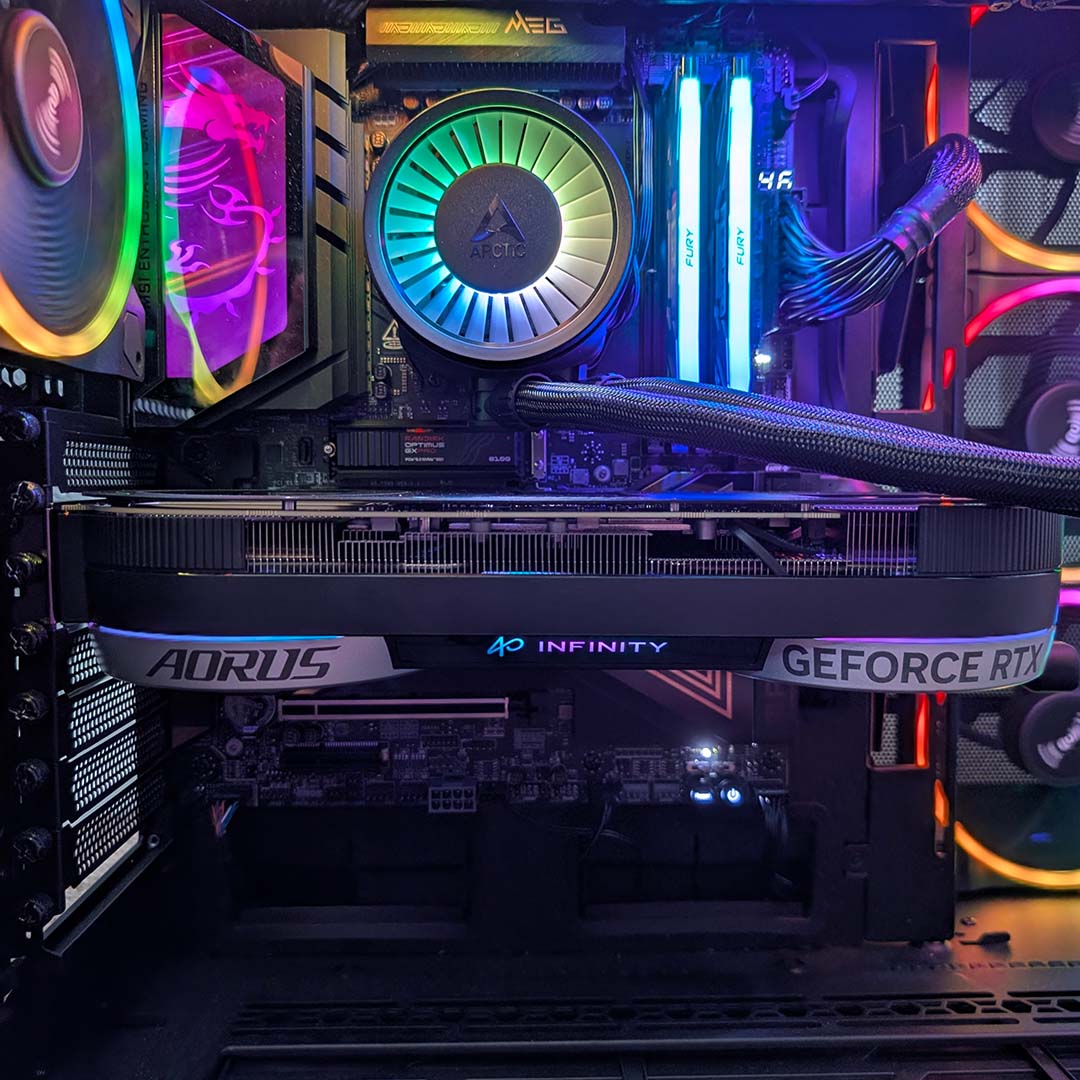
Sat on my desk, this graphics card certainly stands out from the sea of blocky coolers, with rounded edges across the entirety of its shell. The grey frames surrounding each fan contrast against the black chassis in a striking manner. The overall aesthetic feels more ‘jet engine’ than ‘infinite’ to me, but it’s an appreciatively attractive and unique design regardless, complete with A-RGB LEDs.
Relative to the RTX 5070 Founders Edition, this card is much larger. With its dimensions measuring 309 x 132 x 55mm, the Infinity card is considerably longer, but maintains a dual-slot requirement despite small increases to height and width. These dimensions are actually closer in size to those of an RTX 5080 Founders Edition, as the photos above illustrate.
All that said, most third-party coolers are notably bigger than Nvidia’s exceptionally petite design, with Gigabyte’s own Aorus GeForce RTX 5070 Master proving stockier still at 317 x 136 x 64mm. That extra size does have benefits, of course, with welcome improvements to operating temperatures and noise, which I’ll discuss in more detail later.
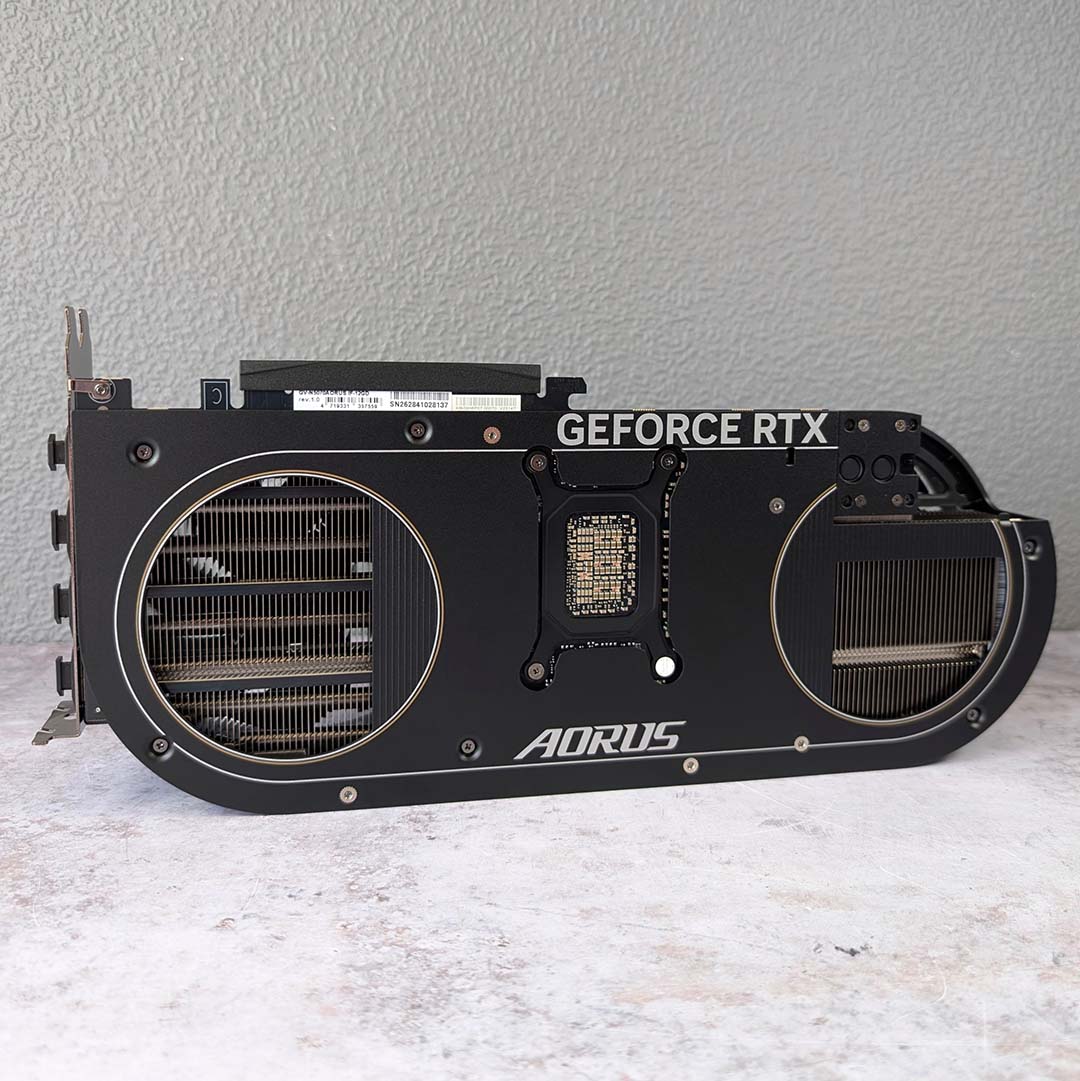
The only other difference the Aorus RTX 5070 Infinity carries relative to stock specifications is a higher clock speed. The card promises a boost clock of 2,715MHz, 203MHz (+8%) above stock. However, you can expect operating frequencies well beyond this value in real-world use, thanks to Nvidia’s GPU Boost tech.
In our testing, we saw clock speeds consistently push above 3GH, which is much higher than what Gigabyte promises on paper. More specifically, our card peaked at 3,037MHz during a Cyberpunk 2077 benchmark. Gigabyte has retained the reference 250W TDP on this design, despite those higher clock speeds. However, the firm recommends pairing the card with a 750W power supply, 100W greater than Nvidia’s official suggestion.
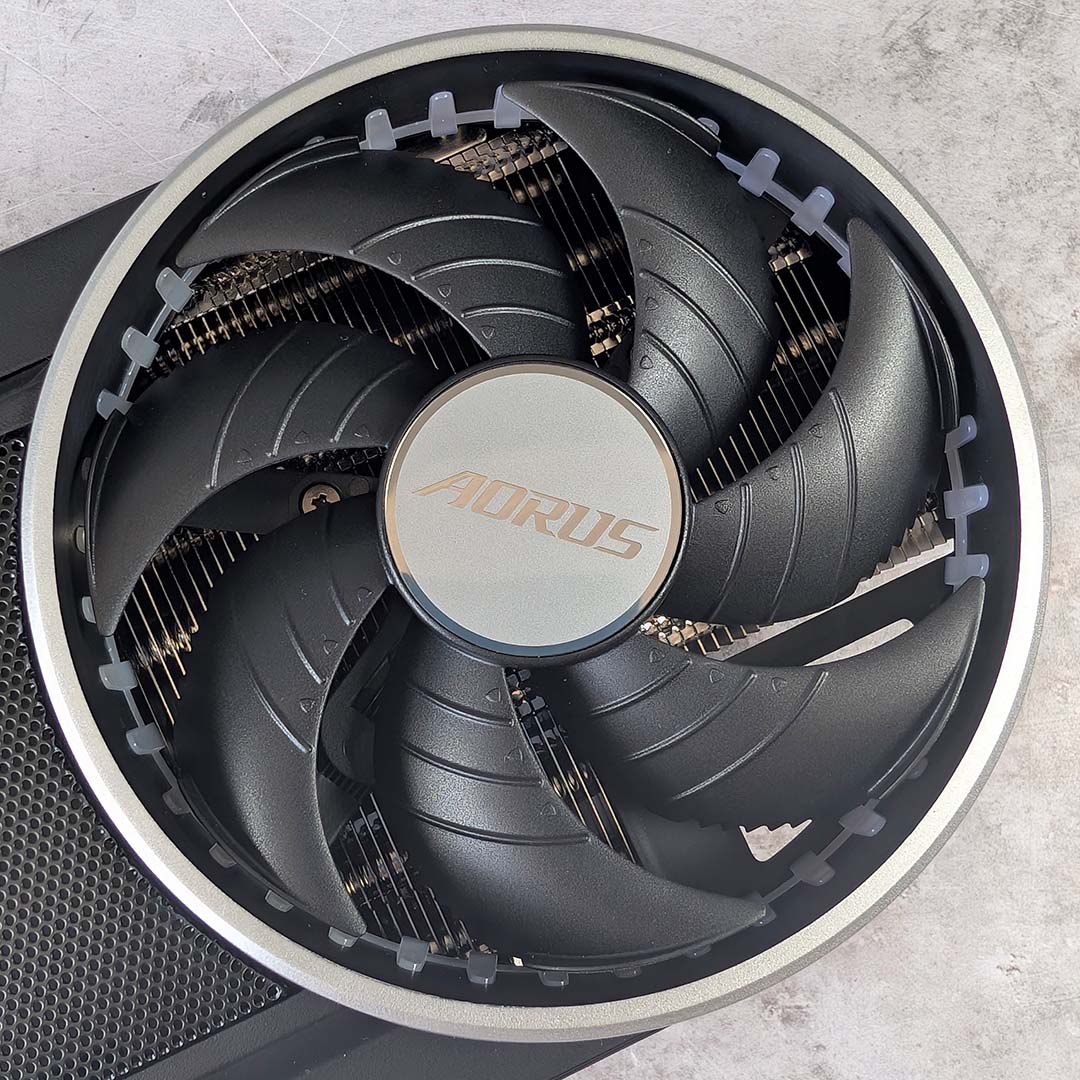
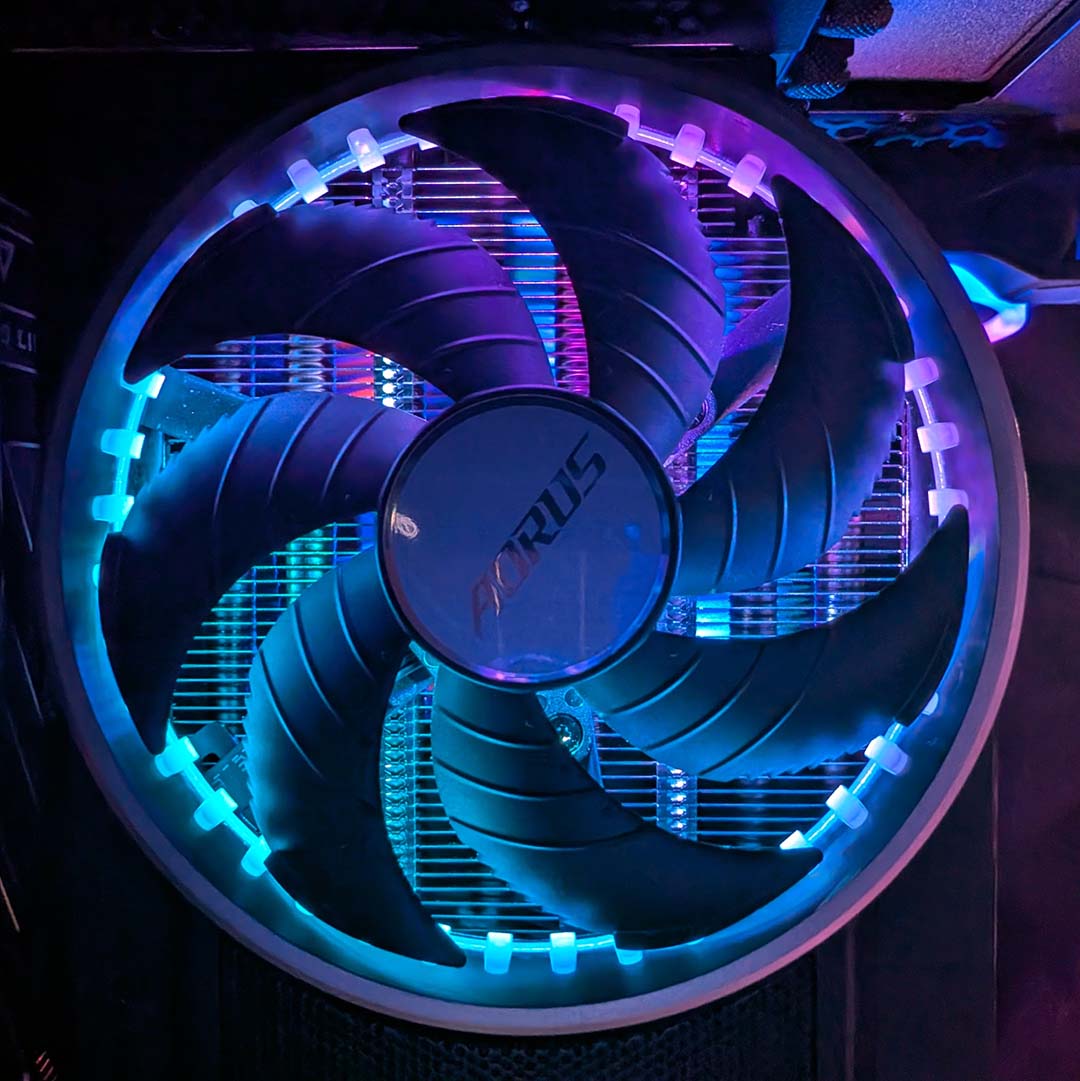
Gigabyte equips the Aorus RTX 5070 Infinity, with its new Windforce Hyberburst Cooling System. This setup is unique to its Infinity cards, arriving with the usual promises of “optimised cooling efficiency” and “peak performance”, but there’s proof in this proverbial pudding.
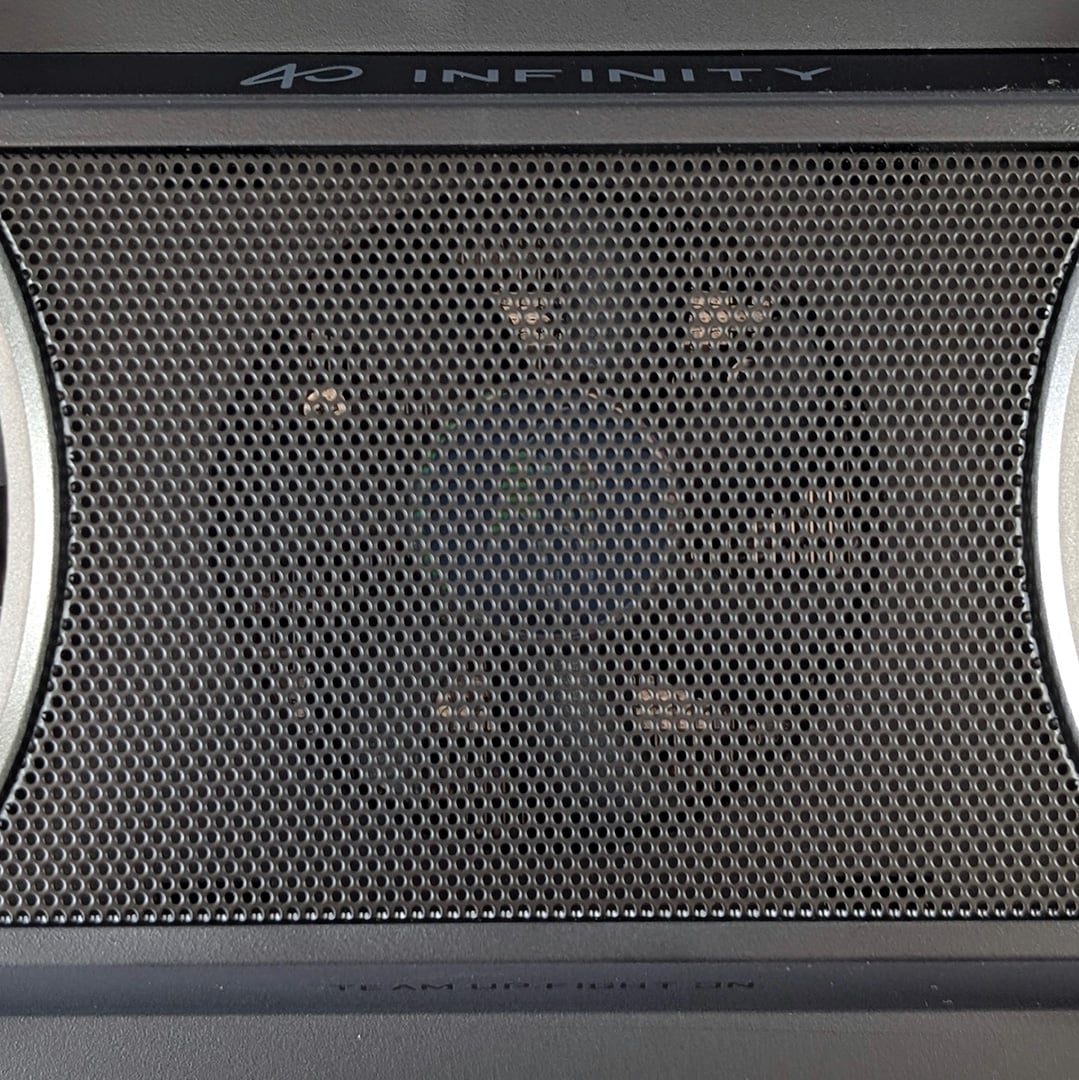
At first glance, the cooler appears to feature two of Gigabyte’s Hawk fans, each with exhaust cut outs on the backplate for better heat dissipation, but there’s also a third blower hiding behind the centre grille. This will only activate where necessary, presumably upon hitting a particular temperature or GPU usage target (like its bigger counterparts).
Underneath the shroud, you’ll find a copper plate and composite heatpipe that works in tandem with thermal conductive gel and composite metal grease to keep both the GPU and VRAM running cool under load. It’s a robust cooling setup by any measure, and it manages to keep the card running cool and fast, even in the face of the latest British heatwave.
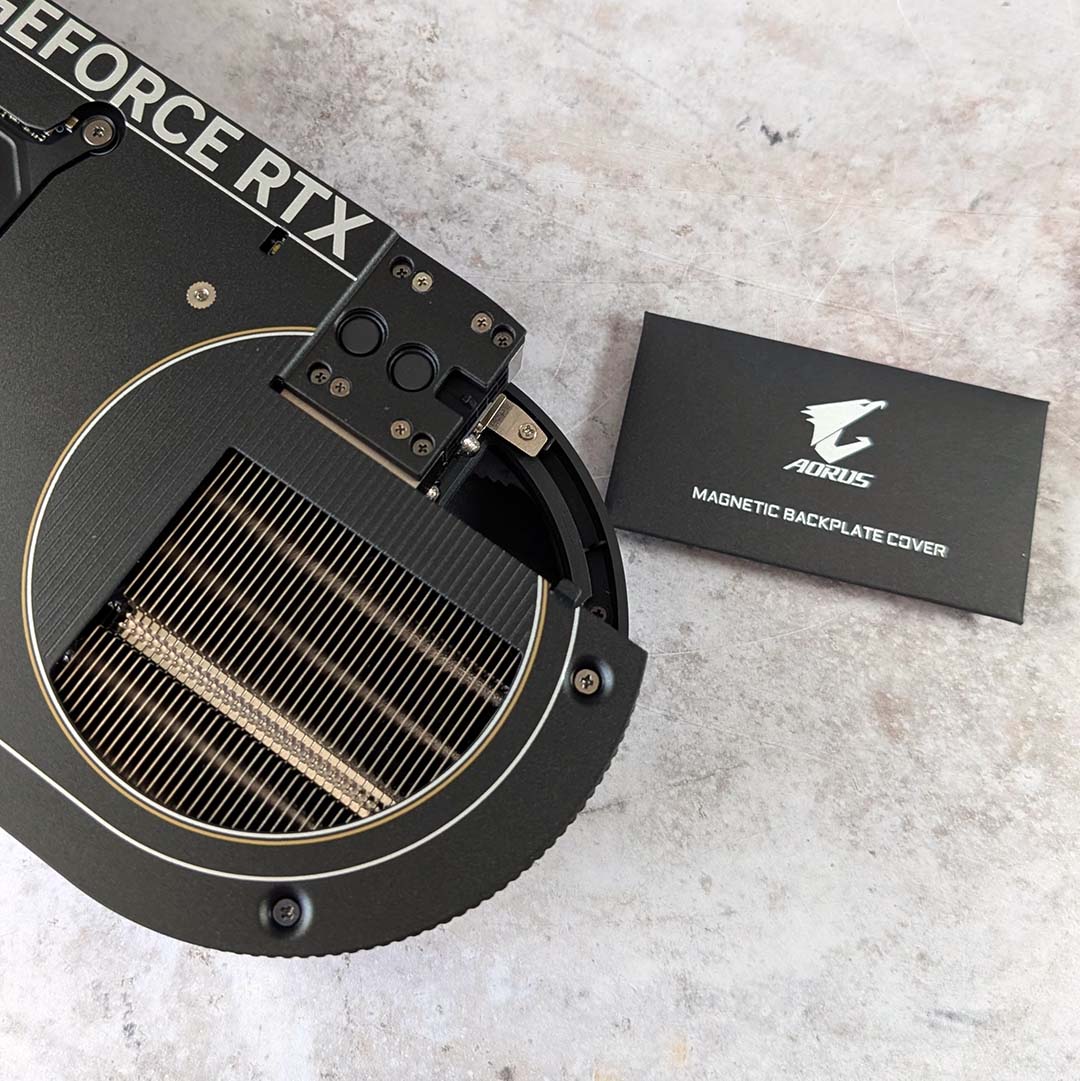
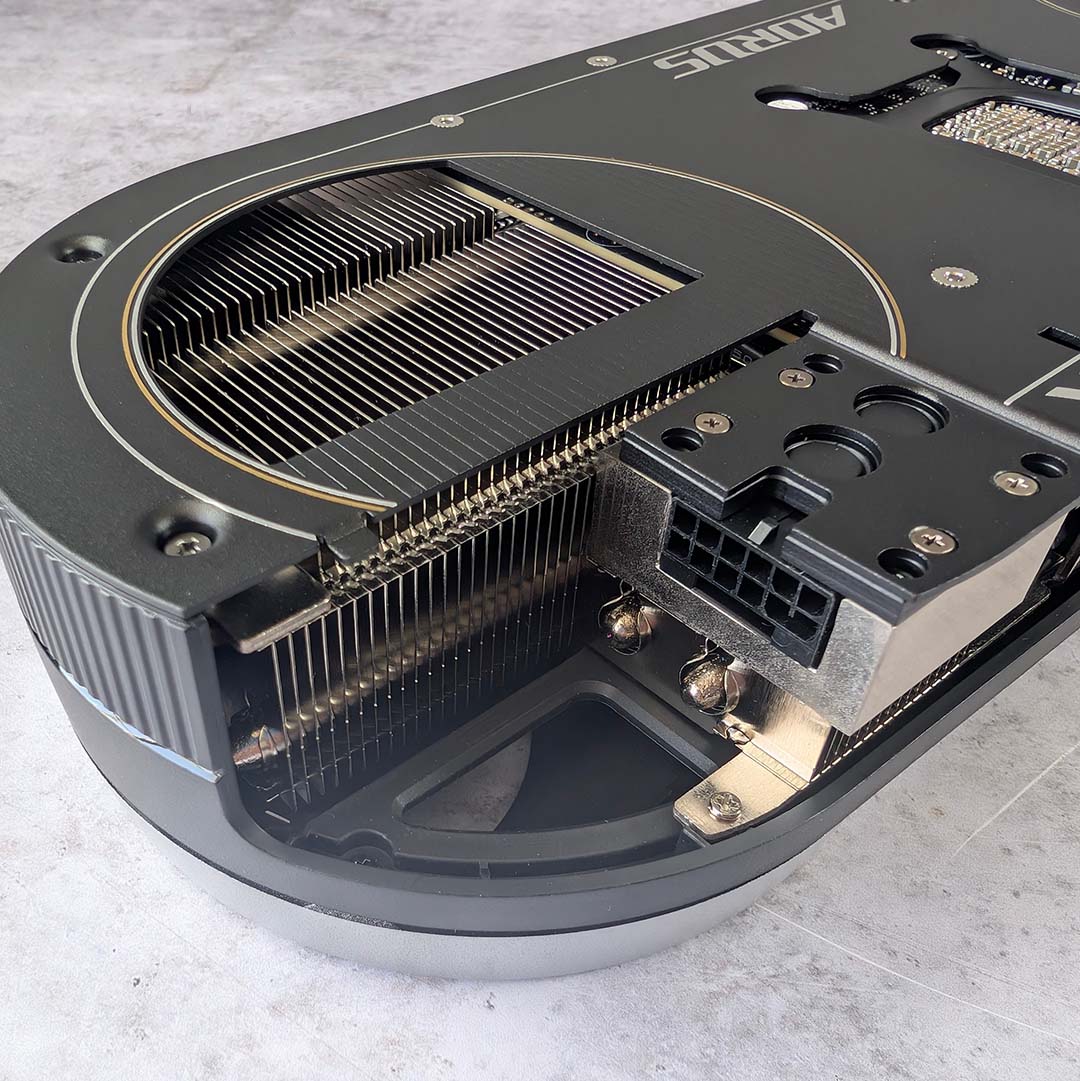
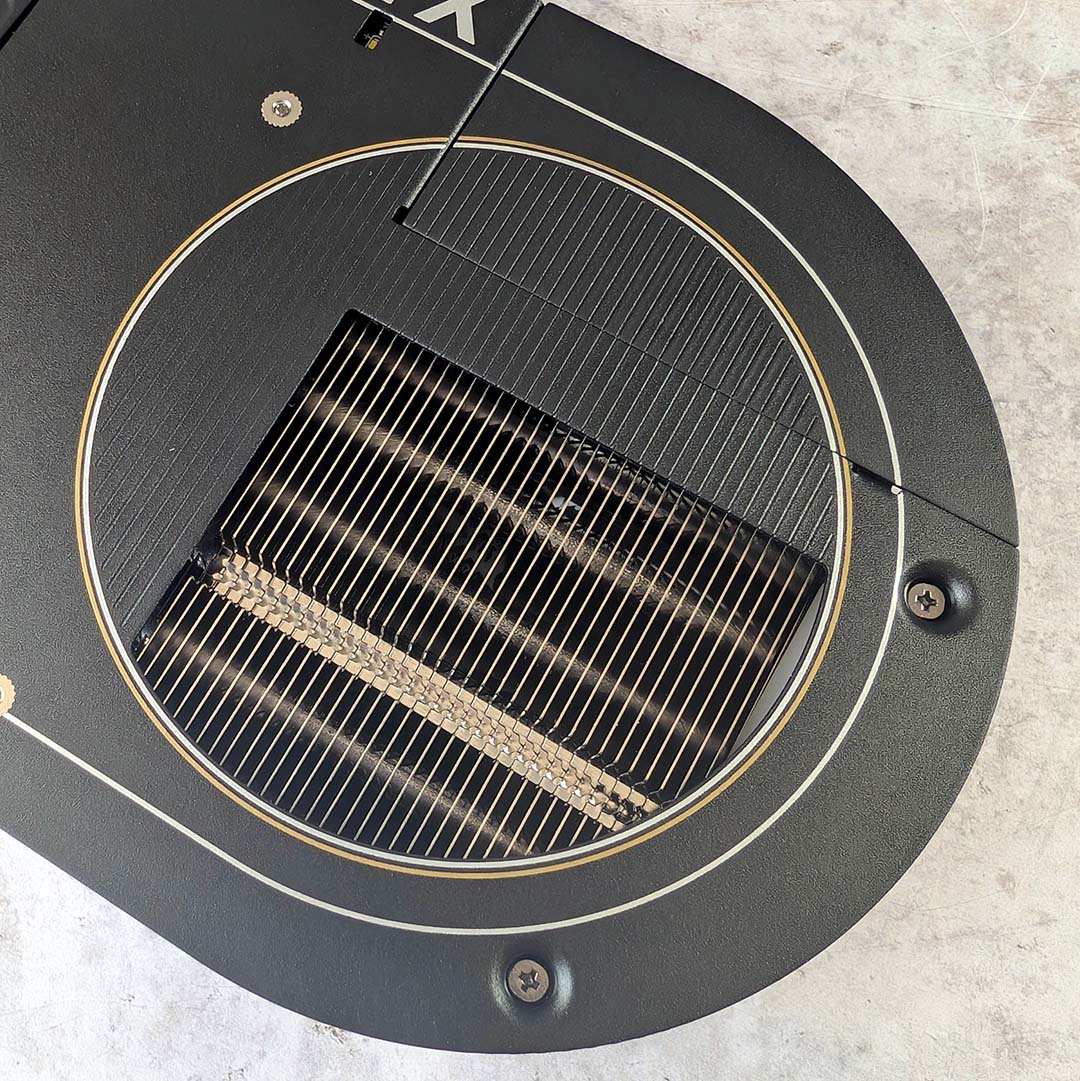
No one likes wires spoiling the look of their graphics card, particularly on premium coolers. With this in mind, I appreciate Gigabyte’s inclusion of a discrete cubby of sorts on the Aorus RTX 5070 Infinity for your 16-pin cable
At first glance, the card appears to be missing an edge but you’ll find a cardboard holder for the magnetic backplate cover as you lift this pixel pusher out from its packaging. This approach reminds me of the Sapphire Nitro+ Radeon RX 9000 coolers, but in this case the modular backplate cover piece is far smaller. and cable routing isn’t as rigid.
All put together, the result is pleasingly stealthy. That said, I’d recommend plugging your 16-pin cable into this card before installing it into a motherboard, as doing so after the fact leaves you with little space, and makes the job fiddlier.
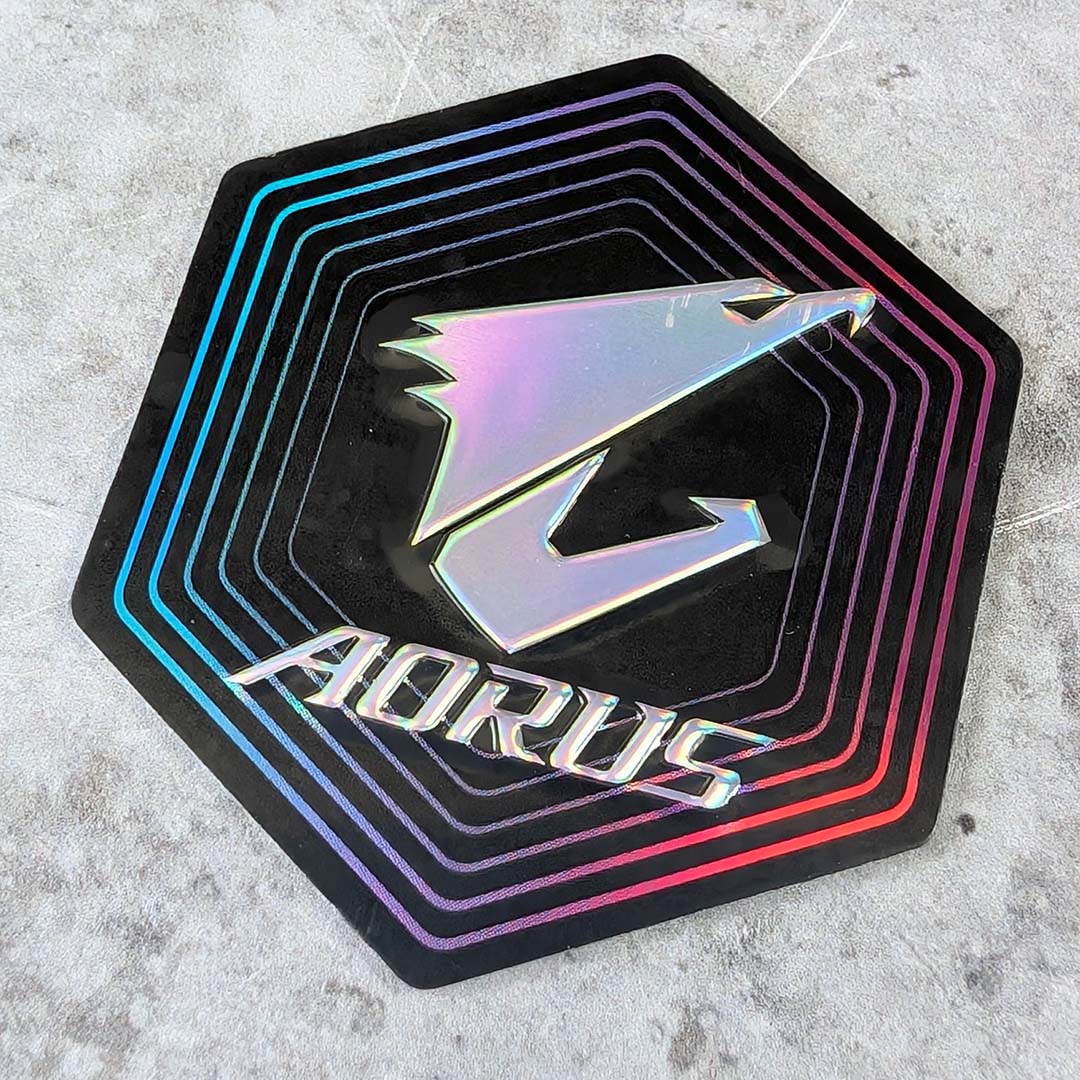

In addition to the magnetic backplate cover, several other goodies arrive with this graphics card. Starting with the most superfluous but shiny, there’s a reflective hexagonal Aorus magnet that you can place as you please. In my experience, though, I always leave accessories like this in the box and forget about them.
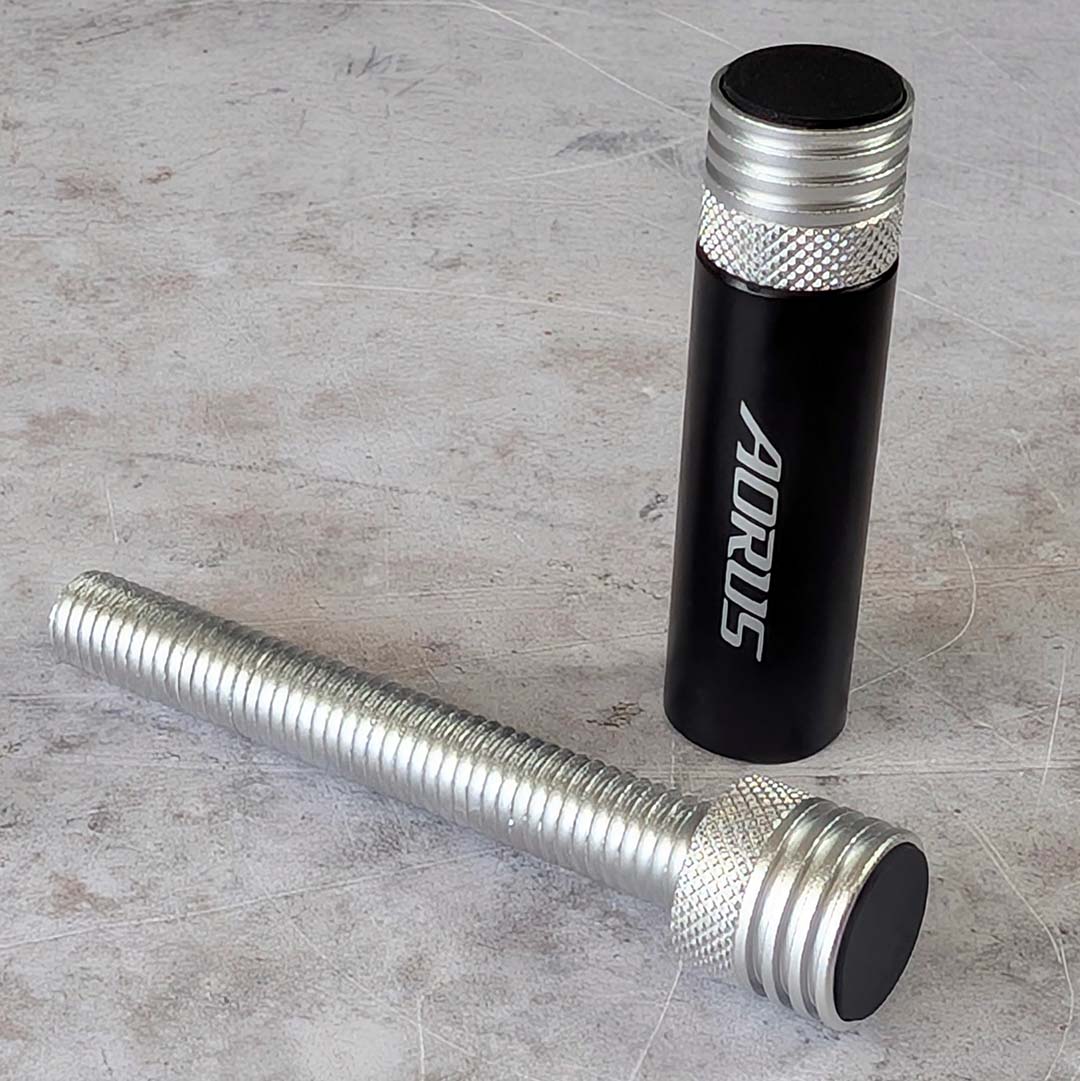
Like most other 16-pin graphics cards, you’ll find an 8-pin dongle among the packaging if you don’t have a native 12VHPWR or 12V-2×6 cable available from your power supply. Finally, Gigabyte throws in a stylish adjustable GPU support. In addition to the smaller stock screw, there’s a taller alternative you can use instead if your case requires the extra height. If your case has enough airflow room, though, I’d recommend mounting the Aorus RTX 5070 Infinity vertically so you can properly appreciate its appearance.
Performance
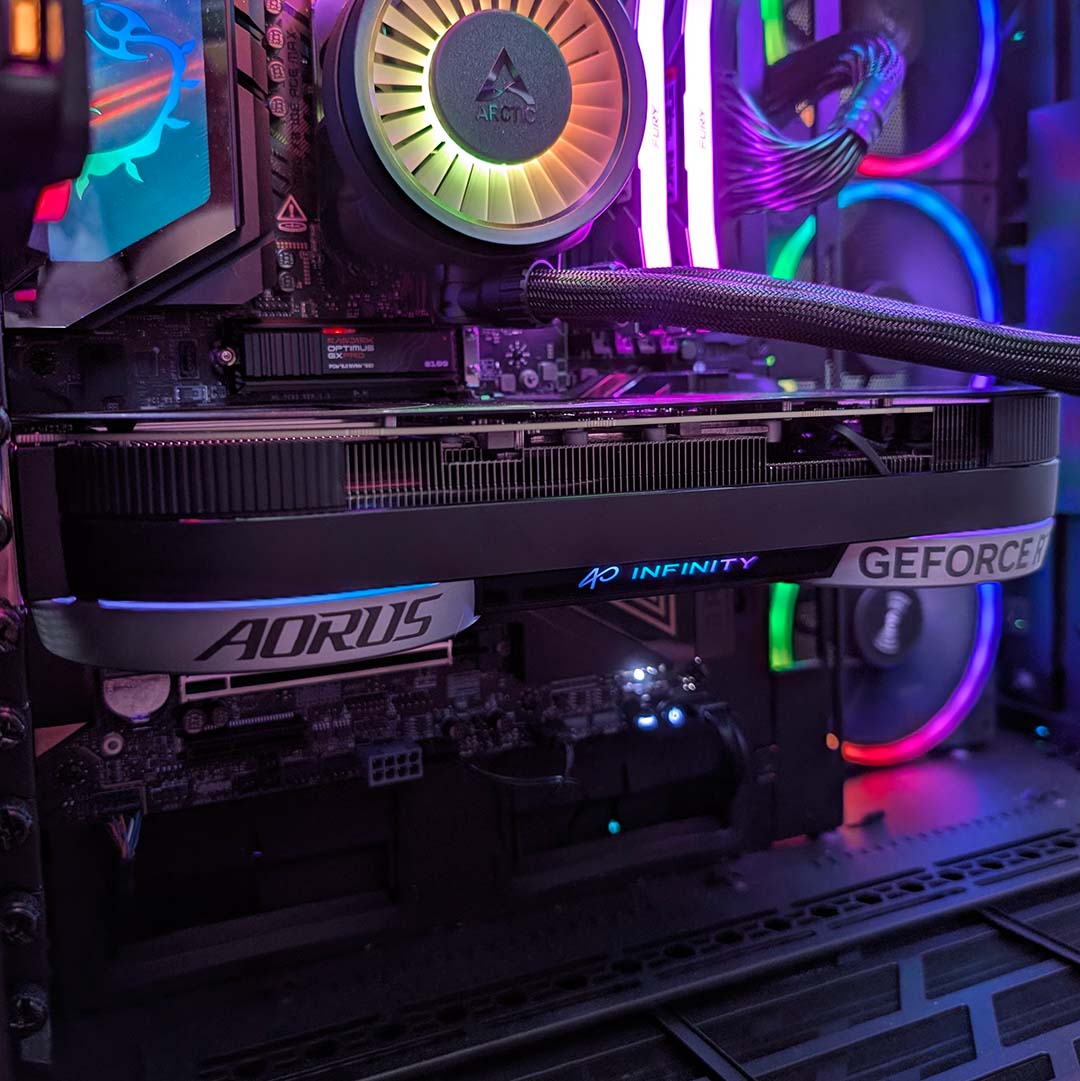
To show the Aorus RTX 5070 Infinity in its best light, I’ve installed this graphics card in one of our 9950X3D test benches to eliminate all potential performance bottlenecks. This is the same system we’ve used to test other pixel pushers too, and my analysis will include comparisons to those alternatives.
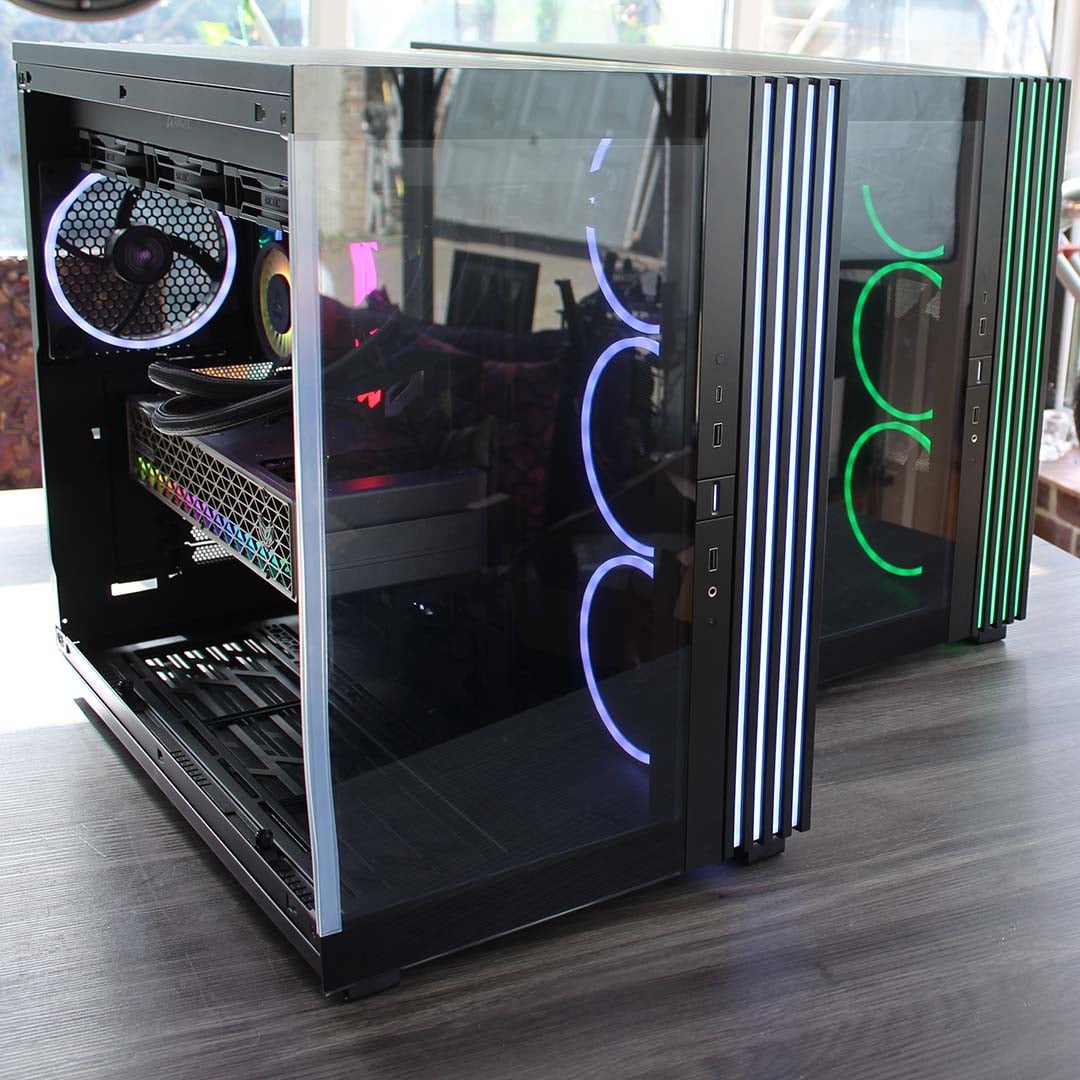
Our 9950X3D Test PCs
Club386 carefully chooses each component in a test bench to best suit the review at hand. When you view our benchmarks, you’re not just getting an opinion, but the results of rigorous testing carried out using hardware we trust.
Shop Club386 test platform components:
CPU: AMD Ryzen 9 9950X3D
Motherboard: MSI MEG X870E Ace Max
Cooler: Arctic Liquid Freezer III 420 Pro ARGB
GPU: Sapphire Nitro+ Radeon RX 9070 XT
Memory: 64GB Kingston Fury Renegade DDR5
Storage: 4TB Sandisk Optimus GX Pro 8100
PSU: be quiet! Dark Power 14 1,200W
Chassis: be quiet! Light Base 900 FX
I’ve tested the card’s capabilities in a variety of general applications, and benchmarked gaming performance across FHD (1920×1080) and QHD (2560×1440) resolutions. There’s room in the tank to push to 4K (3840×2160) on occasion, but that’s an exception rather than the rule. I’ll also explore the impact of Nvidia’s DLSS 4.5 suite on frame rates.
Apps
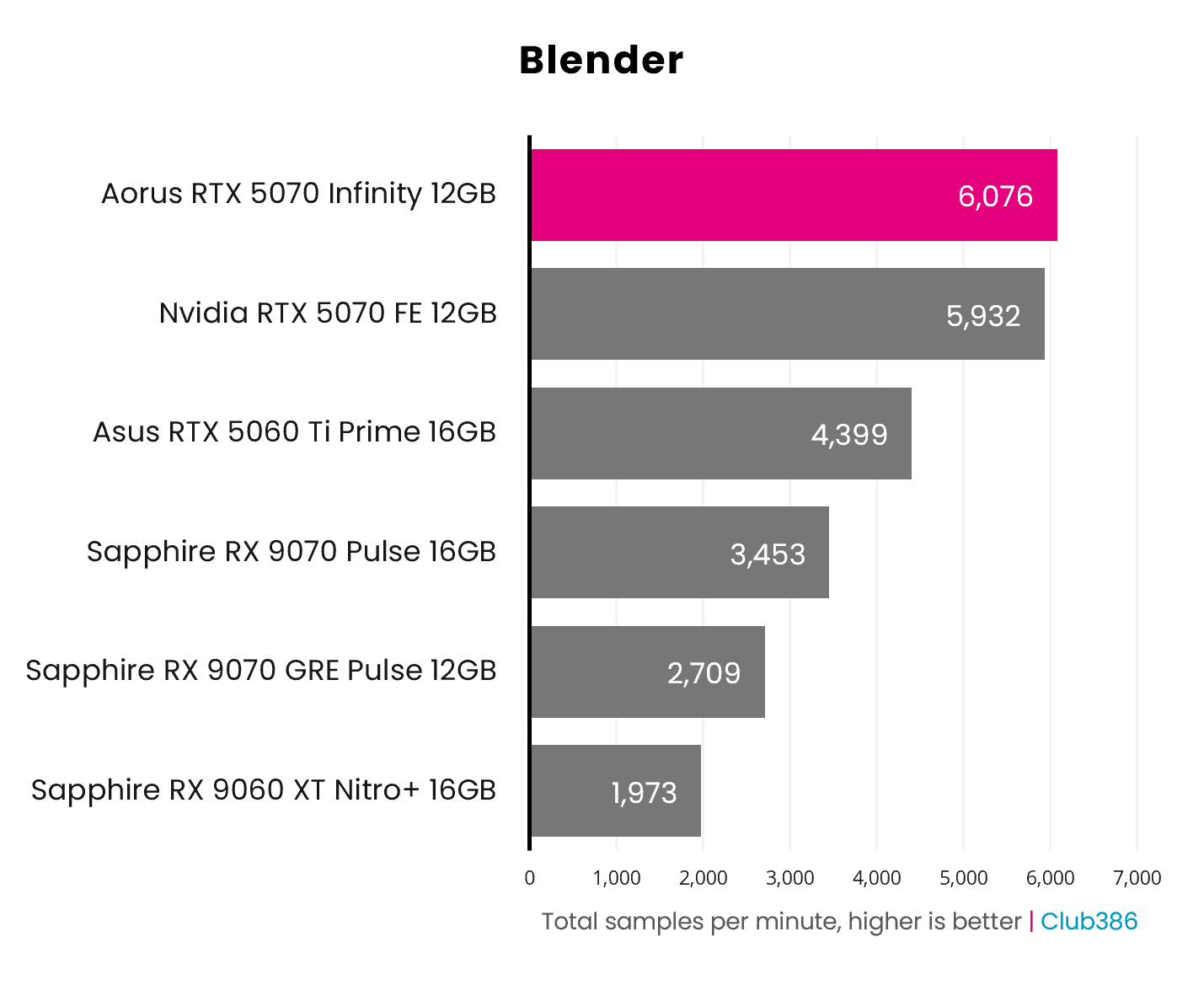
Blender renders are famously faster on Nvidia GeForce graphics cards than AMD equivalents, owing to the application’s support for OptiX and CUDA rendering, while Radeons only have access to the slower OpenCL pipeline. With this in mind, it comes as no surprise that the Aorus RTX 5070 Infinity proves the fastest of our lot.
That said, higher clock speeds don’t push Gigabyte’s contender massively beyond stock RTX 5070 performance. Total sample count for the premium card clocks in at 6,076 per minute, just 144 (+2.4%) higher than the Founders Edition. Any uplift here is welcome. as it’ll cut down rendering time, but that’s a relatively small saving considering the how much more you’re paying.
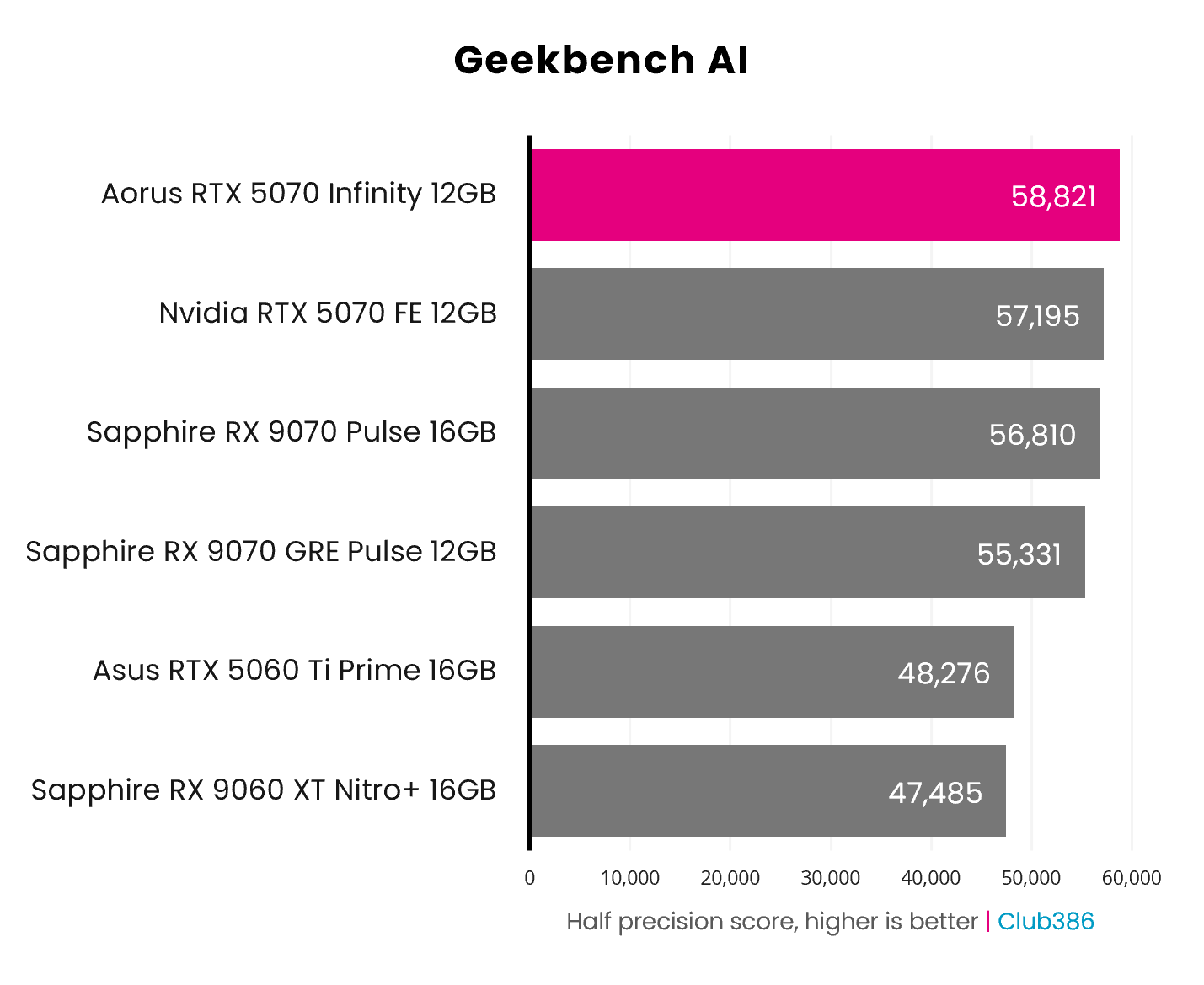
The Aorus RTX 5070 Infinity claims first place in Geekbench AI, running an ONNX runtime via DirectML. At risk of repeating myself, this win isn’t enormous, with a 1,626-point (+2.8%) lead over the RTX Founders Edition. Better performance, yes. Better value, no.
It’s worth noting that AMD has put serious work into its second-generation AI accelerators across the Radeon RX 9000 series. While the RX 9070 doesn’t quite match up to either RTX 5070 score, the card isn’t far behind with 56,810 points.
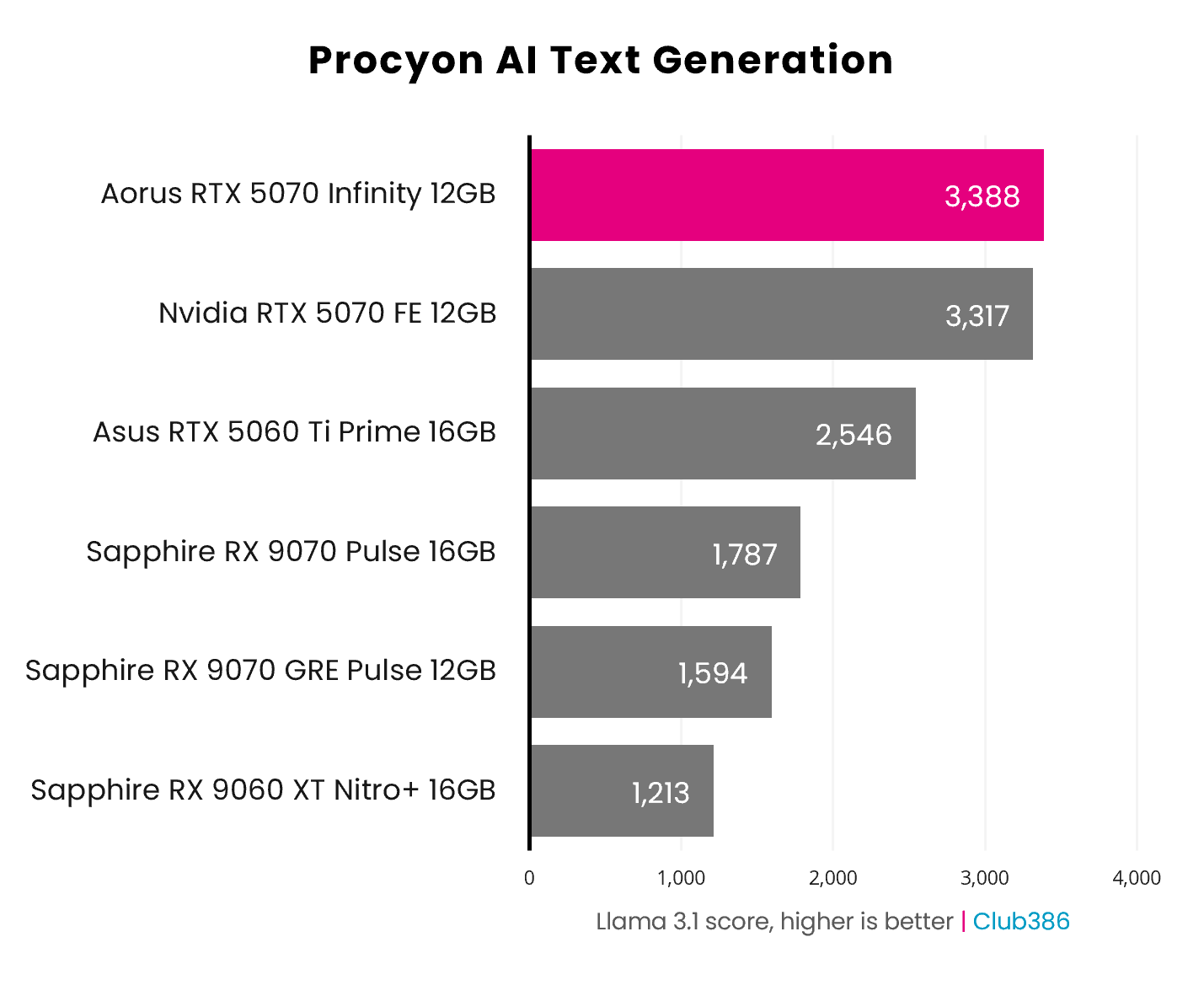
The maturity of CUDA relative to ROCm continues to prove beneficial for Nvidia in the world of LLMs. The disparity between GeForce and Radeon scores in the Llama 3.1 benchmark chart above vividly illustrate this dominance.
Both RTX 5070 cards accrue decisive victories in this test, almost lapping the RX 9070’s score. The Aorus RTX 5070 Infinity leads the pack, but only by the thinnest of hairs, pulling ahead of the Founders Edition by 71 points (+2.1%).
Gaming
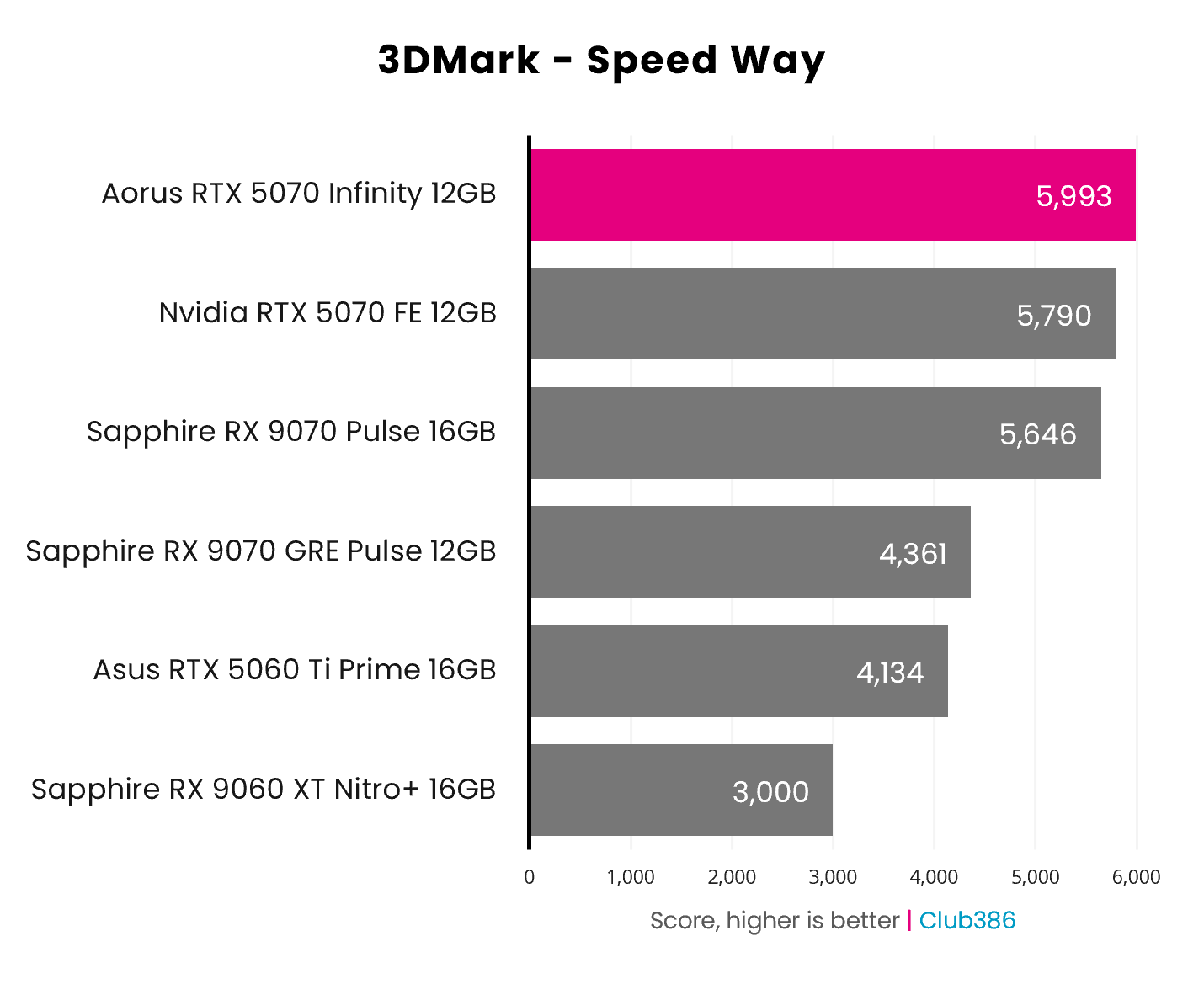
Our gaming test suite begins with a ray tracing benchmark in 3DMark Speed Way, the results of which see the Aorus RTX 5070 Infinity land top of the chart. With a score of 5,993 points, the card is 203 points (+3.5%) clear of the RTX 5070 Founders Edition. In real-terms, though, this amounts to negligible increase of just 2.03fps.
Relative to AMD alternatives, the RTX 5070 looks the better choice over the Radeon RX 9070 GRE in terms of ray tracing performance but costs considerably more. Meanwhile, the RX 9070 isn’t far behind and costs a similar amount to the FE, while being significantly cheaper than the Infinity. However, this lead will vary, as real-world examples will show later.
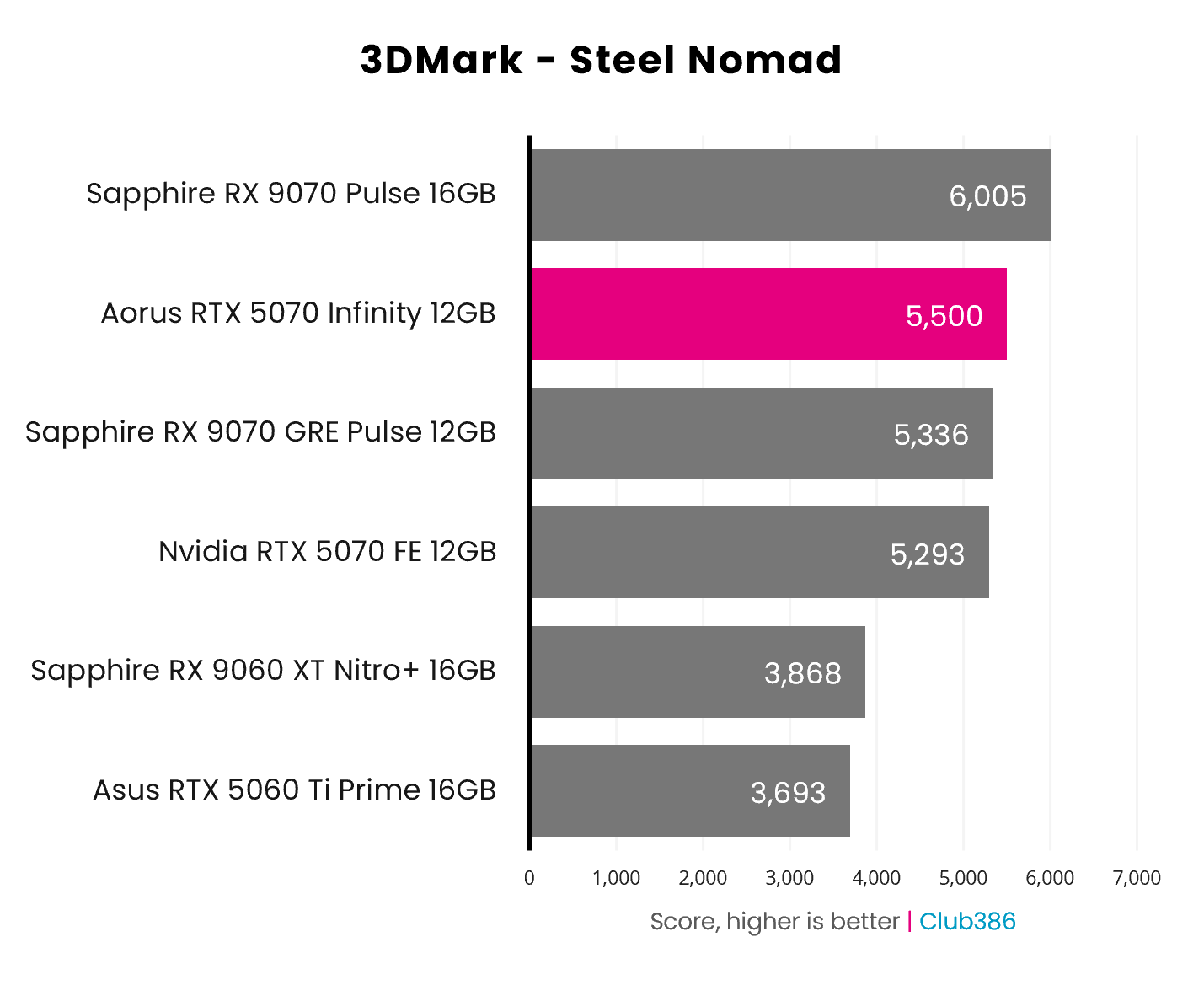
Swapping over to rasterised rendering in 3DMark Steel Nomad, the Aorus RTX 5070 Infinity once again finds itself ahead of the Founders Edition. 207 points (+3.9%) characterise this lead, or 2.07fps in real terms, giving Gigabyte’s card another technical win over Nvidia’s card, rather than anything substantive.
A score of 5,500 points isn’t enough to secure the top spot in our chart, though, as the RX 9070 clinches prime podium position with 6,005 points However, like the Speed Way results, scores in Steel Nomad aren’t indicative of absolute supremacy across all games, and instead serve as a broad estimate of each card’s capabilities.
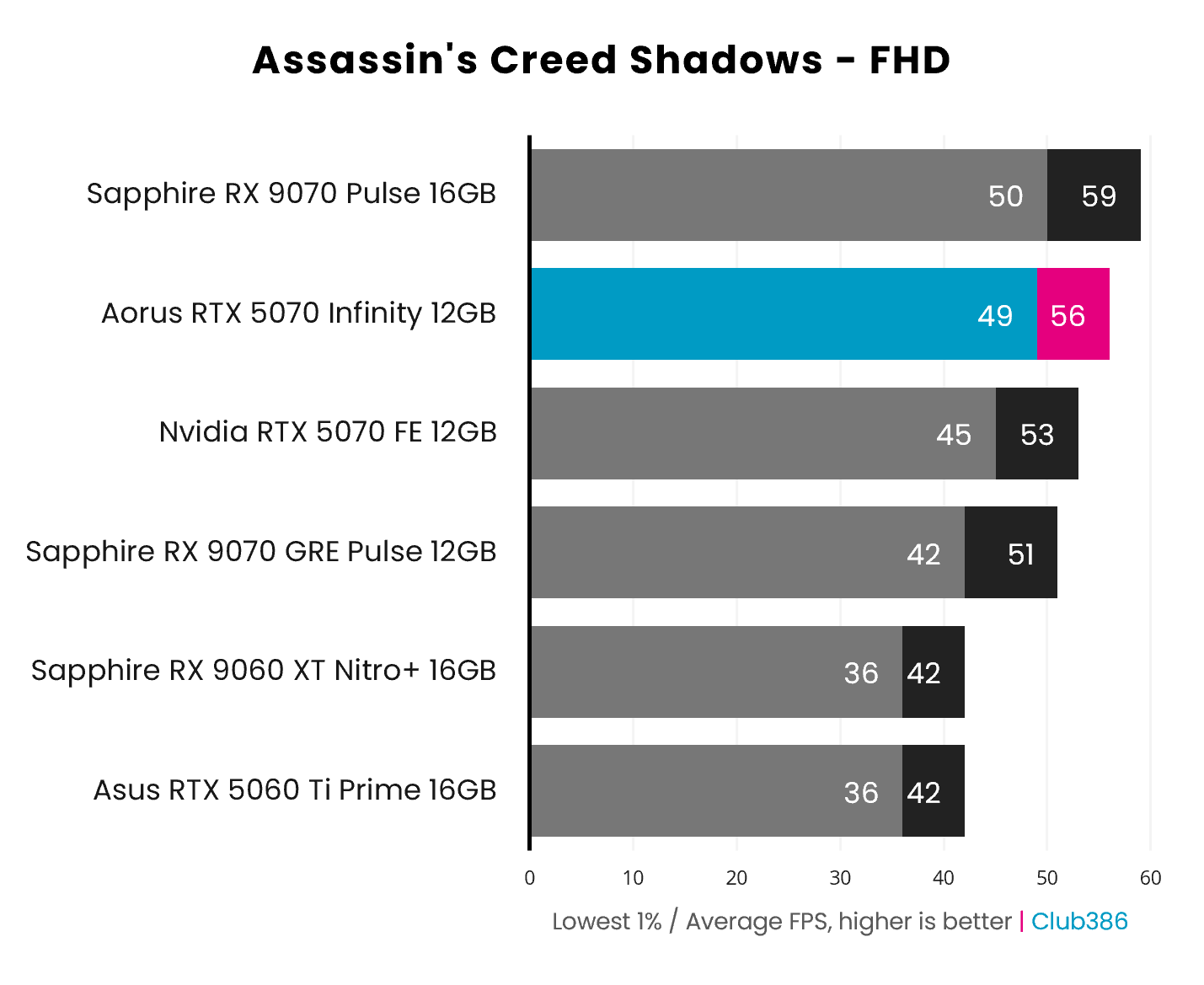
Despite the intense pressures of Assassins Creed Shadows’ ray traced rendering of feudal Japan bearing down on the Aorus RTX 5070 Infinity, we still enjoy a respectable 56fps average, mixed with 1% lows of 49fps. You could easily bring these figures up to 60fps+ via a splash of DLSS.
This result sees the premium RTX 5070 dash past the Founders Edition by 3-4fps (5.7-8.9%) across 1% lows and average frame rates, securing second place on the chart. However, it’s the RX 9070 that secures the overall win, albeit with a slim advantage of just 1-3fps.
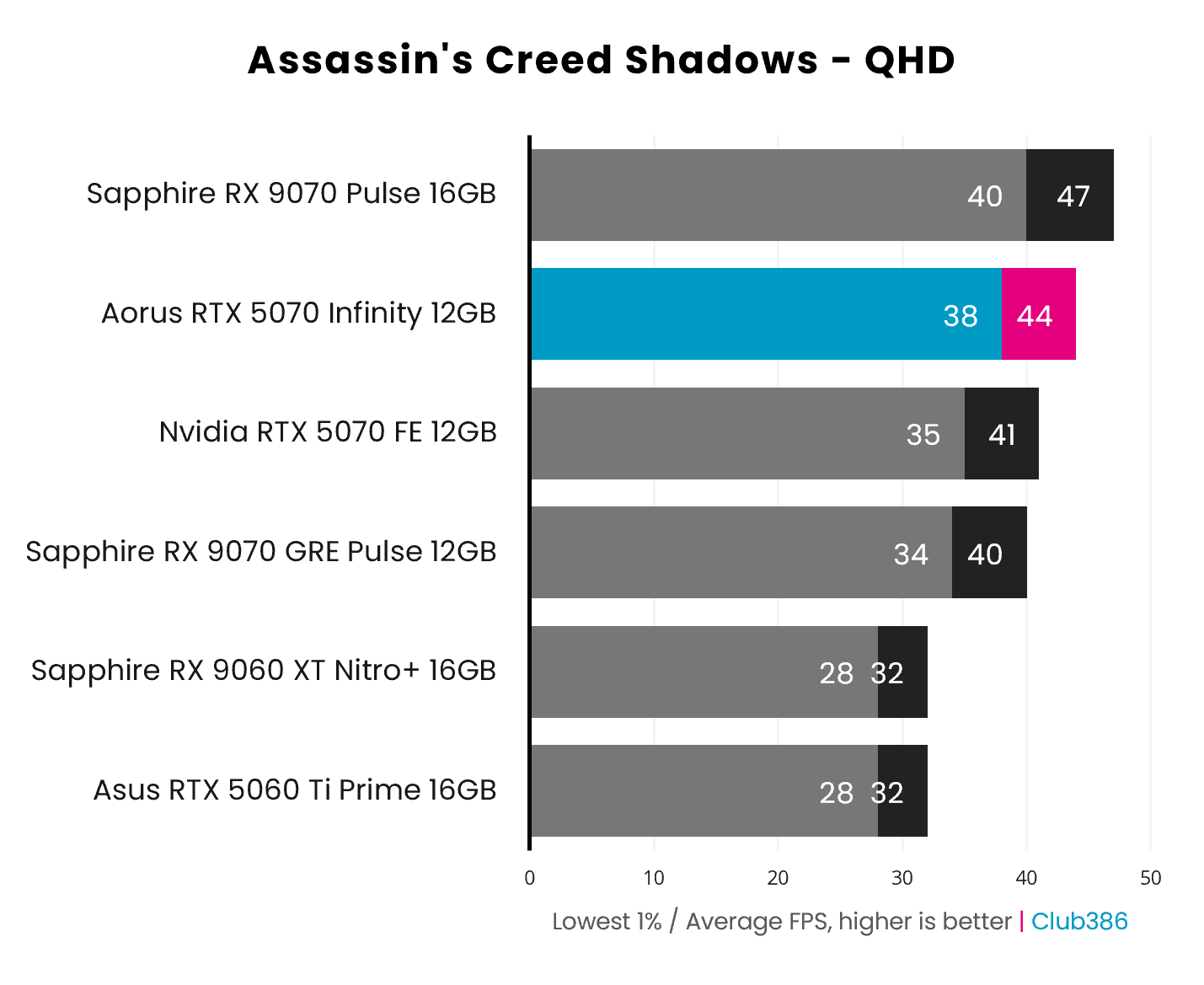
Increasing resolution to QHD does nothing to alter chart positions, nor usher in any major differences in performance gaps between graphics cards. However, the need for upscaling to achieve a 60fps+ experience on all models is far greater, with both RTX 5070 models’ frame rates slipping to the mid-to-low 40s.
The Aorus RTX 5070 Infinity once again pushes past the Founders Edition with a slight lead, this time of 3fps (+7.3-8.6%) across 1% lows and average frame rates. There are larger gains to come, but the former’s higher clock speeds do little to move the needle in this title.
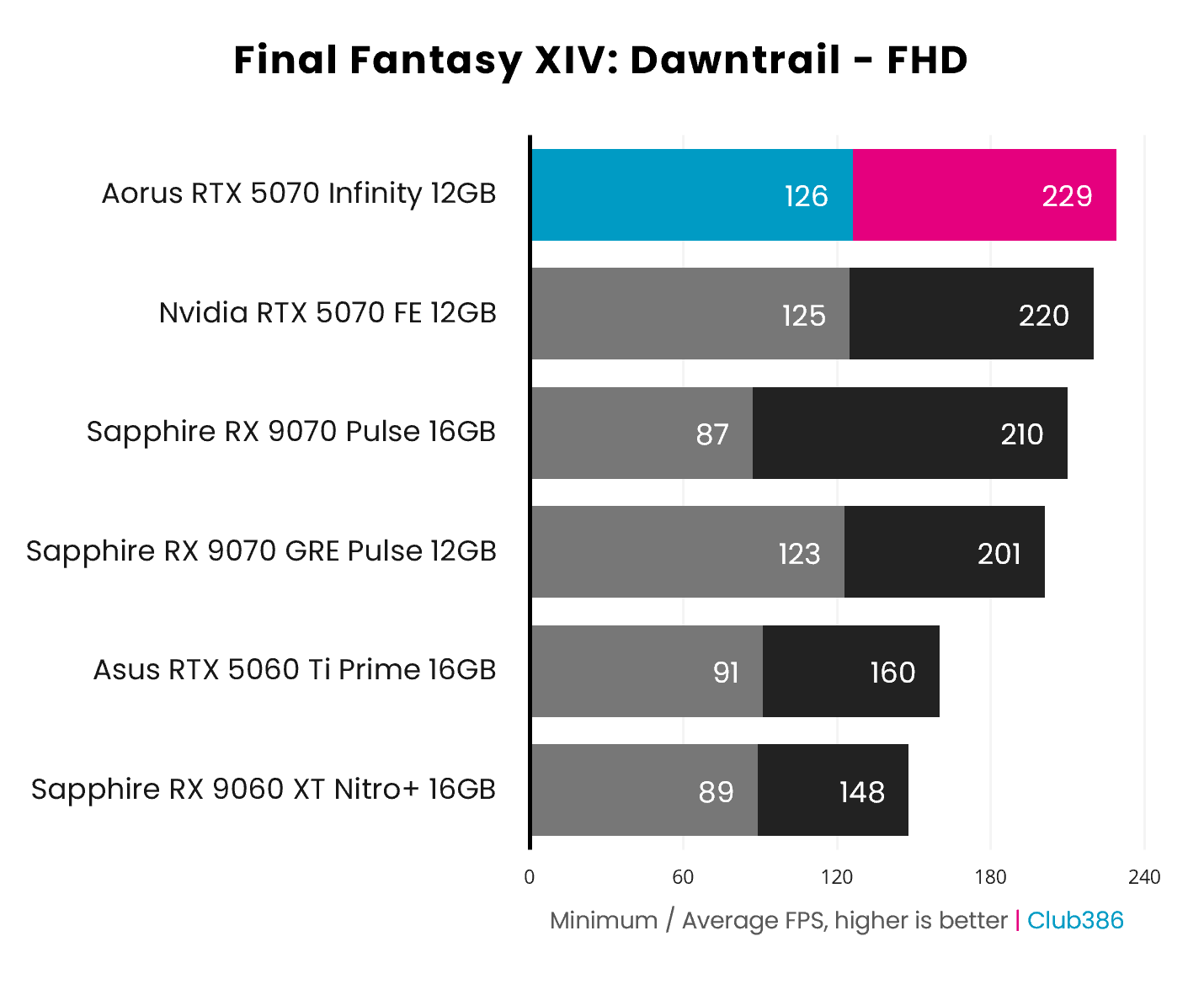
Modern graphics cards make short work of Final Fantasy XIV: Dawntrail’s Maximum preset, resulting in some impressive triple-digit frame rates. Our Aorus RTX 5070 Infinity leads the pack in this FHD benchmark with a stonkingly large 229fps average.
While impressive in its own right, that result is only 9fps (+4.1%) ahead of the Founders Edition at most, continuing the unflattering trend of minor performance gains, despite commanding a large premium. Relative to the RX 9070, average frame rates are 19fps (+9%) higher.
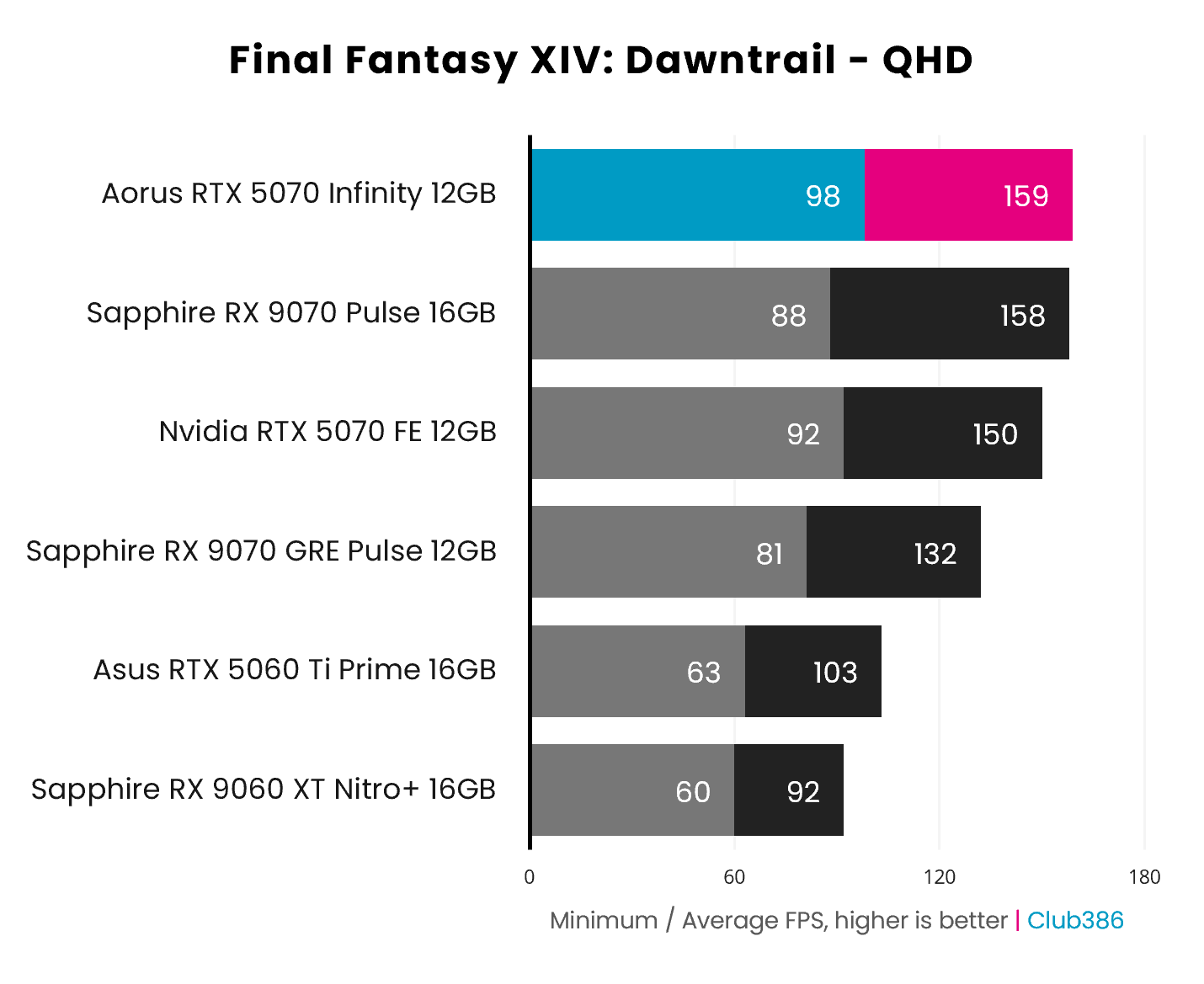
In this case, turning up the rendering heat with a jump to QHD does see a notable shift in pole positions and a shrinking of FHD advantages. While the Aorus RTX 5070 Infinity maintains dominion over our chart, it reigns by a slim majority of just 1fps over the RX 9070.
Comparisons to the Founders Edition are more flattering, but not massively so, as the Gigabyte graphics card enjoys a 9fps (+6%) advantage.
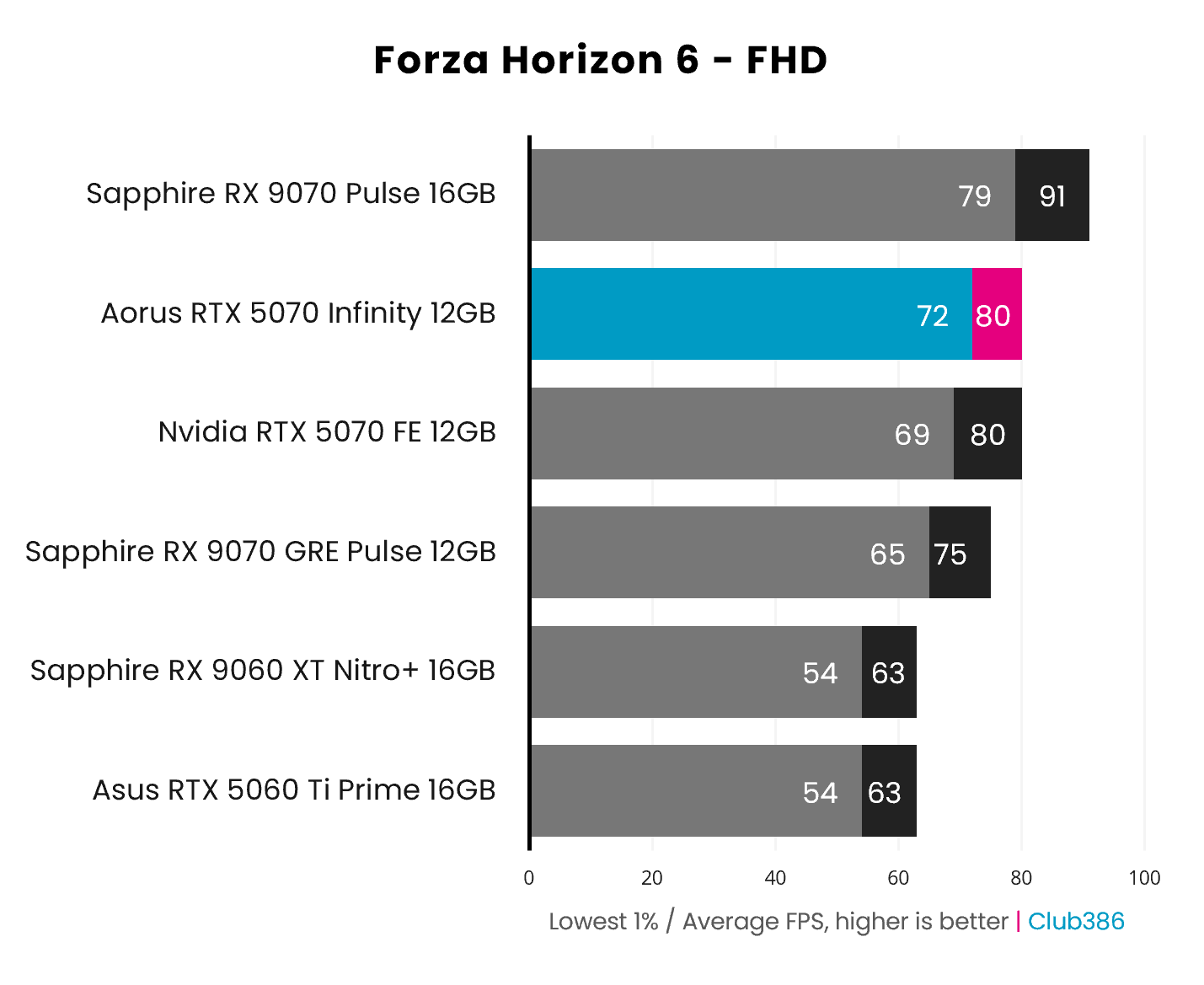
Returning to ray tracing in Forza Horizon 6, the ‘Extreme + RT’ quality preset at FHD provides plenty of eye candy without proving quite as demanding as other games. In fact, all graphics cards on the board deliver a 60fps+ average using this setting, shifting the goalpost from meeting that performance threshold to how far they can all rise above it.
As per the AC Shadows results we discussed earlier, the Aorus RTX 5070 Infinity’s higher clock speeds do almost nothing to elevate performance beyond the Founders Edition, with just a 1% low improvement of 3fps. Meanwhile, the RX 9070 celebrates a confident lead at the top of the chart, besting the £799 card by 11fps (+13.8%).
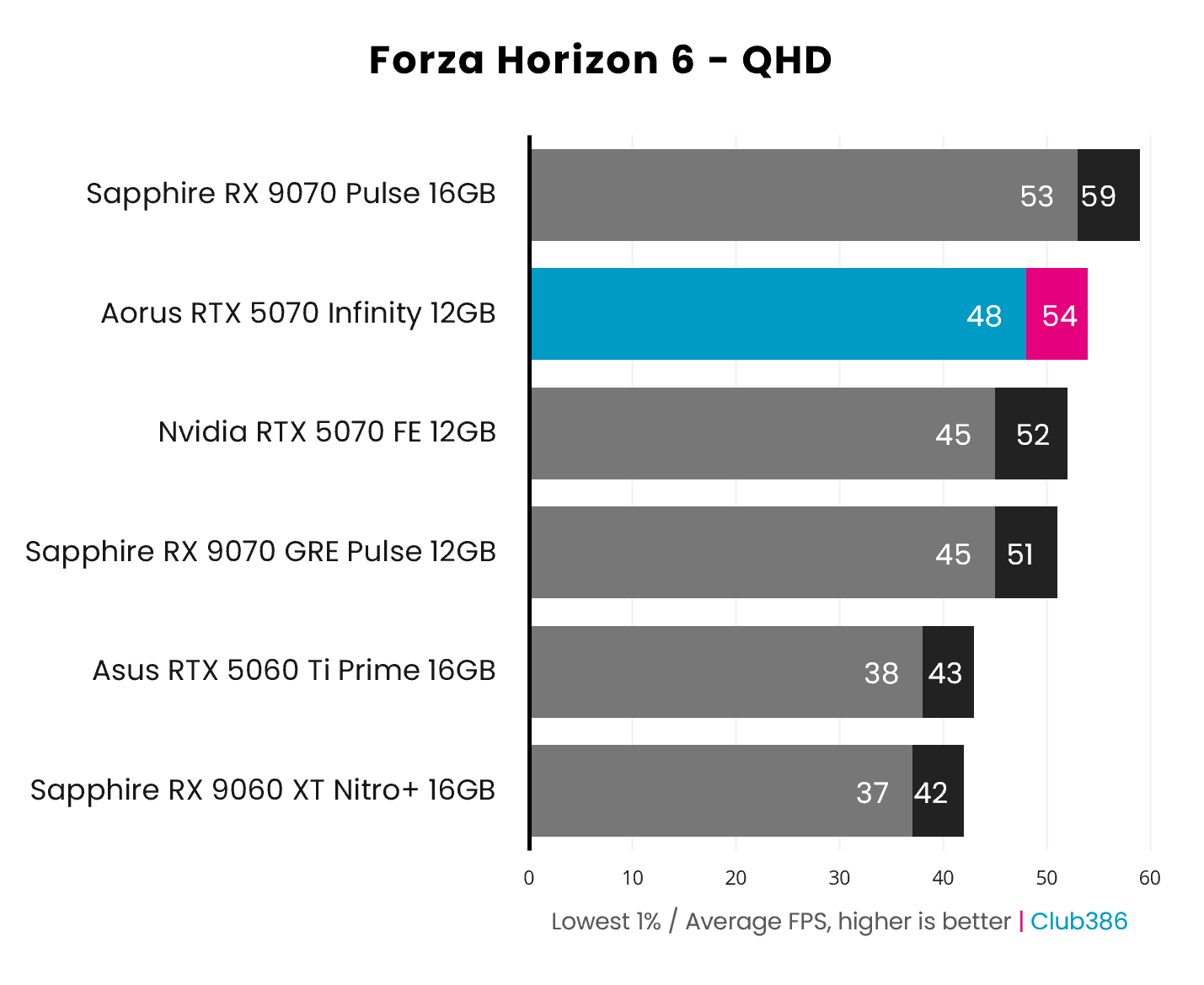
Shifting up the stakes a gear with QHD, all the graphics cards in this round of tests are considerably slower, as each now fails to meet the 60fps threshold they all so confidently met at a lower pixel count. Thankfully, when it comes to the RTX 5070, the boost required from DLSS to reach that target isn’t enormous.
The silver medal once again goes to the Aorus RTX 5070 Infinity, but it does pull slightly further ahead of the Founders Edition with a 2-3fps uplift in 1% low and average frame rates. Conversely, the gap between first and second place has shrunk, as the RX 9070 now crosses the finish line with a 5fps (+9.2-10.4%) across both performance categories.
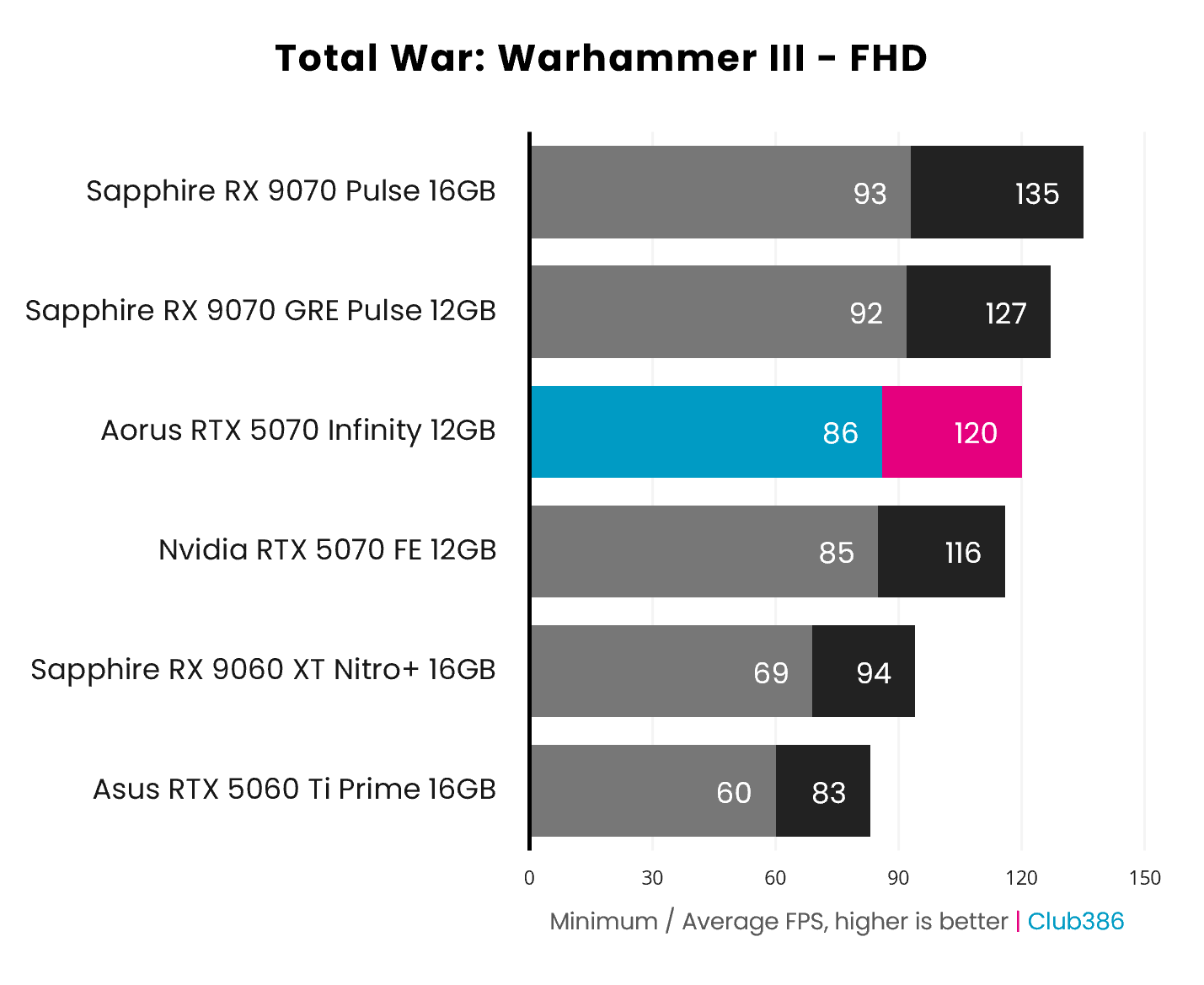
Total War: Warhammer III at FHD proves an exceptionally unfortunate showing for the RTX 5070. This is the only time the card sits in third place across our charts, as both the Aorus Infinity and Founders Edition fall behind AMD’s RX 9070 GRE.
These results also mark the largest performance gap between the RTX 5070 Infinity and RX 9070, with 15fps (+12.5%) separating the two GPUs. Meanwhile, the GRE revels in a smaller but notable advantage of 7fps (+5.8%).
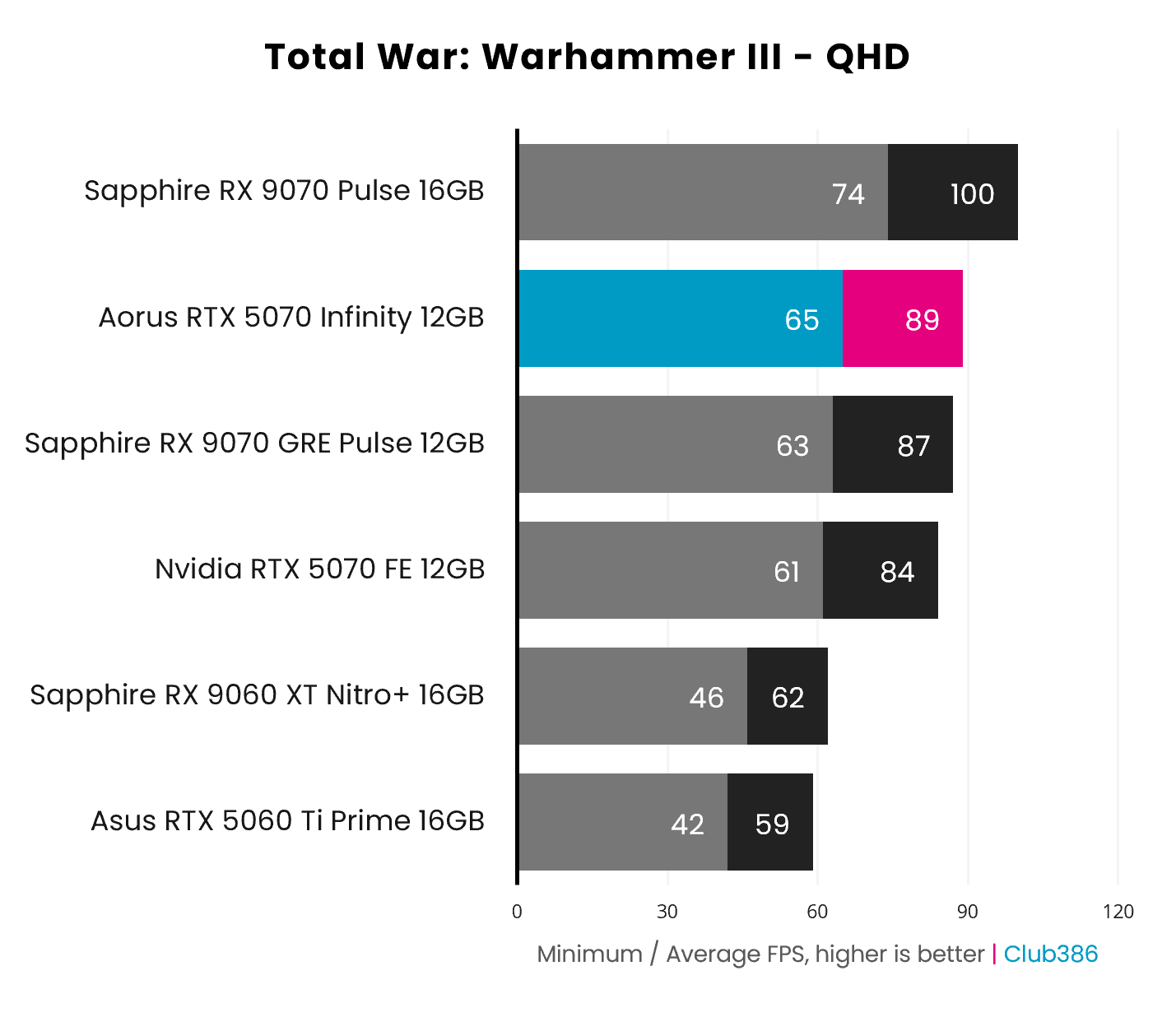
Increasing GPU strain with a resolution bump to QHD sees the Aorus RTX 5070 Infinity reclaim its usual second place position on the chart. The RX 9070 GRE isn’t far behind, though, with the GeForce card nipping past its Radeon rival by just 2fps (+2.2%).
Comparisons to the Founders Edition reveal a 5fps (+6%) advantage to Gigabyte’s design. Meanwhile, the RX 9070 remains the firm winner in this benchmark, producing the only triple-digit frame rate and claiming a confident victory by way of 11fps (+12.3%).
DLSS
The GB205 die at the heart of every RTX 5070, including the Aorus Infinity, has access to the entire Nvidia DLSS 4.5 suite. This includes support for multi-frame generation, Ray Reconstruction, as well as Super Resolution. Importantly the latter now comes with a minimal penalty on image quality, thanks to the newer, higher quality Transformer upscaling model.
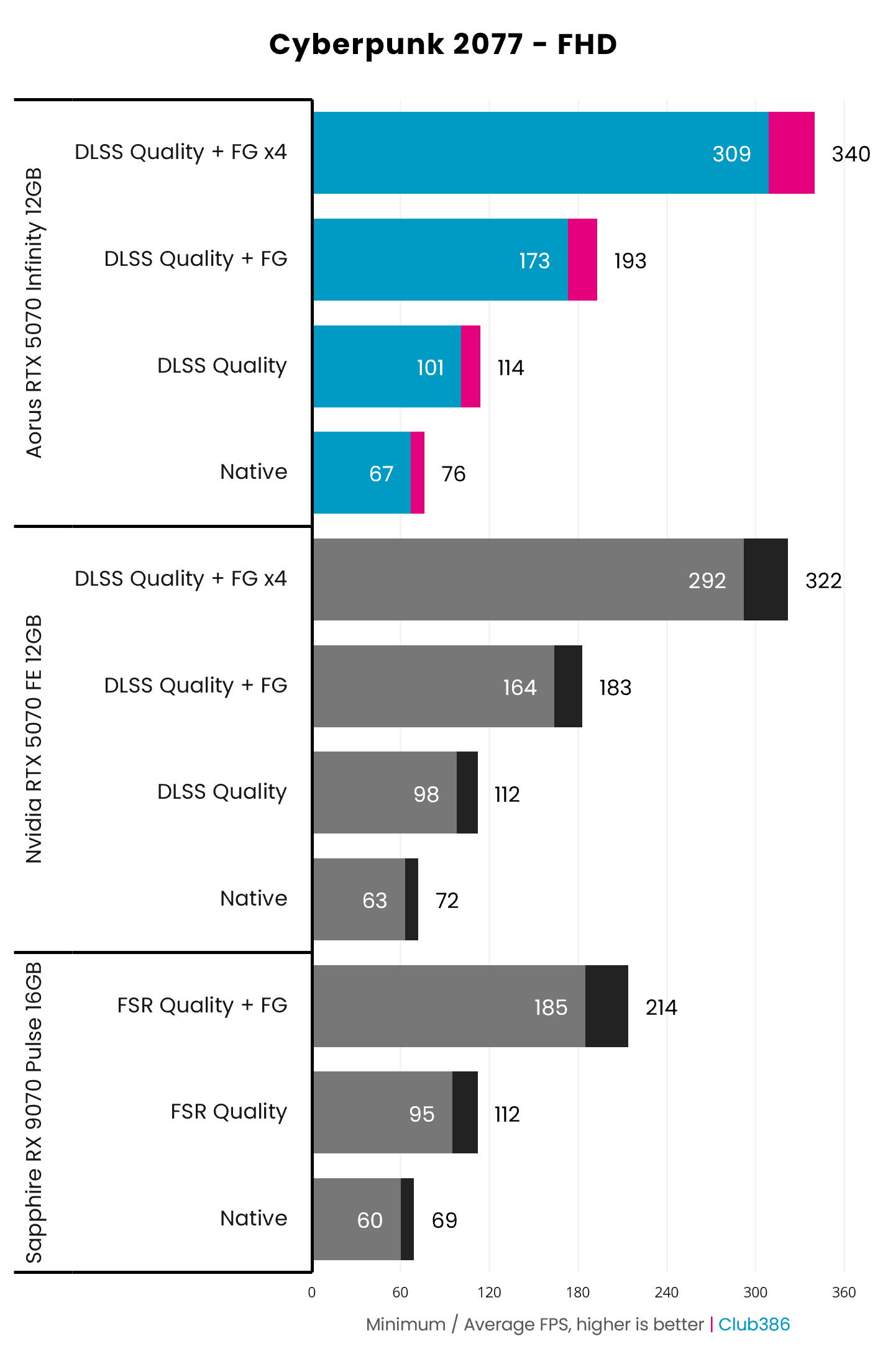
Cyberpunk 2077 provides fertile testing ground for all three aforementioned technologies, as much as the RTX 5070 can handle itself in the face of the game’s RT Ultra graphics preset. Building from the Aorus Infinity’s inarguably solid 76fps average, engaging DLSS Super Resolution on the Quality preset provides a welcome 38fps (+50%) performance uplift, with negligible impact to image quality.
I don’t recommend turning on frame generation unless you’re already running a game at 60fps+, with or without upscaling, in order to keep latency in check. Thankfully, with a 114fps base from which to work, we’re well clear of that target. Using single frame gen, the Aorus Infinity hits 193fps, rising to 340fps once we crank the multiplier to 4x. That’s one big bonus over AMD’s cards, which don’t feature any level of multi frame gen yet.
Relative to the RTX 5070 Founders Edition, we’re seeing performance advantages in favour of the Aorus Infinity ranging between 2-18fps. This marks another small lead for the premium card, whose higher boost clocks can only do so much to provide greater performance.
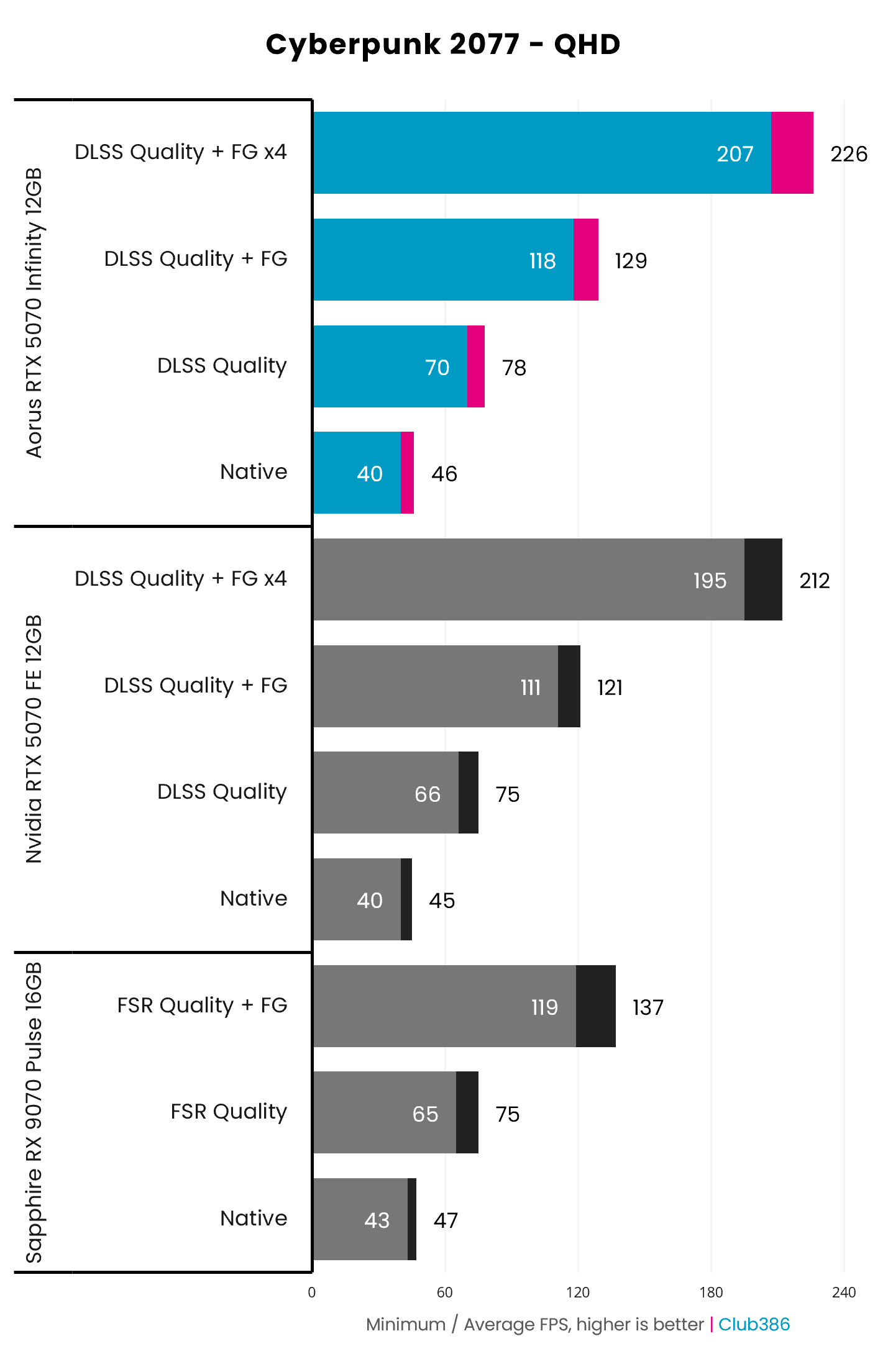
Without the assistance of upscaling, all three graphics cards on the chart fall short of a 60fps+ average at QHD, but quickly find their footing once we enable the feature. In the case of the Aorus RTX 5070 Infinity, frame rates rise from 46fps by a chunky 22fps (+70%).
A 78fps base, while not as zippy as the 114fps we enjoy at FHD, still creates a sufficiently stable base from which to engage frame generation without fear of sky-high latency. Single frame generation pushes motion clarity to 129fps levels, with a 4x multiplier increasing this value to a handsome 226fps.
A single frame separates the Aorus Infinity from the RTX 5070 Founders Edition at native resolution, increasing to 3fps with DLSS in play, before finally growing to 8-14fps using frame generation. That’s another pyrrhic victory for Gigabyte’s card.
Temperatures
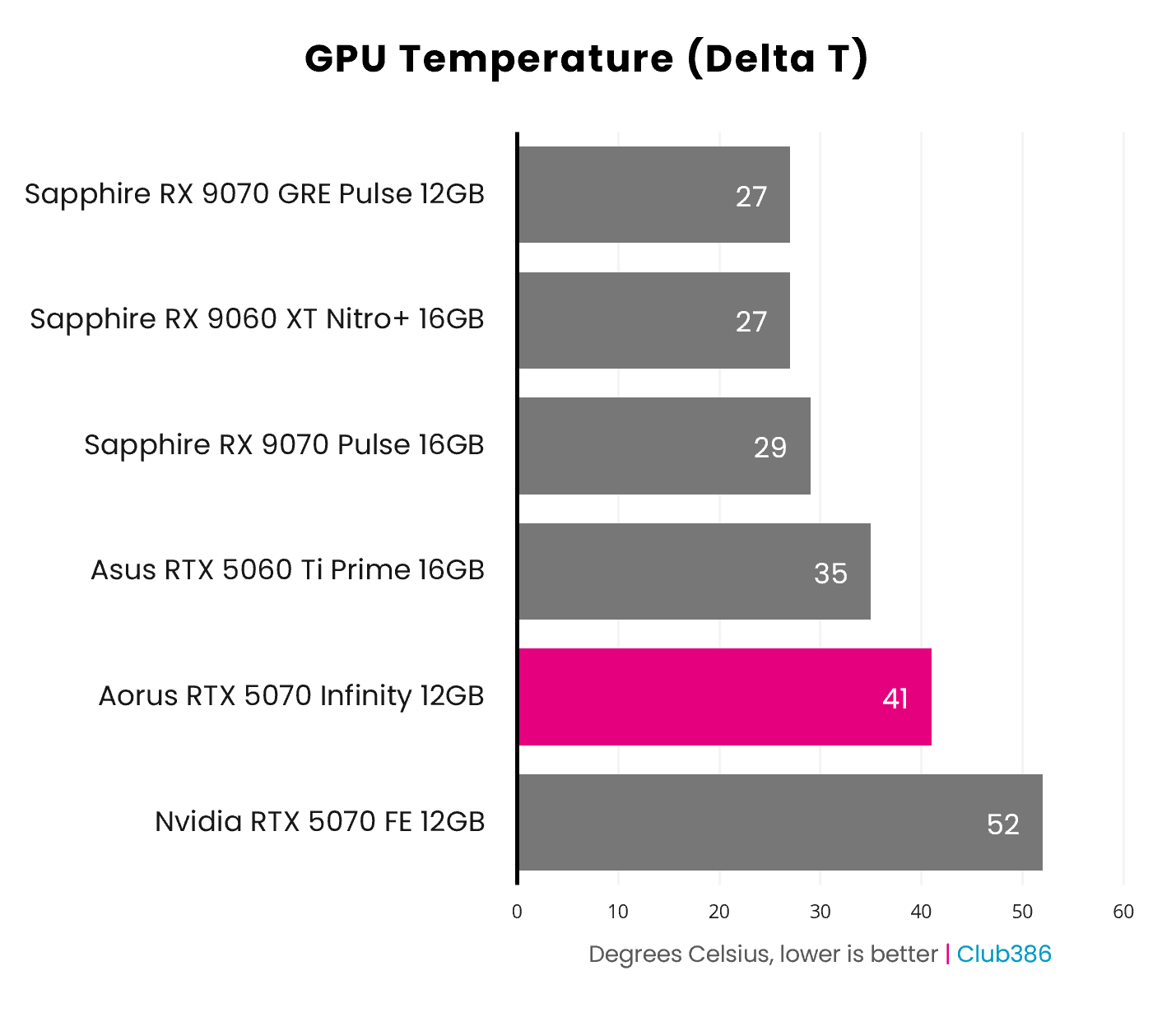
My office was nothing short of an oven during my testing of this card, with my digital hygrometer describing ambient temperatures as reaching 32°C. Despite these oppressive conditions, Gigabyte’s pixel pusher managed to operate in a pleasingly quiet manner.
Across my testing, the RTX 5070 Infinity reached its highest temperature during the Cyberpunk 2077 benchmark. The absolute value came back as 73°C in HWInfo, which results in our 41°C value in the chart above once you subtract ambient temps. That’s a cool 11°C better than the RTX 5070 Founders Edition.
While idle, Gigabyte’s contender sits silently and relies on the passive cooling from its heatsink. Once the fans activate in response to higher GPU usage and temperatures, noise remains palatable, measuring just 38dbA from 30cm away with the side panel open in our test system. Naturally, with a wall of tempered glass in the way and at a reasonable sitting distance, the card’s all the quieter.
Conclusion
The Gigabyte Aorus GeForce RTX 5070 Infinity ticks all the boxes you would expect from a premium board. The cooler’s aesthetics are undeniably striking and unique, while delivering substantially strong thermals and noise levels, as well as offering higher performance relative to stock.
Of course, all those bonuses come at substantial cost. As mentioned earlier, you’ll find this card on store shelves for £799, well over the current market baseline of £542. That’s a serious premium, and one that’s difficult to justify for marginally superior frame rates and scores. As much as I love the undeniably unique look of the Infinity cooler, I wouldn’t rush to spend so much on it.
I have some sympathy for Gigabyte, as part of that price undoubtedly reflects the more contemporary cost of GDDR7 modules, which haven’t had as dramatic an effect on older models. At least, for now. However, such understanding doesn’t soften the bottom line that the Aorus Infinity is very expensive relative to other options you can buy right now.
More broadly, there’s also no escaping that this is still a GeForce RTX 5070 at its core, and Nvidia’s mid-range offering continues to find itself awkwardly sandwiched between two potent Radeon rivals. On the one hand, you have the RX 9070 GRE that delivers similar gaming performance at a lower price (£475+). Then there’s the RX 9070, which can deliver greater frame rates in some cases for similar money (£539+ at the time of writing) with the added bonus of more VRAM, enabling you to even unlock some settings at 4K.
While AMD’s mid-range duo are causing headaches for Nvidia in terms of gaming, the GeForce brand’s GPUs still hold a clear lead in many creative and deep learning workflows. That’s not forgetting the advantages of a more mature and varied software suite, with exclusive features including multi-frame generation and more. However these perks apply to the Aorus Infinity as much as they do to all other RTX 5070s on the market.
Summarily, this is a triumph in terms of cooler design, and I hope we can see more like this in subsequent graphics card generations, just without such a substantial premium – it feels wasted on a GPU with the power of the RTX 5070.