
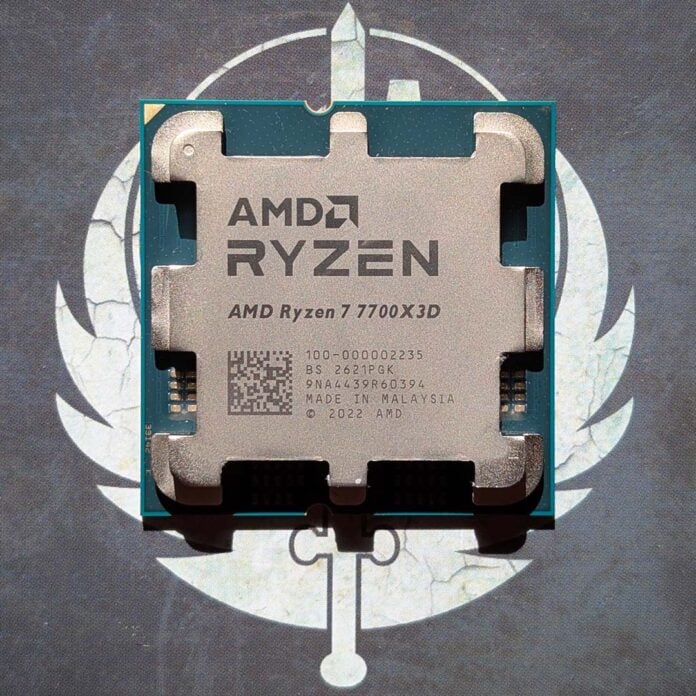
AMD is serving up yet more Zen 4 processors, as its Ryzen 7 7700X3D joins the fray, enabling the firm to make the most of its last-gen silicon. Aiming to provide a more affordable alternative to the long-standing people’s champion, the Ryzen 7 7800X3D, this ‘new’ CPU sadly struggles to accomplish this feat in any meaningful respect.
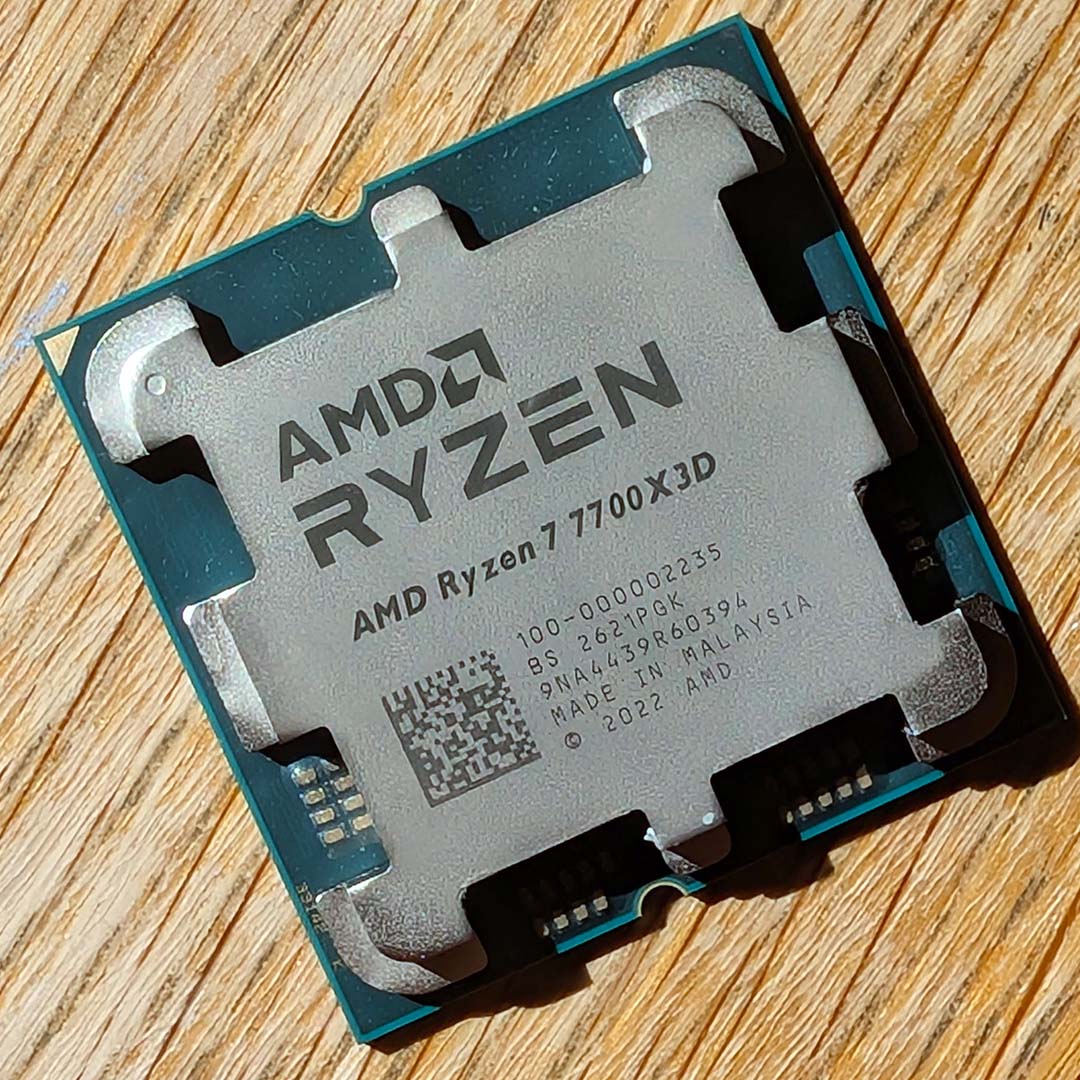

AMD Ryzen 7 7700X3D
£295 / $329
Pros
- Decent gaming pace
- 3D V-Cache boosts frame rates
- Frugal power consumption
Cons
- Price is much too high
- Middling app performance
- Low boost clock speeds
Club386 may earn an affiliate commission when you purchase products through links on our site.
How we test and review products.
Since its debut earlier this year, the 7700X3D has seen a slight price cut in both the US and UK. At the time of writing, the States enjoys a minor discount of $10, while those in old Blighty can pick up the chip with a £26 cost reduction.
In isolation, this improves the processor’s value. However, this isn’t the only CPU on the market that’s now more affordable than it was at launch. That’s a big problem for AMD’s latest Zen 4 contender, relative to the likes of the 7800X3D and beyond.
Specifications
Slotting the 7700X3D into our Club386 Table of DoomTM highlights the similarities between this CPU and the 7800X3D, sharing the same TDP, core and thread count, as well as cache pool size. Instead, it’s clock speeds that separate the newest addition to the Zen 4 lineup from its closest relative, with lower base and boost frequencies. Let’s dive into these facets in more detail.
| Model | Cores / threads | TDP | L3 cache | Base clock | Boost clock | Launch MSRP |
|---|---|---|---|---|---|---|
| 9000 series | ||||||
| Ryzen 9 9950X3D2 | 16 / 32 | 200W | 192MB | 4.3GHz | 5.6GHz | $899 |
| Ryzen 9 9950X3D | 16 / 32 | 170W | 128MB | 4.3GHz | 5.7GHz | $699 |
| Ryzen 9 9950X | 16 / 32 | 170W | 64MB | 4.3GHz | 5.7GHz | $649 |
| Ryzen 9 9900X3D | 12 / 24 | 120W | 128MB | 4.4GHz | 5.5GHz | $599 |
| Ryzen 9 9900X | 12 / 24 | 120W | 64MB | 4.4GHz | 5.6GHz | $499 |
| Ryzen 7 9850X3D | 8 / 16 | 120W | 96MB | 4.7GHz | 5.6GHz | $499 |
| Ryzen 7 9800X3D | 8 / 16 | 120W | 96MB | 4.7GHz | 5.2GHz | $479 |
| Ryzen 7 9700X | 8 / 16 | 65W | 32MB | 3.8GHz | 5.5GHz | $359 |
| Ryzen 5 9600X | 6 / 12 | 65W | 32MB | 3.9GHz | 5.4GHz | $279 |
| 7000 series | ||||||
| Ryzen 9 7950X3D | 16 / 32 | 120W | 128MB | 4.2GHz | 5.7GHz | $699 |
| Ryzen 9 7950X | 16 / 32 | 170W | 64MB | 4.7GHz | 5.7GHz | $699 |
| Ryzen 9 7900X3D | 12 / 24 | 120W | 128MB | 4.4GHz | 5.6GHz | $599 |
| Ryzen 9 7900X | 12 / 24 | 170W | 64MB | 4.7GHz | 5.6GHz | $549 |
| Ryzen 7 7800X3D | 8 / 16 | 120W | 96MB | 4.2GHz | 5.0GHz | $449 |
| Ryzen 7 7700X3D | 8 / 16 | 120W | 96MB | 4.0GHz | 4.5GHz | $329 |
| Ryzen 7 7700X | 8 / 16 | 105W | 32MB | 4.5GHz | 5.4GHz | $399 |
| Ryzen 5 7600X3D | 6 / 12 | 65W | 96MB | 4.1GHz | 4.7GHz | $299 |
| Ryzen 5 7600X | 6 / 12 | 105W | 32MB | 4.7GHz | 5.3GHz | $299 |
| Ryzen 5 7500X3D | 6 / 12 | 65W | 96MB | 4.0GHz | 4.5GHz | $269 |
Like all Ryzen 7-class processors, the 7700X3D features eight CPU cores, in this case of the Zen 4 variety. While this now-four-year-old architecture is due its second successor in the coming months, there’s still plenty of punch left in AMD’s inaugural AM5 chip design. Of course, the processor supports simultaneous multithreading, meaning each core can handle two threads at once, for a total of 16.
Meanwhile, 96MB of L3 cache bolsters all that processing power, through the wizardry of AMD’s 3D V-Cache technology. This is up from the 32MB you’ll typically find on non-X3D chips with the same number of cores. It’s this feature that allows the chip to push frame rates further in some games, as it’s more quickly able to access data by being less reliant on system RAM.
As I mentioned earlier, it’s clock speed that mainly differentiates the 7700X3D from AMD’s older chip. It has a modest 4.0GHz base frequency, which rises to a 4.5GHz maximum boost clock. The latter value is a hefty 500MHz (-10%) lower than that of the 7800X3D, and also makes this CPU one of the slowest chips AMD’s ever released for the AM5 platform in terms of frequency, matching the 6-core Ryzen 5 7500X3D.
Taking all the above into account, the 7700X3D should deliver application and gaming performance comparable to the 7800X3D with a potential shortfall of ~10%. This isn’t a problem, as long as pricing reflects this potential. However, at £269 / $319, we’re not even close to hitting that mark, as the older chip currently retails for £265 / $329. Just like that, the value proposition of this chip goes up in smoke.
Test methodology
As per other processors we’ve reviewed in recent months, the 7700X3D is entering our 2026 test benches. This system give a processor all the room to breathe that it could possibly want, and it also enables us to make comparisons to historical performance data, so we can compare this CPU against its modern peers. That said, I’ve taken the time to capture fresh metrics for the 7800X3D.
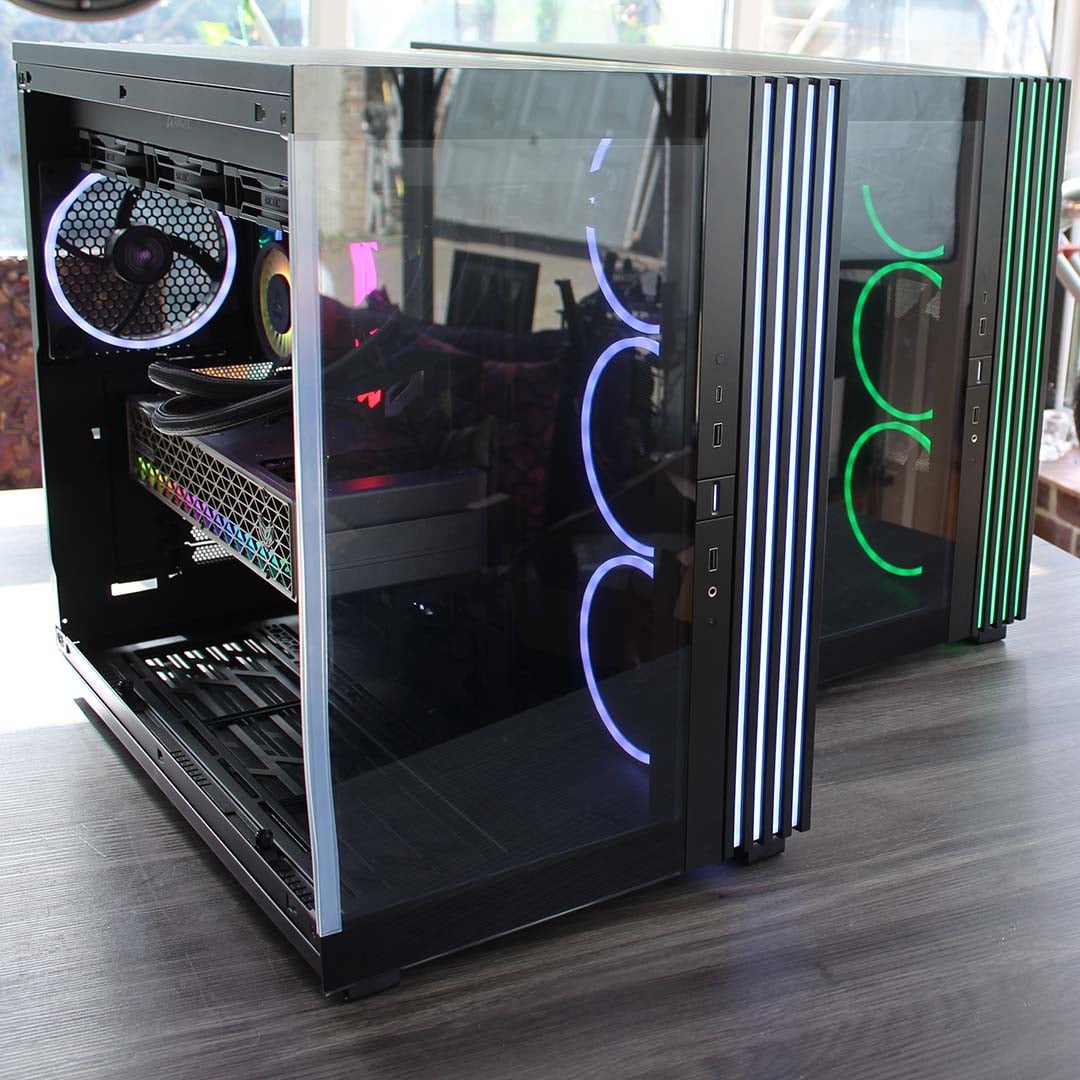
Our 9950X3D Test PCs
Club386 carefully chooses each component in a test bench to best suit the review at hand. When you view our benchmarks, you’re not just getting an opinion, but the results of rigorous testing carried out using hardware we trust.
Shop Club386 test platform components:
CPU: AMD Ryzen 9 9950X3D
Motherboard: MSI MEG X870E Ace Max
Cooler: Arctic Liquid Freezer III 420 Pro ARGB
GPU: Sapphire Nitro+ Radeon RX 9070 XT
Memory: 64GB Kingston Fury Renegade DDR5
Storage: 4TB Sandisk Optimus GX Pro 8100
PSU: be quiet! Dark Power 14 1,200W
Chassis: be quiet! Light Base 900 FX
The only change I’ve made to the specification list in the widget above for this review is the graphics card, swapping out our Radeon RX 9070 XT for a GeForce RTX 5090. While folks eyeing a 7700X3D aren’t likely to pair a 7700X3D with such an expensive pixel pusher, our interests lie in how much absolute performance the processor has to offer. As such, this amend is in service of eliminating any GPU bottlenecks, rather than creating a realistic rig.
Below you’ll find all our application benchmark charts, and there are plenty of gaming frame rates to parse too. The latter are all recorded at FHD (1920×1080) resolution, using each game’s High preset sans upscaling and frame generation.
App performance
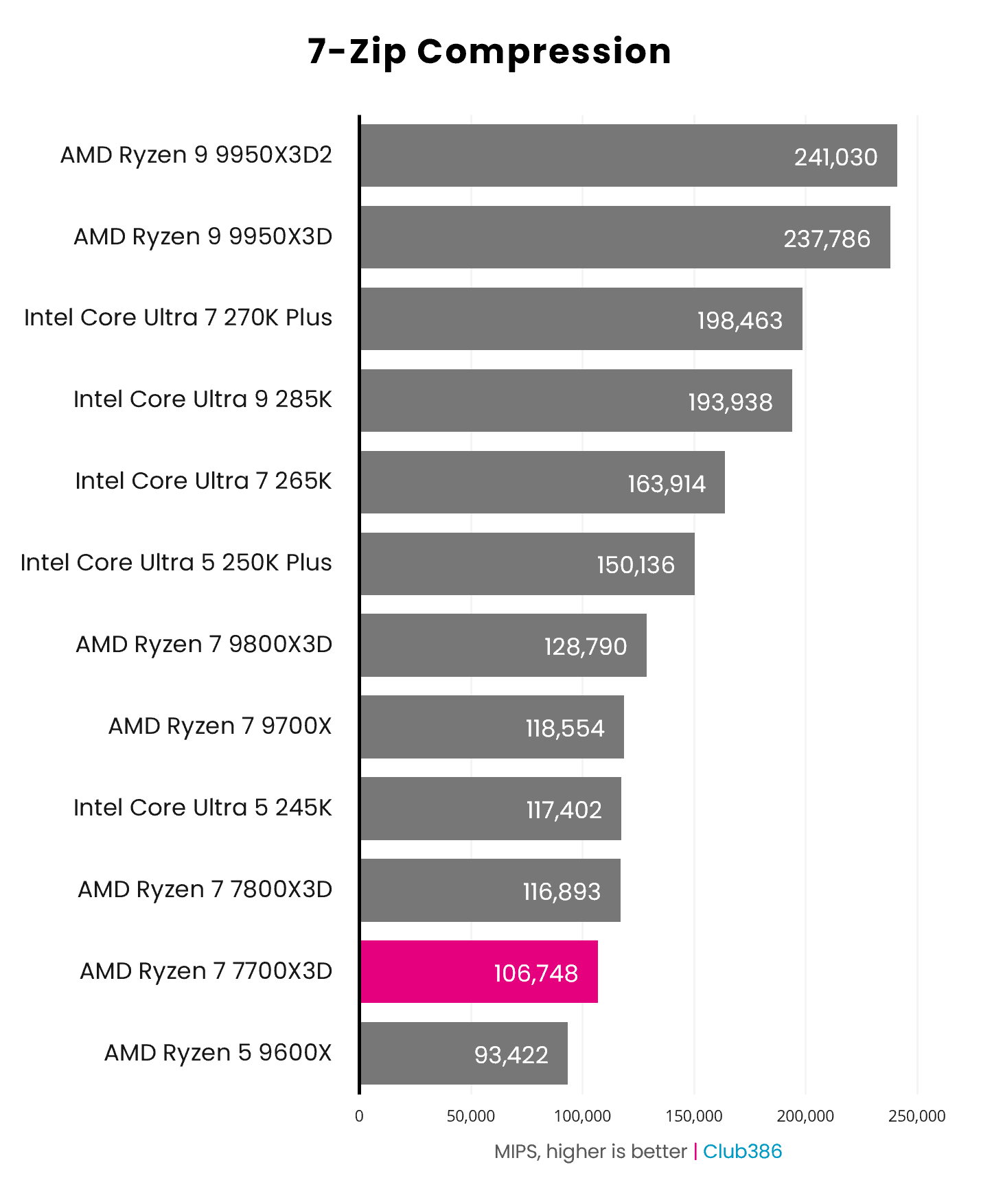
Running a 7-Zip compression workflow, the Ryzen 7 7700X3D manages to avoid the bottom of our chart by beating the Ryzen 5 9600X. However, relative to processors with eight or more cores at their disposal, the chip emerges the slowest of the bunch, with 106,748 million inputs per second. This score marks an 8.7% decrease from the 7800X3D.
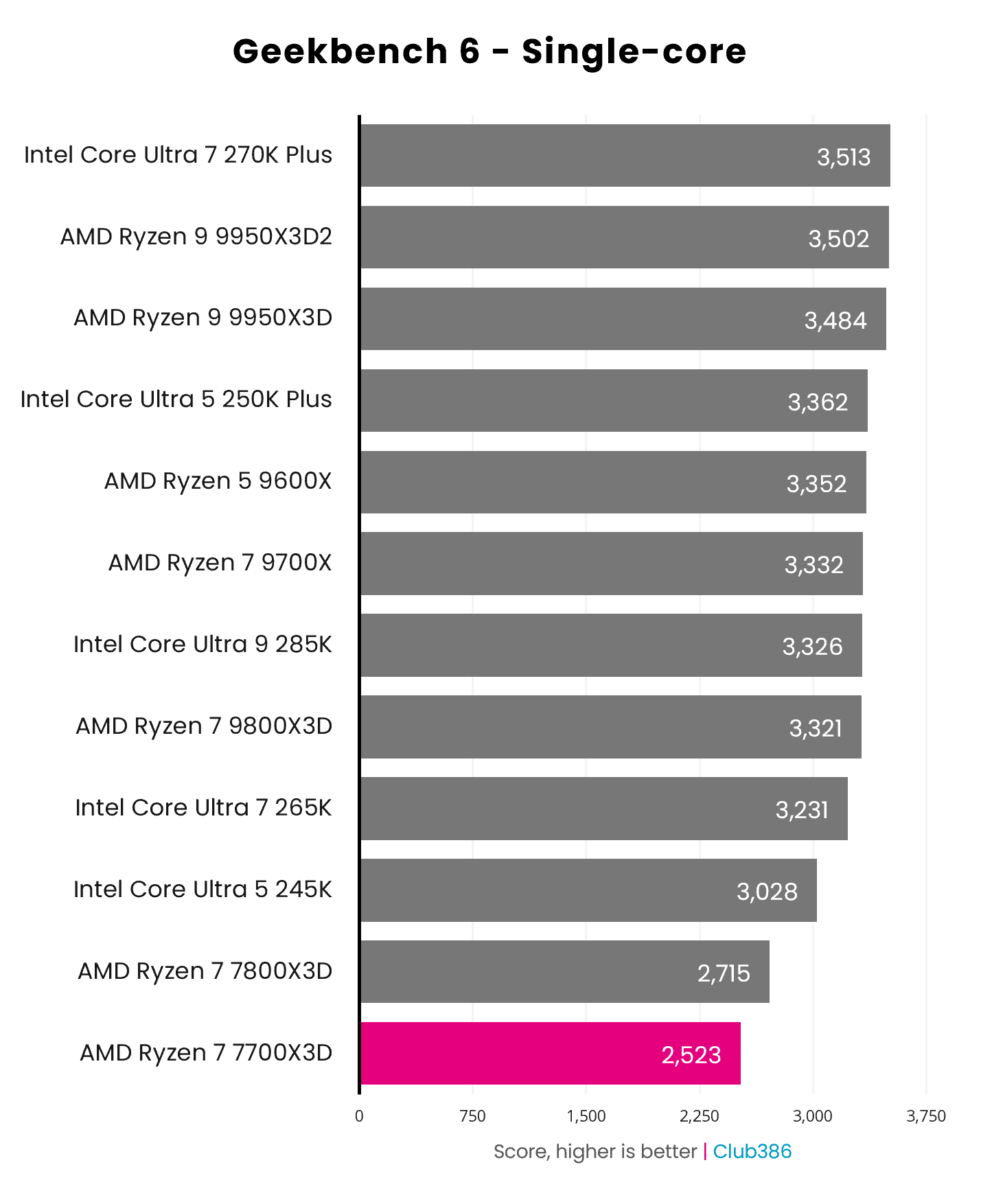
Given that the 7700X3D has the lowest maximum boost clock on the above chart, at 4.5GHz, it comes as no surprise to find the processor in last place in our Geekbench 6 single-core results. The 7800X3D doesn’t fare much better, but the newer chip is still 7.1% behind its older sibling.
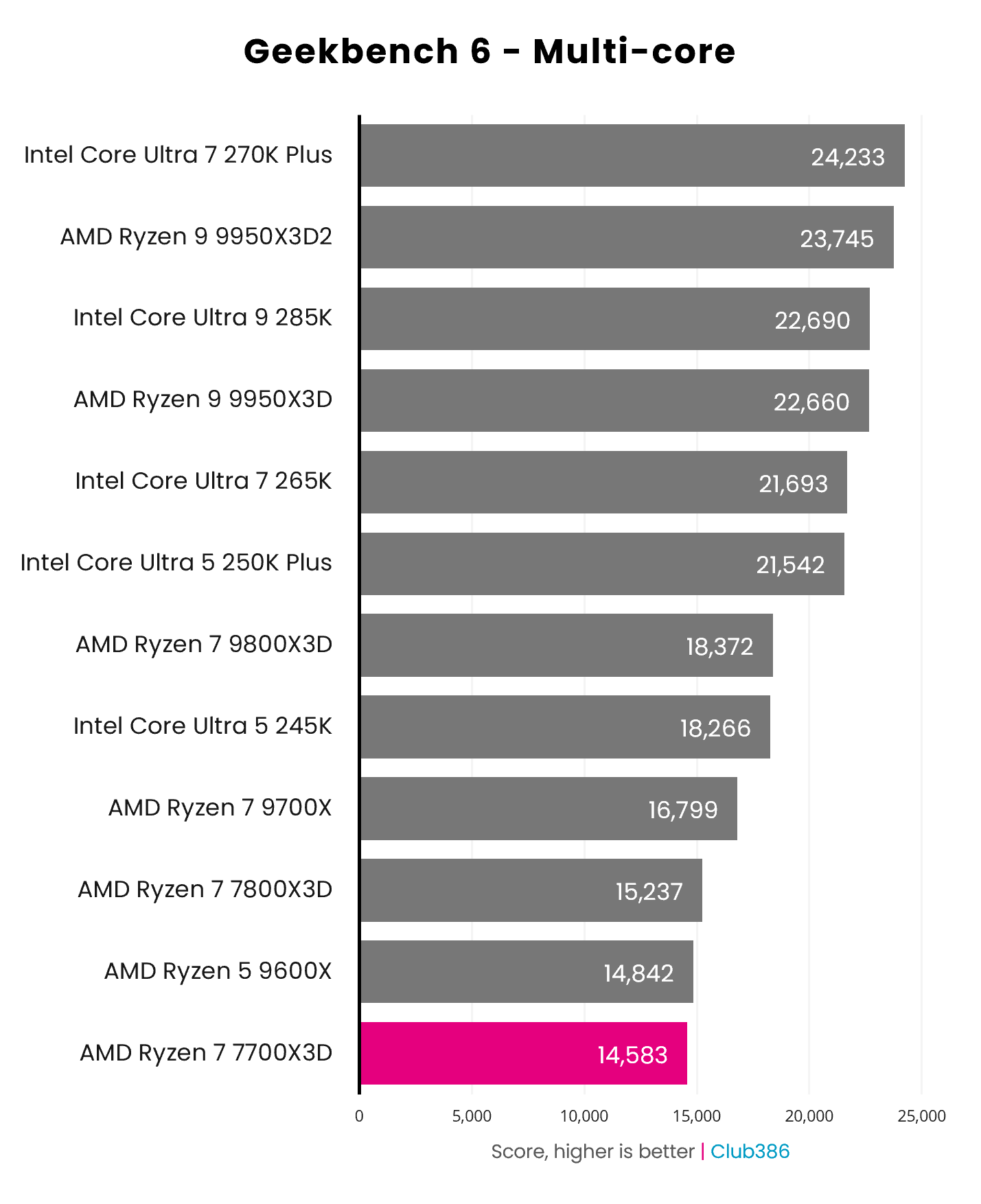
Despite having more cores and watts at its disposal than an AMD Ryzen 5 9600X, our 8-core 7700X3D can’t quite best the 6-core chip in Geekbench’s 6 multi-core test. This benchmark keenly highlights the advances in instructions per cycle (IPC) that Zen 5 chips offer relative to Zen 4, not forgetting the higher frequencies in play too. With a score of 14,583, it’s only 4.3% behind the 7800X3D.
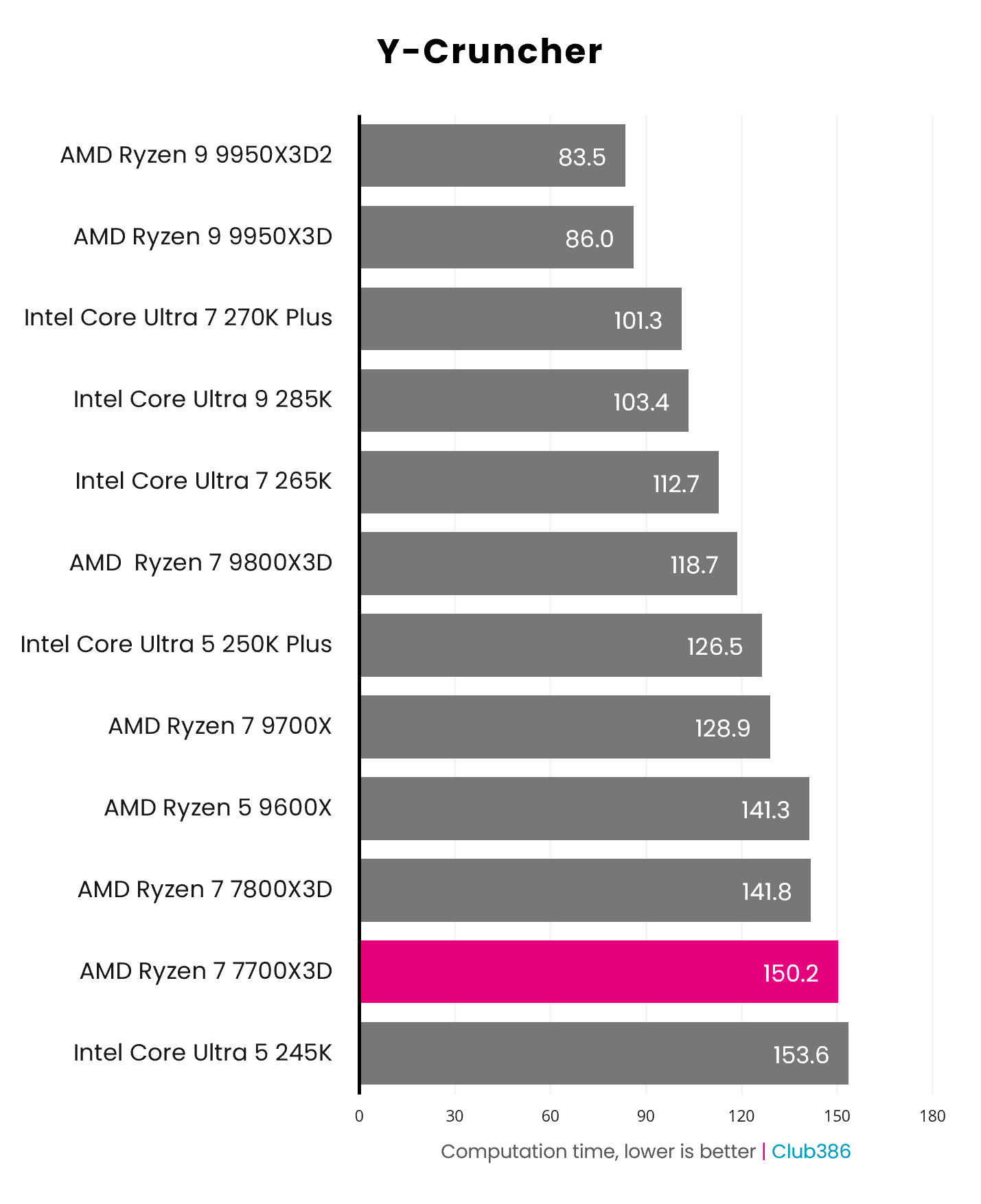
While it would certainly take me longer than 150.2 seconds to calculate Pi to five-billion digits, this result leaves the 7700X3D looking relatively slow compared to the majority of its peers, save the Core Ultra 5 245K. The 7700X3D is 5.6% slower than the 7800X3D in this task, which comes next on the chart, while chasing the coattails of the cheaper 9600X.
Content creation
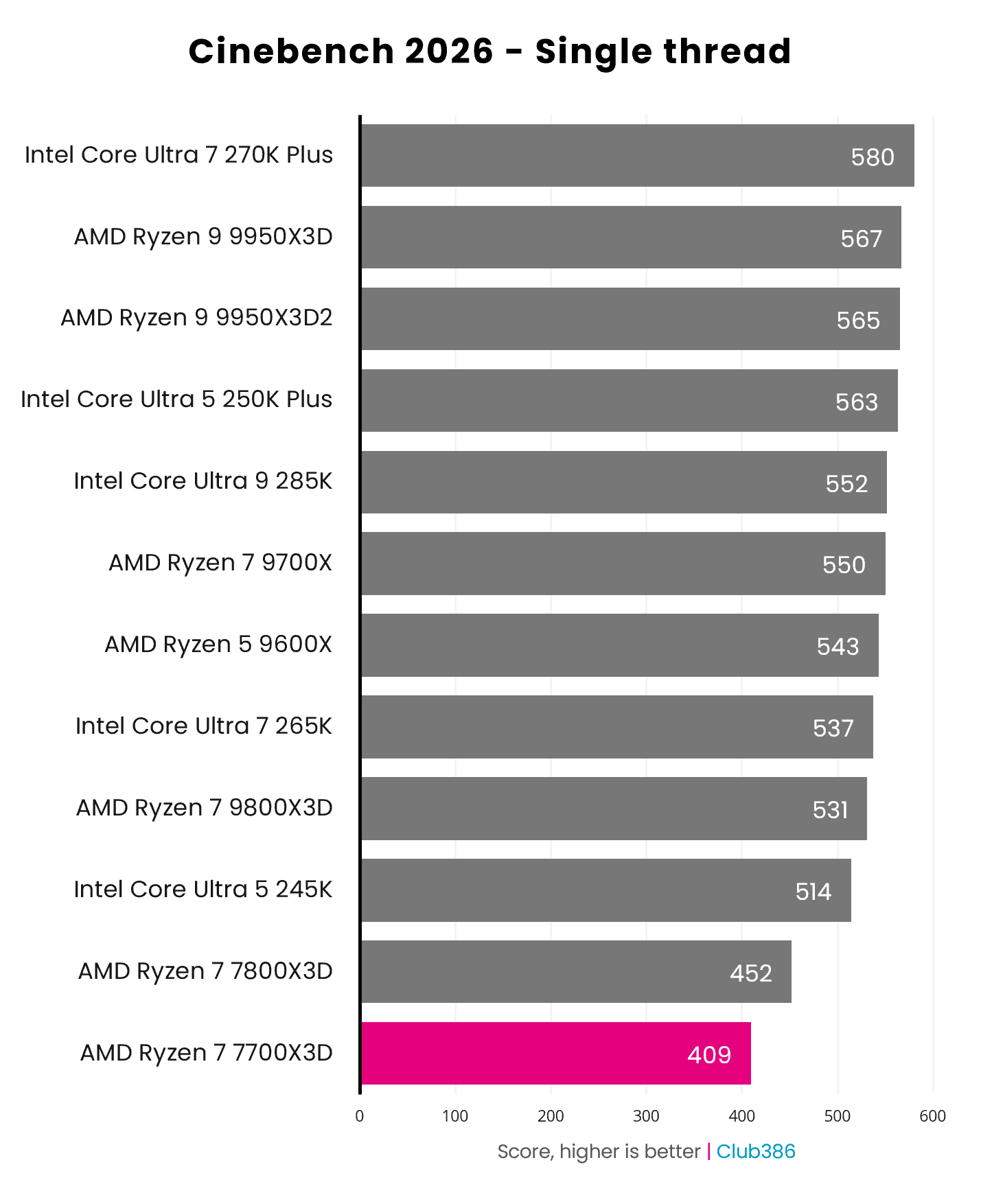
Shifting from general compute to content creation, Cinebench 2026 proves unkind to the 7700X3D, with a relatively measly single-threaded score of 409. That 500MHz frequency deficit relative to the 7800X3D clearly manifests in this test, falling behind the beefier chip by 9.5%. However, both processors are the only ones on the chart to achieve a result under 500 points.
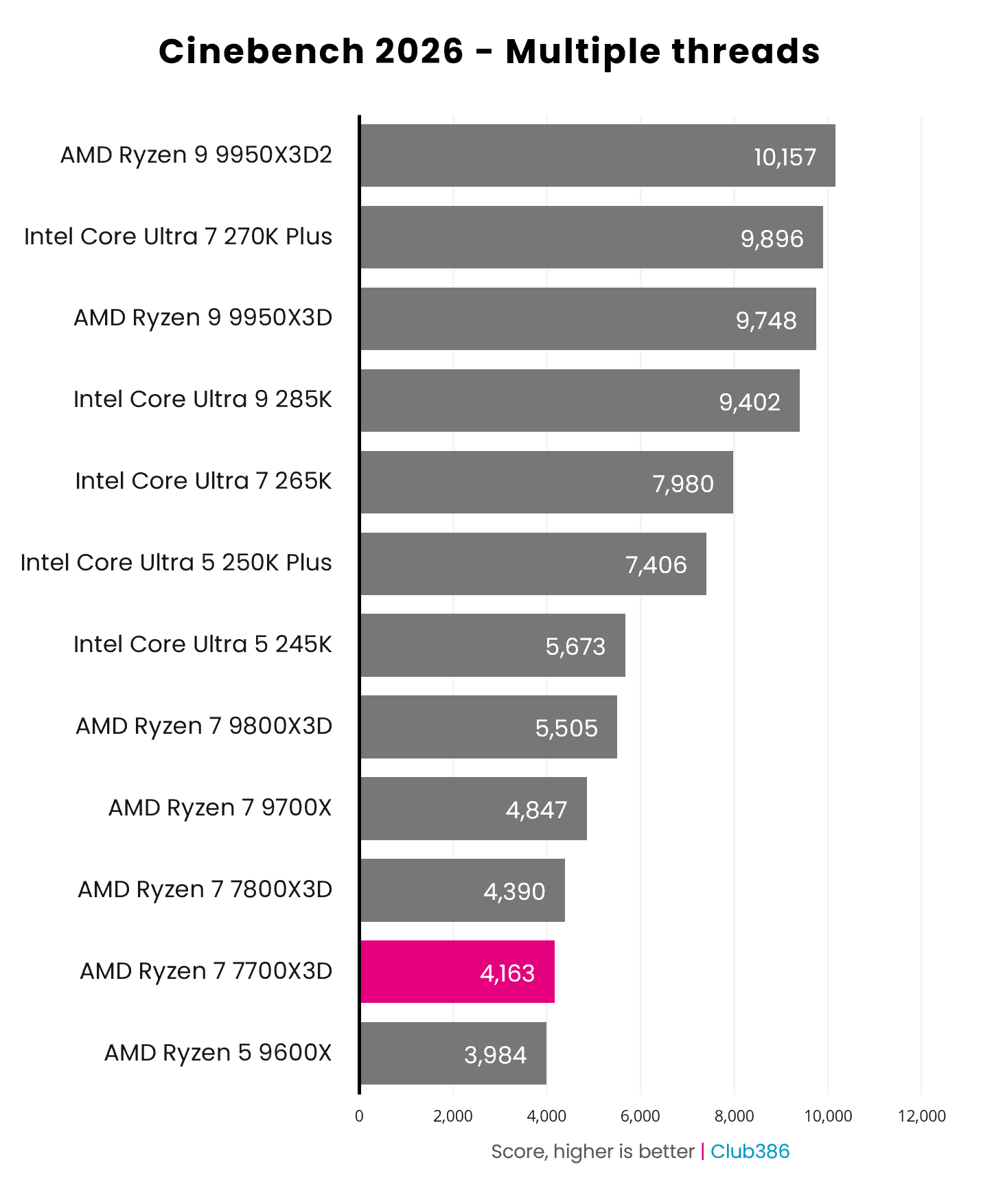
Engaging all eight of its cores in Cinebench 26’s multi-threaded test, the 7700X3D manages small win over the 9600X. One rung up the chart, the 7800X3D manages the same feat over the new chip, which sits 5.2% behind.
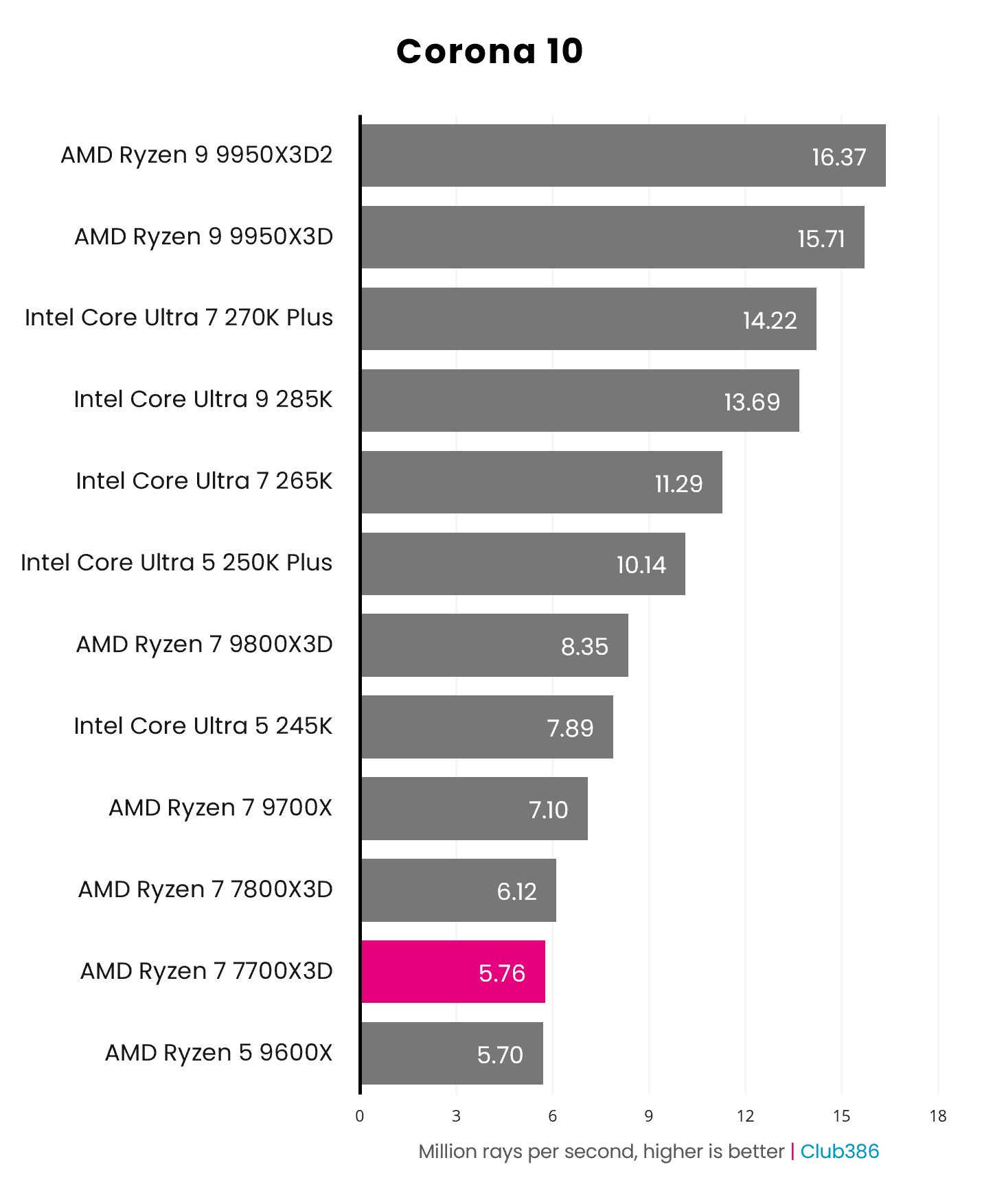
Switching rendering applications to Corona 10, the 7700X3D continues to demonstrate that its workstation qualities are starkly behind those of modern alternatives. Outputting 5.76M rays per second makes this processor 5.9% slower than the 7800X3D in this task.
Gaming
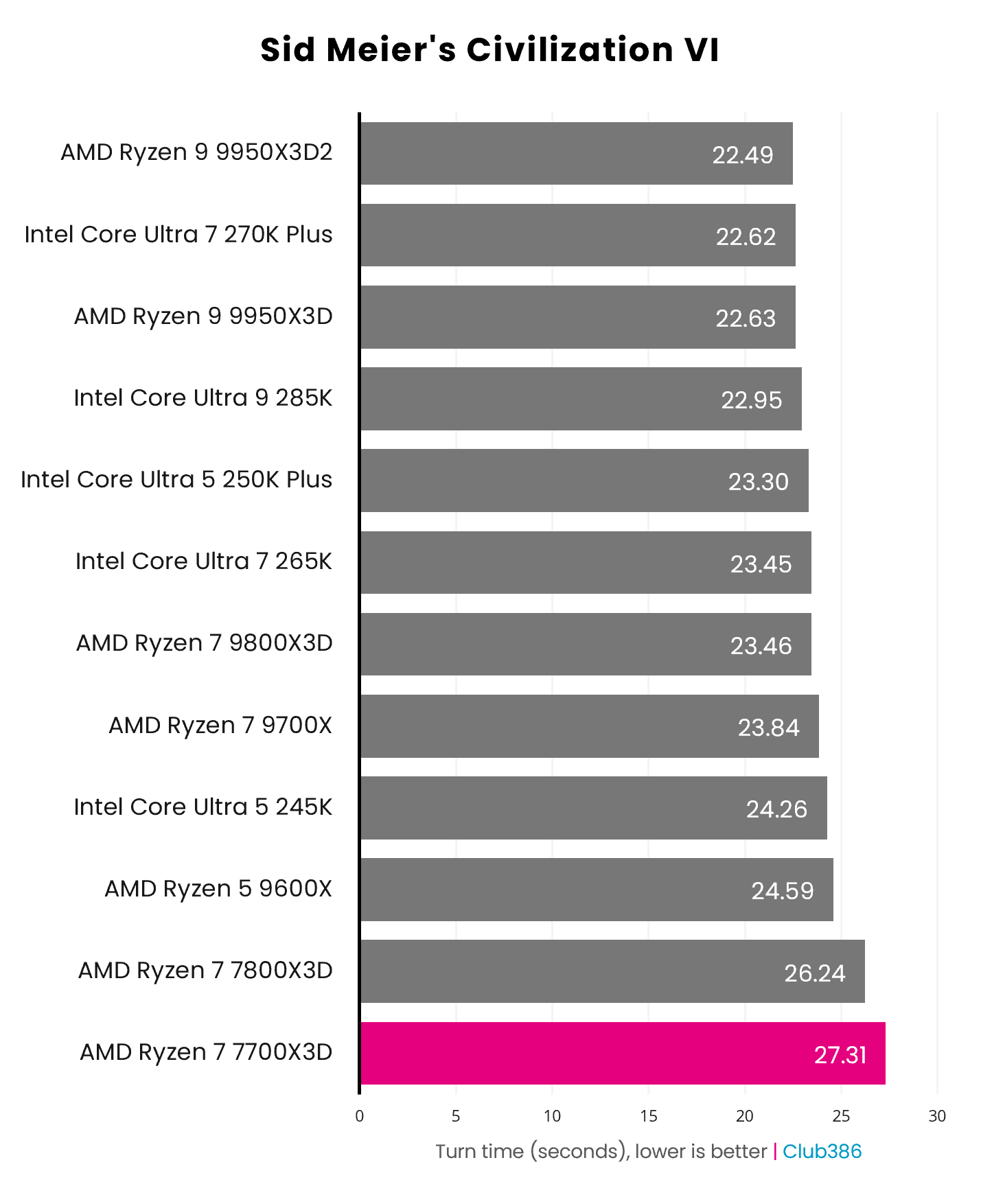
Sid Meier’s Civilization VI christens our voyage into gaming benchmarks, testing the computational chops of all our chips with the hefty Gathering Storm AI benchmark. Clock speeds and IPC are largely kings in this test, meaning the 7700X3D had little chance of placing anywhere else but bottom of the board, 4.2% behind the 7800X3D.
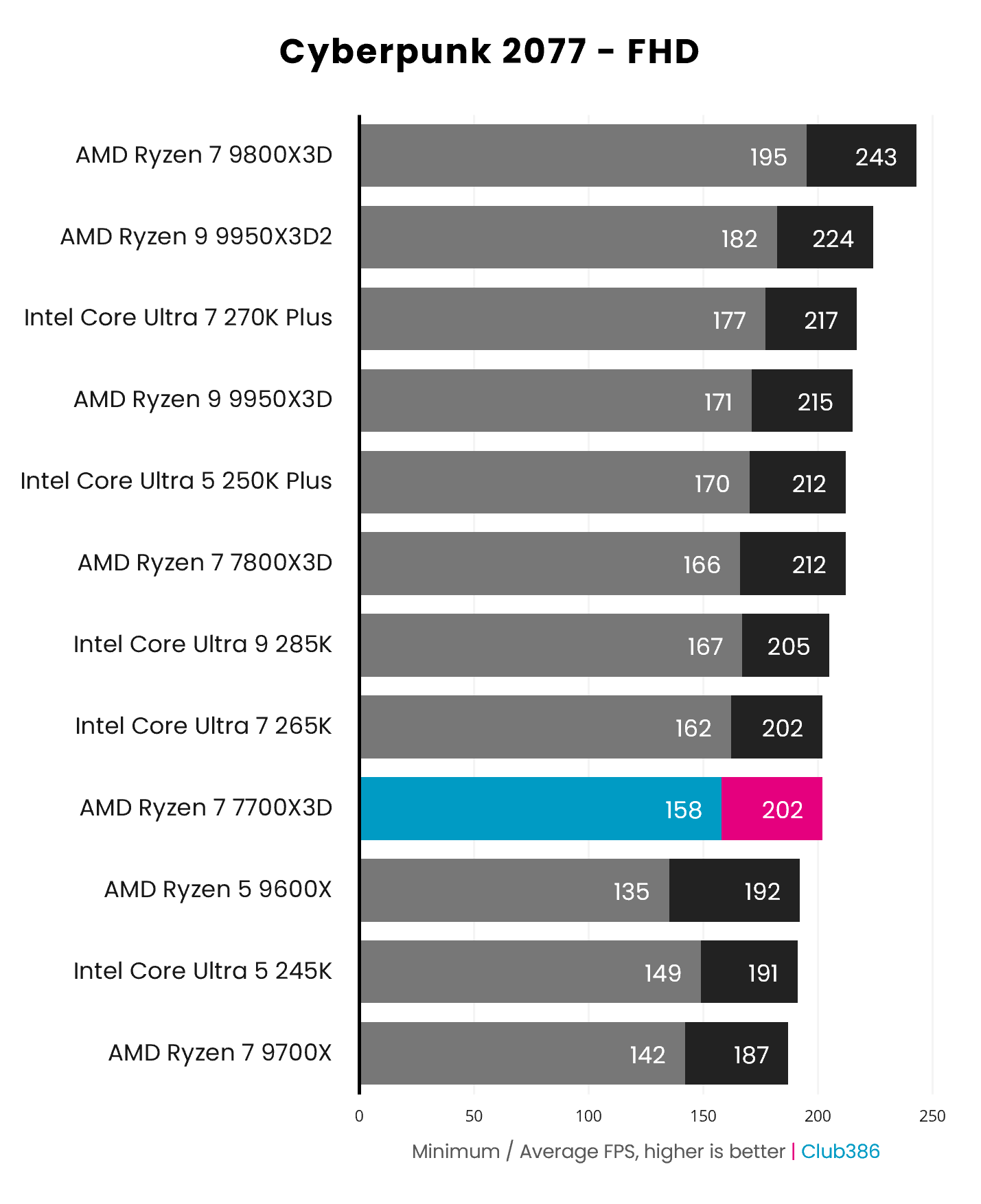
Cyberpunk 2077 gives us our first sign of how 3D V-Cache can improve performance. The 7700X3D frame rates best the Intel Core Ultra 245K, Ryzen 5 9600X, and Ryzen 7 9700X, despite the latter two chips boasting the greater IPC of AMD’s Zen 5 architecture. However, clock speeds still have their place in pushing performance, as results pale by 5% relative to the 7800X3D.
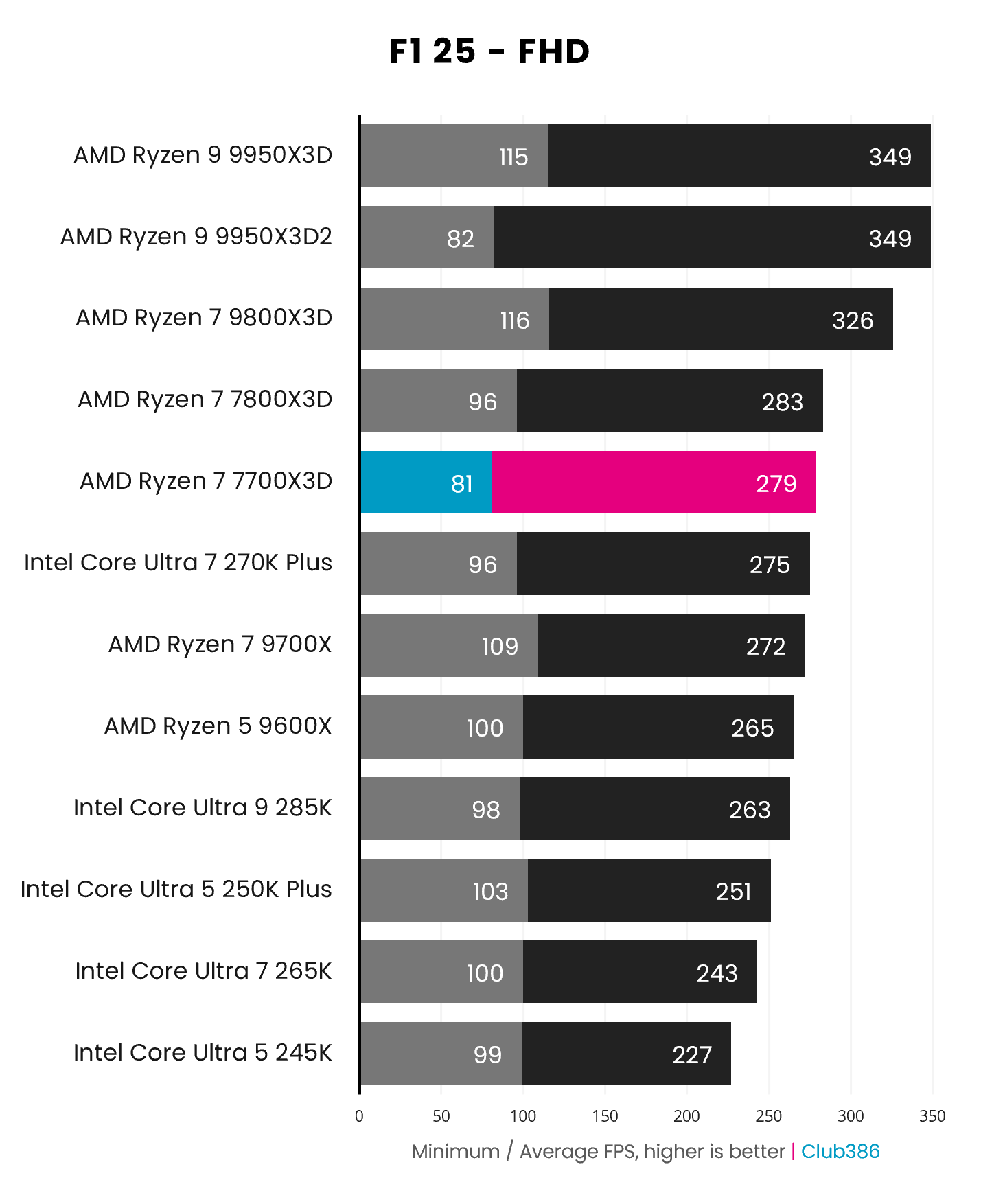
F1 25 is another game that benefits from 3D V-Cache, giving the 7700X3D its highest chart position thus far in our review. Moreover, the chip is within spitting distance of the 7800X3D, falling behind by a mere 1.4%. All that said, both the 9700X and 9600X aren’t far behind either Zen 4 X3D CPU, highlighting that loads of L3 cache isn’t always a silver bullet.
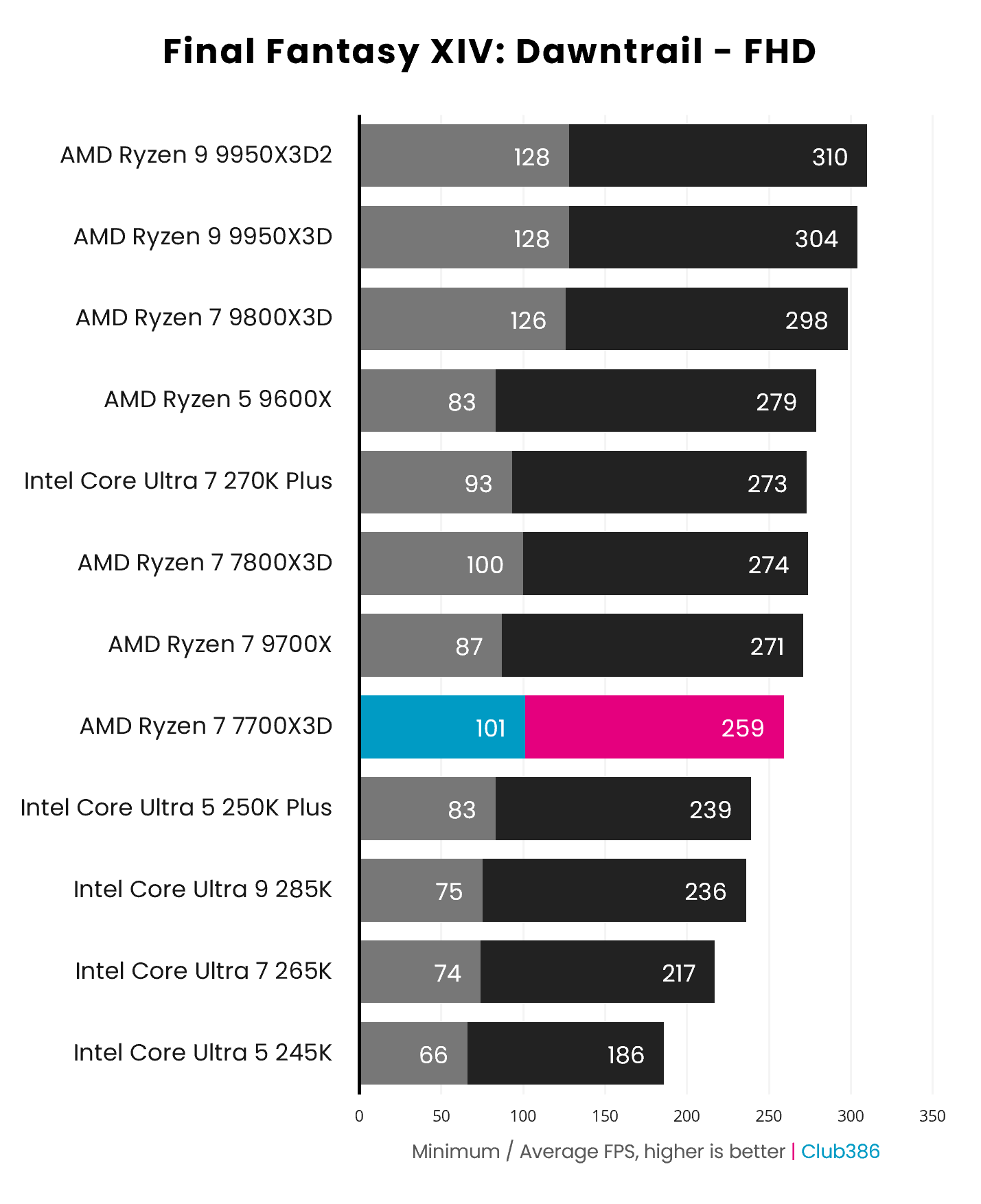
Final Fantasy XIV: Dawntrail furthers the notion that 3D V-Cache can only elevate frame rates so far, with clock speeds and IPC remaining an important part of determining performance. In the MMORPG, AMD’s 7700X3D manages a win over the majority of Intel chips, but falls behind both the 9700X and 7800X3D by 4.4% and 5.5%, respectively.
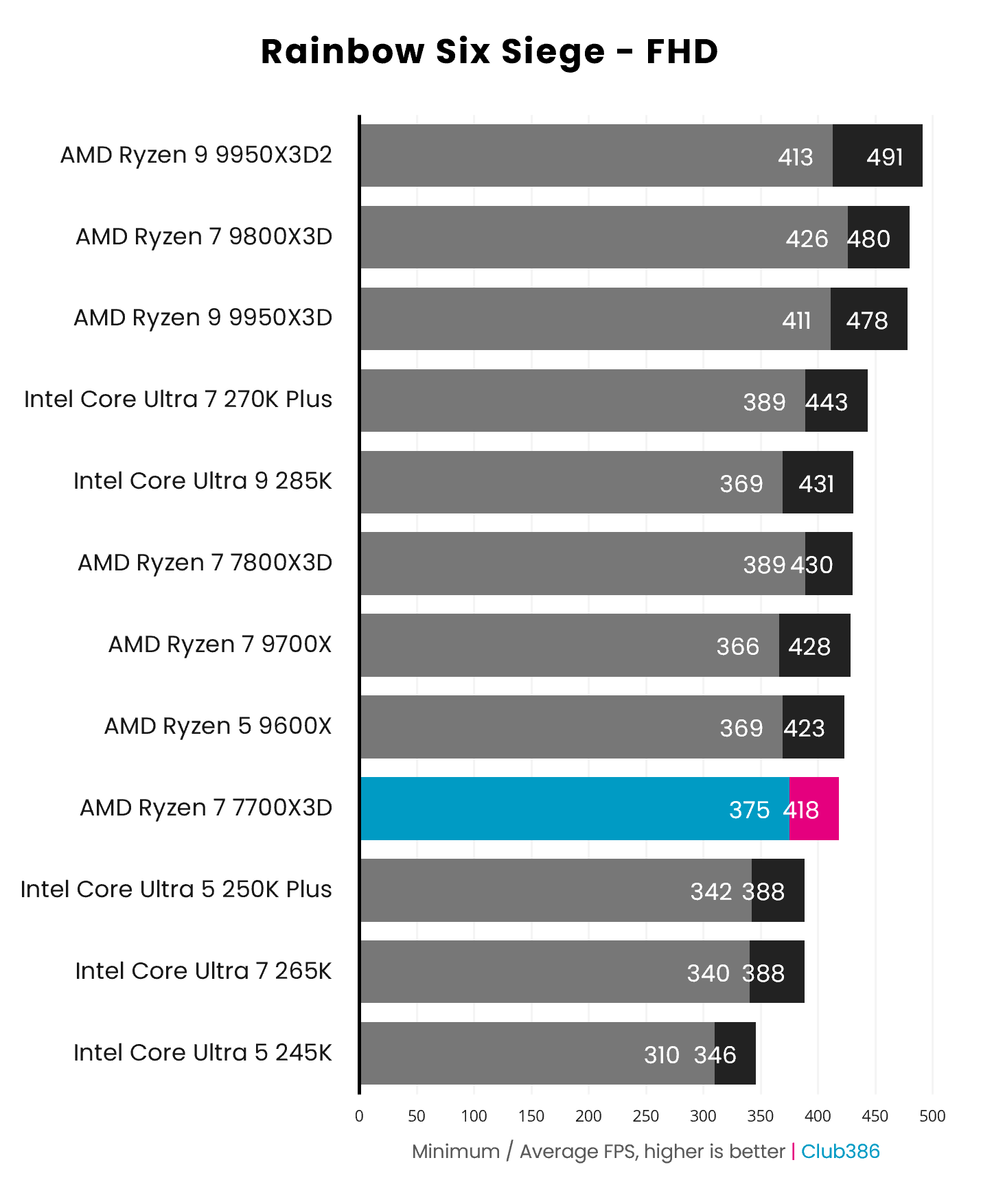
Rainbow Six Siege similarly showcases that 3D V-Cache isn’t the be-all and end-all for frame rates, much as performance in this competitive FPS does enjoy a serious boost from the tech. Our 7700X3D finds itself below the 9600X and 9700X, while higher clock speeds allow the 7800X3D to claw ahead of all three of these chips.
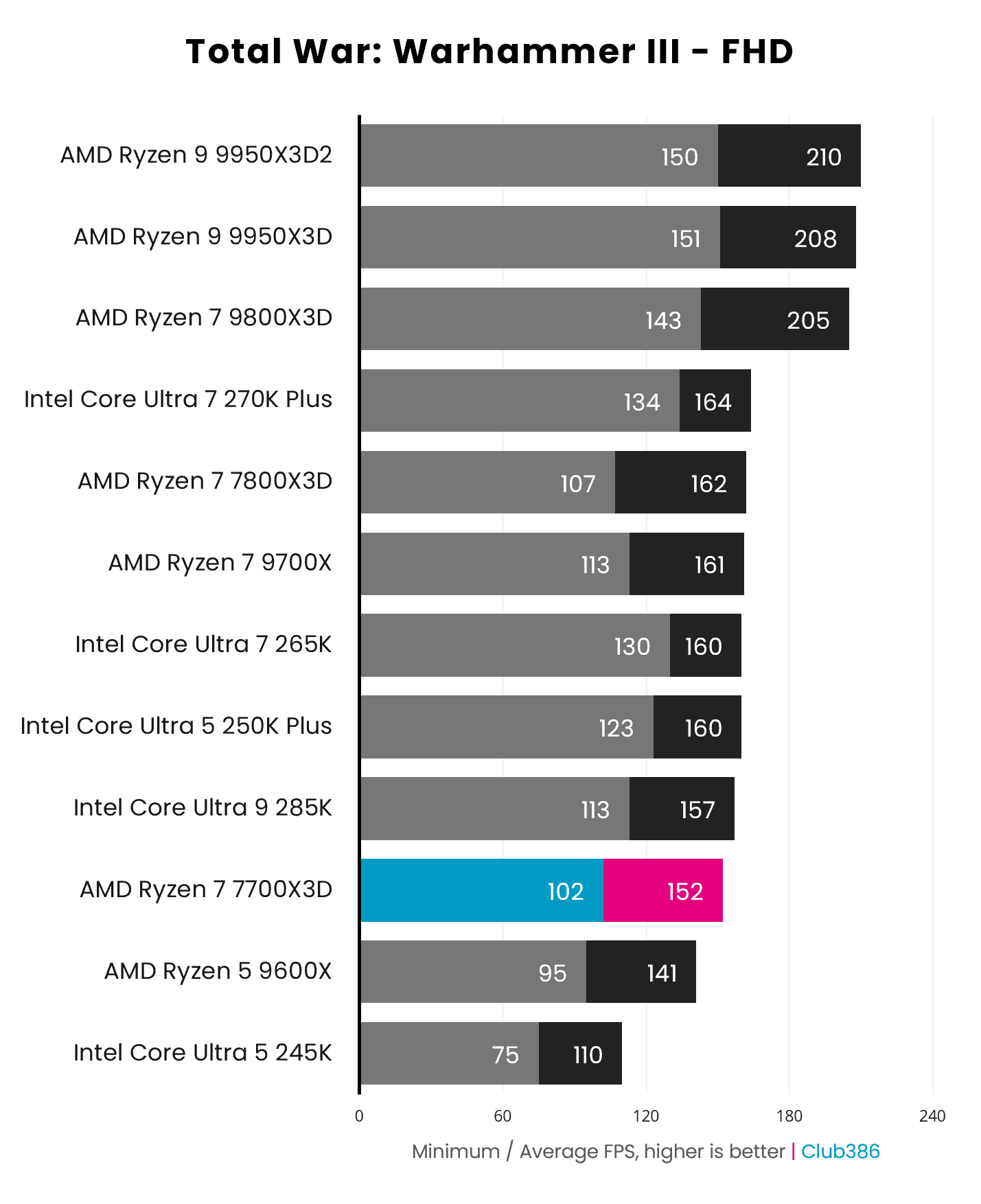
The story is much the same for the 7700X3D as we run Total War: Warhammer III’s Mirrors of Madness benchmark. Running this fantasy strategy game, the X3D CPU beats AMD’s Ryzen 5 9600X but is 6% behind the 7800X3D.
Power and temperature
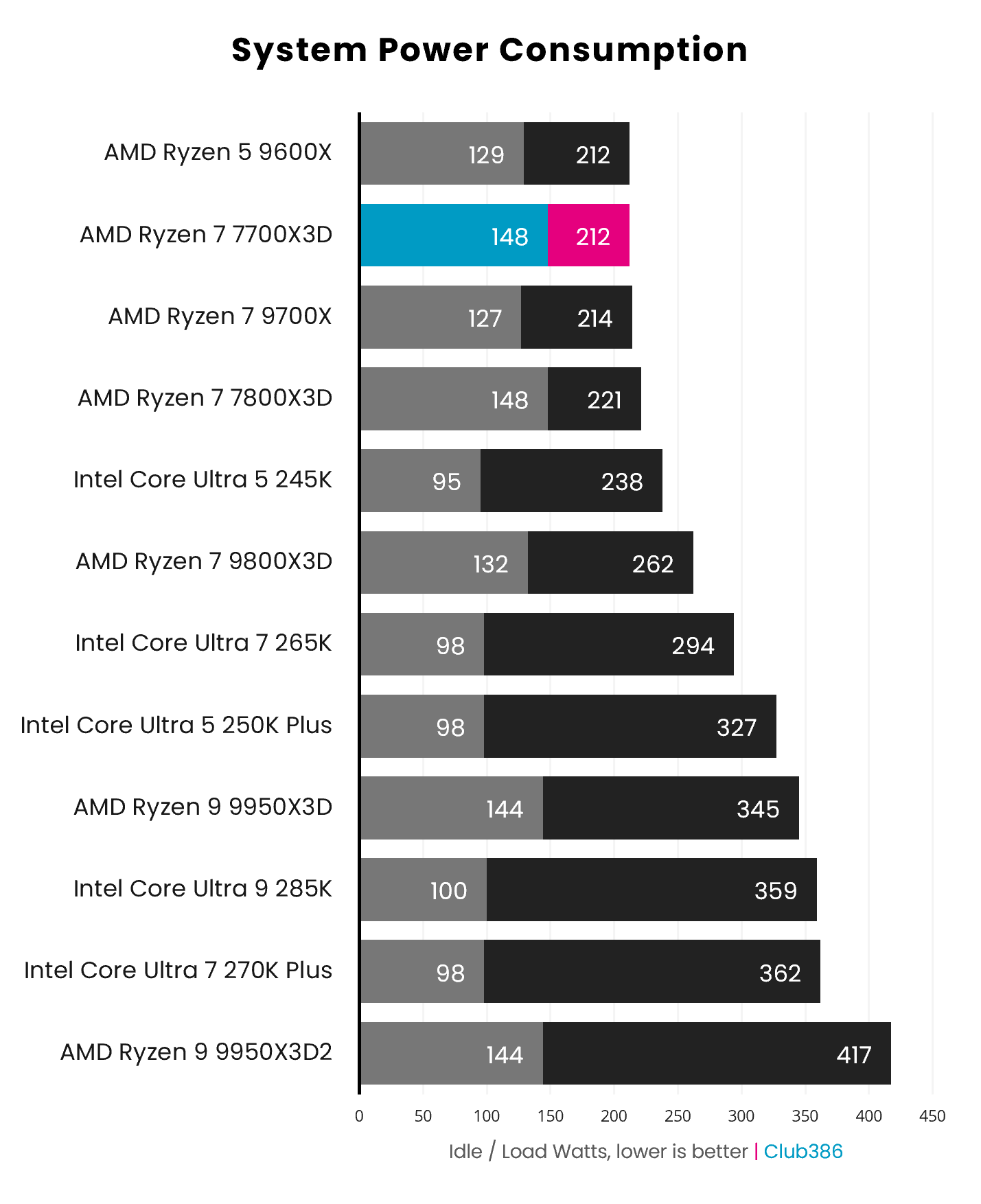
Credit where it’s due, the 7700X3D doesn’t ask for a massive amount of power under load. In our Cinebench 2026 multi-core benchmarks, our system pulled a reasonable 212W at most with the 7700X3D installed, closely matching AMD’s 9600X, 9700X, and 7800X3D. However, as we’ll explore shortly, raw watts from the wall doesn’t illustrate a processor’s whole story.
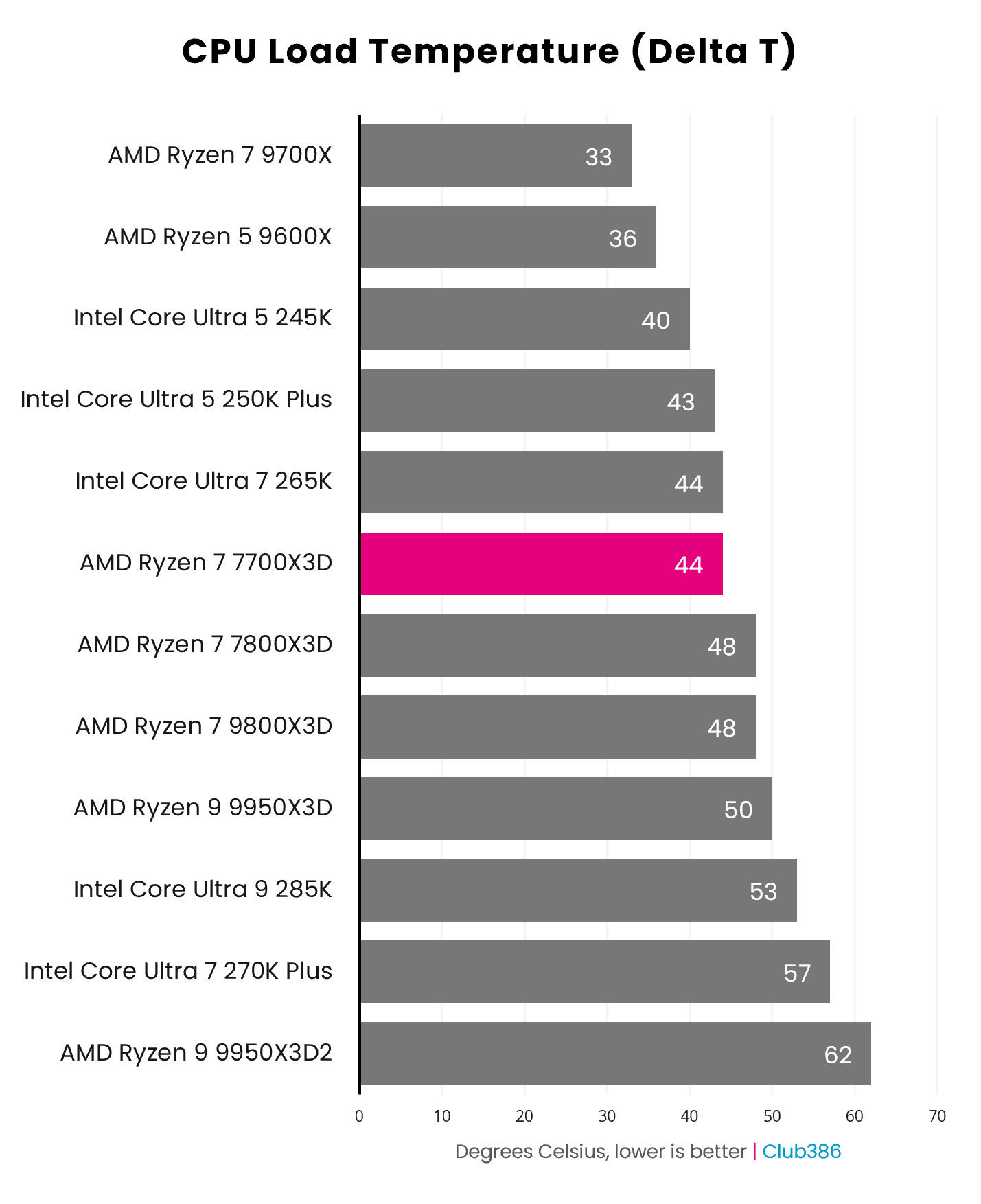
The 7700X3D faced the harshest ambient climate of any processor I’ve tested this year, with my office sitting at a cosy 25°C. Separating that value from the absolute core temperatures reported by our system, we arrive at the Delta T values above. At 44°C, this new X3D CPU runs moderately cool, sitting a few degrees cooler than the 7800X3D, but certainly not by an earth shattering degree.
Value
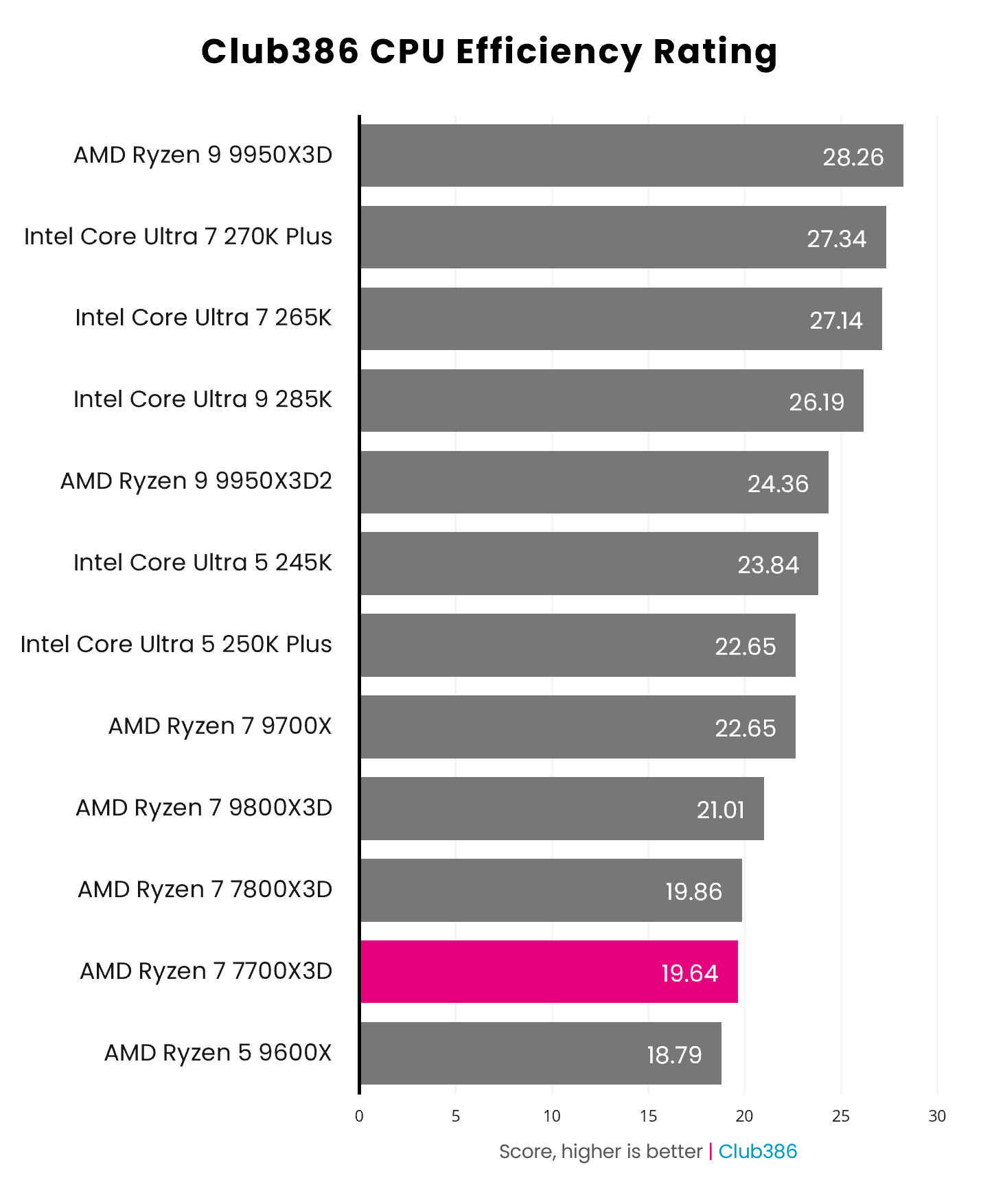
Dividing the 7700X3D’s multi-core Cinebench score (4,163) by its peak power consumption (212) provides us with our Club386 CPU Efficiency Rating. Those 212W sadly don’t go all that far in terms of workstation performance, scoring 19.64, but that’s only 1.1% behind the 7800X3D.
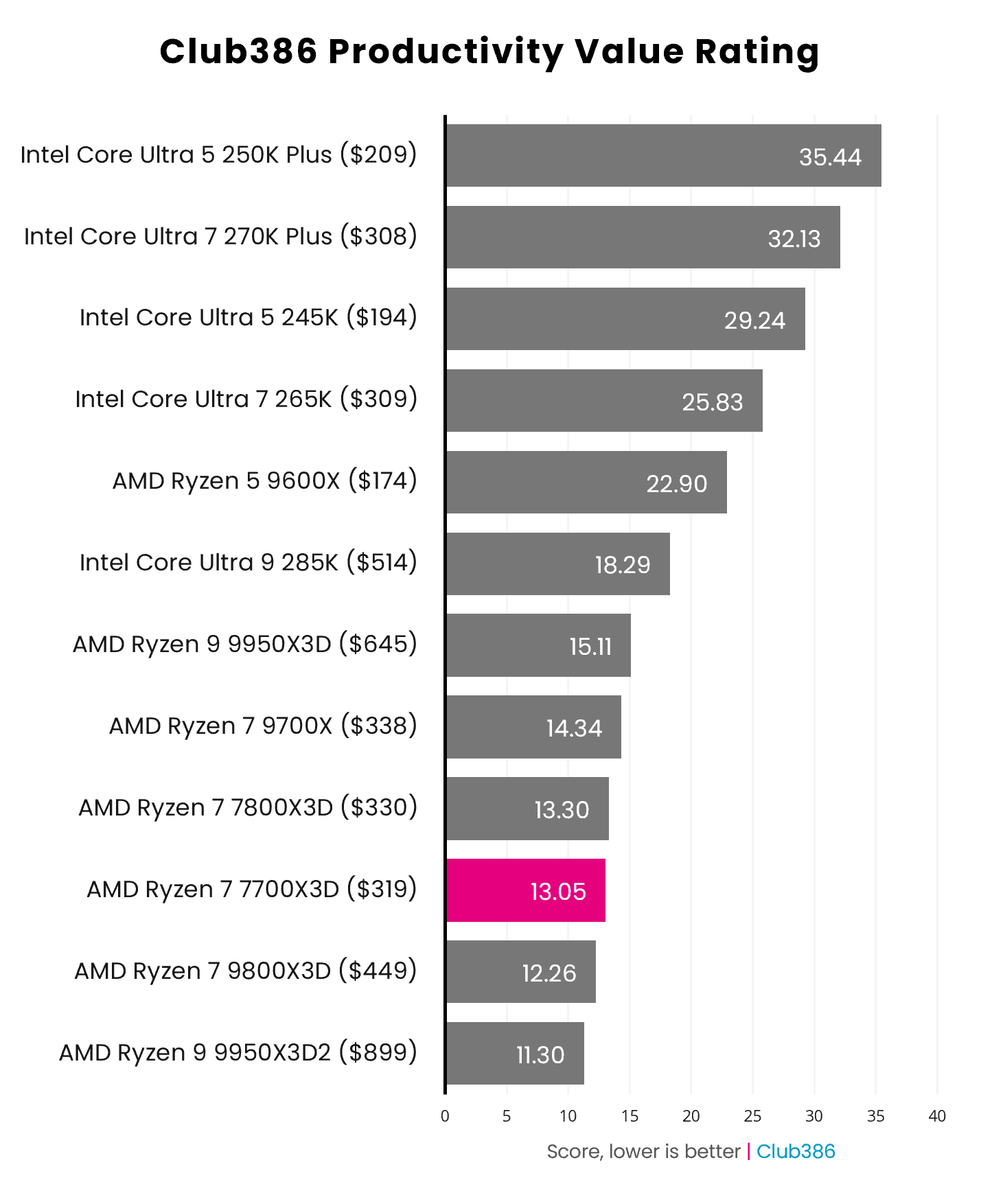
Taking that same Cinebench 2026 multi-core score but now diving by retail prices gives us the Club386 Productivity Value Rating. The AM4 CPU proves better value than both the Ryzen 9 9950X3D2 and Ryzen 7 9800X3D, but both are relatively poor in this respect. In this last shown, the 7700X3D’s value rating is 1.9% worse than that of the 7800X3D.
Conclusion
The AMD Ryzen 7 7700X3D offers little to celebrate in terms of workstation chops, but this processor still has decent gaming performance to offer, in large part thanks to the helping hand of 3D V-Cache. Relative to the 7800X3D, we found frame rates were up to 6% lower, which is an entirely agreeable reduction at the right price.
However, at $319, the 7700X3D simply doesn’t make economic sense, as you’re only saving 3.3% relative to the 7800X3D’s current price tag of $330. Should the latter processor’s cost increase, then opting for the cutdown X3D CPU makes more sense. For these prices to make sense, there should really be a $50 difference between the 7700X3D and 7800X3D.
More broadly, I’m confused as to who the 7700X3D is meant to service. The only folks that will see a meaningful upgrade from this chip are those with existing AM5 systems running a Ryzen 5 7600X or below, or those considering building a PC around the platform for the first time. I’d sooner suggest both parties save up for a more substantial leap via a 9800X3D if possible, or consider saving some cash via the 9600X, than take this route.
There are simply too many forces working against the 7700X3D to make this chip anything more than a processor worth considering, rather than an outright recommended purchase. The bones of a decent CPU are here, but the timing and pricing are well and truly offbeat.