
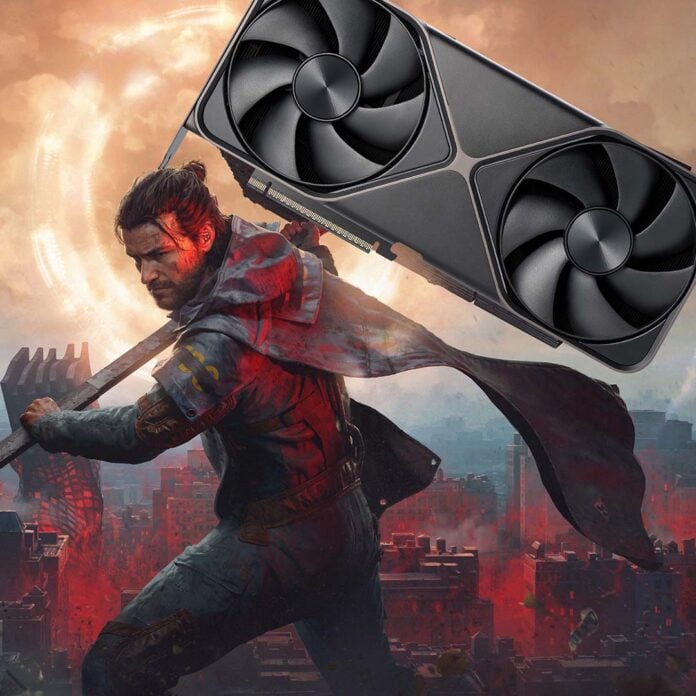
You’ll need the second-most powerful graphics card on the market, an Nvidia GeForce RTX 5080, to get Control Resonant looking and playing at its absolute best. If you’re short of such high-calibre hardware, though, the system requirements floor for the game is surprisingly low.
Control Resonant’s September 24 launch date is fast approaching, and now Remedy Entertainment has published official component recommendations, as well as the PC features supported by this game. The developer has shared three tiers each for both rasterised and ray traced settings, while highlighting full support for Nvidia DLSS 4.5 and AMD FSR 4.1.
Before we dive into individual tiers, let’s get some universal requirements out of the way. You’ll need 16GB of RAM across the board to play Control Resonant, regardless of settings, in addition to 120GB of space on an SSD. Lastly, the game will be playable on both Windows 10 64-bit and Windows 11.
Rasterisation
| Minimum (FHD / 30fps) | Recommended (QHD / 60fps) | Enthusiast (4K / 60fps) | |
|---|---|---|---|
| Graphics preset | Low | Medium | High |
| RT preset | Off | Off | Off |
| Upscaler preset | Quality | Balanced | Performance |
| GPU | Nvidia GTX 1070 AMD RX 5600 XT Intel Arc A580 | Nvidia RTX 3060 Ti Radeon RX 6700 XT Intel Arc B580 | Nvidia RTX 3080 AMD RX 6800 XT |
| VRAM | 6GB | 8GB | 10GB |
| CPU | Intel Core i5-8500 AMD Ryzen 5 3500 | Intel Core i7-10700 AMD Ryzen 7 3700X | Intel Core i7-10700 AMD Ryzen 7 3700X |
Starting from the bottom up, the beloved but aged GeForce GTX 1070 has enough horsepower to run Control Resonant at 1080p/30fps, using the game’s Low graphics preset, without ray tracing. Importantly, this is while using a Quality upscaling preset, presumably with FSR 3.1 as neither that graphics card, nor the Radeon RX 5600 XT or Arc A580, support either DLSS 4.5 or FSR 4.1 upscaling. As a general rule of thumb, though, you’ll need a GPU with 6GB of VRAM.
Moving up to 1440p/60fps and a Medium graphics preset necessitates a huge leap in pixel pushing performance and higher levels of upscaling, shifting now to Balanced mode. A GeForce RTX 3060 Ti sets the floor here, joined by a Radeon RX 6700 XT or Arc B580, while video memory requirements rise to 8GB. You’ll also need more processing power at your disposal, with Remedy asking for a Core i7-10700 or Ryzen 7 3700X at minimum, rising up from the Core i5-8500 and Ryzen 5 3600 from the previous tier.
Pushing to 4K/60fps with High settings doesn’t require as large a jump as you might think, though Performance-level upscaling certainly helps lighten the rendering load. Processor recommendations remain the same as at the previous tier, and we’re still dealing with Ampere and RDNA 2 GPUs. This time it’s up to the RTX 3080 and RX 6800 XT to foot the bill, alongside a new 10GB VRAM floor.
Overall, these are relatively modest system requirements given the age of the hardware Remedy Entertainment is requesting. Even at the highest tier, we’re talking about graphics cards that are approaching their sixth year of service and processors that are similarly old. Suffice to say, many modern GPUs and CPUs should have little problem meeting the challenges of Control Resonant. I’d wager a modest mid-range combo of a Ryzen 5 7600 and GeForce RTX 5070 would be more than up to the task.
Ray tracing
| RT Minimum (FHD / 30fps) | RT Recommended (QHD / 60fps) | RT Enthusiast (4K / 60fps) | |
|---|---|---|---|
| Graphics preset | Low | Medium | High |
| RT preset | Low | Medium | High |
| Upscaler preset | Quality | Balanced | Performance |
| GPU | Nvidia RTX 2060 Super AMD RX 6600 Intel Arc A580 | Nvidia RTX 4070 Ti AMD RX 9070 | Nvidia RTX 5080 |
| VRAM | 8GB | 10GB | 12GB |
| CPU | Intel Core i7-8700K AMD Ryzen 5 3600X | Intel Core i7-10700 AMD Ryzen 7 3700X | Intel Core i7-10700 AMD Ryzen 7 3700X |
Ray tracing naturally necessitates a shift from GTX to RTX, with a GeForce RTX 2060 Super and 8GB of VRAM headlining the RT Minimum tier (1080p/30fps), alongside a Radeon RX 6600 and Arc A580. We’re using the same graphics and upscaler presets as the prior rasterised trio, as is the case for recommended and enthusiast tiers. Note the small increase in CPU requirements relative to raster, with a Core i7-8700K and Ryzen 5 3600X setting the floor.
Intel misses out on getting RT Recommended (QHD/60fps) status on the GPU front, but this is no surprise considering Remedy calls for a GeForce RTX 4070 Ti or Radeon RX 9070 to fit this bill, and there’s no Arc card that can compete with either. VRAM requirements increase to 10GB, while the Core i7-10700 and Ryzen 7 3700X return to processing duties.
Those intent on maximising graphical fidelity at the RT Enthusiast (4K/60fps) tier will need to settle for nothing less than a GeForce RTX 5080, despite these settings only requiring 12GB of VRAM. According to the most-recent Steam Hardware Survey, that encompasses less than 3% of the storefront’s user base, making this a highly exclusive club.
While Control Resonant does support frame generation, the developer says it curated these performance targets and system requirements without using the feature. This is pleasing to hear – after all, if you can only hit 30fps (or even 60fps) with frame gen, the game would feel awful to play on account of high latency.
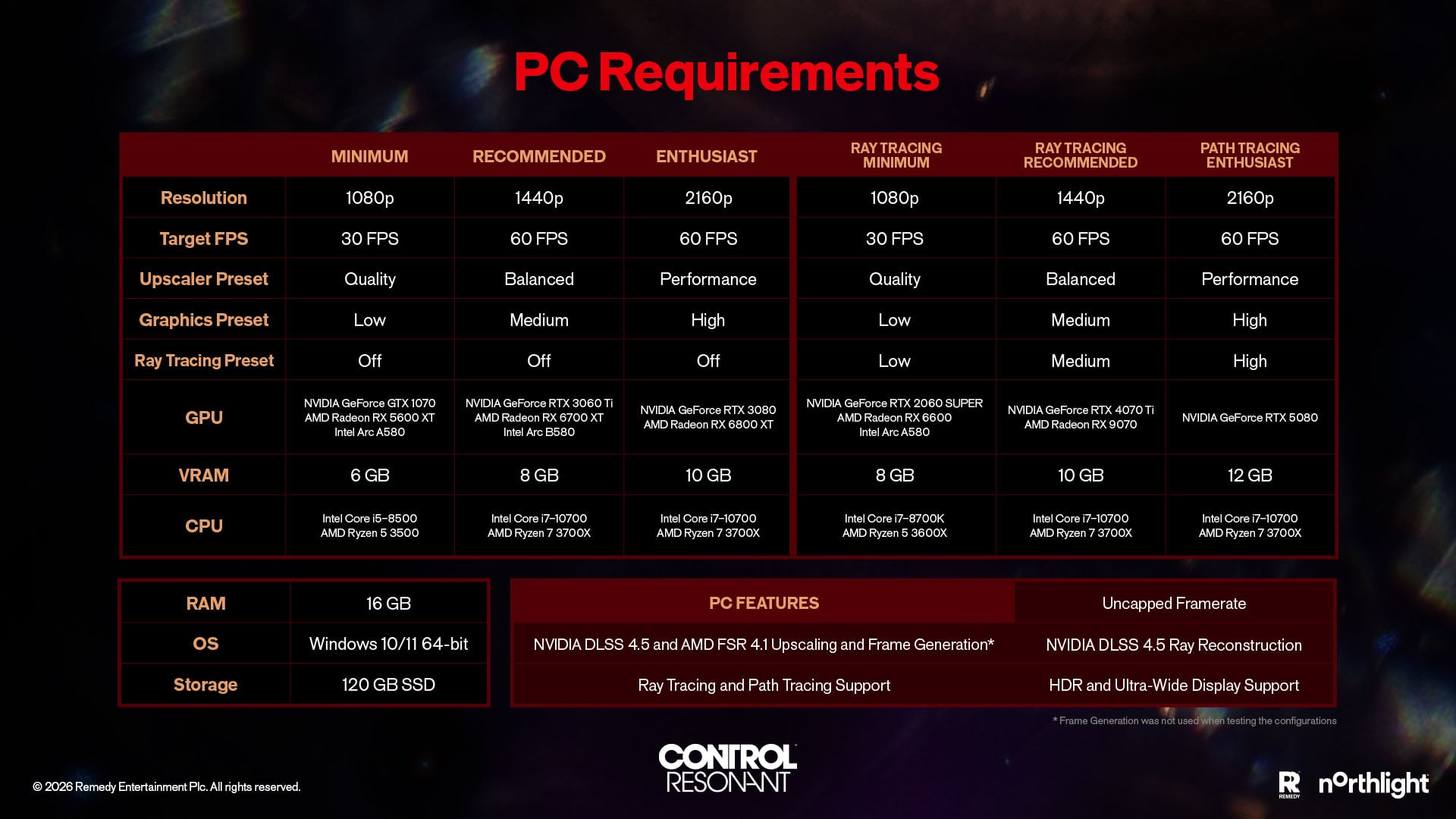
There’s no mention of ultrawide resolutions in these specs lists, but the game does support this form factor. That’s in addition to uncapped frame rates and HDR. If you’re after a GPU upgrade after reading these system requirements, check out our picks of the best graphics cards you can buy today.