
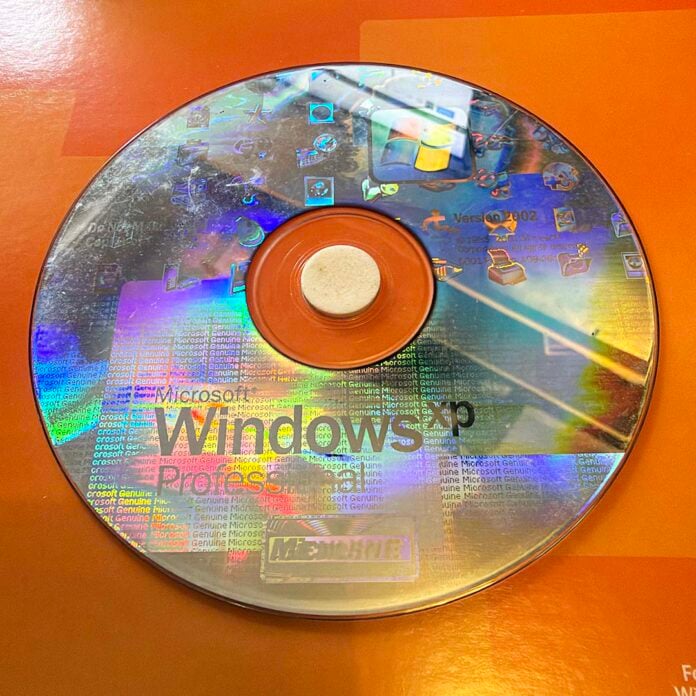
It’s the code that launched thousands of dodgy Windows XP installations, often written on the front of pirate CD-Rs in marker pen. If you hadn’t bought your own legitimate version of Microsoft’s venerable OS in the early noughties, you could always illegally copy it off a friend and punch in the well-known code that everyone in the business knew, sometimes off by heart.
That code was FCKGW-RHQQ2-YXRKT-8TG6W-2B7Q8, and we now know some of the story behind it. Microsoft’s former primary author of Windows Product Activation, Dave W Plummer, has just shared an epic post with the details on social media platform X. It turns out that this legendary key may well have been leaked by someone at Dell or Intel, and that the operating system’s key validation tech involved Microsoft Bob of all things.
Pump up the Volume
Plummer says that Microsoft developed two types of key – one for retail CDs, and one for volume installations at big businesses. “Those customers did not want to have to activate every offline PC,” explains Plummer. “So in that case, you would be given special ‘Volume Media’ that could be unlocked with a Volume key.”
The problem is that it’s one of the latter that leaked, meaning anyone with the OS and the key could install and activate their copy of Windows. “The key itself still had to pass the product-key validation math,” says Plummer. “Once it did, WPA simply skipped the rest of the process. That combination – valid VLK + matching volume media – is what made the install look fully legitimate, including early Windows Update checks.”
So what happened? Plummer recalls that the OS was sent to manufacturing partners on 24 August 2001, well before the retail launch was planned on 25 October the same year. In that interim period, the warez group DevilsOwn, leaked a whole ISO of Windows XP Pro Corporate that could be directly written to a CD, along with the famous FCKGW key.
That happened five weeks after the OS was sent to Microsoft’s corporate system builder partners, and well before the retail release. This leads Plummer to believe that “the most plausible source is an OEM or hardware partner that received final media early so they could ship PCs on launch day.”
Was it Dell or Intel?
Any names? “Dell is the name that comes up most often,” he says, adding that “Intel has also been mentioned because of later source dump.” Importantly, Plummer says that there were “very few organizations that actually possessed a VLK that early, which is why the timing points at a partner rather than a random corporate customer.” Basically, it was probably leaked by someone at a very big tech firm.
Interestingly, Plummer also shared some of the inner workings of the Windows Volume activation process. That FCKGW code doesn’t work on a retail Windows XP disc, and that’s because it doesn’t have the 10MB block of entropy-stripped data that Plummer made sure was on Volume Windows install discs.
“That secret data, which I hashed and checked to match to the key, was Microsoft Bob. I took their disc data and compressed and encrypted it several times.” In case you’re unfamiliar with your Microsoft history, Bob was a piece of software designed to make early versions of Windows more easily usable, with a patronising cartoon interface that saw you clicking around a living room. It flopped dramatically, but it turns out you still had a copy of it on your disc if you owned a Volume installer, or indeed the pirate version.
“The operational failure was that the media and one of those keys left the building before the product even reached stores,” says Plummer. “Once both pieces were public, WPA’s hardware-binding never got a chance to run.” In case you’re wondering what Dave Plummer is doing now, check out his Task Manager for MacOS project.