
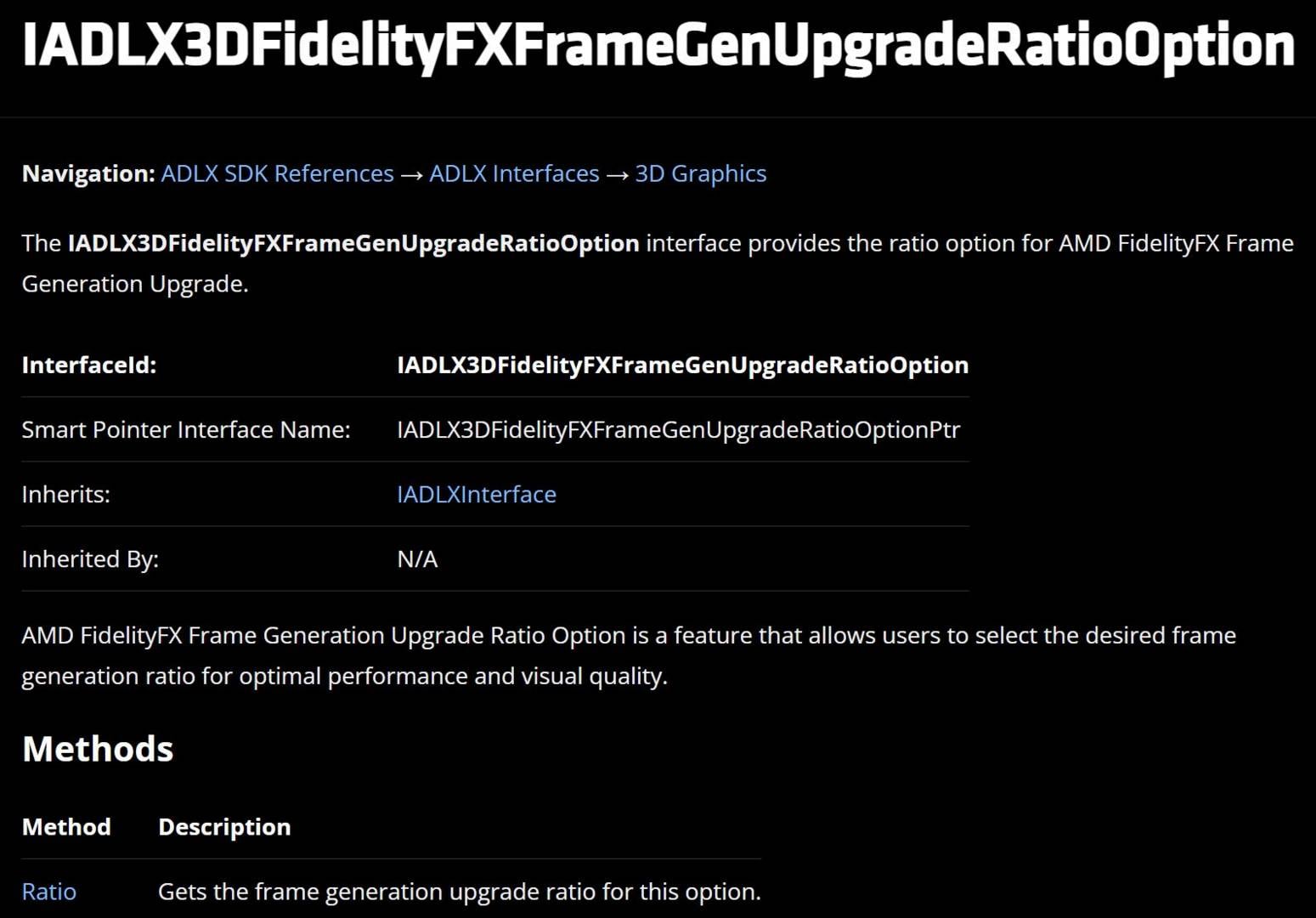
AMD FSR technology seems to be on the brink of a new upgrade, if a recent entry to the GPUOpen is any indication. The new ADLX SDK documentation references a Frame Generation Upgrade Ratio Option, which allows users to select the desired frame generation ratio for optimal performance and visual quality.
Since the appearance of upscaling and frame generation technologies, AMD has so far played catch-up with Nvidia. Well over a year since Nvidia first brought out multi-frame generation (MFG) at the start of 2025, AMD still has no answer, and even Intel has its own MFG tech now for its Arc GPUs. That’s despite modders already forcing AMD GPUs to generate multiple frames using DLSS Enabler, meaning Radeon users who don’t bother with mods were left behind.
Thankfully, this situation may change soon, as the latest GPUOpen update clearly references a ratio-based frame generation system, which looks likely to be AMD’s implementation of Nvidia’s dynamic frame generation tech for its GeForce GPUs. Unlike traditional MFG, dynamic frame generation allows the user to target a specific frame rate – matching your monitor’s refresh rate, for example, and let the tech do its magic. This allows the driver to dynamically generate frames to reach the desired fps, taking better advantage of monitors with fast refresh rates with minimal effort.
Although there’s no specific statement about multi-frame generation anywhere in the docs, the mention of ratio options suggests an option beyond fixed 2x frame generation. Hopefully, my understanding is correct, because otherwise we would only get fixed-ratio MFG, perhaps up to 4x, then we’d need to wait even longer to finally see true dynamic MFG.
Another unnecessary question is whether AMD plans to use an algorithm based on modern machine learning (ML) or not. Going for that approach would likely limit this technology’s support to the latest RDNA 4 GPUs, while going for a non-ML route could make it universally supported at the cost of image quality. Looking at AMD’s trajectory with FSR Redstone, I wouldn’t hold my breath for older hardware support. From FSR 4 upscaling to Ray Regeneration, all new Radeon technologies use machine learning to net you better performance and visuals, but they only run on AMD’s latest RDNA 4 GPUs.
While frame generation, let alone MFG, isn’t the most popular technology among gamers, due to its latency penalty and image artefacts, supporting it is essential for AMD to compete with Nvidia.