
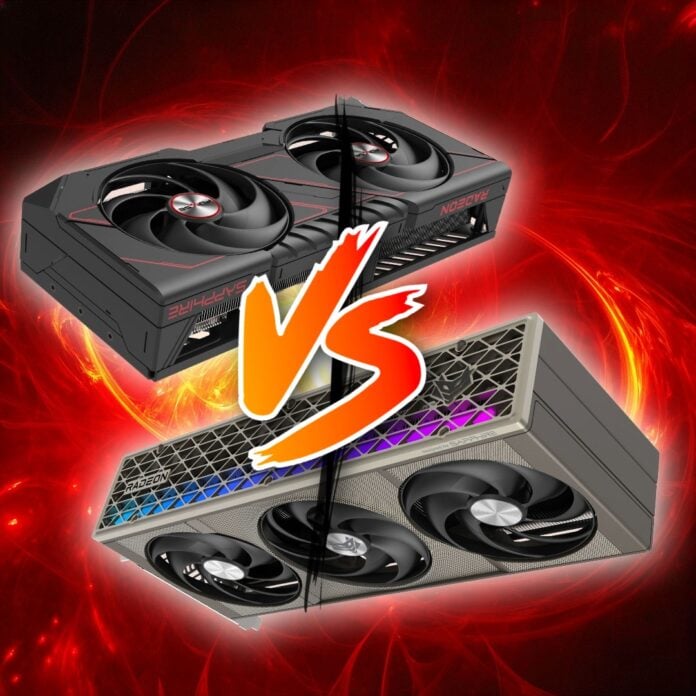
Now that most of Nvidia’s latest GPUs are so overpriced they’re barely worth a second glance, more attention is being paid to AMD’s RDNA 4 GPUs, and for good reason. Yes, both the Radeon RX 9070 and its vanilla non-XT sibling have also felt the impact of inflation during the same timeframe, thanks to the ongoing RAM crisis, but not by the same degree.
Both these GPUs offer a healthy 16GB of VRAM, giving them more room to breathe than Nvidia’s 12GB GeForce RTX 5070. AMD also played a big game of catch up with Nvidia in ray tracing performance with these GPUs as well. In a time when an RTX 5070 Ti will cost you over a grand, AMD’s offerings are looking very tempting indeed.
But should you pay the extra money for a 9070 XT, or save a bit of cash by going for the 9070 instead? That’s what I’m going to answer here, by pitting both the RX 9070 XT and RX 9070 against one another in our graphics card test suite. In this guide, you’ll find computing and gaming performance comparisons, specifications analysis, and all the information you need to choose the right GPU for your needs.
Specifications
There’s actually not a huge difference between the 9070 and its XT variant in terms of memory. You’ll find exactly the same 16GB helping of GDDR6 VRAM, running at 20Gbps and attached to a 256-bits wide bus. That’s a solid spec, meaning both these GPUs offer a maximum memory bandwidth of 640GB/s. The main differences concern the core GPU specs.
| RX 9070 XT | RX 9070 | Ratio | |
|---|---|---|---|
| Released | March 2025 | March 2025 | – |
| Codename | RDNA 4 | RDNA 4 | – |
| GPU | Navi 48 | Navi 48 | – |
| Process | TSMC N4P | TSMC N4P | – |
| Transistors | 53.9bn | 53.9bn | 1.00 |
| Die size | 357mm² | 357mm² | 1.00 |
| Stream processors | 4,096 | 3,584 | 1.14 |
| Boost clock | 2,970MHz | 2,520MHz | 1.18 |
| Compute units | 64 of 64 | 56 of 64 | 1.14 |
| RT cores | 64 (3rd-gen) | 56 (3rd-gen) | 1.14 |
| AI cores | 128 (2nd-gen) | 112 (2nd-gen) | 1.14 |
| ROPs | 128 | 128 | 1.00 |
| Memory | 16GB | 16GB | 1.00 |
| Mem. type | GDDR6 | GDDR6 | – |
| Mem. clock | 20Gbps | 20Gbps | 1.00 |
| Mem. interface | 256-bit | 256-bit | 1.00 |
| Mem. bandwidth | 640GB/s | 640GB/s | 1.00 |
| Board power | 304W | 220W | 1.38 |
| Launch MSRP | $599 | $549 | 1.09 |
Both the 9070 XT and 9070 are based on AMD’s Navi 48 die, which measures 357mm² and is manufactured by TSMC on its N4P process. However, the 9070 XT has all 64 of its compute units enabled, while the standard 9070 has eight of them disabled. This means the latter has a corresponding shortfall when it comes to core counts. As such, you get 4,096 stream processors on the full 9070 XT, compared with 3,584 on the 9070.
Likewise, the number of AI and ray tracing cores goes up by a ratio of 1.14 if you step up from the 9070 to the 9070 XT. That’s not a huge difference, but it does give the 9070 XT a definite advantage.
The other main difference is clock speed. AMD has gone all out on the 9070 XT, giving it a massive maximum boost clock of 2,970MHz. Comparatively, the 9070 only boosts to 2,520MHz as standard, giving it a substantial frequency deficit of 450MHz compared to the XT. This has a knock-on effect on power draw as well. While the 9070 has a total rated board power of 220W, the 9070 XT draws up to 304W with the standard spec.
It’s worth factoring the latter into your buying decision here, as you may need to upgrade your power supply. You can get away with a 650W PSU for the 9070, but AMD says you’ll need at least a 750W unit for a 9070 XT. We’d actually go further and recommend at least an 850W PSU for the latter, as you’ll see.
Test methodology
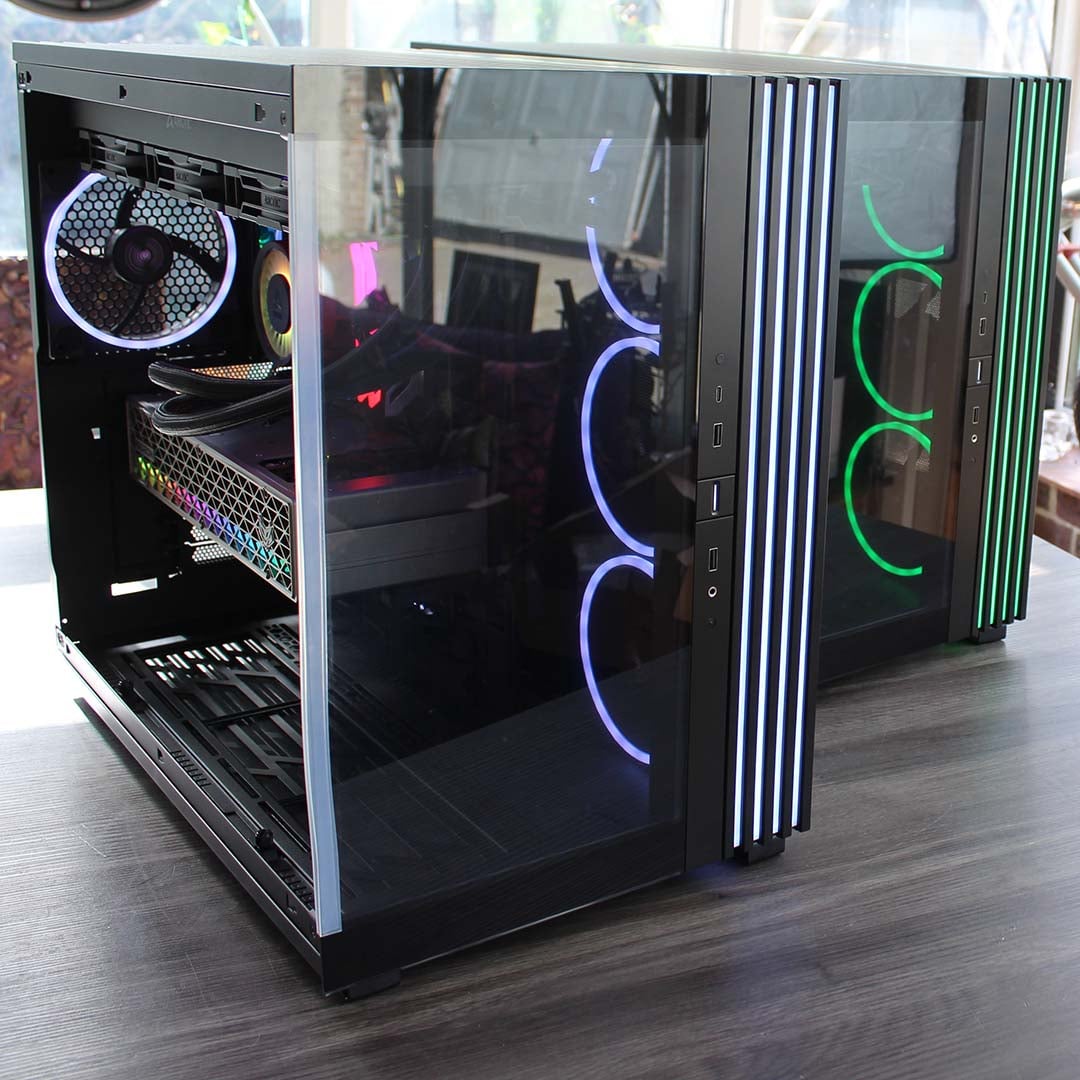
To give these graphics cards a level playing field, I’ve benchmarked both the RX 9070 XT and vanilla RX 9070 in one of our Ryzen 9 9950X3D test PCs. This means I’ve removed any potential bottlenecks, so I can see how fast these GPUs can perform when they’re able to stretch their legs.
Our 9950X3D Test PCs
Club386 carefully chooses each component in a test bench to best suit the review at hand. When you view our benchmarks, you’re not just getting an opinion, but the results of rigorous testing carried out using hardware we trust.
Shop Club386 test platform components:
CPU: AMD Ryzen 9 9950X3D
Motherboard: MSI MEG X870E Ace Max
Cooler: Arctic Liquid Freezer III 420 Pro ARGB
GPU: Sapphire Nitro+ Radeon RX 9070 XT
Memory: 64GB Kingston Fury Renegade DDR5
Storage: 4TB Sandisk Optimus GX Pro 8100
PSU: be quiet! Dark Power 14 1,200W
Chassis: be quiet! Light Base 900 FX
I’ve captured 1080p (FHD) and 1440p (QHD) frame rates on both the RX 9070 XT and RX 9070. Thanks to their large 16GB frame buffers, both cards are capable of playing some games at 4K as well, but these tests will give you an idea of the performance difference between them at the two most-used resolutions.
As there’s no AMD reference card design available for either the RX 9070 XT or RX 9070, I’m using a pair of Sapphire cards for this comparison. I’ve tested a Sapphire Pulse Radeon RX 9070, which runs at stock speeds, and a Sapphire Nitro+ Radeon X 9070 XT. The latter has a small 90MHz overclock, so it can boost to 3,060MHz.
This will only have a minimal impact on performance, given that there’s already a 450MHz difference between the two GPUs – just bear in mind that a stock 9070 XT may be a tiny little bit behind these results.
All our game tests are run at maximum graphics settings with all their ray tracing effects enabled, and with FSR disabled, unless specified otherwise. The exceptions to this rule are Final Fantasy XIV: Dawntrail, which enables FSR by default, and Cyberpunk 2077, which we run at the Ultra ray tracing preset, rather than the all-out Overdrive mode with path tracing.
Performance
Apps
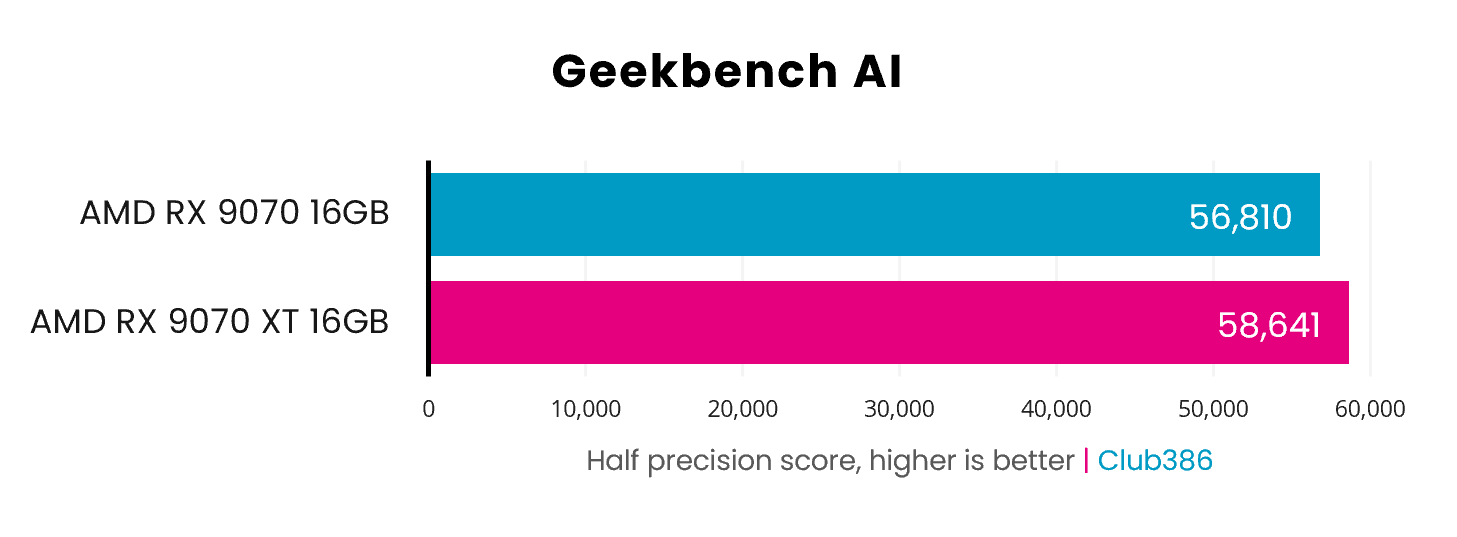
There’s a modest improvement in AI performance going from the 9070 to the XT model, thanks to those 16 extra AI cores. We’re only talking about a 3.2% boost in Geekbench, though, running an ONNX runtime via DirectML. That’s enough to take the 9070 XT past the Nvidia GeForce RTX 5070’s score of 57,195, but the difference isn’t huge.
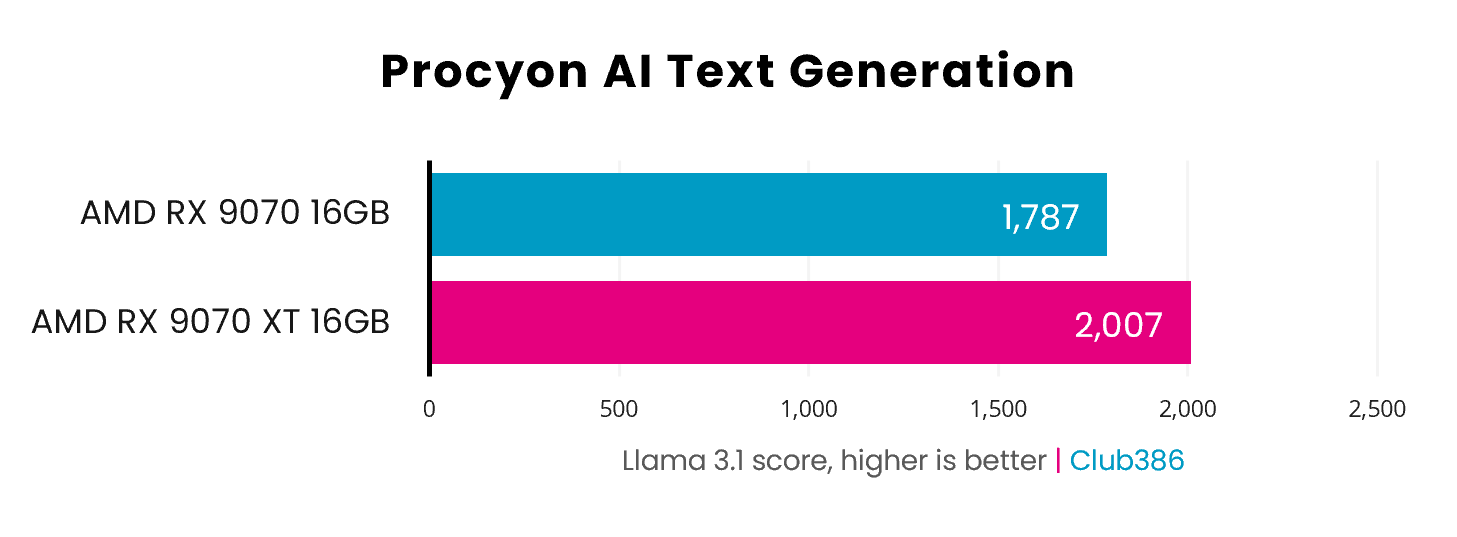
We see the AI performance gap widen between these two GPUs when we run our Procyon Llama 3.1 tech generation benchmark. The 9070 XT’s score of 2,007 is a good 12.3% ahead of the 9070 here. That’s a fair way off the performance of Nvidia’s Blackwell GPUs (even the RTX 5060 Ti) in this large language model test, but the 9070 XT is appreciably quicker than a vanilla 9070 here.
Gaming
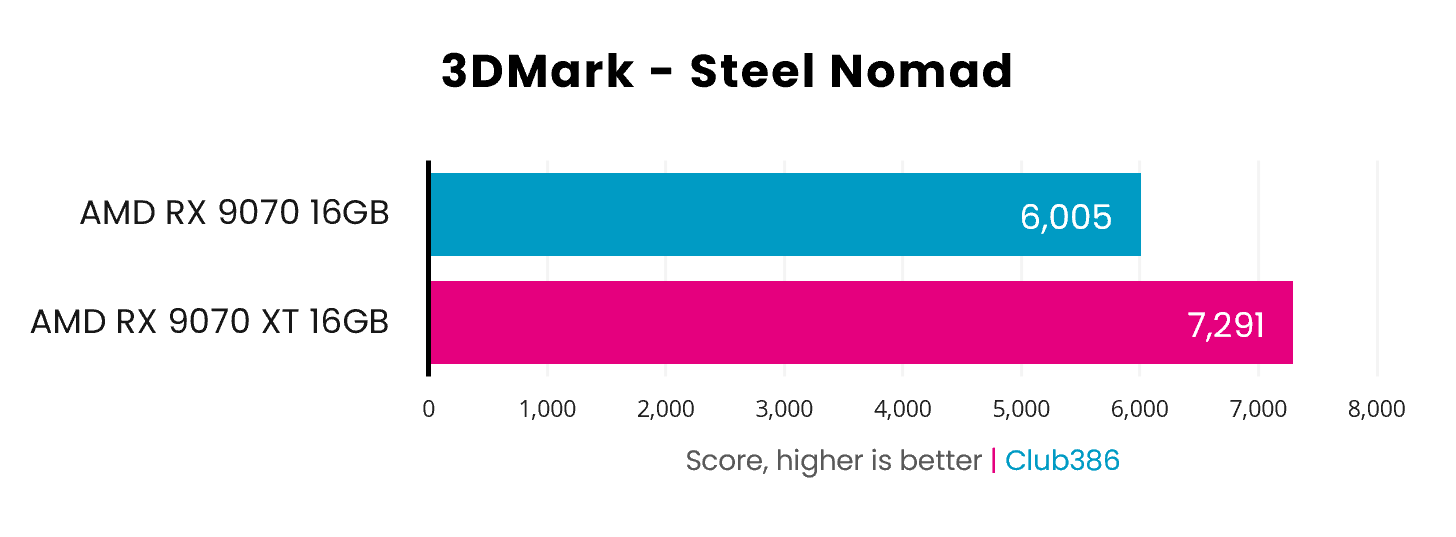
While AMD has made huge strides with ray tracing performance lately, rasterisation is still its forte, and that’s demonstrated in 3DMark Steel Nomad, which stresses raw shader power.
Both GPUs are well ahead of the 5,293 scored by Nvidia’s RTX 5070 in this test, and the 9070 XT clocks up an excellent result of 7,291 – 21.4% quicker than the 9070. That’s all thanks to those 512 extra stream processors and the XT’s big clock speed boost.
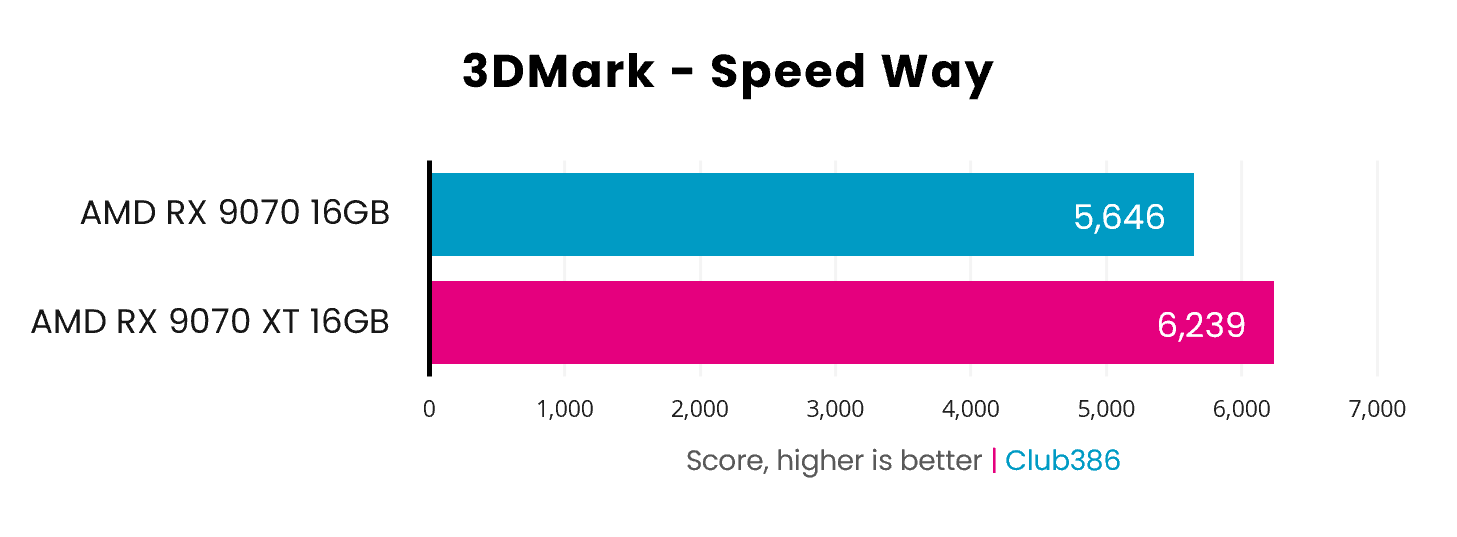
Pushing these two GPUs to their limits in ray tracing, 3DMark’s very shiny and reflective Speed Way test shows a smaller difference between them. When it comes to all-out ray tracing, we’re looking at a 10% performance boost when going from the standard 9070 to the XT. Comparatively, the RTX 5070 sits between these two results at 5,790.
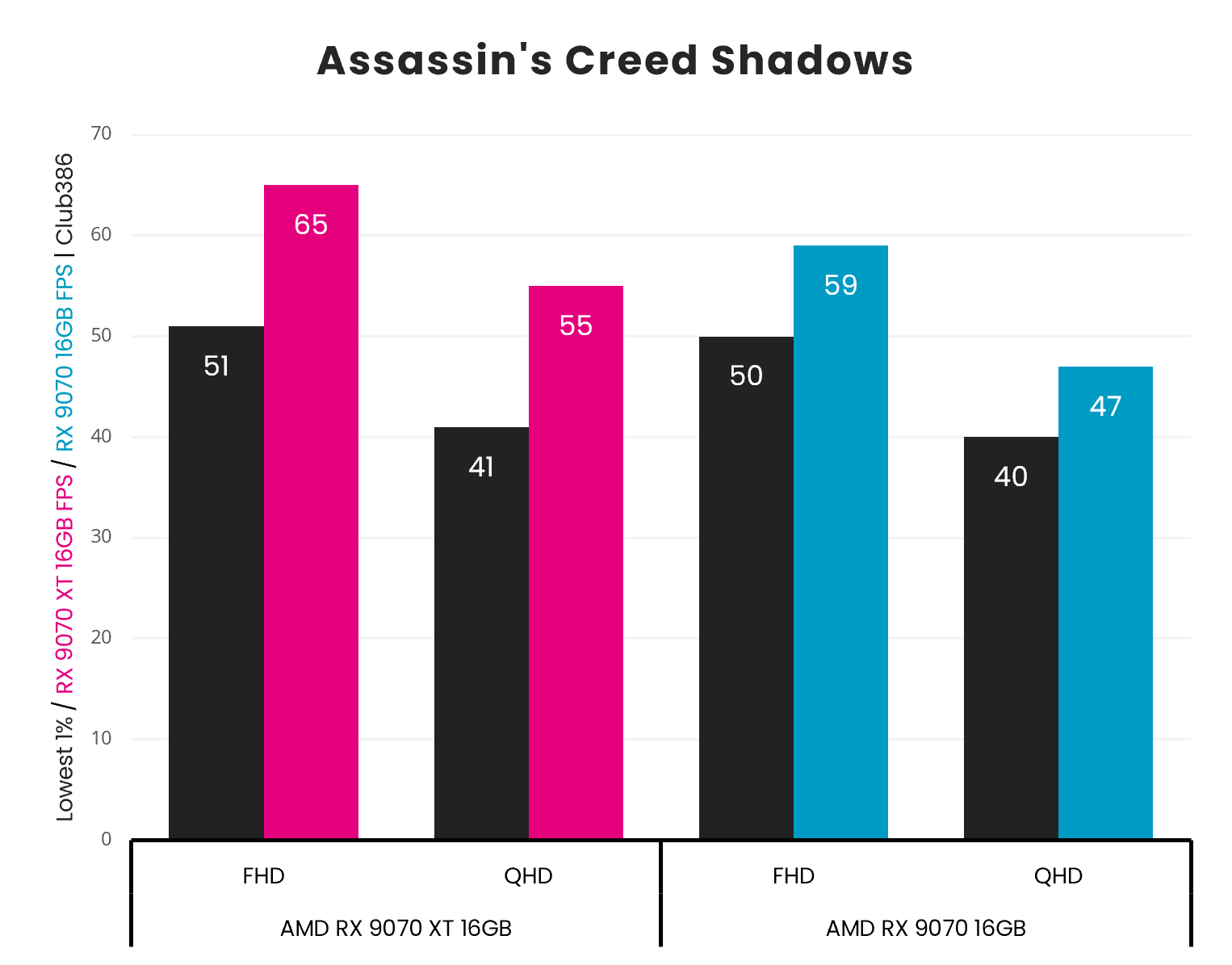
Assassins Creed Shadows looks absolutely gorgeous with all its graphics sliders maxed out, and there’s not a huge difference between these two GPUs here at 1920×1080 – the 9070 handles this game at nearly 60fps, and dropping a few graphics settings and enlisting some help from FSR will get you an even smoother frame rate.
There’s only a small increase in 1% lows when you step up from the 9070 to the XT across the board, but averages see a bigger improvement. In particular, at 2560×1440, the 9070 XT averages 55fps, compared to 47fps for the 9070 – a 17% boost and an appreciably smoother frame rate.
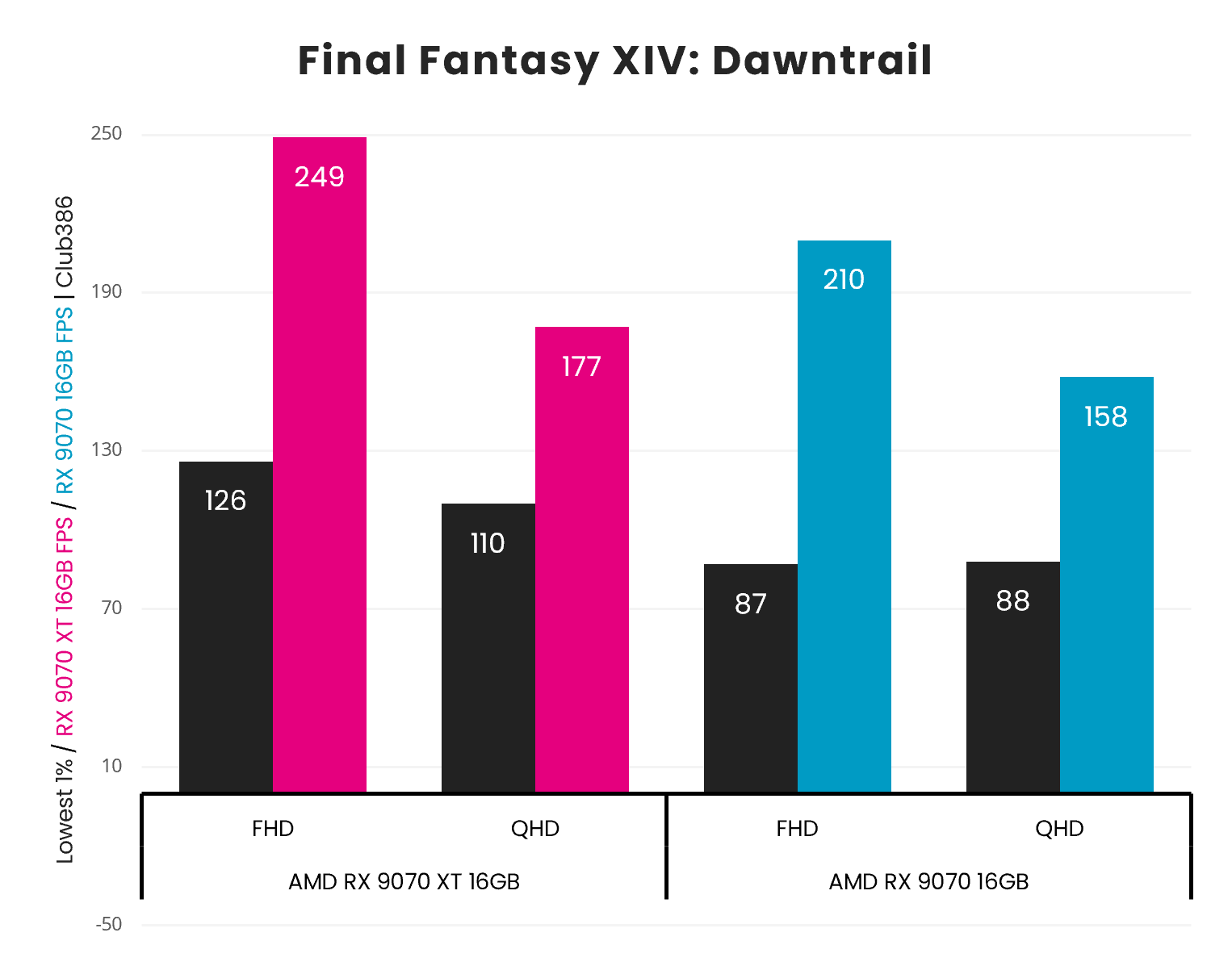
The 9070 XT absolutely rules Final Fantasy XIV: Dawntrail, thanks to its awesome shader power and high clock speed. Its average of 249fps at 1920×1080 is a cracking result, being 18.6% quicker than the 9070. The gap narrows a bit at 2560×1440, but the XT is still appreciably faster. Dawntrail’s 1% lows also really stand out in this test – the XT has enough horsepower to keep this game running well above 100fps across the board, while the 9070 is sometimes dropping below 90fps.
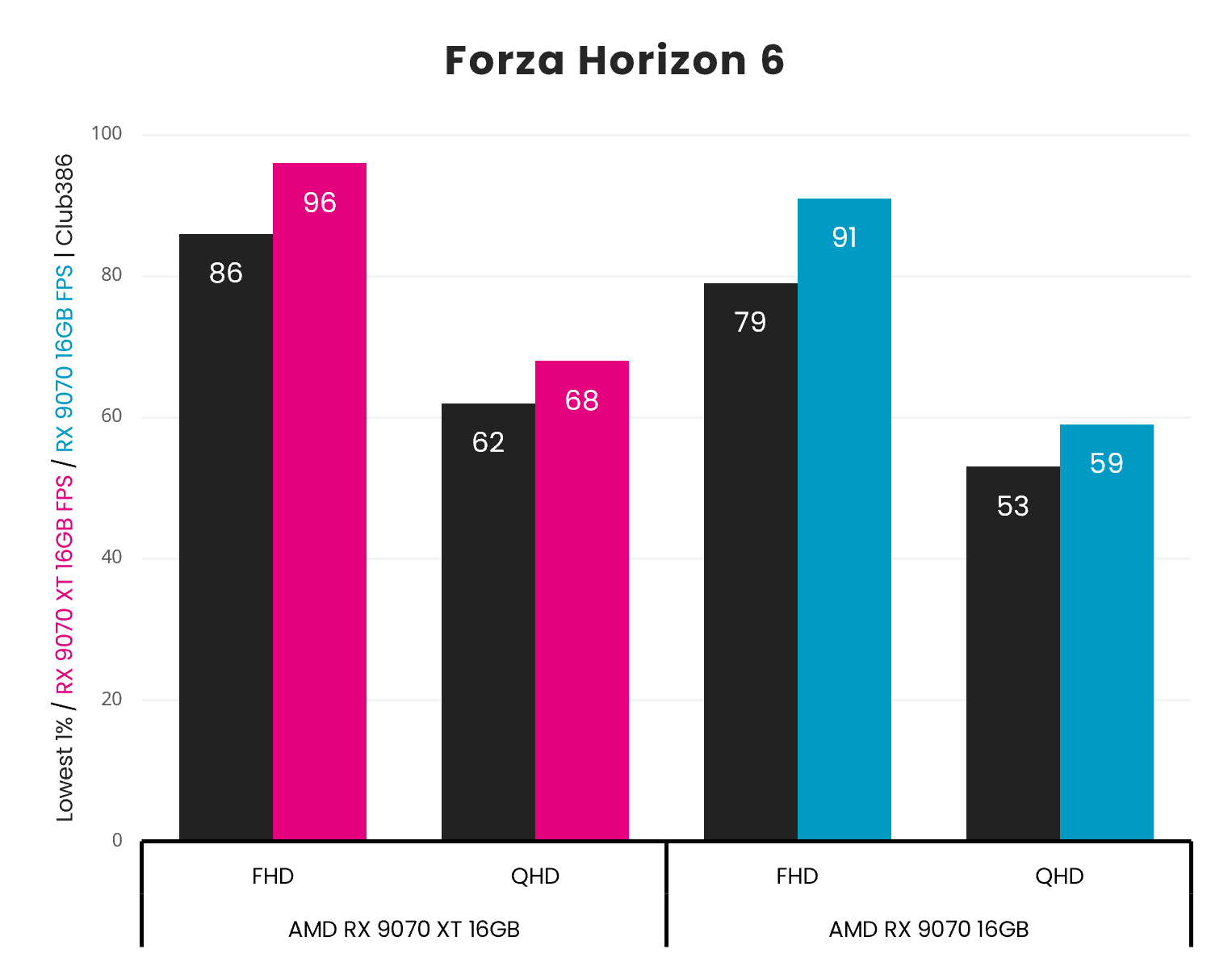
Forza Horizon 6 looks fantastic with all its ray tracing eye candy enabled, and both GPUs handle this game really well at 1920×1080. If you want to run it at 2560×1440, the 9070 XT can maintain a frame rate above 60fps, while the 9070 drops down to 53fps. It’s still perfectly playable on the 9070 at this resolution, and you can always enlist some help from FSR 4 to make it run smoother, but the 9070 XT has a definite advantage.
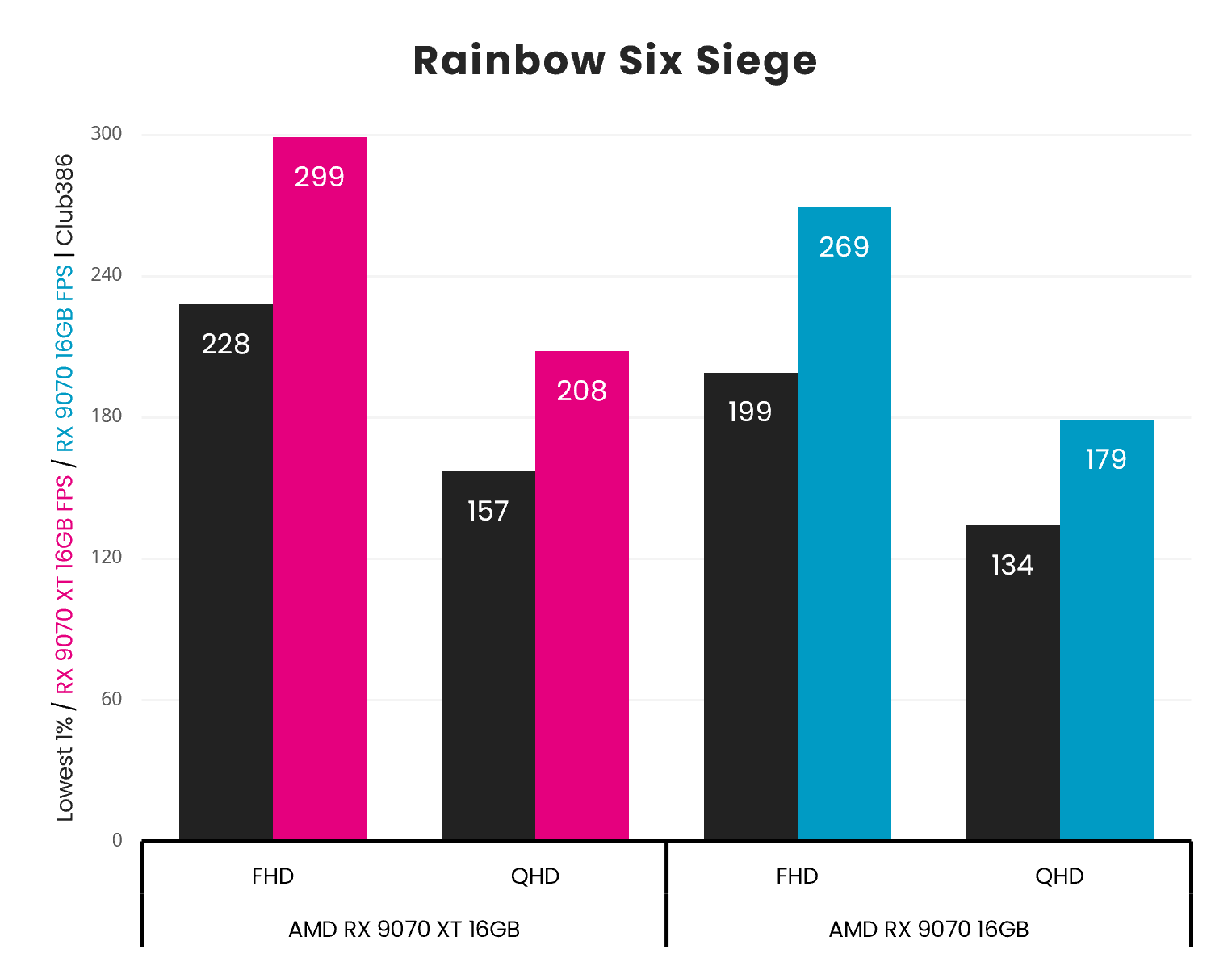
AMD’s Radeon RX 9070 XT pulls away from the 9070 in Tom Clancy’s Rainbow Six Siege, generally adding around 30fps to the frame rate. Even at 2560×1440, the XT is averaging over 200fps (16% quicker), while its 1% lows only dip to 157fps. All that said, while the XT is clearly faster, both GPUs handle this game absolutely fine, even with all the graphics settings maxed out.
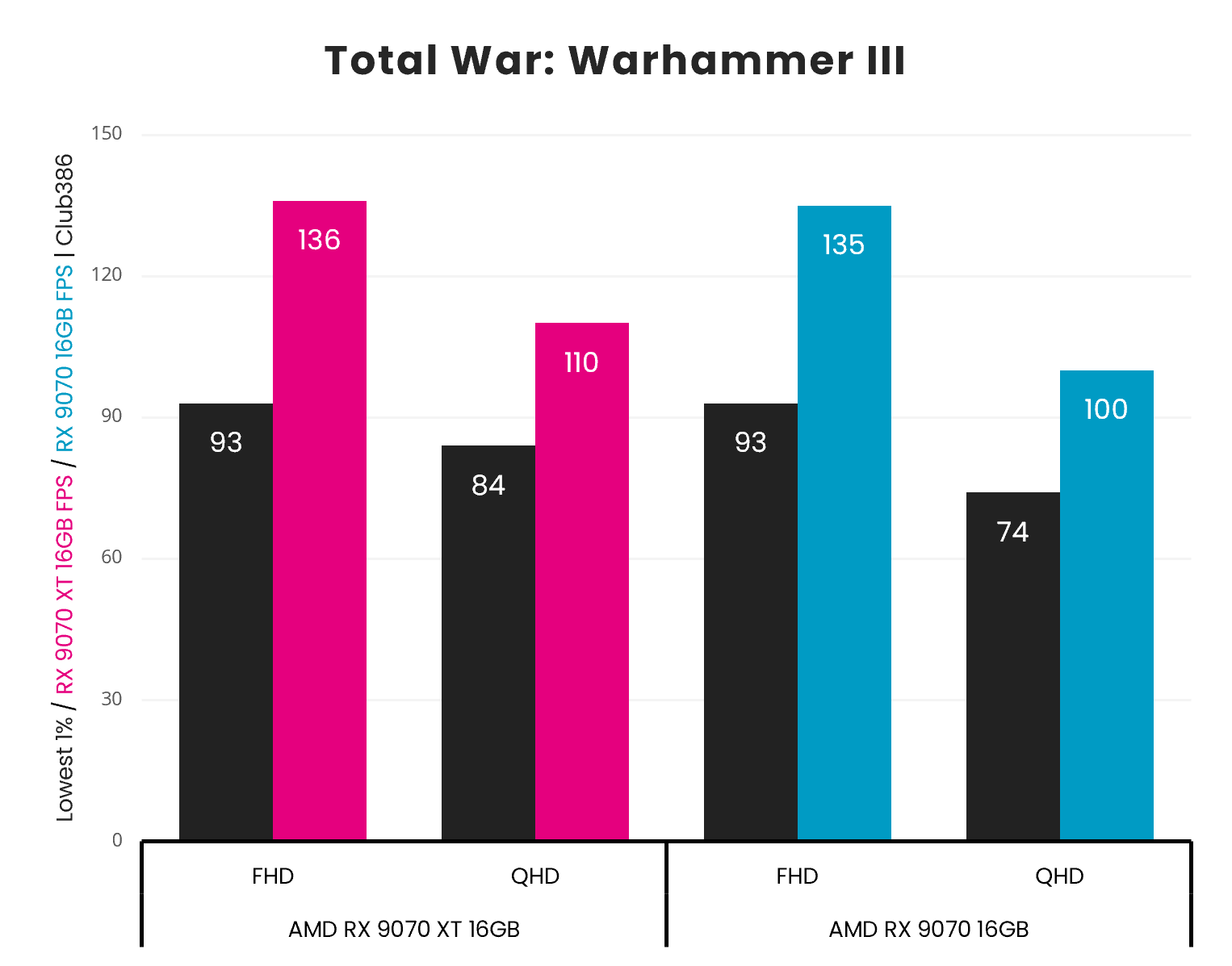
Total War: Warhammer III’s gruelling Mirrors of Madness benchmark is clearly no longer GPU limited at 1080p once you get to this level of graphics power, as there’s barely any difference between these two GPUs. However, once you step up to 2560×1440, the 9070 XT starts to stretch its legs a bit more. It’s only 10fps quicker than the 9070 at this resolution, though, and both GPUs handle this game well.
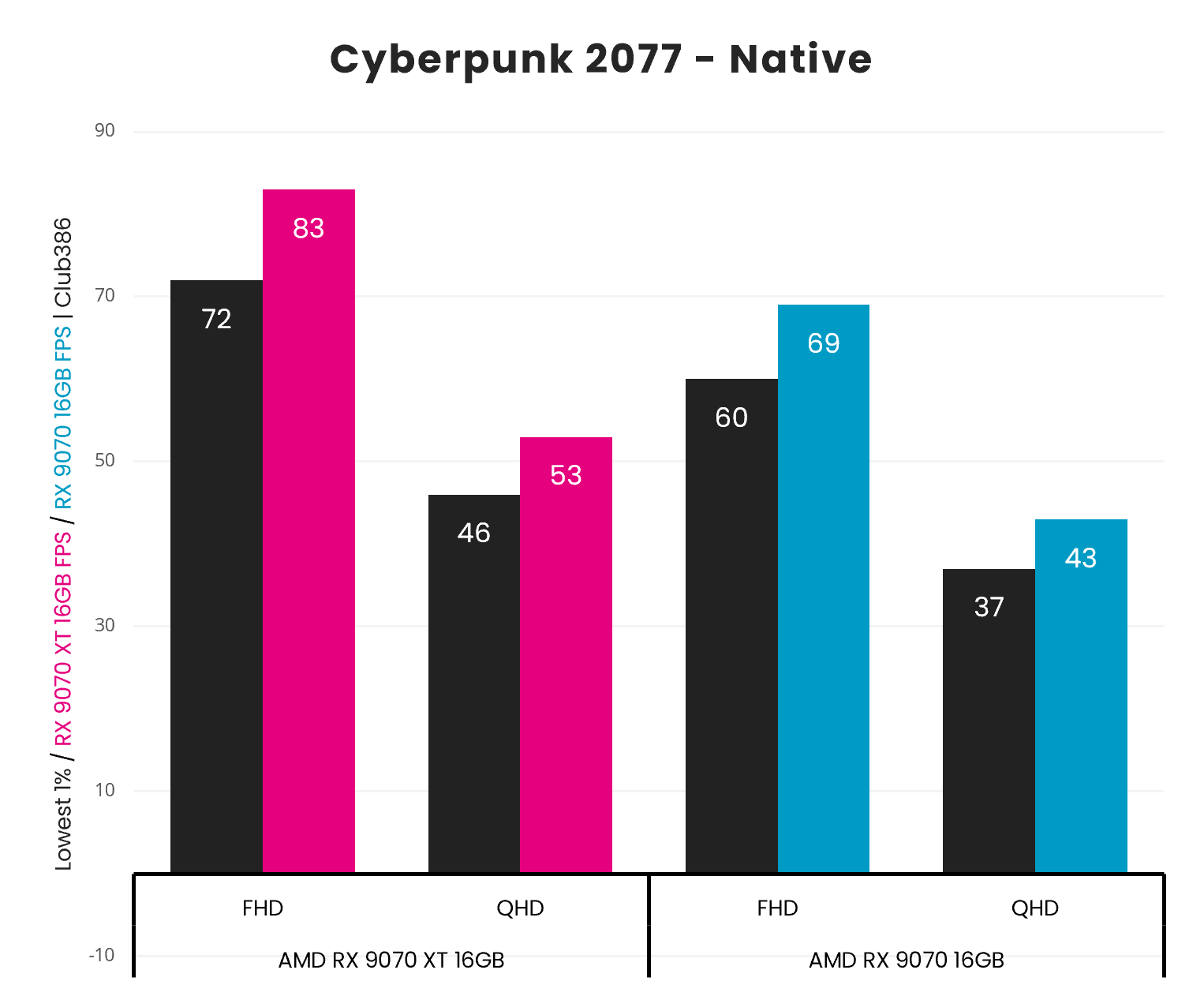
Moving onto the gorgeous ray-traced streets of Night City, both the 9070 and 9070 XT can handle this game at 1920×1080 without any help from FSR. The 9070 XT has a definite performance advantage, though, running 20% quicker than the 9070. Neither card can smoothly handle these settings at 2560×1440 without dropping below 60fps, though, and the 9070 dips as low as 37fps.
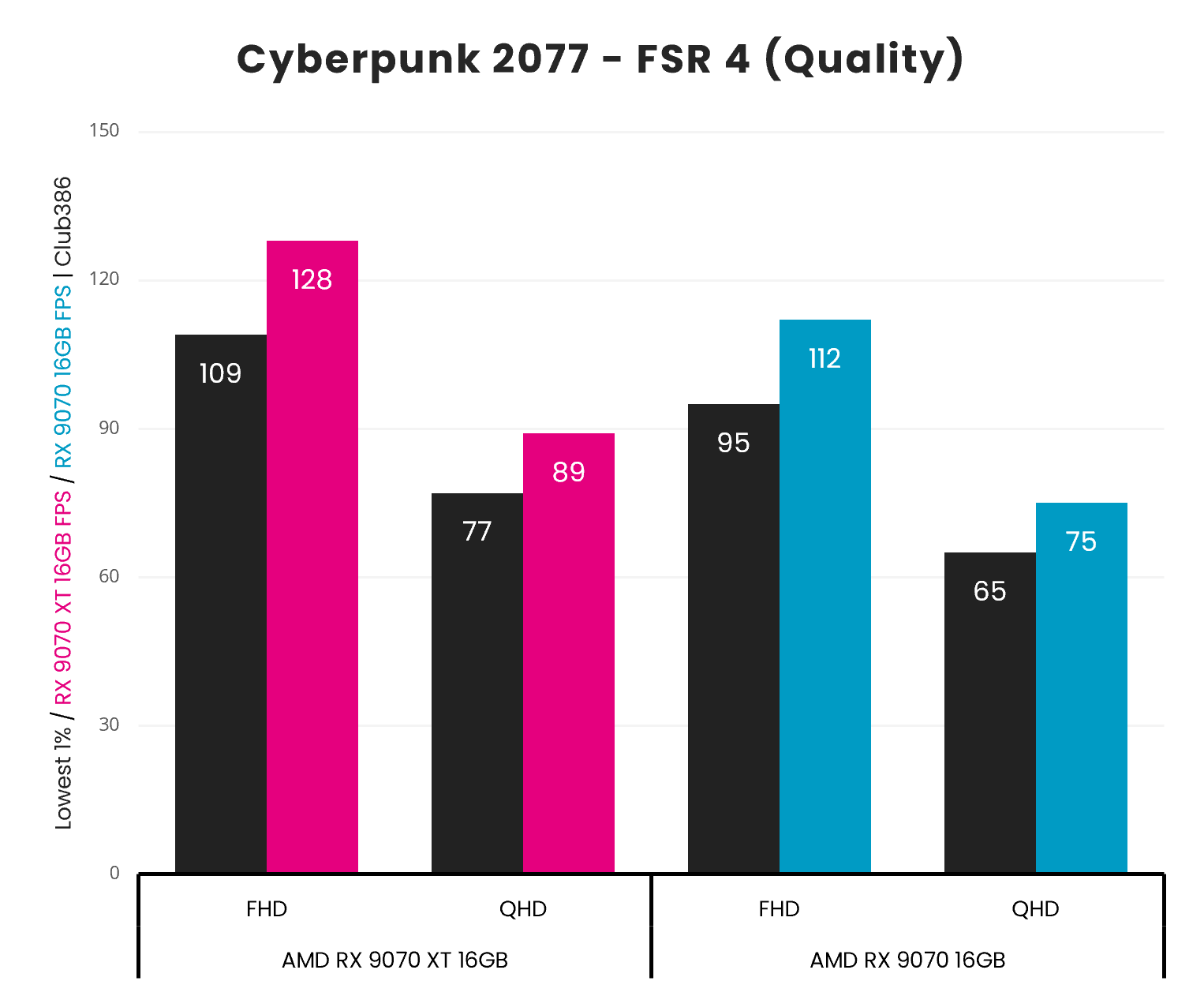
Adding a dose of AMD’s FSR 4 upscaling magic really helps here, and the game still looks great with this upscaler on its Quality setting. Both GPUs can now run the game at 2560×1440 above 60fps, but the 9070 XT is significantly more powerful, running 18.7% quicker.
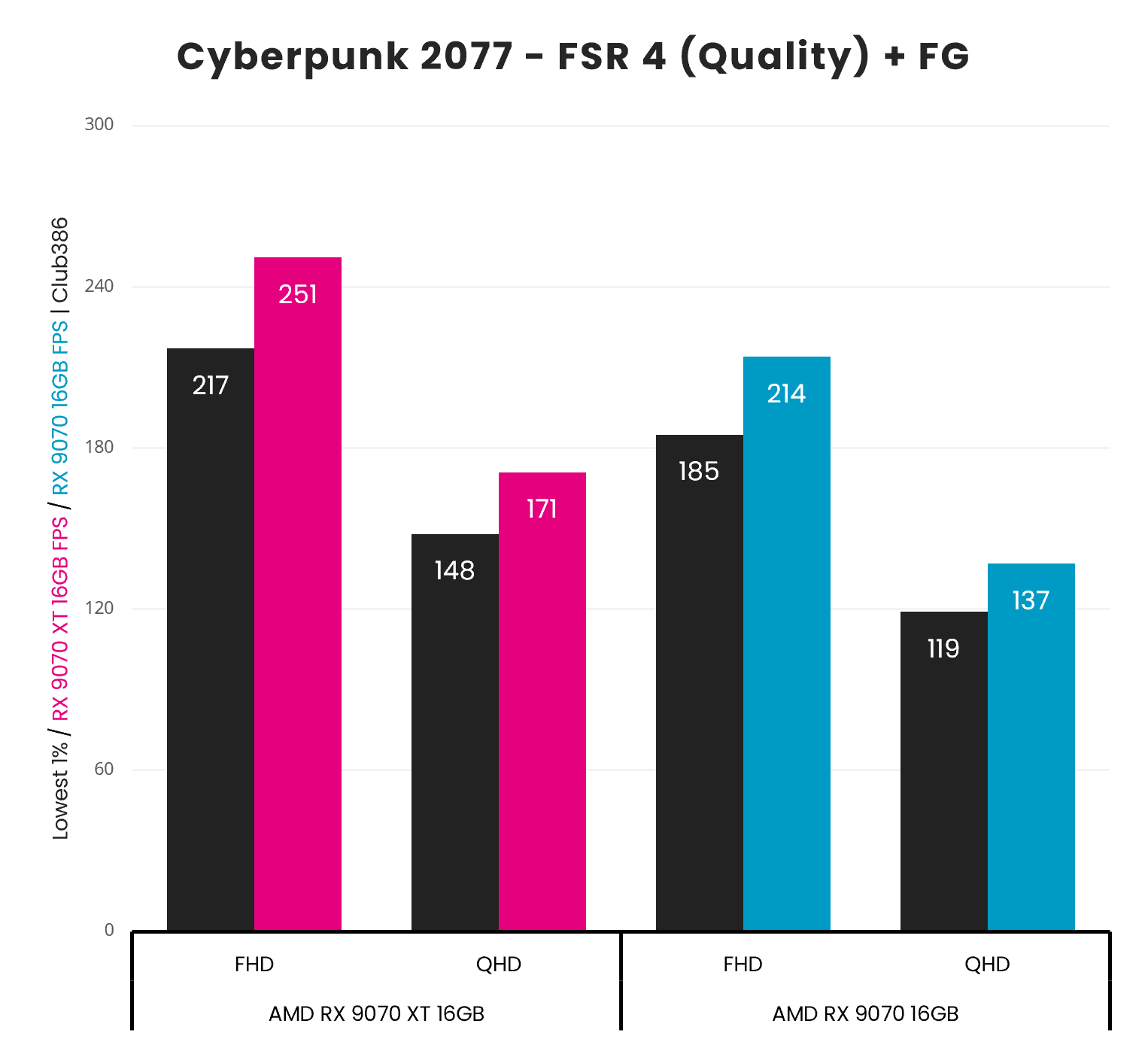
Unlike Nvidia’s GPUs, there’s no multi frame gen available to these AMD offerings, but you can enable single FSR frame gen to help smooth out motion. The 9070 XT responds particularly well to this feature, thanks to its stronger starting point, averaging 251fps at 1920×1080 and 171fps at 2560×1440. The 9070 is still capable here, but you get a 24.8% frame rate boost by stepping up to the XT at 2560×1440.
Power draw
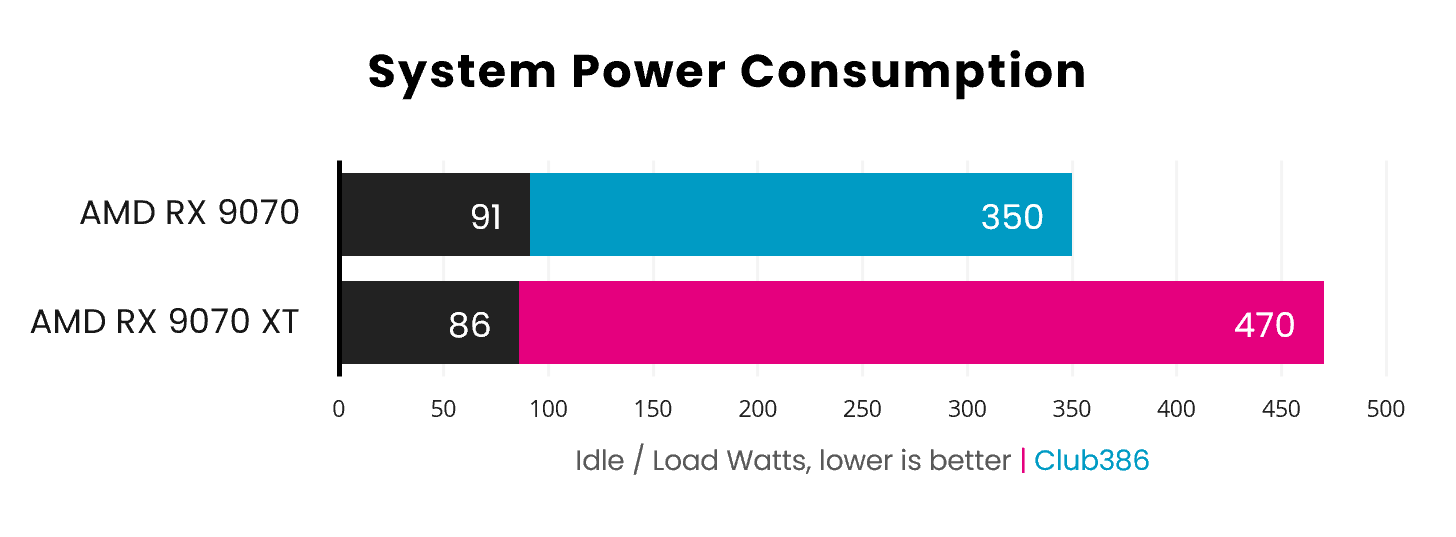
Finally, we come to one sticking point for the 9070 XT – its demanding power requirements. With all that extra clock speed, and more compute units under its belt, our system draws 120W more watts from the wall with the XT at full load than the standard 9070. That’s a big difference for two cards that are ostensibly based on the same core Navi 48 GPU. As such, if you’re thinking of going for the 9070 XT, we recommend at least an 850W PSU, just to be safe, while a 700W unit will be fine for the 9070.
Conclusion
When we first reviewed these two GPUs, the landscape was very different from now. Initially, it was hard to justify buying a Radeon RX 9070 when it was priced so close to both the RTX 5070 and the 9070 XT. These days, however, Nvidia’s RTX 5070 demands a frankly silly price of £739 / $829, making it a non starter for a 12GB card. Meanwhile, the 9070 XT commands a £95 / $100 premium over the standard 9070, rather than the original $50 difference.
All of which means the Radeon RX 9070 is now a more tempting proposition, despite costing a fair bit more than its original price. You can currently pick one up for £656 / $699, making it an obviously better buy than the RTX 5070, while the 9070 XT demands a substantial step up in purchasing power. In these times, the 9070 currently has a fair price for a 16GB graphics card with that level of performance.
AMD Radeon RX 9070 XT
Now costs a fair bit more than the 9070, but remains the best choice of GPU for 2560×1440 gaming, with often significantly faster performance. Read our review.

Even then, though, we recommend saving your pennies for the 9070 XT if you can. At current prices, a Radeon RX 9070 XT will set you back £749. That’s around 14% more than a 9070, which is precisely in line with the 14% boost in compute units. You also get all that extra clock speed with the 9070 XT, though, and it’s often more than 14% faster than the standard 9070, particularly in demanding games such as Cyberpunk 2077.

AMD Radeon RX 9070
An ideal alternative if you can’t afford the 9070 XT at current prices. It’s not as fast, but it’s still capable and has 16GB of VRAM too. Read our review.
What this retest has shown, though, is that while the 9070 XT is the best GPU you can buy in the current landscape, it’s no longer a complete slam dunk. If you can’t afford to pay £749 for a graphics card, that’s completely understandable, and the 9070 still does a fine job if you can’t run to those costs, while also offering plenty of memory.