

Hard disk drives (HDDs) are joining SSDs and RAM in the inflation club, with reports of price increases. AI data centres are thirsty for storage, and that means they need large-capacity hard drives as well as SSDs. Not only that, with a sudden surge in demand from China’s PC market, HDDs are moving towards a potential supply crunch that will force up prices.
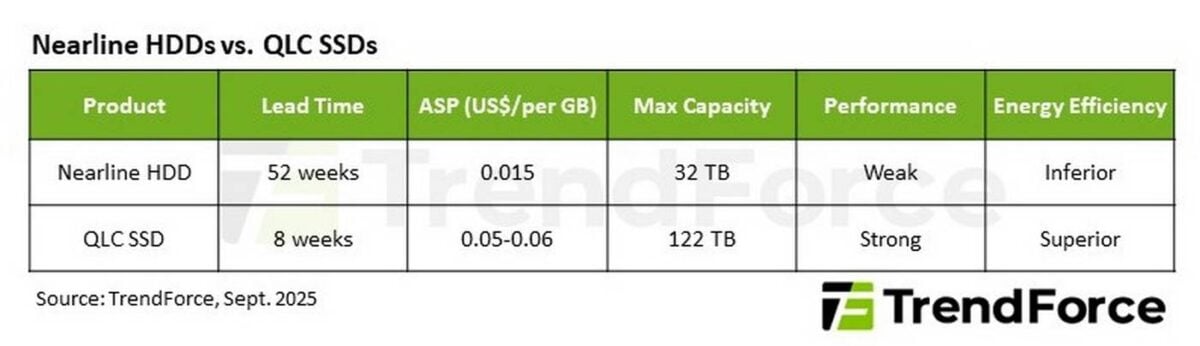
Though HDDs are often treated as legacy technology, they can’t be beaten when it comes to cost per terabyte. When you’re building multi-billion-dollar data centres, you need a lot of storage capacity across all speed ranges, not just fancy Nvidia GPUs and RAM.
So, after a couple of relatively calm years, HDDs are now becoming increasingly in demand. According to reports from DigiTimes Asia, HDD contract prices jumped roughly 4% quarter-over-quarter in Q4 2025. Already representing the most significant price increase seen in roughly two years, this upward trend is expected to persist, adding another blow to mainstream consumers.
While they may be slow for active data treatments and AI training, HDDs can offer great long-term data retention, which is still a concern with SSDs. This makes them perfect for storing the large volume of data generated by AI, and most importantly, the growing raw datasets needed to train new machine learning models. In other words, HDDs will remain in high demand wherever performance requirements are secondary.
Meanwhile, China’s PC market is also driving up demand. That’s thanks to government incentives prioritising domestically produced CPUs and operating systems, and PCs built with cheaper components tend to come bundled with HDDs.
Despite years of predictions that flash storage would completely replace HDDs, these spinning mechanical disks refuse to let go. TrendForce suggests HDD manufacturers are already running at full utilisation, but demand from cloud and hyperscale services is still greater. Furthermore, HDDs need DRAM chips for caching, adding another production bottleneck, since RAM prices are skyrocketing right now.
If this situation continues, analysts warn that an HDD shortage could become apparent in 2026. More so if manufacturers start shifting their production towards higher-margin enterprise products, as we saw with the death of Crucial in the SSD world. Next-gen technologies such as HAMR could alleviate some of this pressure, but they may take a bit of time to reach the market.