
Intel is seemingly planning to launch four CPU families in the next two years, positioned to compete against AMD, Apple, and Qualcomm. The roadmap suggests the company’s manufacturing schedules have finally stabilised after multiple years of delays and roadmap re-adjustments.
According to a new supply chain report, Intel plans to release several CPU architectures through 2028, including Nova Lake, Razor Lake, Titan Lake, and Moon Lake. Team Blue is seemingly targeting a return to a yearly release cadence for new CPUs, starting this year with the launch of Nova Lake. This change is the result of restructuring efforts led first by former CEO Pat Gelsinger and current CEO Lip-Bu Tan, which reportedly helped the company’s execution cadence to get back on track.
Starting with Nova Lake, scheduled for the second half of 2026, Intel is expected to drastically increase the total core count of its desktop processors, reaching up to 52 cores on the flagship model. These continue to use the brand’s hybrid architecture, combining Coyote Cove performance cores with Arctic Wolf efficiency cores. As for the mobile HX/H variants, leaks indicate up to 28-core configurations, likely also with copious amounts of cache. Nova Lake is also rumoured to pack up to 288MB of bLLC cache, dwarfing even AMD’s latest Ryzen 9 9950X3D2.
Next, we have Razor Lake, arriving in Q4 2027 with a heavy focus on IPC improvements. This time, the hybrid design is said to feature the Griffin Cove P-Cores and Golden Eagle E-Cores, but core counts are unknown. Most notably, Razor Lake is reportedly pin-compatible with Nova Lake’s LGA 1954 socket, meaning that it should be supported on the same motherboards and chipsets. Previous rumours claimed that this socket could support four CPU generations, spanning Nova Lake, Razer Lake, Titan Lake, and Hammer Lake.
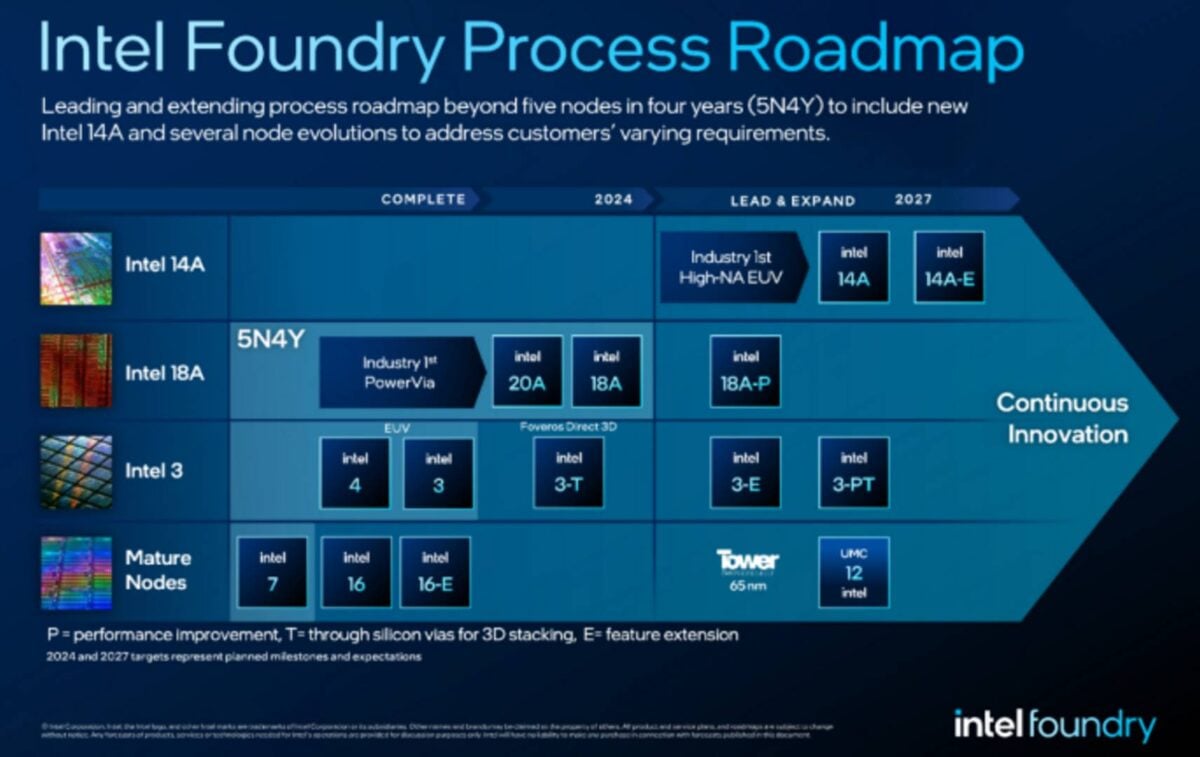
In 2028, Intel will undergo its biggest architectural transition since the introduction of its hybrid P/E-core strategy with Alder Lake. According to the latest rumours, Titan Lake could move back to a unified core architecture known as Copper Shark, which eliminates the distinction between P and E cores. Titan Lake is also said to feature an Nvidia RTX GPU tile instead of Intel’s Arc. Depending on the performance of said GPU, Intel could fight well against AMD’s Strix Halo APUs, which boast a large Radeon graphics portion. Targeting mobile exclusively, Titan Lake could also be among the first to use LPDDR6 memory.
Lastly, we have Moon Lake, an E-core-only CPU design targeting entry-level notebooks and Chromebook-class devices succeeding the Twin Lake family. As such, Moon Lake is expected to prioritise power efficiency over performance, potentially taking advantage of the latest and most efficient manufacturing nodes.
While Intel has yet to confirm all of this, leaks and rumours point to an aggressive CPU strategy covering different use cases with the aim of claiming back any lost market share. We surely don’t mind seeing competition lighting up, starting this year with Nova Lake.