
What do you think is Intel’s most popular desktop CPU on Amazon at the moment? I’ll give you a clue, it’s not either of the Arrow Lake Refresh chips that launched this year, despite getting decent press, including in our own reviews. It’s not even a budget-friendly, sub-£150 CPU that you might expect to be popular with the masses looking to save some money in these tough times. Nope, it’s a 20-core chip from three years ago.
Check the CPU best sellers at Amazon in the US, and you’ll see the Intel Core i7-14700K sitting pretty at number #14 – the first Intel chip to chart under a sea of AMD silicon. Head to Amazon UK, and you’ll find the iGPU-free Core i7-14700KF at number #10 – again the first Intel CPU to make the chart, likewise struggling to surface above the Ryzen tide. This intrigued me, because I actually upgraded to a 14700K myself this year, and I’m seemingly far from alone.

Intel has done its best to repair the damage done by its initial Arrow Lake launch two years ago. Its latest Core Ultra 7 270K Plus is cheaper and than the supposedly flagship Core Ultra 9 285K, and its massively boosted die-to-die interconnect speed makes it significantly better than the 285K in gaming, while being barely off the pace in other tests. Some extremely generous deals have also made this chip, and its lower-cost sibling, the Ultra 5 250K Plus, very affordable, but they’re not being lapped up at the same rate as the older 14700K.
Expensive RAM
That’s firstly because you have to use DDR5 RAM with these new CPUs, and this memory is prohibitively expensive at the moment. Comparatively, the Core i7-14700K supports both DDR4 and DDR5 – you can use your old memory with it if you have some. This is only a part of the equation, though. After all, several AMD Zen 4 and Zen 5 CPUs are outselling the 14700K on Amazon. What’s their secret?

I’d argue that a big factor is the longevity of AMD’s sockets. An ageing X670 board will happily run the latest Ryzen chips, as well as tomorrow’s Zen 6 CPUs. With the 250K and 270K Plus, you have to buy into a dead-end motherboard socket if you want one – it only runs Arrow Lake CPUs, with no support for Raptor Lake chips, such as the 14700K, or tomorrow’s Nova Lake CPUs.
Socket longevity
Decent motherboards aren’t cheap now, and those of us who build our own PCs expect to get several years out of such an investment. If you bought an X670 board with a 12th-gen Intel CPU five years ago, you could put a Core i7-14700K in it. The same won’t be true of a Z890 board a few years down the line. AMD also has the benefit of its 3D V-Cache tech, which makes its X3D CPUs formidable chips in games. X3D chips absolutely dominate the chart – there are five of them above all of Intel’s efforts in the Amazon US best sellers chart.
What’s interesting to me, though, is that it’s the 20-core Core i7-14700K, rather than the cheaper 14600K, or top-end 14900K, that’s proving so popular. For me, it’s all down to the balance you get for the price. Crucially, the 14700K has two more P-Cores than the 14600K, and these are the important ones for gaming. They also boost to up to 5.5GHz at stock speed, compared to 5.3GHz on the cheaper chip. You also get more E-Cores on the 14700K – 12 of them, compared to eight on the 14600K. It’s a better chip in every respect.
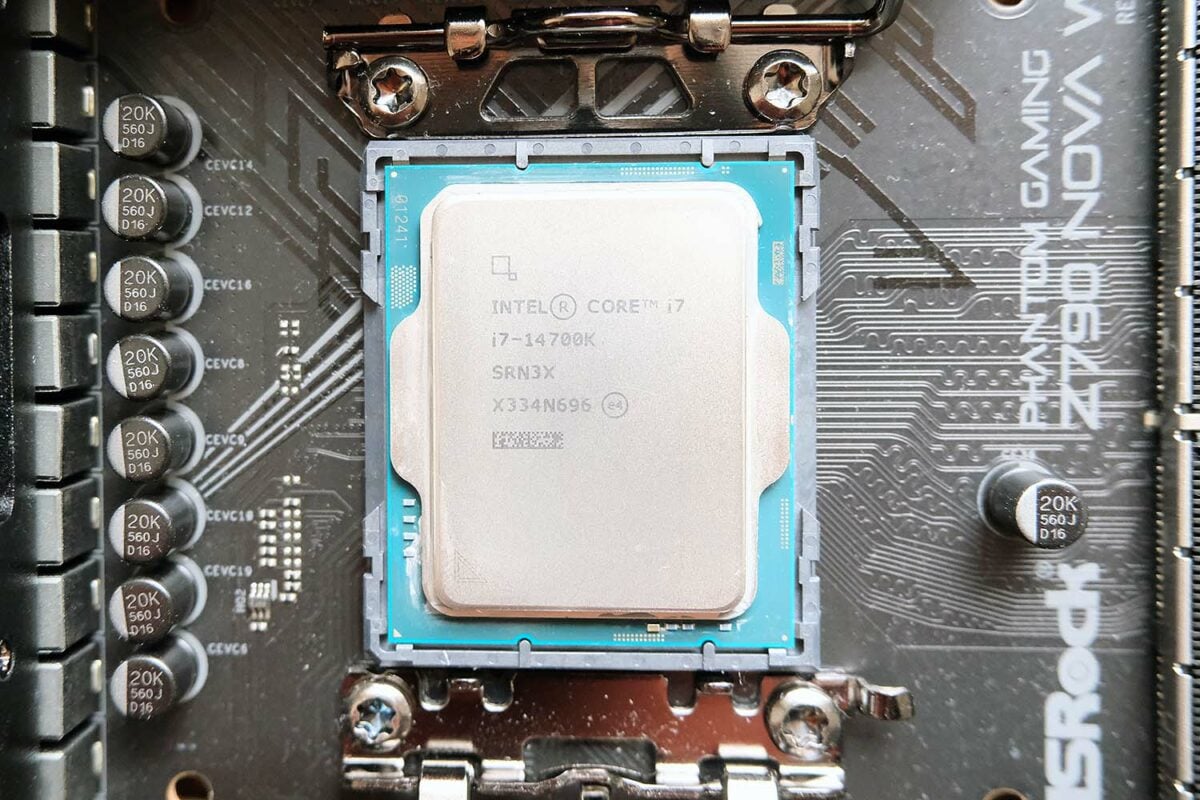
Meanwhile, the 14900K costs a lot more money, but has the same number of P-Cores and only four my E-Cores than the 14700K. It also has a higher boost clock, but runs hot as a result. Certainly, for my needs, the 14700K ticked all the boxes for the best price. It’s a rare example of Intel getting the balance just right for the price of £310.99. You can put one in your old LGA1700 motherboard, even if uses DDR4 RAM, and it covers all your bases.
The future
Why is this all important? Because it looks as though Intel has learned its lesson from the last couple of years. Intel’s VP and GM of its enthusiast channel, Robert Hallock, simply said “I do” when I asked him if he saw a future where future CPU sockets supported more generations. The forthcoming LGA1954 socket is expected to support four generations of Intel CPUs. That’s better than the three (I know, two really) generations supported by LGA1700, and it’s much better than the Arrow Lake-only LGA1851.
Nova Lake isn’t going to support DDR4, of course, but the company is well aware that it needs chips that support this older memory standard, and it looks as though more are coming. Raptor Lake “is not going anywhere” Hallock told me earlier this year, and there are rumours of another Raptor Lake refresh coming soon. The rumoured specs look bang on.
There’s apparently another 20-core (eight P-Cores, 12 E-Cores) CPU coming, just like the 14700K, but without a Core i9 model with 24 cores. I also really like the look of the rumoured chip with eight P-Cores and just eight E-Cores – arguably a much better balance than the 14600K for a lot of people’s needs, particularly gaming.
Finally, Intel is also widely rumoured to be introducing its own bLLC (big last level cache) tech with Nova Lake, so it should be able to properly take on AMD’s X3D chips in gaming.
Intel is undoubtedly well behind AMD in the DIY desktop CPU market at the moment, but the Core i7-14700K shows what happens when the company gets it right. With a commitment to long-term sockets, chips that support DDR4 and DDR5 memory, and big cache seemingly on the horizon, the CPU best sellers chart may have a very different mix this time next year.