

As SteamOS becomes compatible with third-party gaming handhelds, some users have started wondering if it’s worth switching to in place of Windows. To answer this question, folks at Ars Technica took the Linux-based OS for a spin and found some promising results.
To give both operating systems the best chance, Ars Technica went with the Lenovo Legion Go S handheld as it officially supports both SteamOS and Windows 11. Out of the box, the machine came with SteamOS, which was thoroughly tested before installing Windows 11 and compatible drivers. On the subject of drivers, Lenovo’s official drivers were quite old, dating back to January 2025, and were therefore incompatible with Doom: The Dark Ages. The outlet managed to install Asus’s ROG Ally drivers, which funnily enough, offered better performance than Lenovo’s.
Ars Technica’s testing found that recent games run generally better on SteamOS 3.7 compared to Windows 11, reaching higher average fps even though the hardware specs didn’t change. Though Windows 11 didn’t go down without a fight, it was overall slower than SteamOS, sometimes so slow, in fact, that switching to the latter represented the difference between unplayable and playable frame rates.
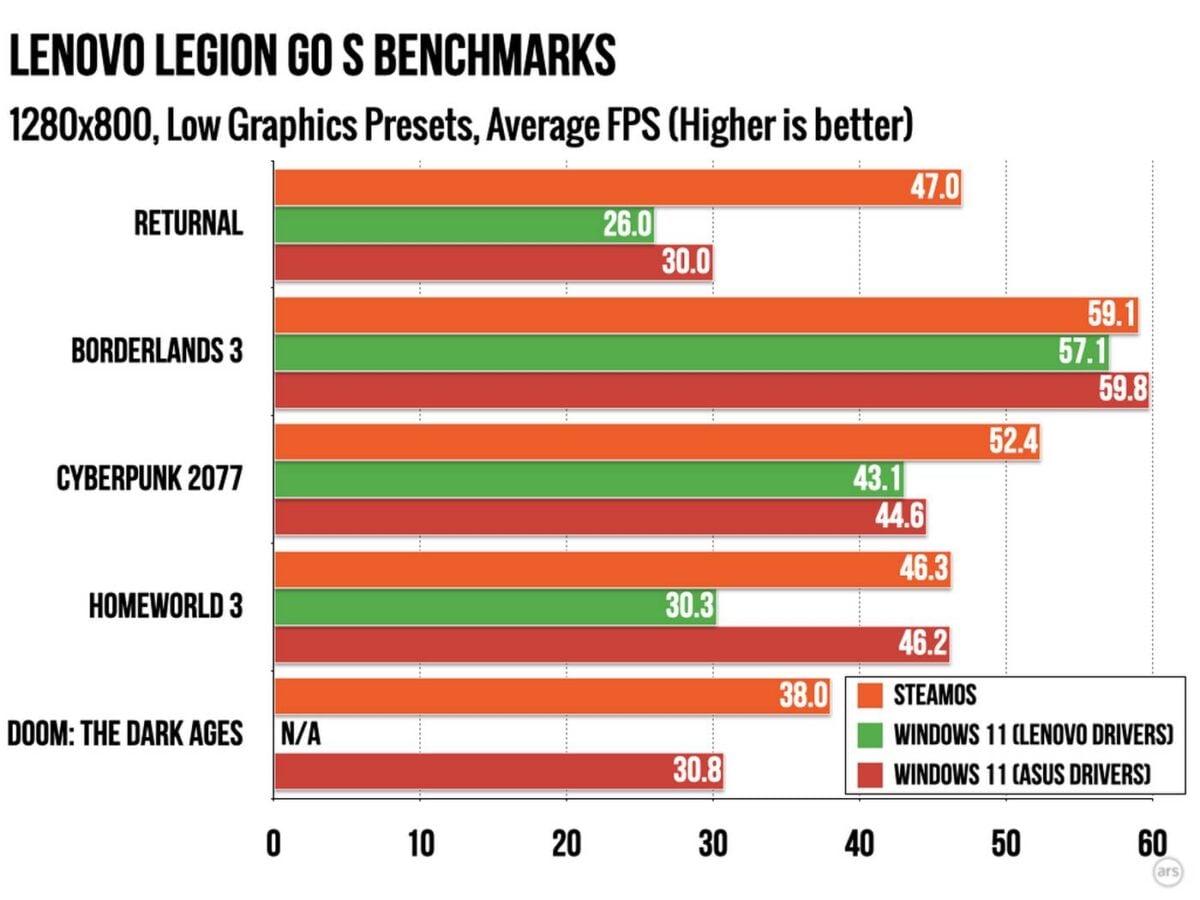
As you can see in the chart above, SteamOS is noticeably faster in three out of the five tested games, delivering up to a 17fps (56%) increase over the best Windows 11 result. Cyberpunk 2077 also saw great gains from SteamOS, jumping from 44.6fps to 52.4fps, i.e. 17%. Across all tested games, Borderlands 3 was the only game that gifted Windows a win, a negligible one that is, of about 1%. These results confirm previous findings by Dave2D, whose benchmarks showed about a 28% advantage for SteamOS.
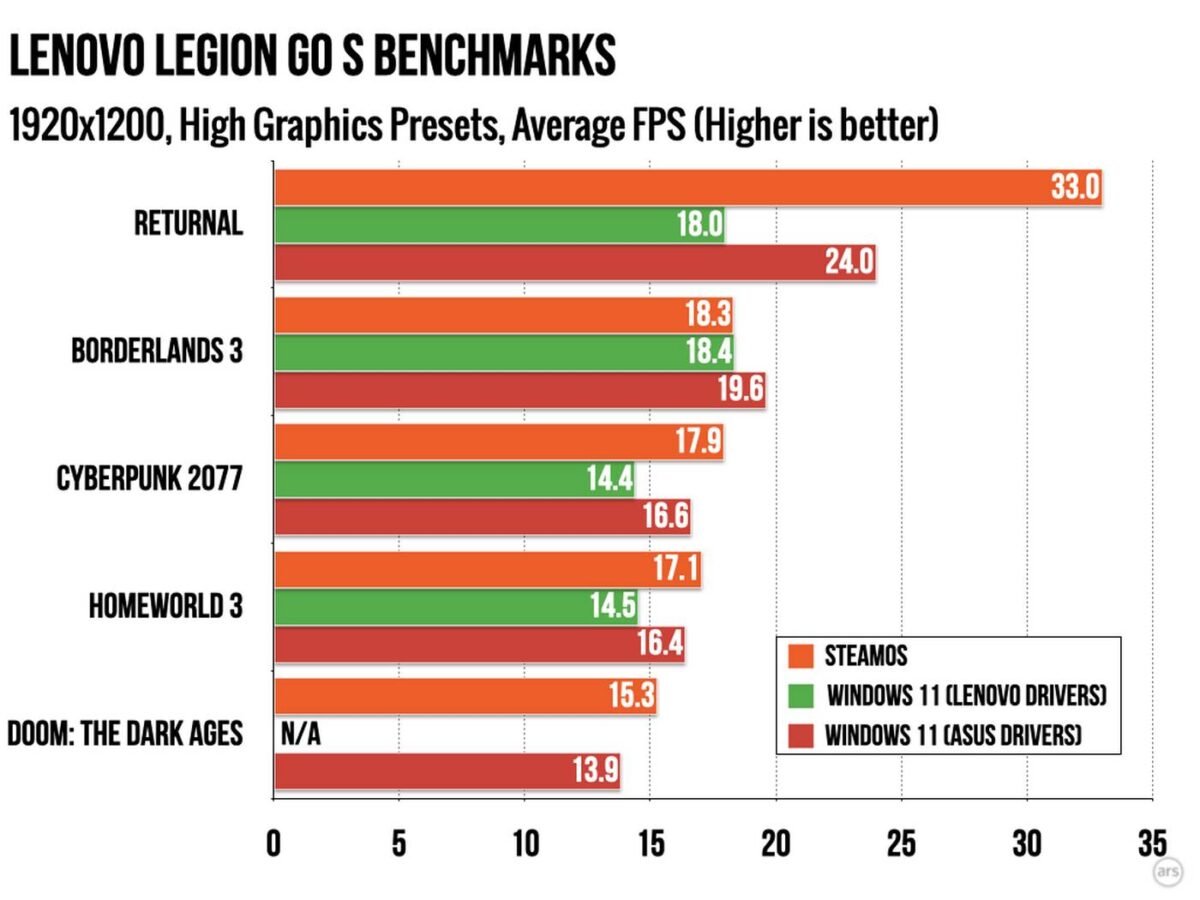
These results become even more impressive when you consider that SteamOS must go through a Proton translation layer on native Windows games. Somehow, Valve managed to optimise this transition enough to beat an OS for which these games were built from the ground up. We also must not forget the great groundwork laid down by the Linux community, which paved the way for Valve.
One of SteamOS’ advantages is its debloated system, which results in lower overhead compared to Windows 11. Microsoft is well aware of this limitation and has already started optimising its OS to better suit power-limited devices like the ROG Xbox Ally by deferring non-essential tasks and minimising background load. When done, Windows may claim some of its performance deficit back, though SteamOS isn’t finished yet.