

After months of continuing to climb due to AI data centre demand and supply constraints, NAND spot prices are finally recording a meaningful drop, perhaps signalling the beginning of a price correction. While an impact on retail prices may take some time to show, this could end up becoming welcome news for consumers.
According to a new report from Korean newspaper Seoul Economic Daily (SED), consumer NAND chip spot pricing has dropped by 20% in one month, despite the continuing AI boom. It seems that the combination of reduced smartphone shipments, which dropped by 14%, PC shipments, which dropped by 22%, and competition from Chinese NAND makers is resulting an oversupply. Citing a report from Bank of America, SED indicates that 512Gb NAND wafers saw a 32% price drop to $14.30 on the spot market, while 1Tb wafers fell 19% to $24.90.
Among the reasons behind this drop, SED notes consumers delaying phone and PC upgrades due to excessively high prices. In the case of smartphones, the decline in shipments marks the lowest third-quarter volumes in 14 years. The result of this lower demand is fewer short-term orders for NAND chips, forcing fabs to lower their prices.
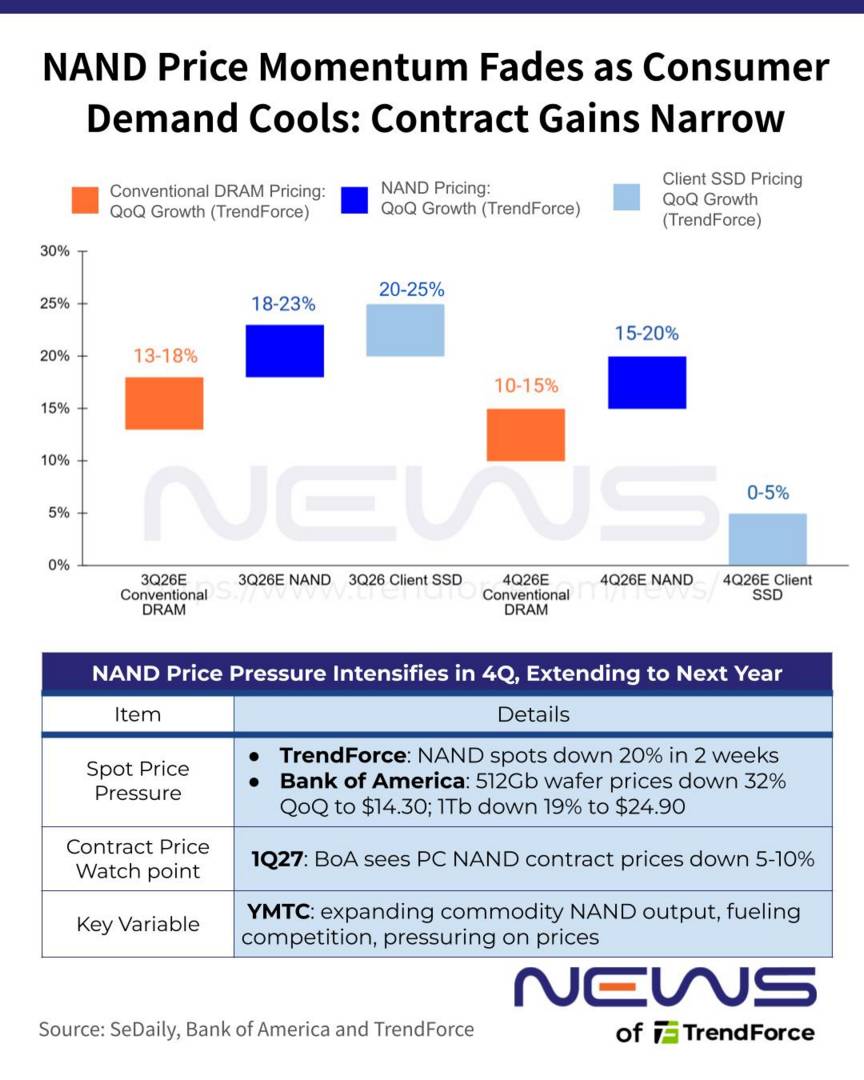
Counterpoint Research expects global smartphone shipments to fall 13.9% year-on-year to about 1.08 billion units, which may put further strain on chip makers to reduce their prices. On top of this, Chinese NAND maker YMTC may create additional pressure, as SED notes the that its 14% market share is now rapidly closing in on Samsung Electronics at 28% and SK Hynix at 19%. As a result, buyers are now demanding discounts on some products, according to SED.
That said, despite this slide, 512Gb NAND spot prices remain 121% up year-on-year, meaning current costs represent a slowdown rather than a return to historical norms. SED says Bank of America expects consumer NAND prices for PCs and smartphones to fall 5-10% on the longer-term contract market in Q1 2027.
Whether these declines translate into lower retail prices for finished devices and components remains to be seen. Either way, an official in the memory industry told SED that, “unlike DRAM, the industry broadly agrees that NAND cannot sustain the steep price gains seen so far,” so there’s always hope.