

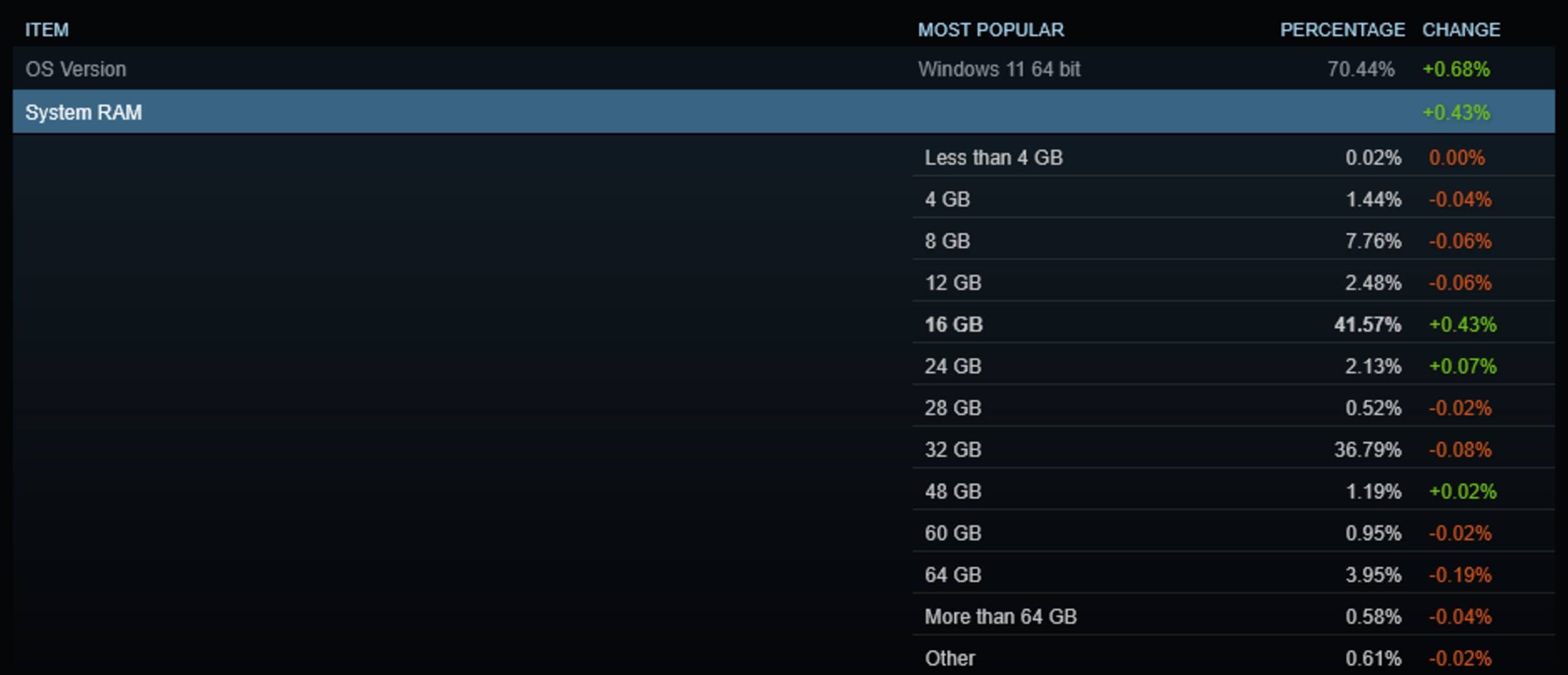
Valve has released its June Steam Hardware Survey, showing a shift in memory and storage preferences, as high prices bite. The systems surveyed this month had less RAM and HDD/SSD capacity than in May, with 16GB of RAM dominating charts.
According to the survey, 16GB memory kits have seen a 0.43% increase compared to last month, bringing their total share of participating Steam users to 41.57%. This increase comes at the detriment of 32GB kits, which saw a 0.08% decline, bringing their share to 36.79%. The survey also shows a slight 0.07% increase in 24GB setups, which could indicate laptop users using 2x12GB, and maybe desktop users are opting for single-channel 24GB installations, or mixing and matching RAM, in the hope of upgrading further down the line.
While the Steam Survey doesn’t reflect the entire PC gaming market, as it only samples a random set of machines, it remains one of the few indicators of gaming hardware trends. Caveats aside, these findings seem to reflect current market conditions, where RAM accounts for a huge chunk of the PC budget. For reference, prices for 32GB DDR5-6000 memory kits have more than quadrupled since September last year, putting the cheapest options at £329.99. Meanwhile, £169.99, single-channel 16GB modules have become the baseline entry-level setup.
The data also shows that this increase is mainly driven by Windows systems, which marked a 0.46% increase in having 16GB of RAM, alongside a 0.11% drop in 32GB installations. In fact, Linux saw the opposite, as the percentage of 32GB machines grew by 0.53%, against a 0.44% drop in 16GB installations.
Another notable change unveiled by this month’s report is the change in storage capacity. It seems that the batch surveyed this month favoured drives below 1TB, with a preference for 750GB to 999GB capacity, which gained 0.80% share compared to last month. This change comes mainly at the cost of systems with more than 1TB, which shrank by 0.73%. That said, most machines still carry above 1TB of storage.
All of this points to a couple of possibilities. The surveyed batch may have included more budget machines, or new users are making do with lower memory and storage capacities until the situation improves. Either way, there is no doubt that current memory market conditions are horrible, locking many gamers out of much-needed upgrades.