

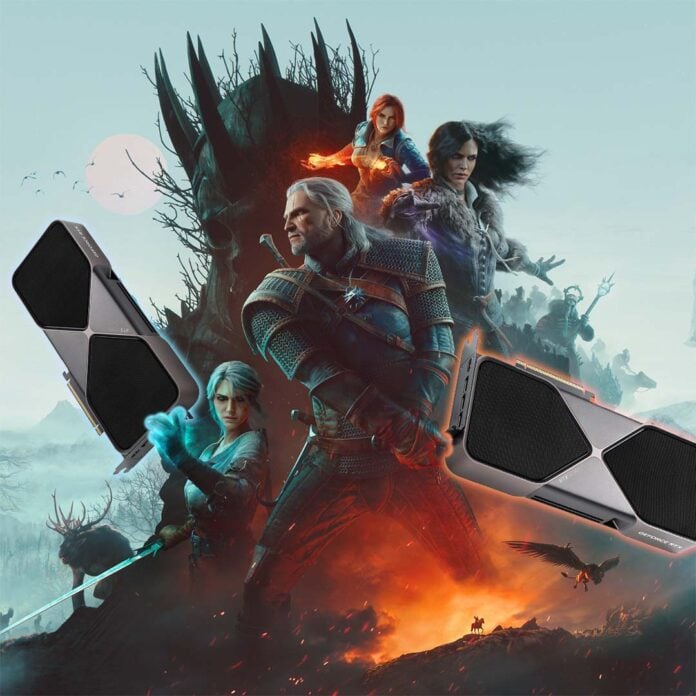
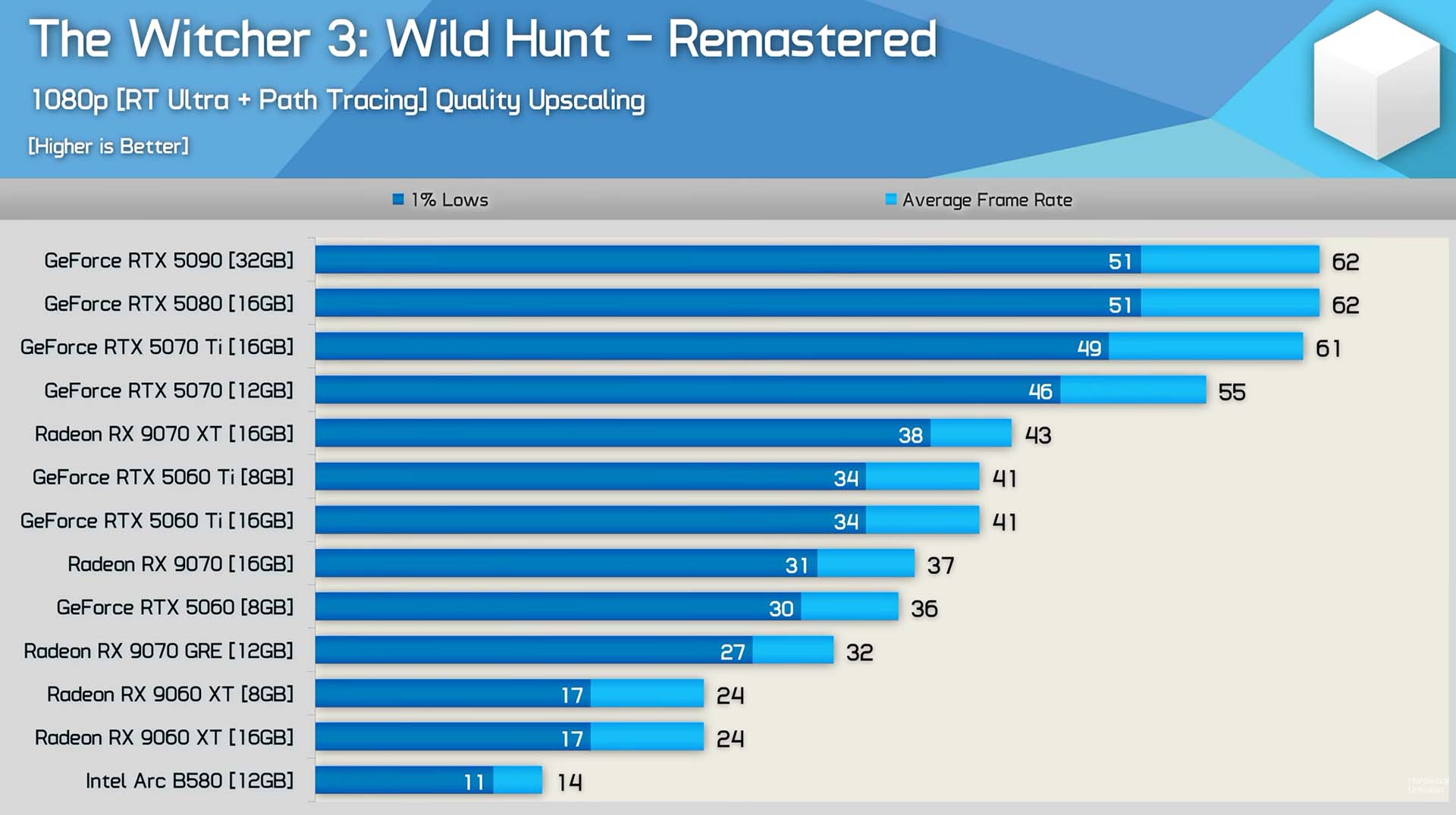
The Witcher 3 Remastered is about to launch, and early benchmarks of the tweaked-up classic show serious performance bottlenecks when running it with path tracing enabled. In fact, even Nvidia’s flagship RTX 5090 peaks at an average of 62fps when running this mode at 1080p, according to testing conducted by tech YouTube channel Hardware Unboxed. What’s more, that’s with DLSS upscaling enabled with the Quality preset.
That’s the exact same result as an RTX 5080, and even an RTX 5070 Ti is just 1fps behind. It looks as though these GPUs are unable to really stretch their legs beyond 60fps. Indeed, the RTX 5090 achieves a very similar average of 59fps at 4K in the same test, with DLSS Performance upscaling enabled. It’s playable, but 62fps at 1080p is a long way from expectations for an RTX 5090.
It’s hard to see exactly what’s going on here, but Hardware Unboxed does point out that its Ryzen 7 9800X3D was only hitting around a 35% load in these tests, with none of its cores maxed out to 100%. There may well be some more performance to squeeze out of this game with future optimisations.
The channel’s benchmark test was also focused on a busy area in Novigrad, and said that the path-traced frame rate does go up to around 80fps once you get outside this area. Even then, though, there’s clearly a bottleneck, as the RTX 5080 still runs at the same speed as a 5090.
To make matters worse, path tracing doesn’t appear to look great in this game. “Path tracing is very underwhelming in this title,” says Hardware Unboxed, “and in some cases just looks bad.” Several examples are given in the full test video, including the screenshot below, which compares Yennefer with standard ray tracing on the Ultra preset to the same footage with path tracing (an extra setting that appears once you’re on the Ultra RT preset).
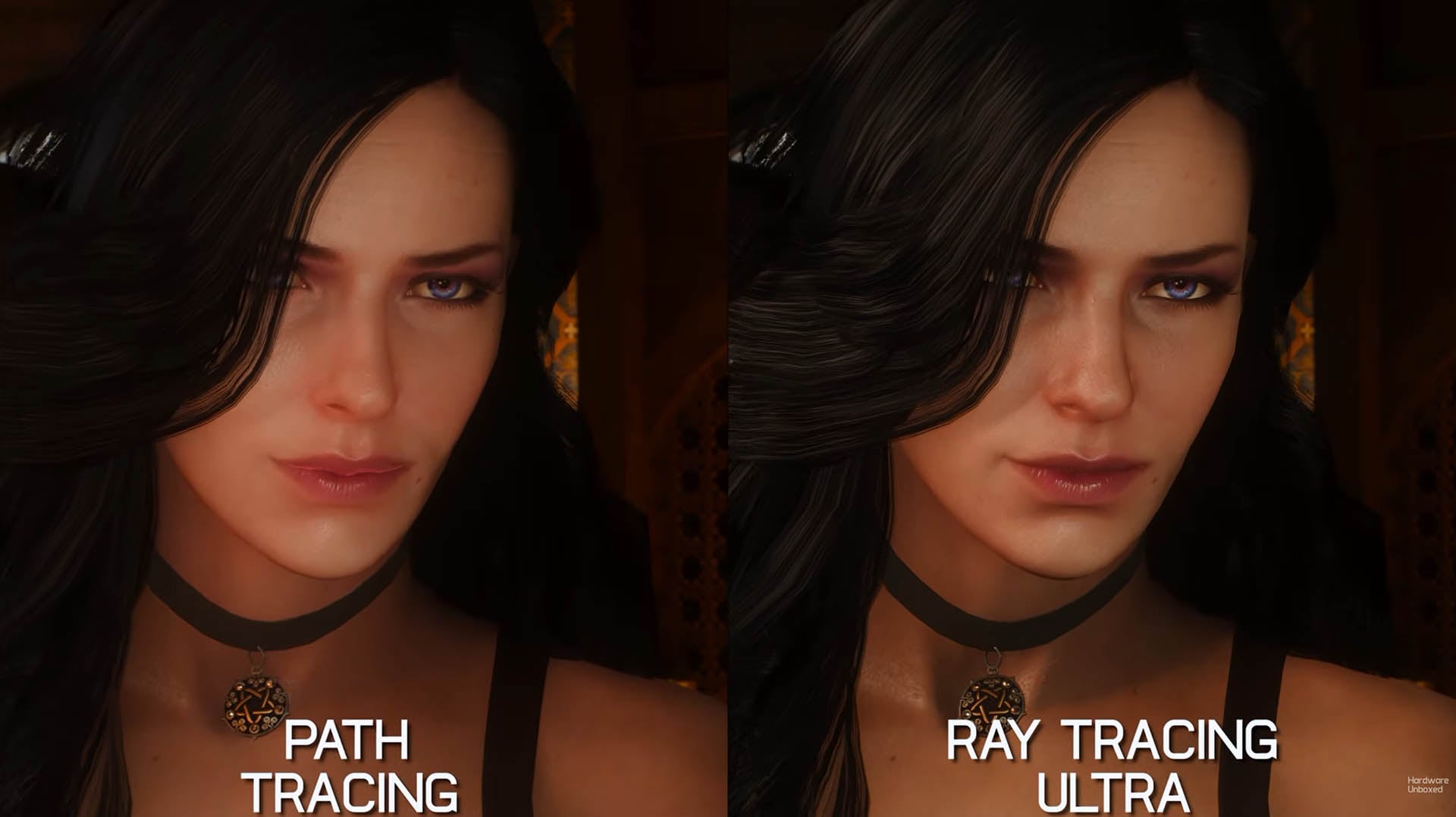
There’s certainly more definition in shadows with the standard RT Ultra setting, while the overall result looks a bit washed out and over exposed when path tracing is enabled. Further examples show that path tracing has a bit of a warmer look than the other modes, with an emphasis on red and orange tones.
On the plus side for Nvidia, its GPUs can at least handle path tracing in this game. Comparatively, AMD’s Radeon RX 9070 XT only averages 43fps at 1080p and drops right down to 23fps at 4K, using comparative levels of FSR upscaling.
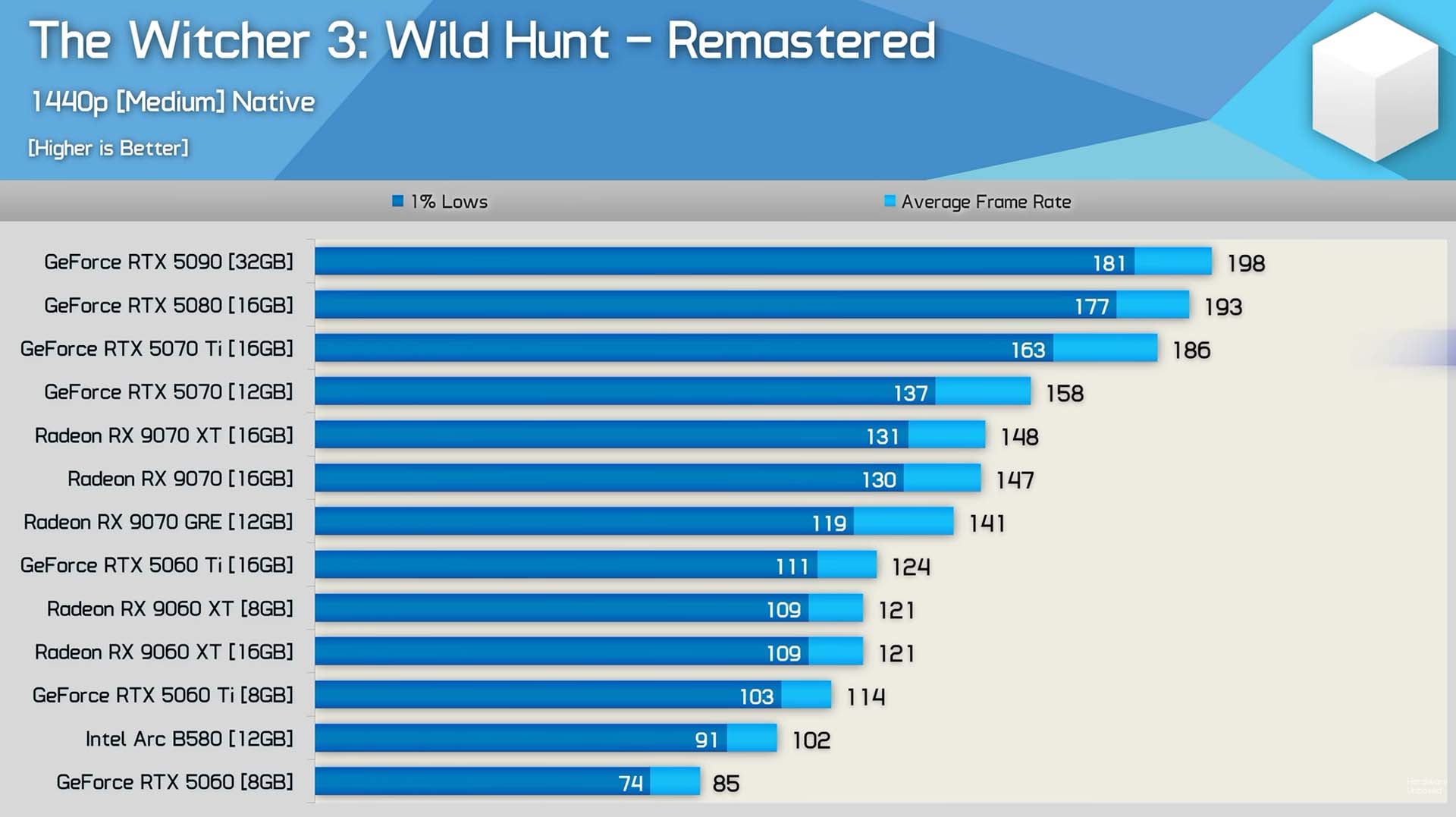
The 60fps Nvidia path tracing cap isn’t the only anomaly in the results either. If you run the game at its standard Medium preset, all the Radeon GPUs appear unable to get past 150fps, while the Nvidia cards can pull ahead of their GPU power allows it. This preset is also a high point of the game’s settings, according to Hardware Unboxed, as it runs smoothly while offering superior visuals to the original game.
Even modest GPU hardware can handle the remastered game well at this setting with a 2560×1440 resolution, with an Intel Arc B580 averaging 102fps, an RTX 5060 running at 85fps, and a Radeon RX 9060 XT 8GB achieving a solid result of 121fps.
Meanwhile, the RT Ultra preset appears to be the best mode for visuals without the ruinous performance impact of path tracing. Hardware Unboxed points to AMD’s Radeon RX 9070 GRE as the minimum card to run the game at these settings at 2560×1440, where it averages 58fps with a 49fps 1% low.
Hopefully there will be new drivers and game optimisations coming soon to help improve performance here. If you haven’t played The Witcher 3: Wild Hunt yet, you should absolutely give it a go, as well as its two excellent expansions.