

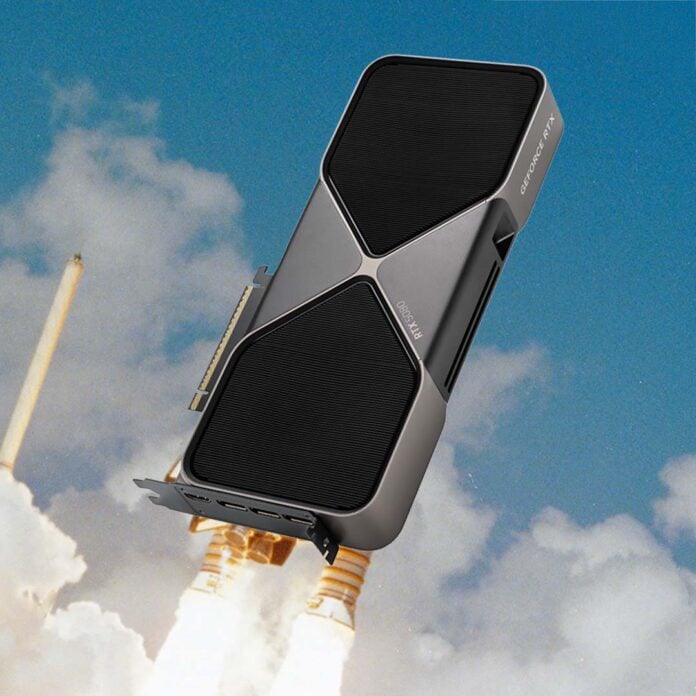
A tech enthusiast has just put Microsoft’s recent update to its DXR (DirectX Raytracing) API to the test on a GeForce RTX 5080, and the results are impressive. Thanks to the power of Clustered Geometry, the Blackwell GPU enjoyed enormous ray tracing performance gains in excess of 200x relative to standard techniques.
In case you missed it, Microsoft unveiled its major DXR API update at the end of October. The key innovations here are the aforementioned Clustered Geometry and Partitioned Top-Level Acceleration Structures (PTLAS), which both aim to massively improve the efficiency of ray-traced rendering on graphics cards.
Microsoft had shown the features at work on a Radeon RX 9070, but Osvaldo Doederlein, senior software engineer at Google, has just put Clustered Geometry to work on a GeForce RTX 5080. Without beating around the bush, the performance boost is phenomenal.
Same benchmark as previous thread(*), CG Off→On:
🖥️Rebuild: 720ms → 1.0ms
🖥️DispatchRays: 1.8ms → 2.0ms
🖥️VRAM: 4,716 MB → 267 MB
🖥️Framerate: 1.4fps → 310fps(*: Yes I waited the animation to run until the EXACT frame as before and clicked pause😎)
https://t.co/GqviwCShEP— Osvaldo Pinali Doederlein (@opinali) November 5, 2026
Using traditional techniques for ray-traced rendering in a stress test, the graphics card chugged along at an unsightly 1.4fps, all while consuming 4,716MB of VRAM. Crucially, rebuild times sat at 720ms. That last measurement describes how long the CPU and GPU take to build acceleration structures around objects in scenes so that rays understand what they’ve hit.
With Clustered Geometry in the mix, the frame rate skyrocketed to 310fps, while VRAM usage fell to a piddly 267MB and rebuild time sped up dramatically to just 1ms. Ray dispatch time, which describes how quickly rays enter the rendering pipeline, went up slightly (2.0ms vs. 1.8ms) but this clearly has no major bearing on performance.
I recommend reading Fahd’s initial coverage for an in-depth breakdown of Clustered Geometry, but I’ll give you a brief overview here. In short, the feature aims to reduce the compute load of repeatedly building bottom-level acceleration structures (BLAS), by breaking down the render into smaller clusters of triangles that can be reused as objects within a scene change, through animation or other variables.
While we’re yet to see Clustered Geometry at work in an application, Nvidia has already released a similar technology by way of RTX Mega Geometry. In Gears of War: E-Day, as shown in the video above, the feature can demonstrably reduce VRAM usage by 2GB and boost performance by 6fps on a GeForce RTX 5090.
While those improvements are far less impressive than those in the test scene above, one shouldn’t expect the same dramatic swings in a geometrically simple test scene to translate to a more complex game world. Regardless, any move to reduce the compute footprint of ray tracing is welcome.
For more ray tracing chatter, check out our picks of the best graphics cards on the market today.