
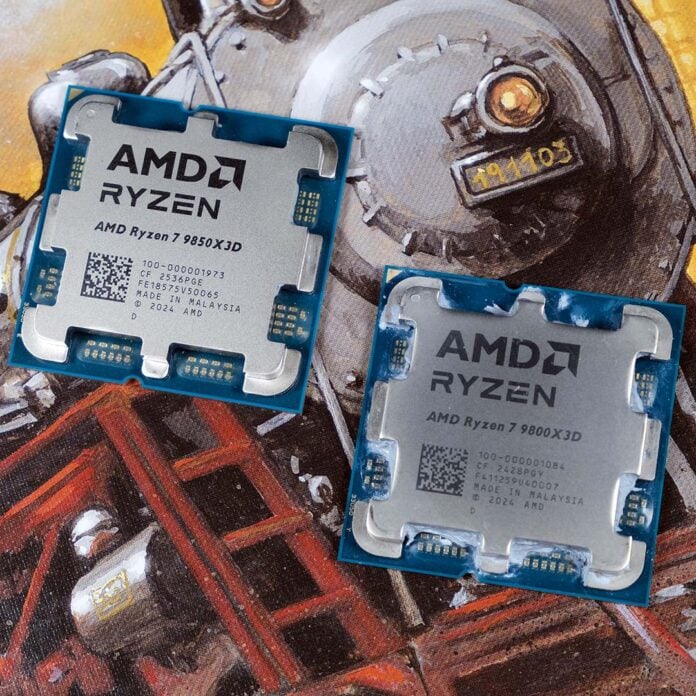
There can be only one king of gaming CPUs, and the Ryzen 7 9800X3D is facing a fresh challenge for its throne from its 9850X3D sibling. Pitting the two processors against one another makes for a close-fought battle, where every point and frame decides which chip deserves to the rule the roost.
Fresh from our Ryzen 7 9850X3D review, I’ve consolidated our performance data to focus on how the newcomer stacks up against the 9800X3D. Through our computing and gaming benchmarks, complete with pricing commentary, you’ll be able to quickly decide which CPU is the right pick for your PC.
Specs
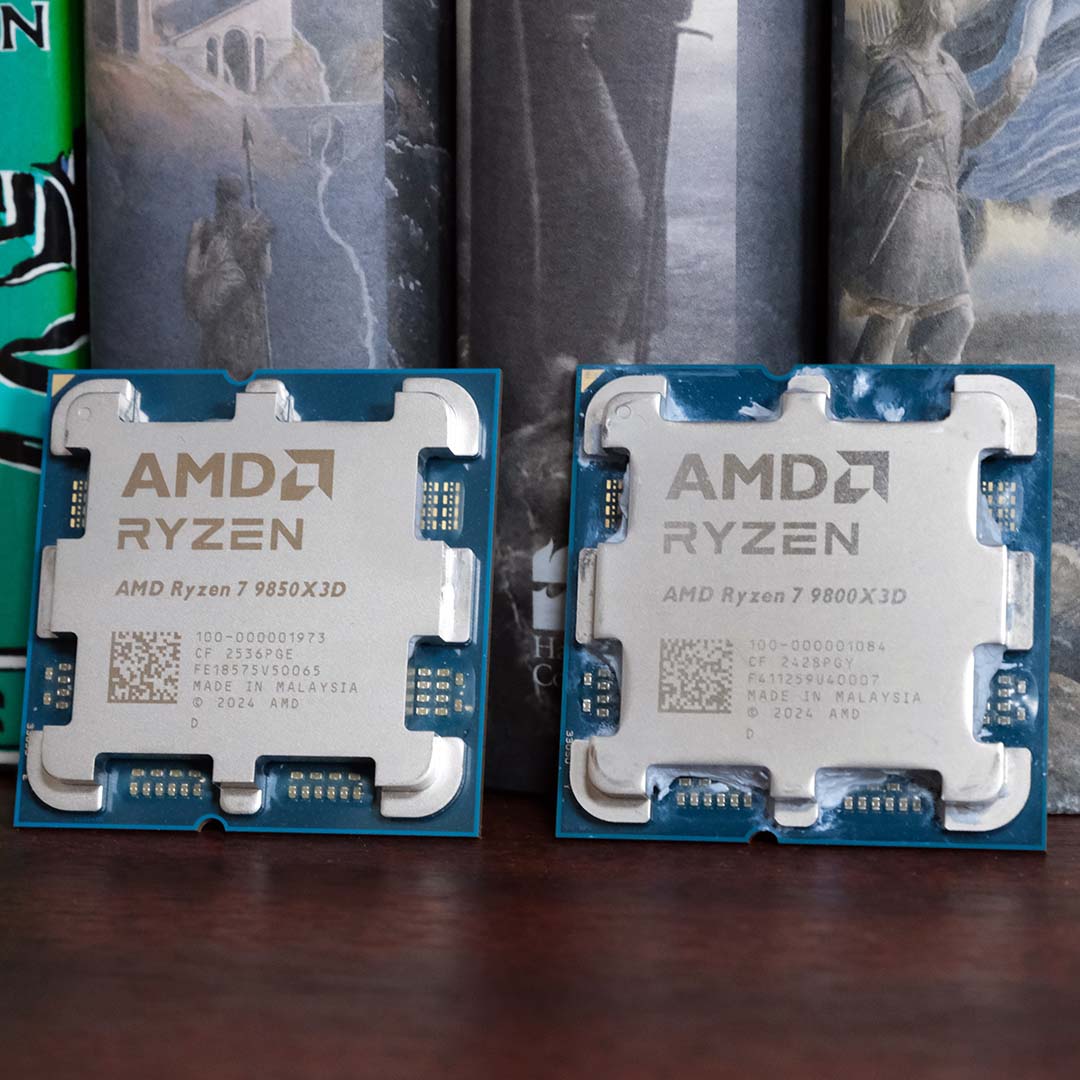
The only meaningful metrics that separate the Ryzen 7 9850X3D and 9800X3D is maximum boost clock frequency and price. Outside of these two categories, the two processors are identical.
Both CPUs sport eight Zen 5 cores and 16 threads, providing plenty of processing headroom for contemporary applications and games. Each processor also has 96MB of L3 cache, courtesy of AMD’s 3D V-Cache technology, enabling them to often boost gaming performance well beyond the capabilities of otherwise equivalent non-X3D chips.
| Ryzen 7 9850X3D | Ryzen 7 9800X3D | Ratio | |
|---|---|---|---|
| Release date | January 2026 | November 2024 | – |
| Platform | AM5 | AM5 | – |
| Cores | 8 | 8 | 1.00 |
| Threads | 16 | 16 | 1.00 |
| TDP | 120W | 120W | 1.00 |
| Architecture | Zen 5 | Zen 5 | 1.00 |
| L2 cache | 8MB | 8MB | 1.00 |
| L3 cache | 96MB | 96MB | 1.00 |
| Base clock | 4.7GHz | 4.7GHz | 1.00 |
| Boost clock | 5.6GHz | 5.2GHz | 1.08 |
| Launch MSRP | $499 / £439 | $479 / £449 | 1.04 / 1.02 |
Arriving with a 5.6GHz boost clock out of the box, the Ryzen 7 9850X3D runs 400MHz (+8%) faster relative to the 9800X3D. This higher frequency doesn’t come with a larger TDP, remaining at 120W, but power consumption is slightly higher on the new chip in practice as I’ll discuss in more detail later.
You’ll pay a small premium of $20 / £10 (+4% / +2%) for the privilege of the Ryzen 7 9850X3D’s higher boost clocks, relative to the 9800X3D’s MSRP. However, time has chipped away at the latter’s launch price, with the retail price difference sitting at $56 / £50 at the time of writing. This understandably complicates the value proposition of AMD’s new chip, but doesn’t negate it entirely.
How we test
The Club386 test bench has recently housed both the Ryzen 7 9850X3D and 9800X3D, tested back-to-back in the last week. Armed with a GeForce RTX 5090 Founders Edition, this setup gives about as much road for these processors to run on that you could ask for.
Test PC specs
Club386 carefully chooses each component in a test bench to best suit the review at hand. When you view our benchmarks, you’re not just getting an opinion, but the results of rigorous testing carried out using hardware we trust.
Shop Club386 test platform components:
CPU: AMD Ryzen 7 9850X3D
Cooler: Arctic Liquid Freezer III
Motherboard: MSI MEG X670E ACE
GPU: Nvidia GeForce RTX 5090 Founders Edition
Memory: 64GB Kingston Fury Beast DDR5
Storage: 2TB WD_Black SN850X NVMe SSD
PSU: be quiet! Dark Power Pro 13 1,300W
Chassis: Fractal Design Torrent Grey
I’ve limited my gaming benchmark results to 1080p resolution (FHD), so that any differences in frame rate will be down to the CPUs above all. Of course, I’ve also run through our usual assortment of computing and content creation tests.
Apps
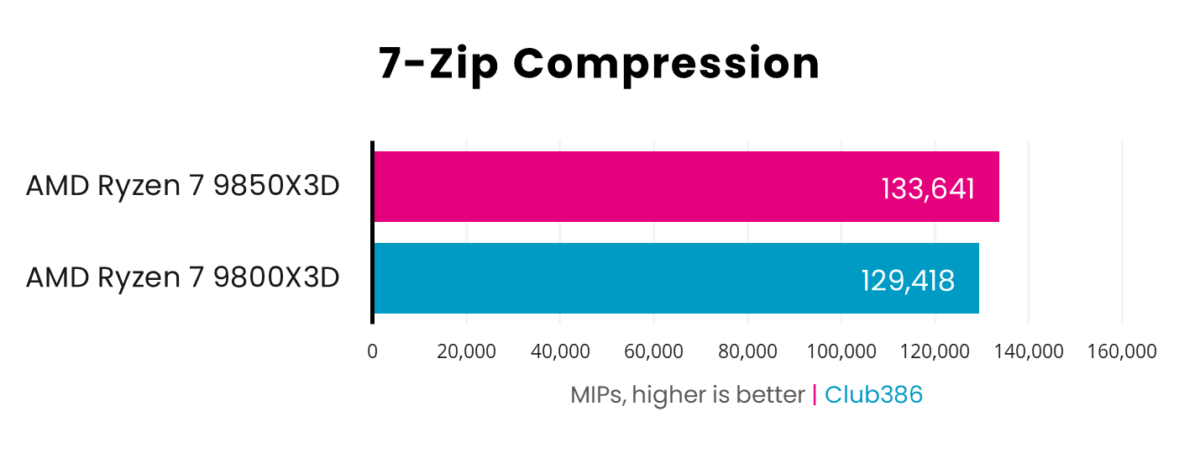
Kicking things off with a bout of 7-Zip compression, the Ryzen 7 9850X3D’s takes the first win with 133,641MIPS (million instructions per second). This represents a small 3% lead, as the 9800X3D isn’t far behind at 129,418MIPS.
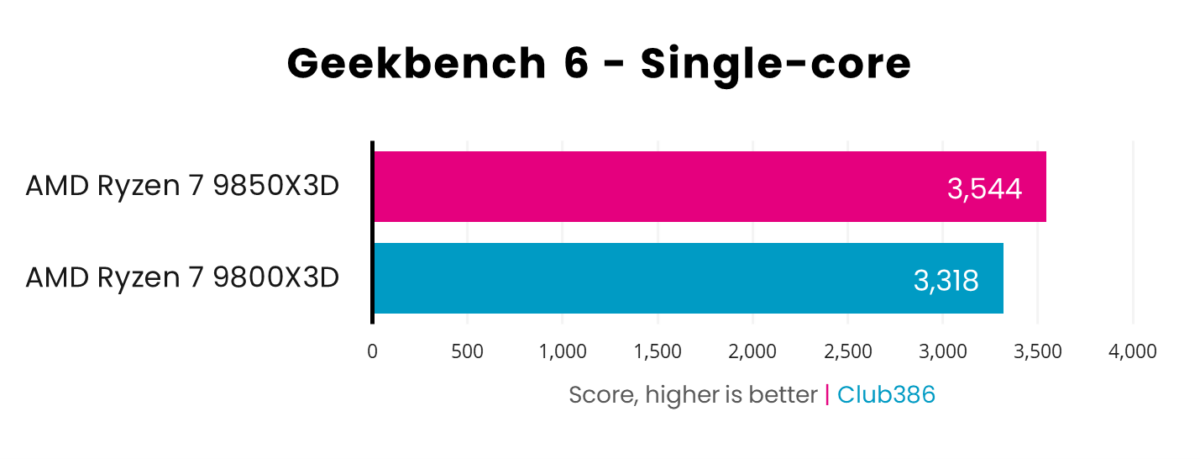
Superior maximum boost clock begets better single-core performance, as the Ryzen 7 9850X3D aptly demonstrates in Geekbench 6. Scoring 3,544pts, the processor’s 7% improvement over 9800X3D’s score of 3,318pts create a near-linear relationship with its 8% higher operating frequency.
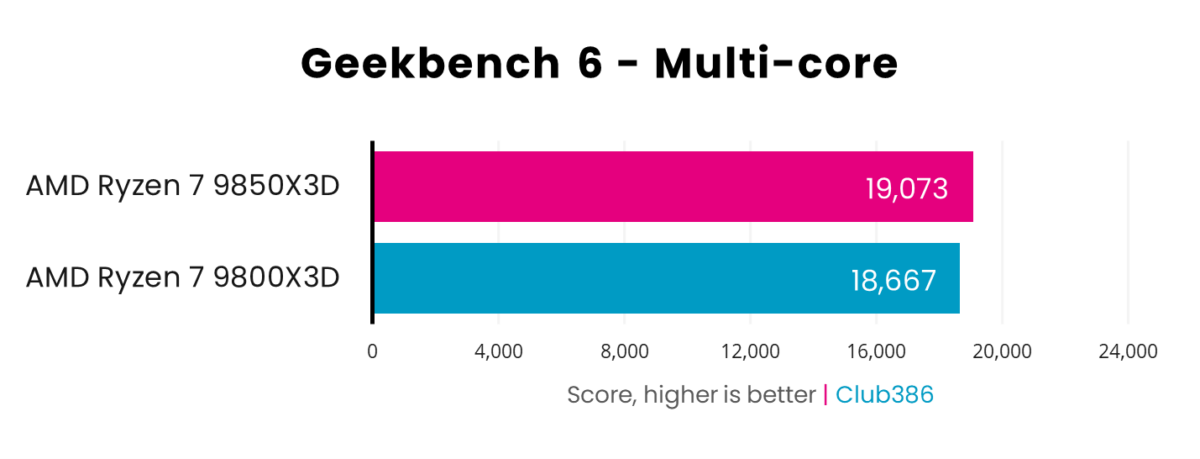
Switching gears to multi-core performance, the Ryzen 7 9850X3D still comes out on top with 19,073pts in Geekbench 6. However, the gap between each processor is much smaller relative to single-core, with the top dog enjoying a mere 2% lead over the 9800X3D’s 18,667pts.
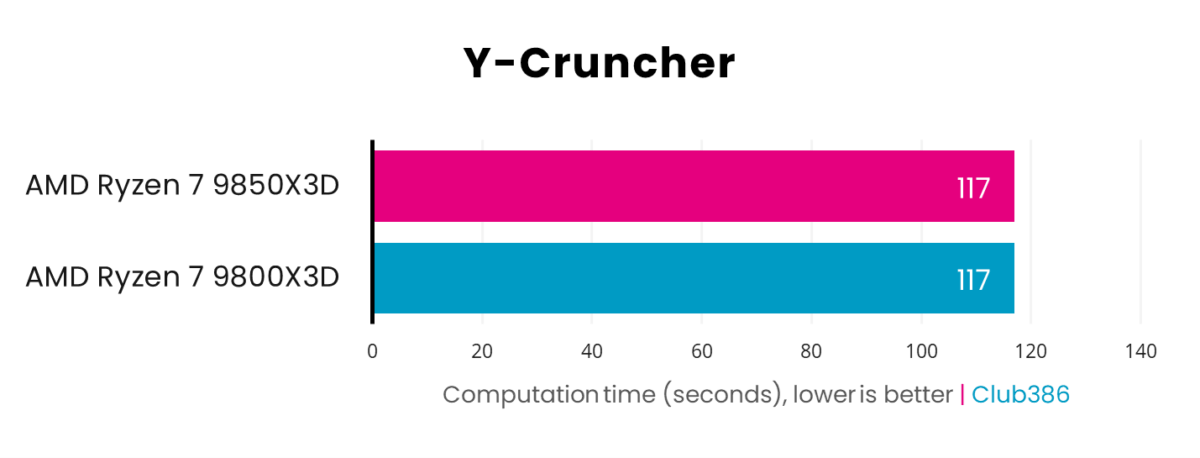
Through calculating Pi to 5b digits, we have our first dead heat. Both Ryzen 7 9850X3D and 9800X3D take 117 seconds to complete the task, as the former’s higher boost clock advantage proves moot in this case. The reason for this rests with the benchmark being mostly multi-core in nature, where both chips boost to a similar speed.
Content creation
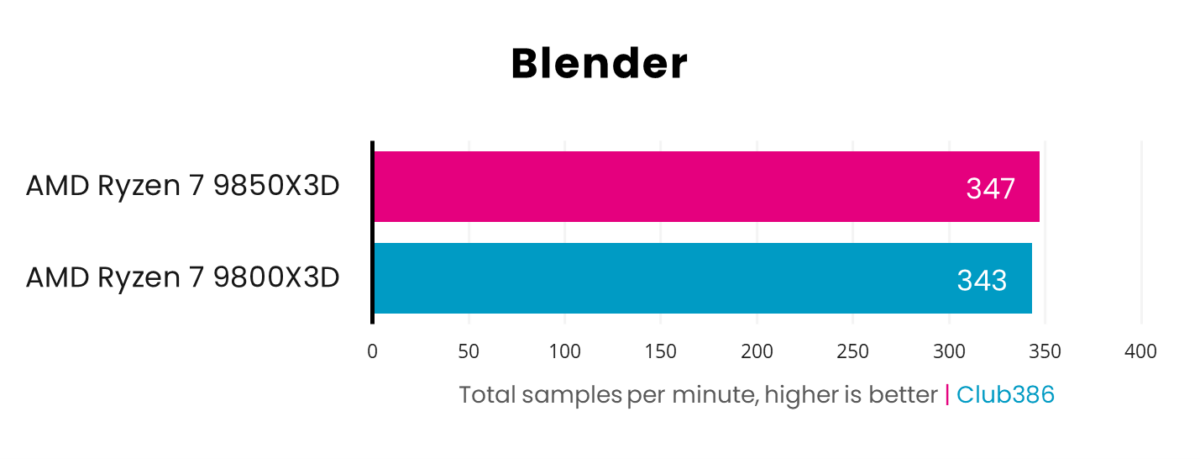
The integrated graphics on the Ryzen 7 9850X3D and 9800X3D are the same, composed of a paltry two graphics cores running at 2.2GHz. As such, it’s processing grunt that makes the difference, but the newer chip pulls ahead by just 1%.
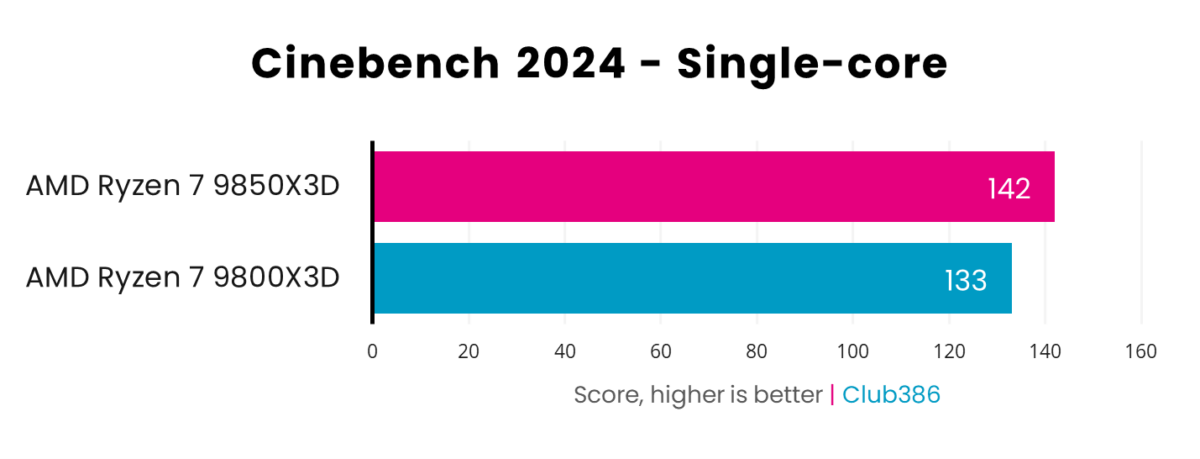
Once again, the faster frequencies of the Ryzen 7 9850X3D give the chip a reasonable advantage in the Cinebench 2024 single-core benchmark. Earning 142pts, to the 9800X3D’s still-respectable 133pts, that 7% improvement from the 8% higher clock speed we saw in Geekbench 6 materialises once again.
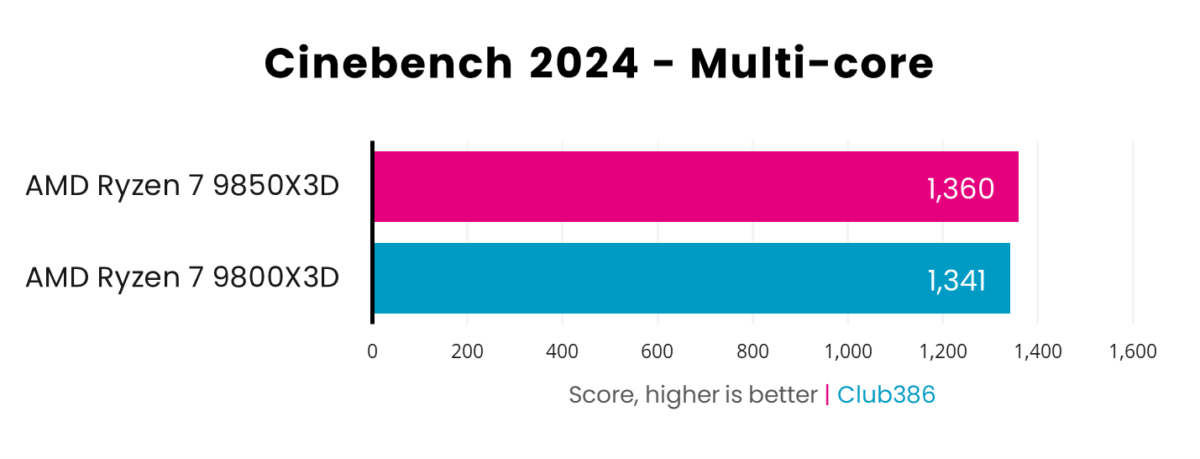
Swapping to a Cinebench 2024 run, the Ryzen 7 9850X3D pips the win with 1,360pts to 9800X3D’s 1,341pts. That’s a minor 1% lead to the newer processor, as its greater frequency headroom doesn’t provide much uplift here.
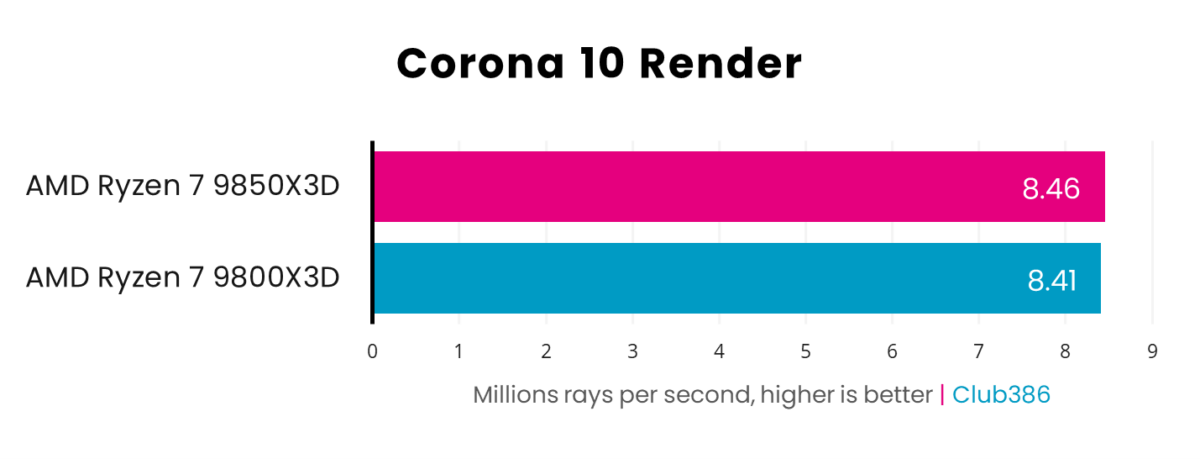
Corona 10 Render further reinforces that the Ryzen 7 9850X3D doesn’t offer much in the way of improvements for multi-core performance. Handling 8.46M rays per second, the new chip is just 1% ahead of the 9800X3D which processes 8.41M.
Memory
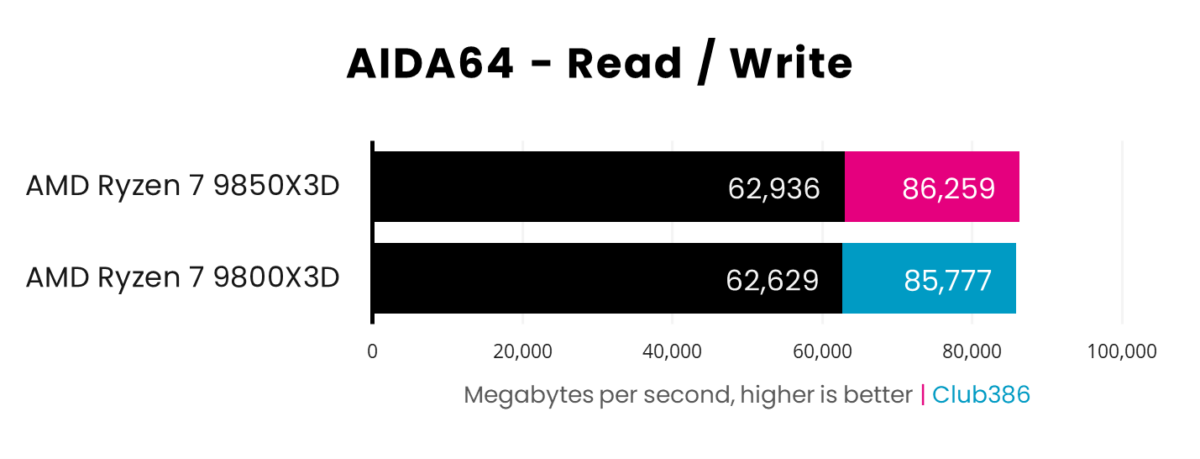
Running through AIDA64 benchmarks, the Ryzen 7 9850X3D exhibits slightly higher read and write memory bandwidth. However, the chip’s results are almost indistinguishable from the 9800X3D, with advantages of 307-482MB/s amounting to a 1% improvement at most.
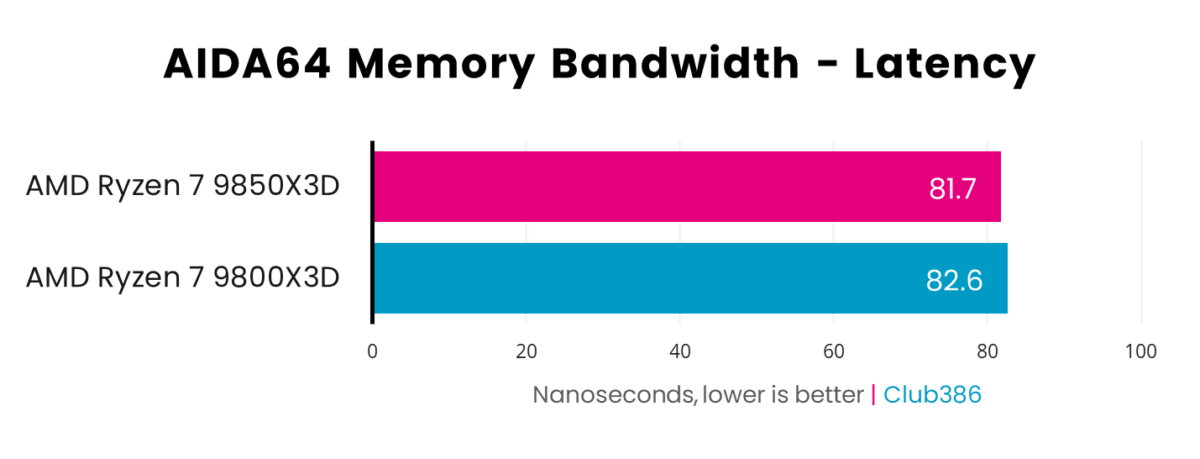
Less than a single nanosecond separates the two processor’s memory latency. The Ryzen 7 9850X3D comes out on top, but this is a literal blink-and-you’ll-miss-it kind of lead. In fact, I’d go on to say the higher peak boost clock is what reduces latency a smidge.
Gaming
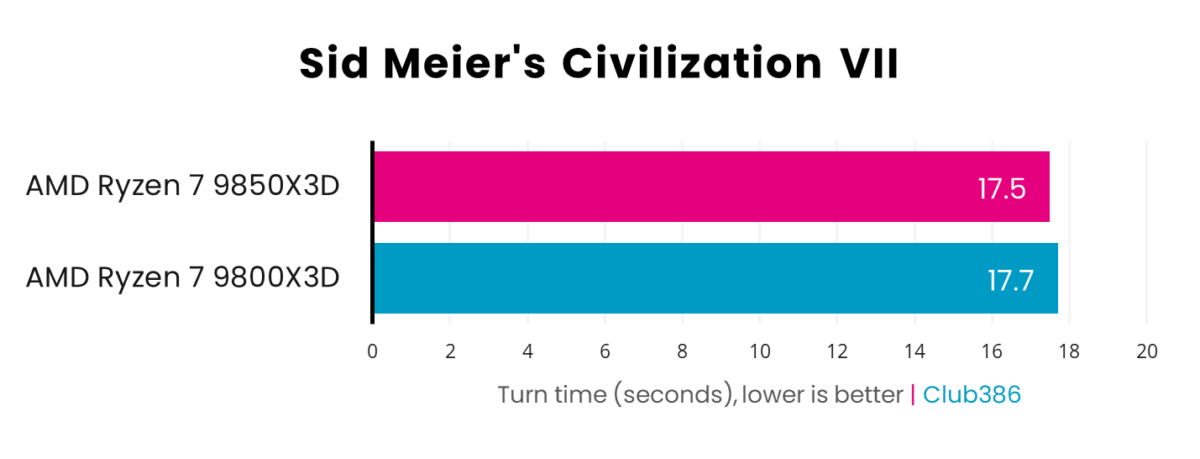
Sid Meier’s Civilization VII AI Benchmark serves as a proper computational crunch for both processors. Turn times stay under 18 seconds on each chip, but Ryzen 7 9850X3D is a touch nippier by 0.2s.
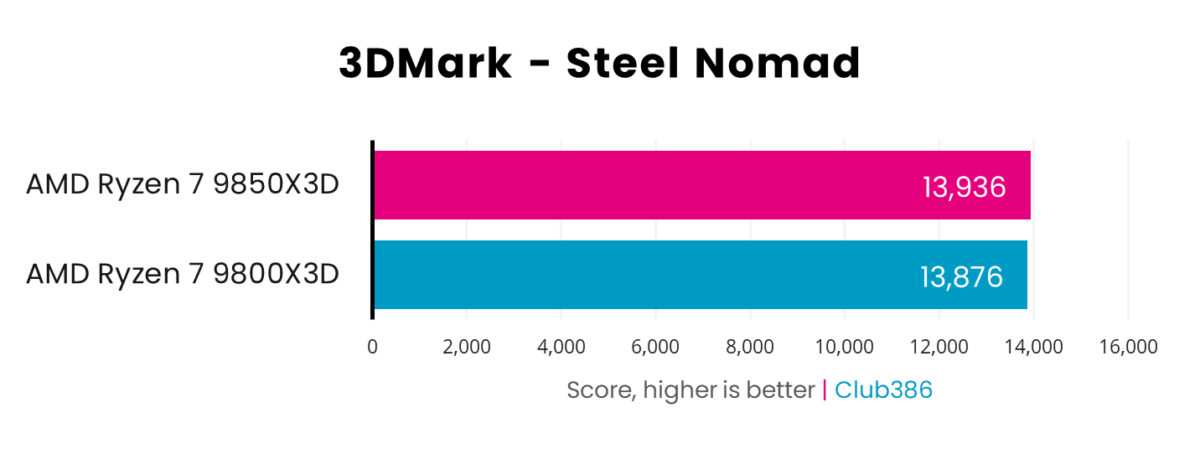
Loading up 3DMark Steel Nomad unsurprisingly delivers a photo finish, with just 60pts separating the two processors. Even though we’re pushing 139fps in this raster benchmark, the graphics card remains the primary bottleneck.
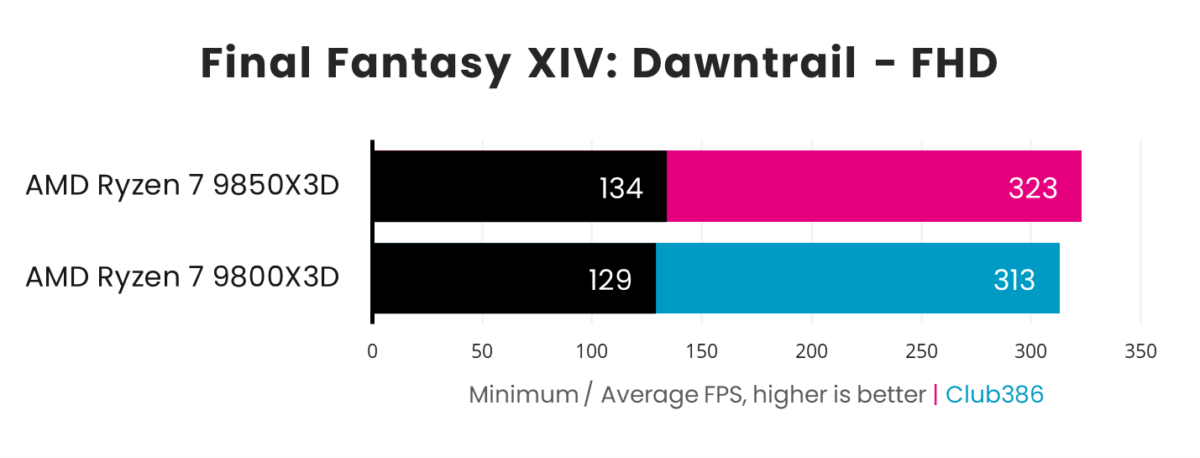
Switching to real-world frame rates, the Ryzen 7 9850X3D delivers a 323fps average frame rate in Final Fantasy XIV: Dawntrail. That’s a modest 3% improvement over the 9800X3D’s 313fps average, but it’s the greatest performance improvement we’ll see.
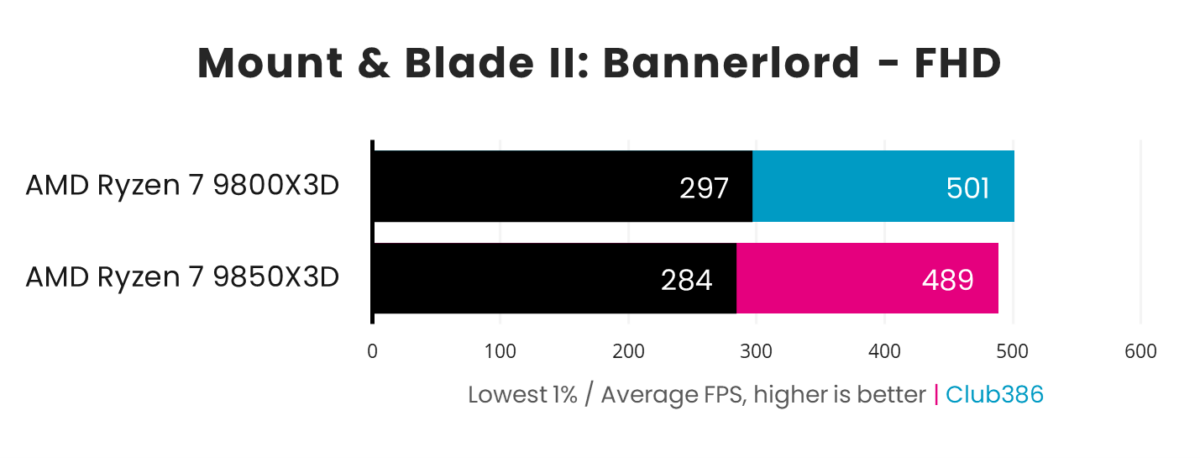
Saddling up in Mount & Blade II: Bannerlord provides an exceptional upset for the Ryzen 7 9850X3D, as it concedes victory to the 9800X3D to the tune of 12fps. These results were repeatable across runs, so I’m willing to blame the game more than the new processor in this case as there’s no reason the newer chip should be losing here.
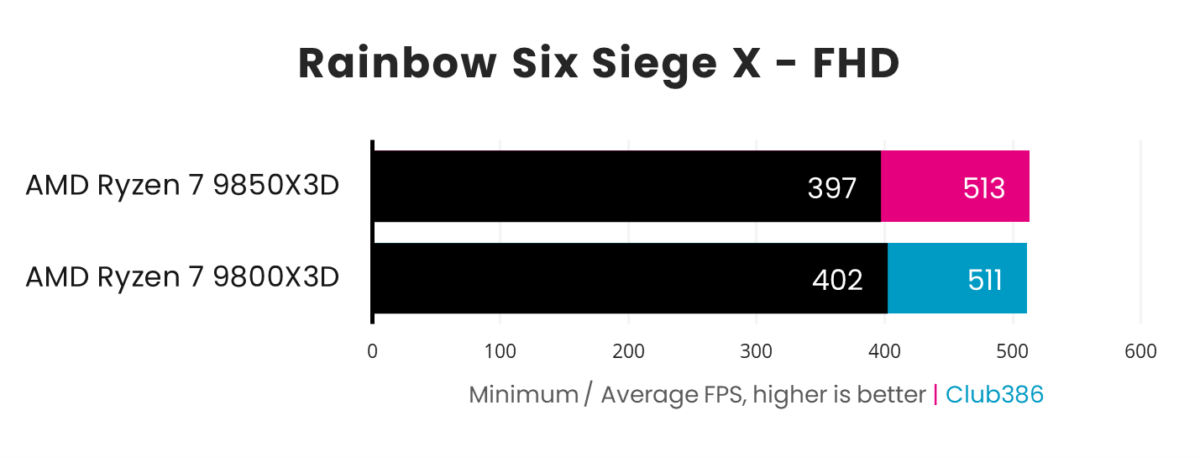
The Ryzen 7 9850X3D does breach the performance ceiling of Rainbow Six Siege X that Ryzen 7 9800X3D establishes, but only by 2fps on average and with a minimum frame rate that’s 5fps worse off. Every frame matters in competitive first-person shooters, and both processors keep rounds running butter smooth.
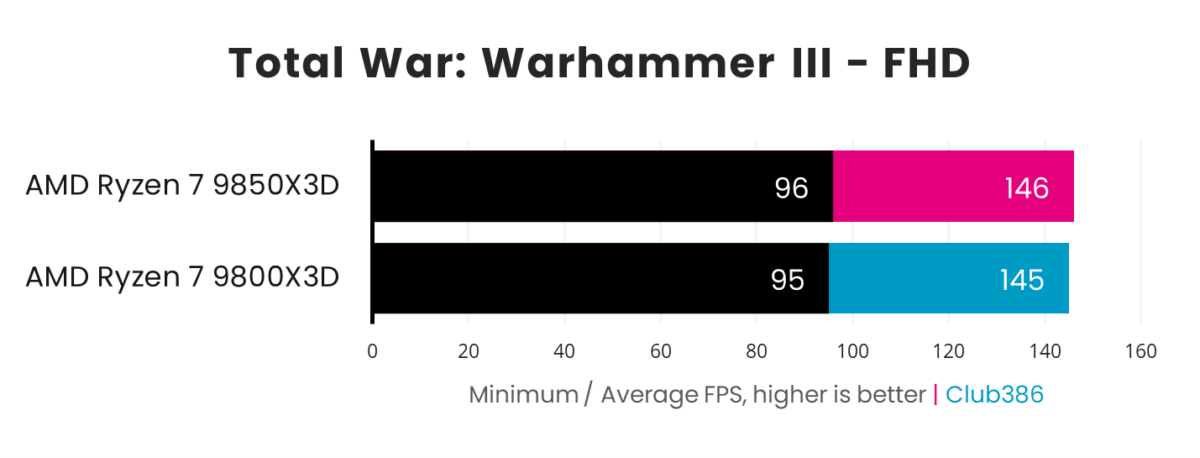
Rounding off our collection of raster tests, there’s just a single frame separating the Ryzen 7 9850X3D and 9800X3D in Total War: Warhammer III, across minimum and average frame rates. To be fair to the CPUs, even the 16-core Ryzen 9 9950X3D can’t push performance higher in the game’s Mirrors of Madness benchmark, so it’s an impressive result all-around.
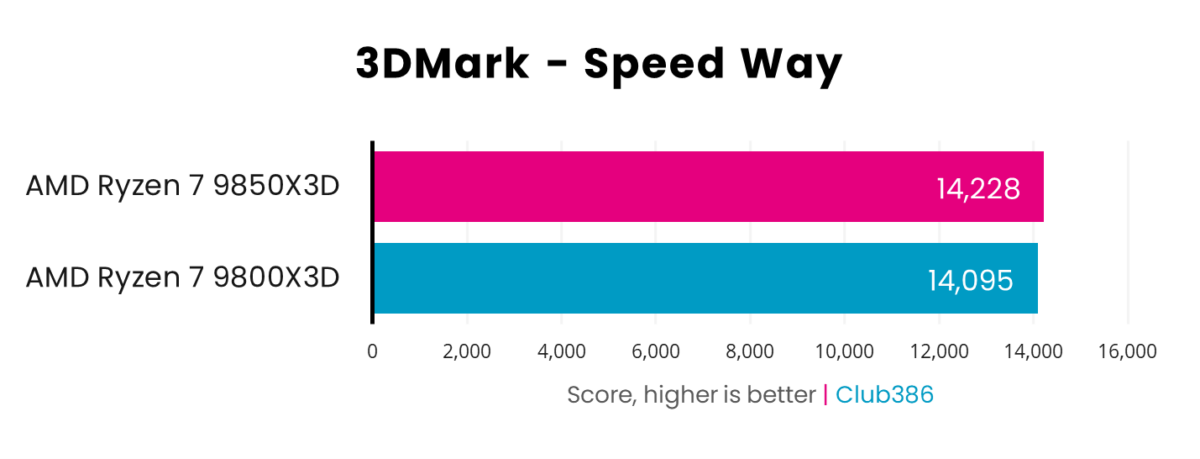
Entering the realms of ray tracing, 3DMark Speed Way reveals a 1fps (1%) lead for the Ryzen 7 9850X3D. This result is illustrative of the majority of ray tracing workloads, but there are occasional real-world scenarios where the gap between 9800X3D widens.
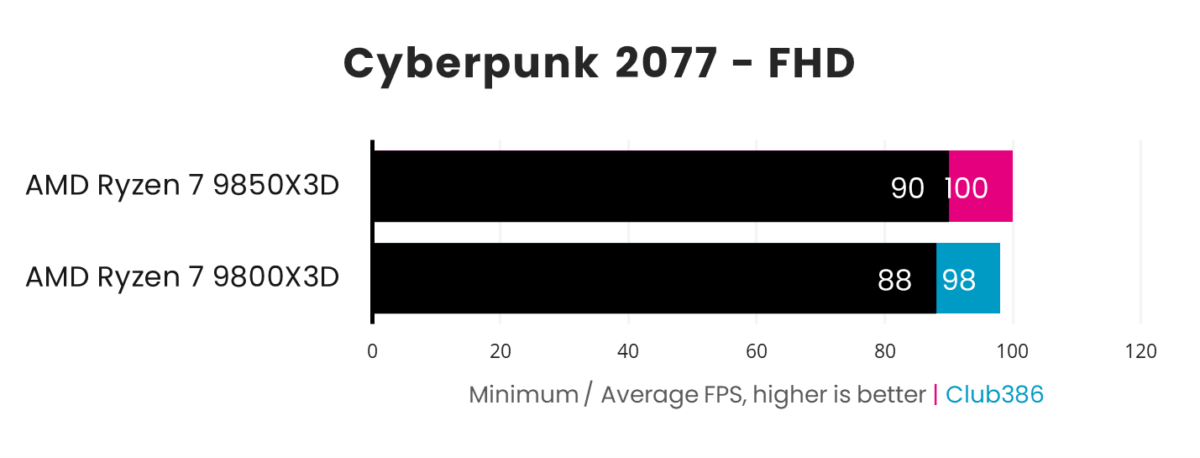
Even while the GeForce RTX 5090 faces the extremely demanding rendering duties of a patch-traced Cyberpunk 2077, the Ryzen 7 9850X3D finds room to boost performance ever so slightly. We’re only talking about a 2fps (+2%) advantage over 9800X3D, but it’s a win for the newer CPU regardless.
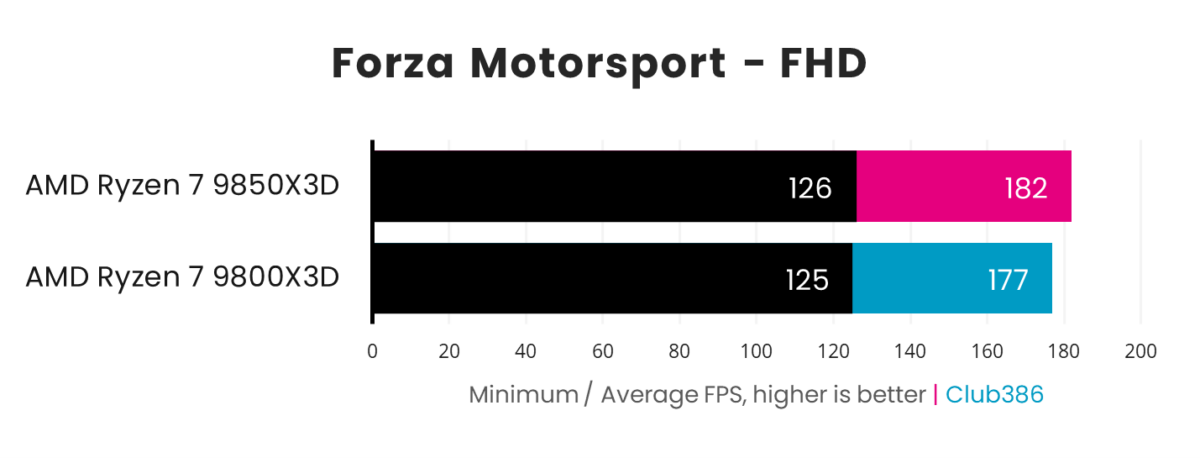
Finally, Forza Motorsport sees the Ryzen 7 9850X3D pull ahead of the 9800X3D by 3%. Again, this is the best percentile improvement we’ve observed with the new chip when it comes to real-world frame rates.
Vitals
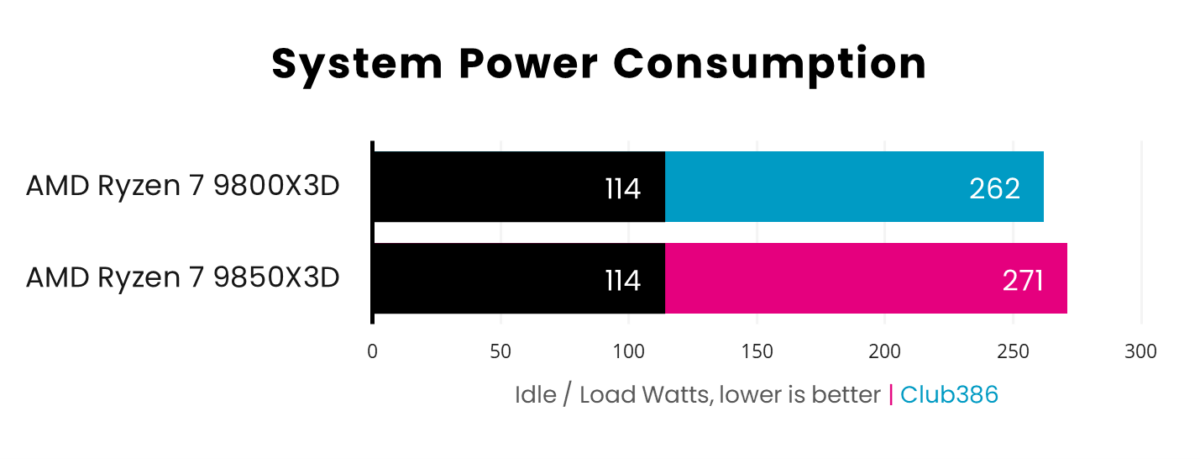
Recording power consumption of the Ryzen 7 9850X3D and 9800X3D during a multi-core Cinebench 2024 run, I observed a difference of 9W (+3%) on the more-powerful processor. Higher clocks typically require more watts, so this comes as no surprise, but at least the increased footprint isn’t enormous.
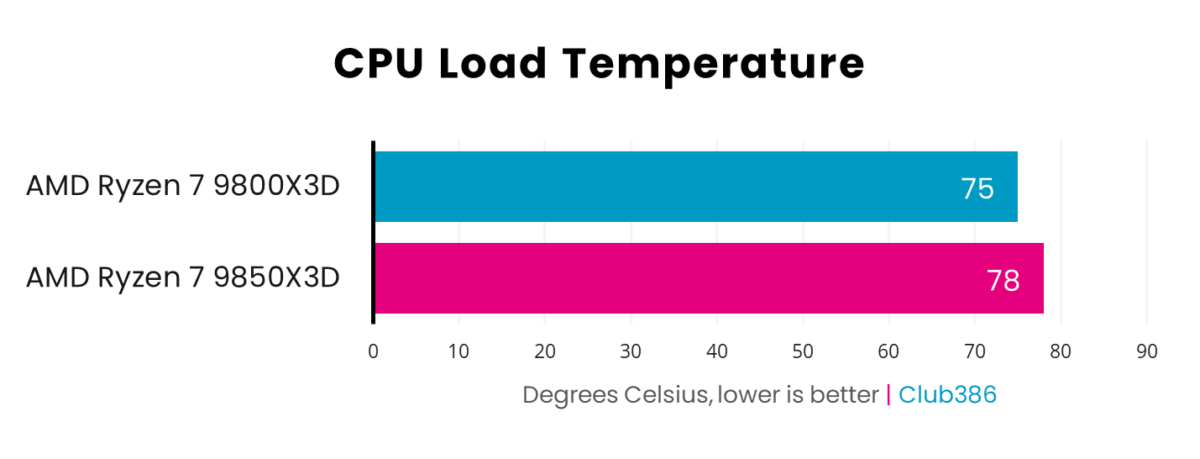
More watts leads to higher temperatures, too, with the Ryzen 7 9850X3D peaking at 78°C under load. 3°C separates the CPU from the Ryzen 7 9800X3D, which tops out at 75°C in the test bench. Neither chip is close to thermal throttling, making this closer to a draw than anything else.
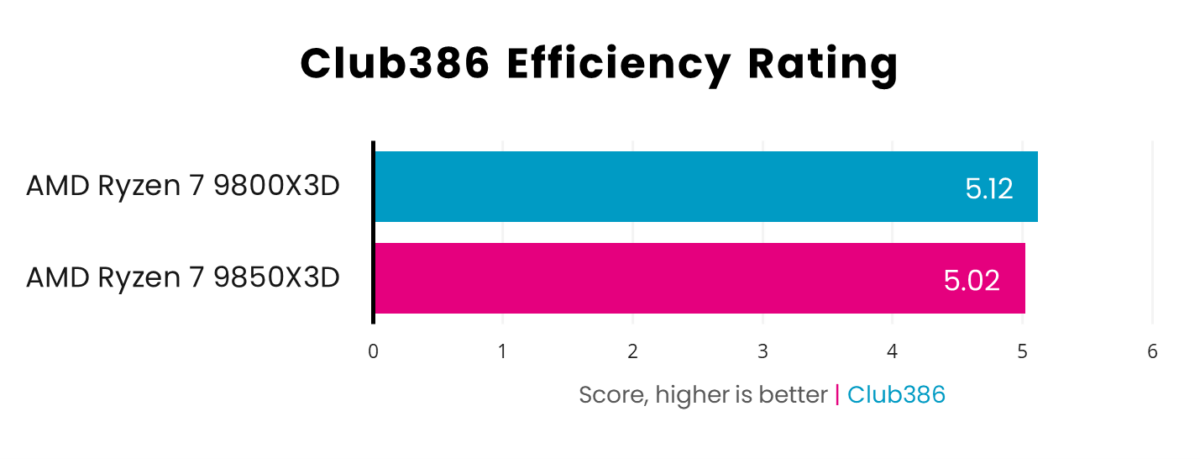
Taking the Cinebench 2024 multi-core score of each processor and dividing it by their peak power consumption results in the Club386 Efficiency Rating. The Ryzen 7 9850X3D expectedly loses out here, but not by much.
Conclusion
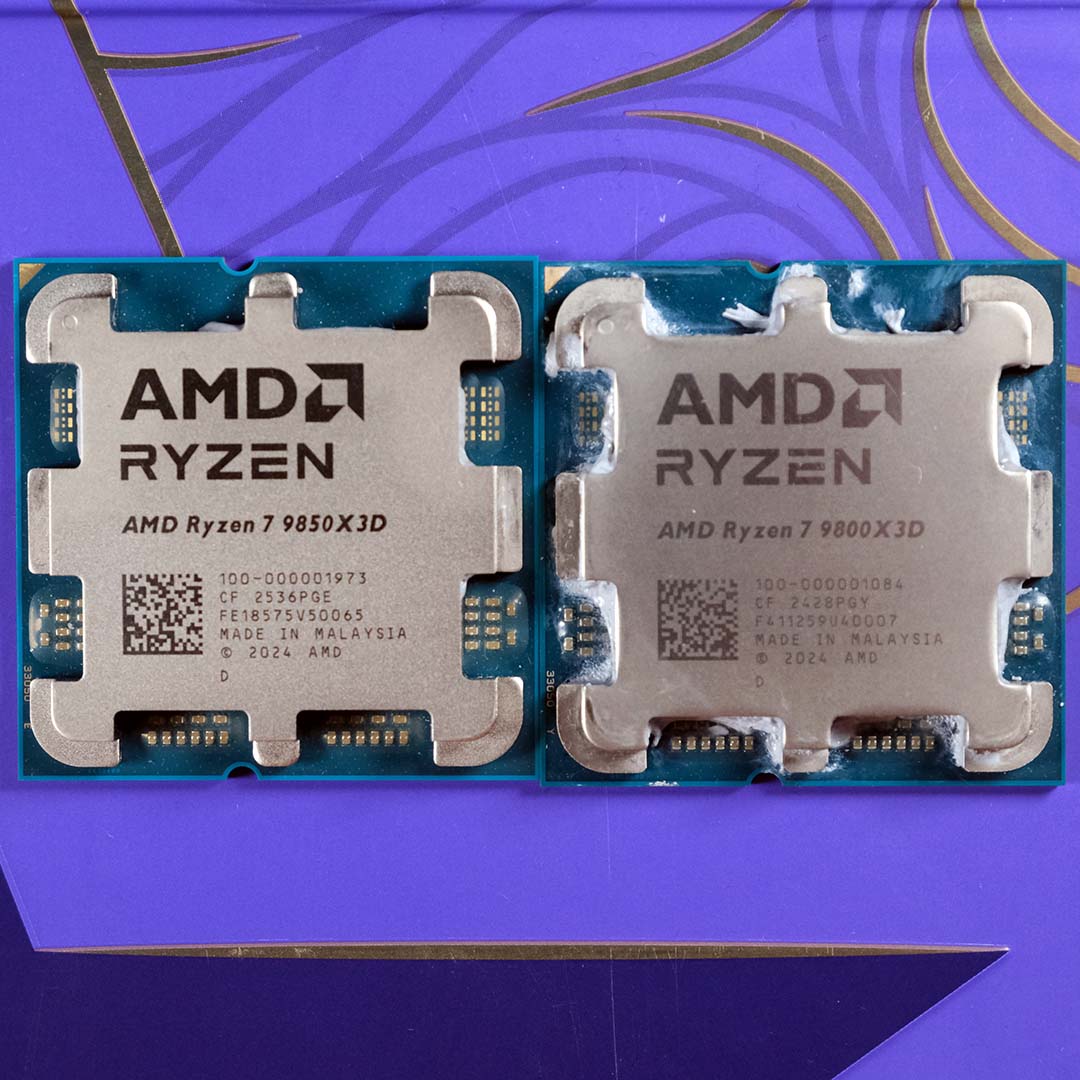
As their specifications betray, the Ryzen 7 9850X3D is faster than the 9800X3D across productivity and gaming. However, the difference in performance between the two CPUs isn’t earth shattering.
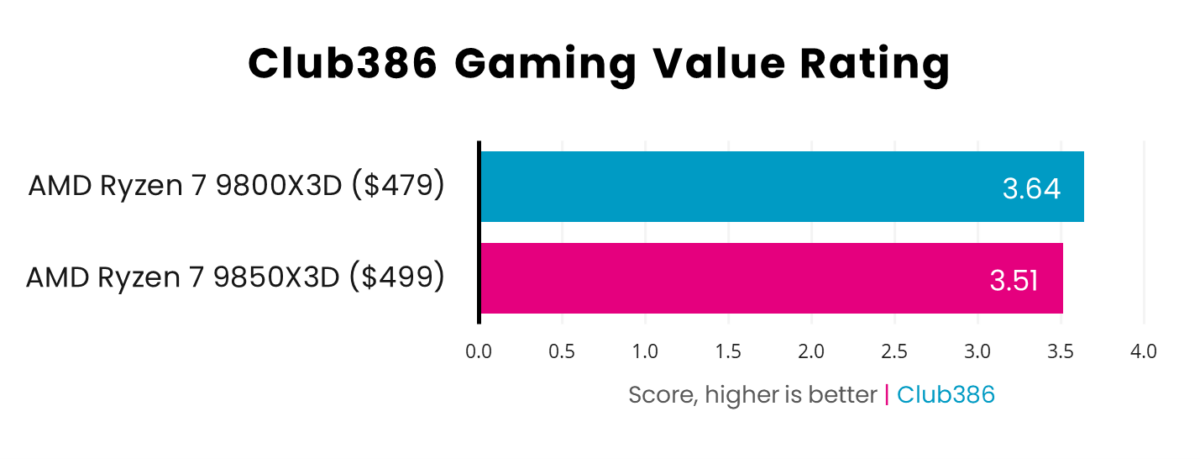
Gaming is the most important battlefield for these processors. Adding up the respective average frame rates of each chip and dividing the result by their price, we arrive at the Club386 Gaming Value Rating.
That extra $20 only buys an additional eight frames per second across our suite. However, as mentioned earlier, the current gap lies at $56, decreasing the Ryzen 7 9850X3D’s value further.
Given how similar the performance is of each chip, it’s difficult not to default to the Ryzen 7 9800X3D. Still, if you’re deciding between that chip and the 9850X3D at MSRP, then there’s value in opting for the more-expensive CPU.
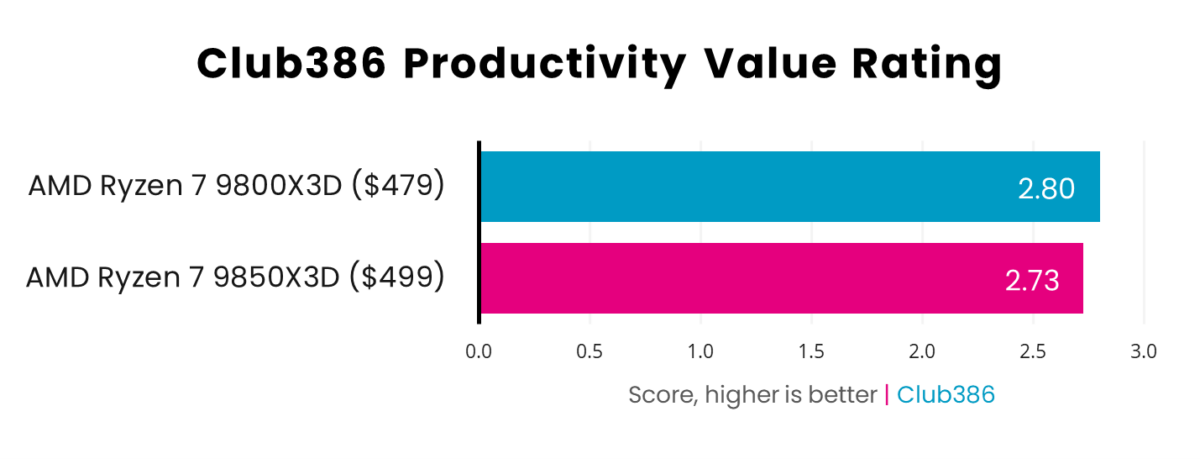
The song’s much the same for the Ryzen 7 9850X3D when it comes to productivity. Multi-core workloads simply don’t benefit much from the processor’s higher clock speeds, hampering its value for workstation workflows.
Both processors are admirable choices in this performance category, considering their core count. Again, though, value lies with the 9800X3D.
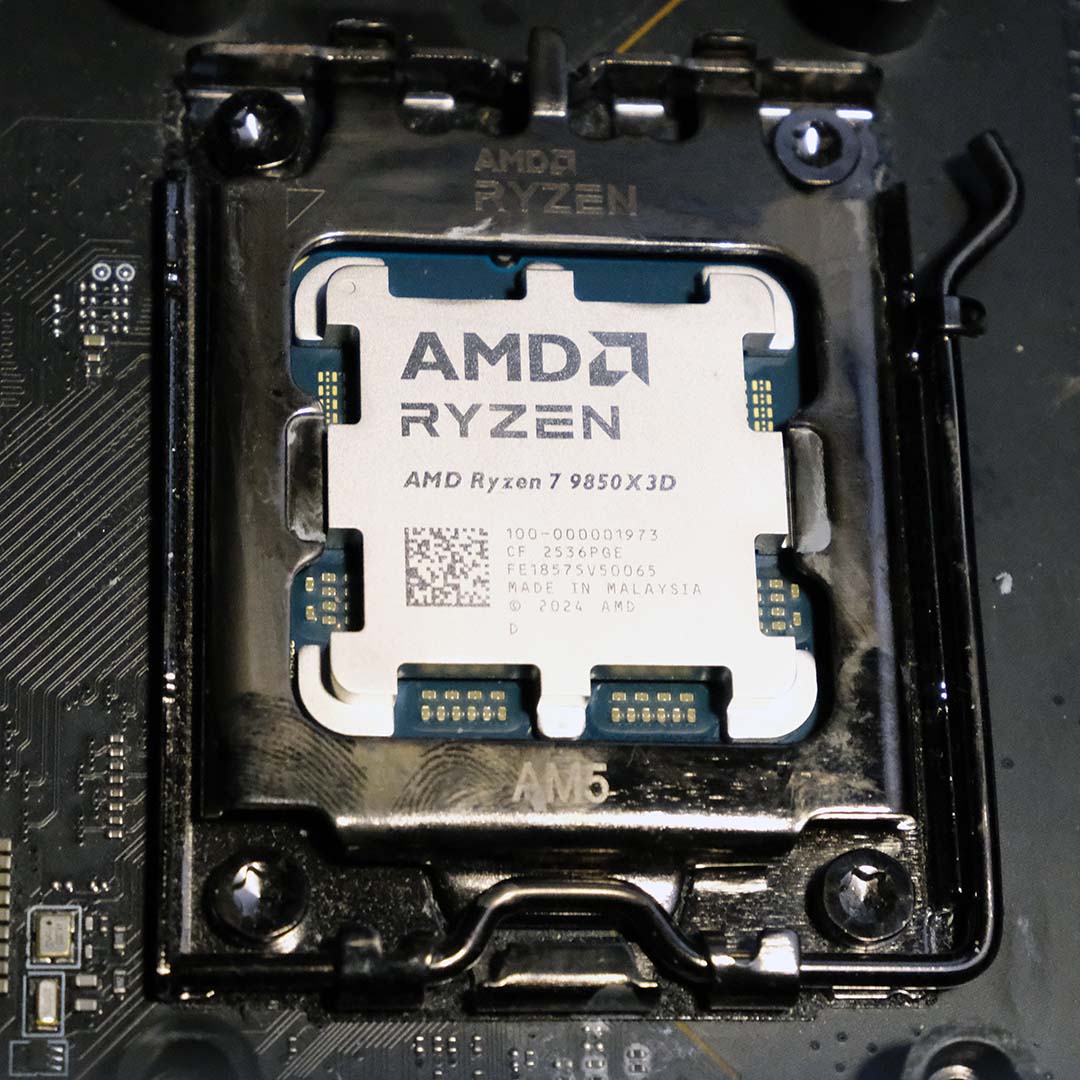
AMD Ryzen 7 9850X3D
For those in the pursuit of absolute gaming performance, all pale in comparison to the 9850X3D. Read our review.
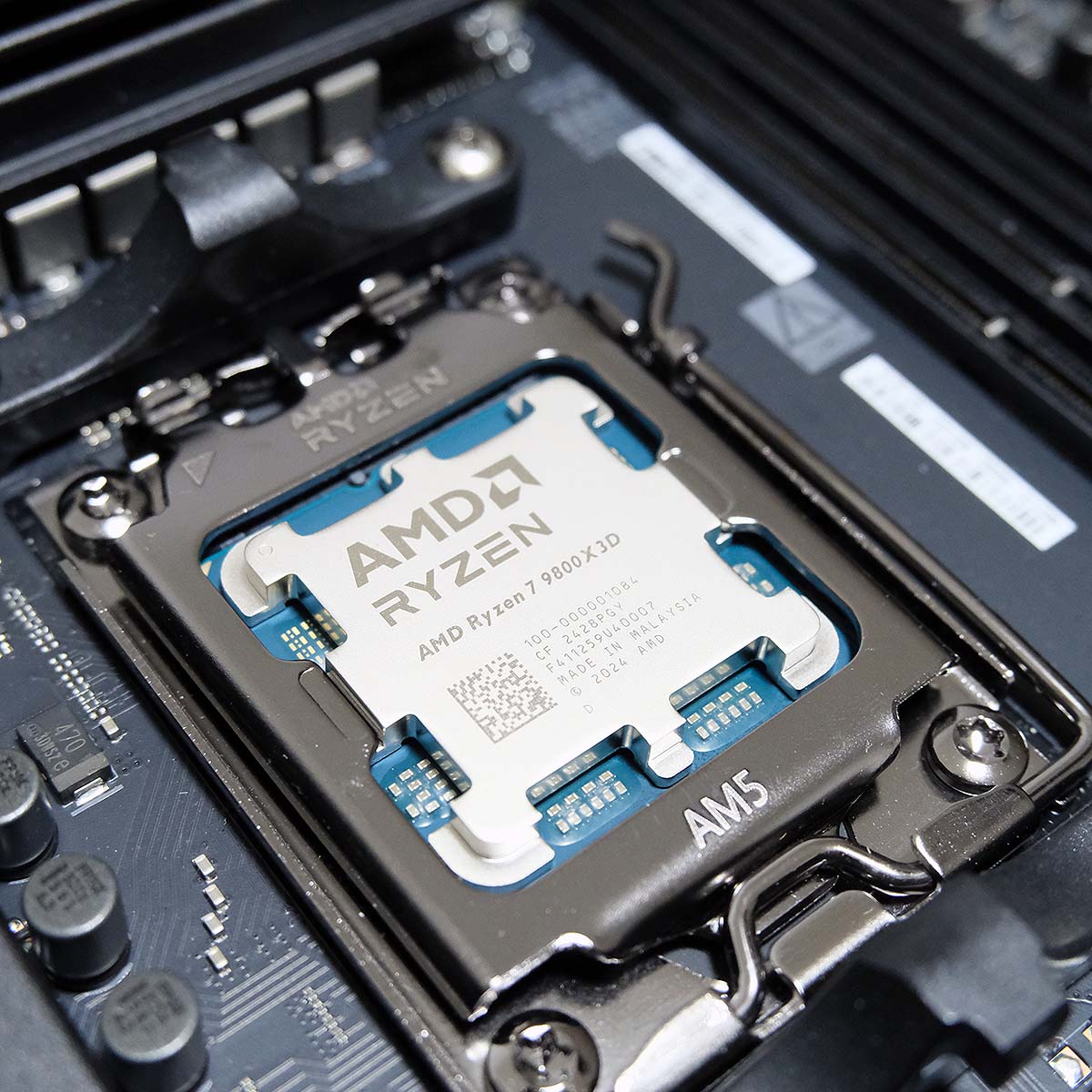
AMD Ryzen 7 9800X3D
Only a few frames behind the 9850X3D, the 9800X3D remains an excellent choice of CPU for any gaming PC. Read our review.
For more processor analysis, check out our best CPU guide, where we have chip recommendations for budgets great and small.