
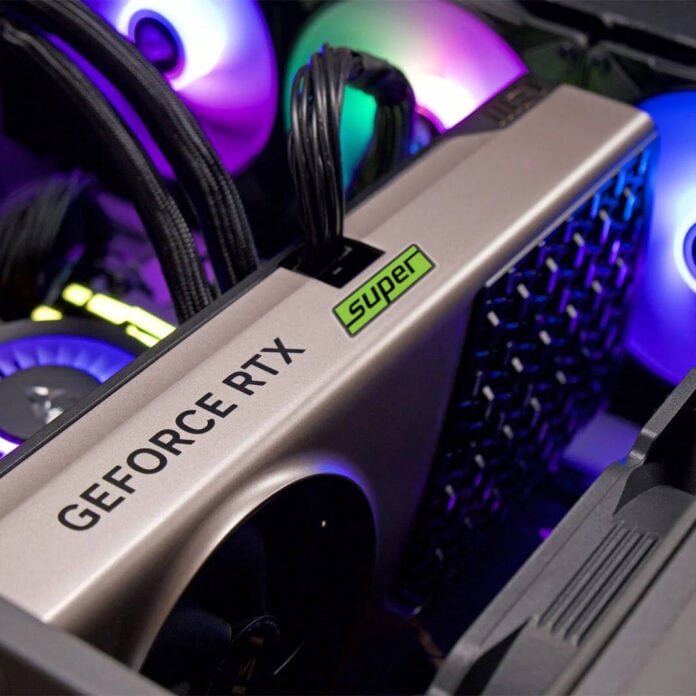
Nvidia is reportedly targeting an early 2027 launch for its rumoured GeForce RTX 50 Super GPU refresh. The new cards are expected to feature denser 3GB GDDR7 chips than the original lineup’s 2GB chips, meaning Nvidia can boost their VRAM capacity without requiring a wider bus.
Tech site Benchlife says its sources have indicated that Nvidia could announce its long-rumoured RTX 50 Super GPUs at CES 2027. While the company has yet to officially confirm the Super series’ existence, we have heard rumours about it since April 2025. Since then, there have been numerous reports about the project’s cancellation due to ongoing memory shortages, but it now looks as though it’s back on track.
A recent leak suggested the RTX 5080 Super launch has indeed returned to active development, indicating the company is targeting a late 2026 launch. Benchlife’s sources push that estimation slightly to January 2027. Regardless of who is correct, this would represent the longest gap between a regular and Super GPU refresh.
For reference, previous Super releases were issued about a year after the original launches, serving as mid-generation refreshes. If it’s unveiled at CES 2027, the RTX 50 Super series would have taken about two years, assuming the claim is true.
In addition to the Super series return, tech leaker @Zed__Wang recently indicated that Nvidia may be planning a new model based on the RTX 5060, again with a memory bump. Like the rest of the Super lineup, this RTX 5060 Super is expected to gain 50% more VRAM, increasing its pool from 8GB to a much more respectable 12GB.
As a result, the current rumoured RTX 50 Super series includes the RTX 5060 12GB, RTX 5070 Super 18GB, RTX 5070 Ti Super 24GB, and RTX 5080 Super 24GB. All cards are expected to use 3GB GDDR7 instead of the original lineup’s 2GB chips, which boost their capacity by 50% without needing a wider memory bus link. Some of these GPUs are also rumoured to be getting more CUDA cores, such as the RTX 5070 Super, which is said to have 6,400 cores, 256 more than its non-Super variant.
While such a delay would result in outright cancellation during normal times, as it would interfere with next-gen GPU launches, this shouldn’t be an issue this time around, as the RTX 60 Series now isn’t expected to appear until at least late 2027, possibly 2028.
That said, the question remains: What change has pushed Nvidia to reconsider introducing the Super series? Does it expect an imminent memory price drop? Does it have spare capacity left over from its professional production lines? Either way, we don’t expect these cards to replace their non-super counterparts at the same price.