
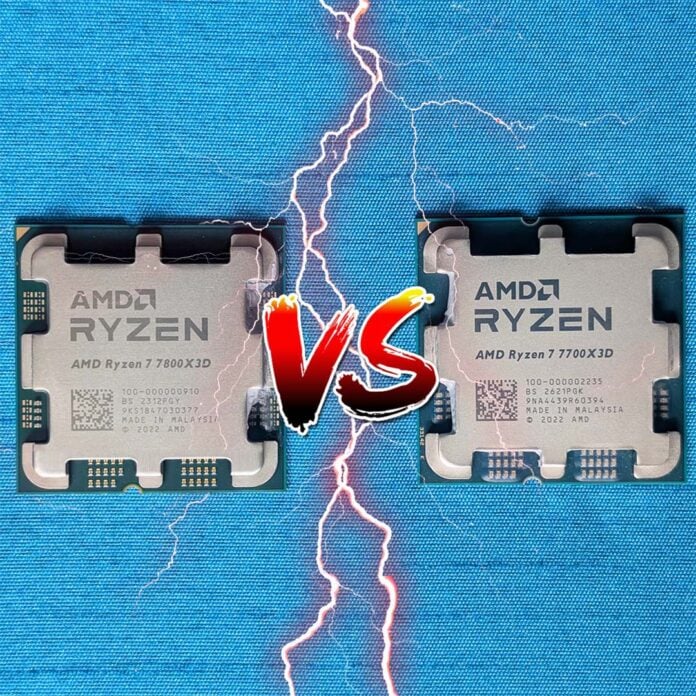
What does AMD do if it has loads of 8-core Zen 4 chips that can’t quite make the 7800X3D grade? That’s simple – set them to run at a lower clock speed they can handle, drop the model number a bit, slap on a cheaper price tag and, hey presto, you’ve got a new CPU in your arsenal. The result in this case is the AMD Ryzen 7 7700X3D.
With both the 7800X3D and 7700X3D costing considerably less money than AMD’s Zen 5 X3D chips, such as the Ryzen 7 9800X3D, they both look like tempting options. If your top priority is gaming performance, but you can’t quite run to the cost of AMD’s latest CPUs with 3D V-Cache, then this pair of CPUs is your best bet.
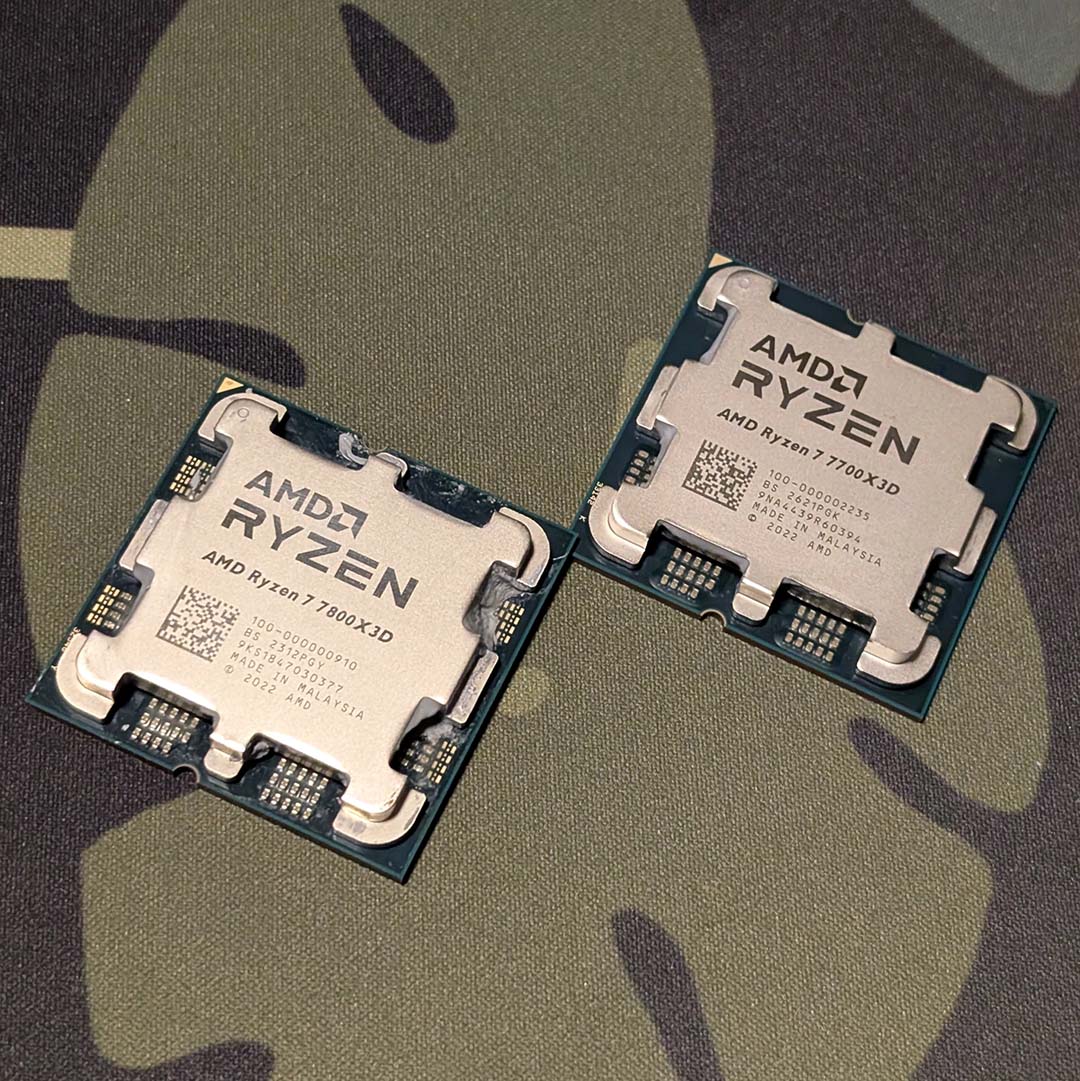
But which one should you buy, and is there much of a difference between these two similar-looking chips? To find out, I’ll be comparing their performance across a range of tests, including 3D rendering, content creation, and compression, plus several game benchmarks. I’ll also take a look at pricing, power efficiency, and ultimately whether the 7700X3D is worth buying as a slightly cheaper option.
Specs
To say the Ryzen 7 7700X3D and 7800X3D share a lot in common would be an understatement – they’re basically the exact same CPU, but with different clock speeds. That means both chips offer eight cores based on AMD’s last-gen Zen 4 architecture, and pop into a standard AM5 motherboard socket.
Importantly, both these CPUs also come with that magic 64MB 3D V-Cache chip stacked on top of their 8-core chiplets, which makes all the difference to gaming performance. Unlike non-X3D chips, such as the Ryzen 7 7700X, which just has 32MB of L3 cache built into its core chiplet die, these CPUs have a massive 96MB of L3 cache.
| Ryzen 7 7700X3D | Ryzen 7 7800X3D | Ratio | |
|---|---|---|---|
| Release date | Jul 2026 | Apr 2023 | – |
| Platform | AM5 | AM5 | – |
| Architecture | Zen 4 | Zen 4 | – |
| Cores | 8 | 8 | 1.00 |
| Threads | 16 | 16 | 1.00 |
| TDP | 120W | 120W | 1.00 |
| L2 cache | 16MB | 16MB | 1.00 |
| L3 cache | 96MB | 96MB | 1.00 |
| Base clock | 4.0GHz | 4.2GHz | 0.95 |
| Boost clock | 4.5GHz | 5.0GHz | 0.90 |
| Launch MSRP | $329 | $449 | 0.73 |
This significantly reduces the chance of a cache miss when you’re gaming, which means your CPU can focus on the game in hand, so to speak, setting up frames for your GPU without having to page your slower system memory as much.
The only real difference here is the aforementioned clock speed. While the 7800X3D has a 4.2GHz base frequency and can boost to up to 5GHz when required, the 7700X3D’s clock speeds are much more conservative. The newer chip can only boost to 4.5GHz, which means it has a substantial 500MHz clock deficit compared to the 7800X3D.
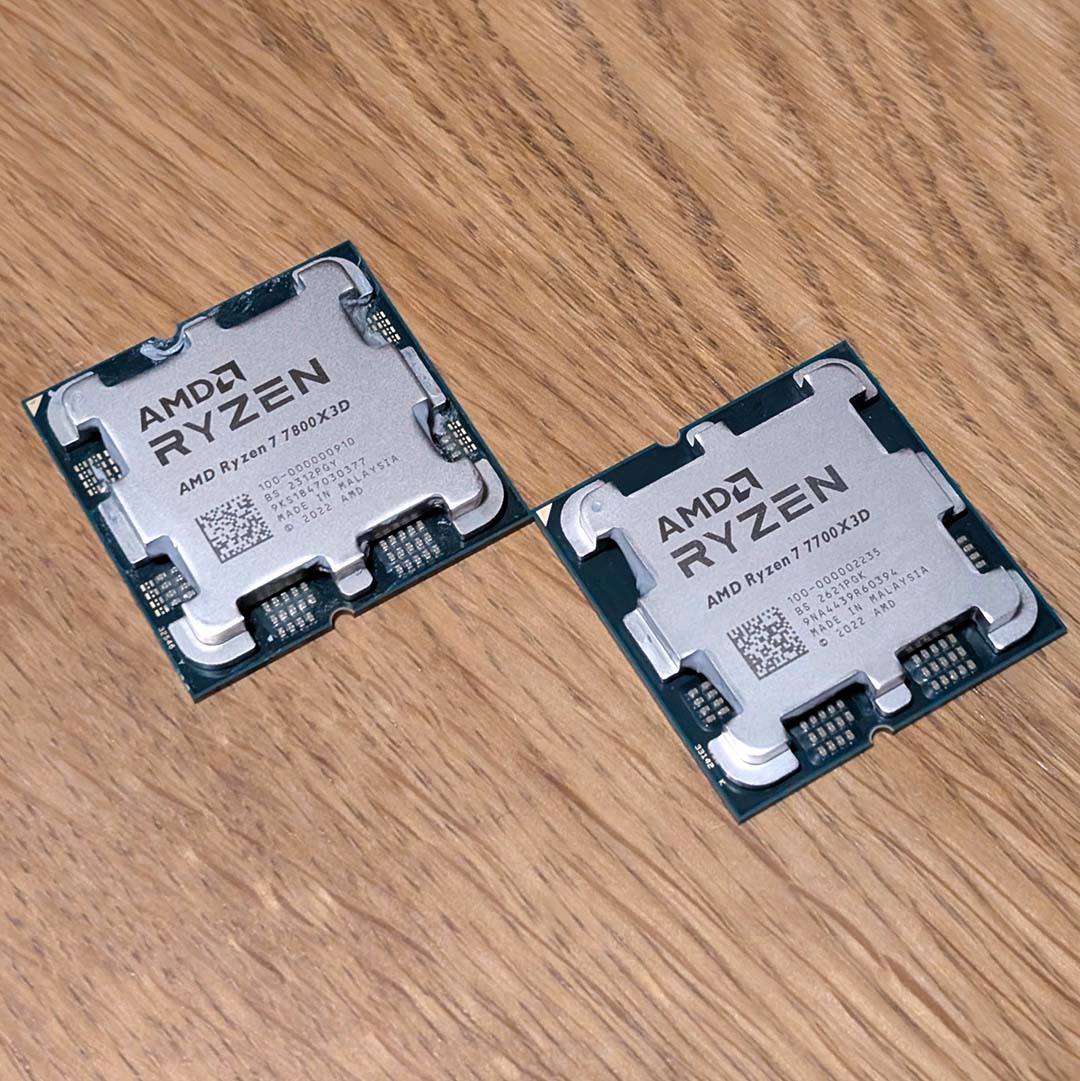
That’s actually a pretty hefty drop in clock speed, especially when you consider that AMD’s latest chips with 3D V-Cache, such as the Ryzen 7 9850X3D, are now boosting to 5.6GHz. This comparative lack of frequency is likely to impact the 7700X3D’s performance in single-threaded tests, but its cache is still going to stand it in good stead when it comes to gaming.
Despite that 500MHz clock speed difference, both the 7700X3D and 7800X3D target a 120W TDP, which is standard for an 8-core AM5 CPU with 3D V-Cache, and a 240mm AIO cooler or mid-range heatsink-and-fan assembly will handle this chip. If you think you need to upgrade your thermal setup, check out our guide to buying the best CPU cooler for your needs.
Test methodology
Both the Ryzen 7 7700X3D and 7800X3D have been benchmarked in one of the Club386 2026 test rigs. These systems all use killer high-end components, eliminating any potential bottlenecks as far as possible. That means there’s a high-end MSI MEG X870E Ace Max motherboard, for example, as well as 64GB of Kingston Fury Renegade 6,400MT/s DDR5 memory, while a huge Arctic Liquid Freezer 420 Pro ARGB cooler ensures there’s no thermal throttling.
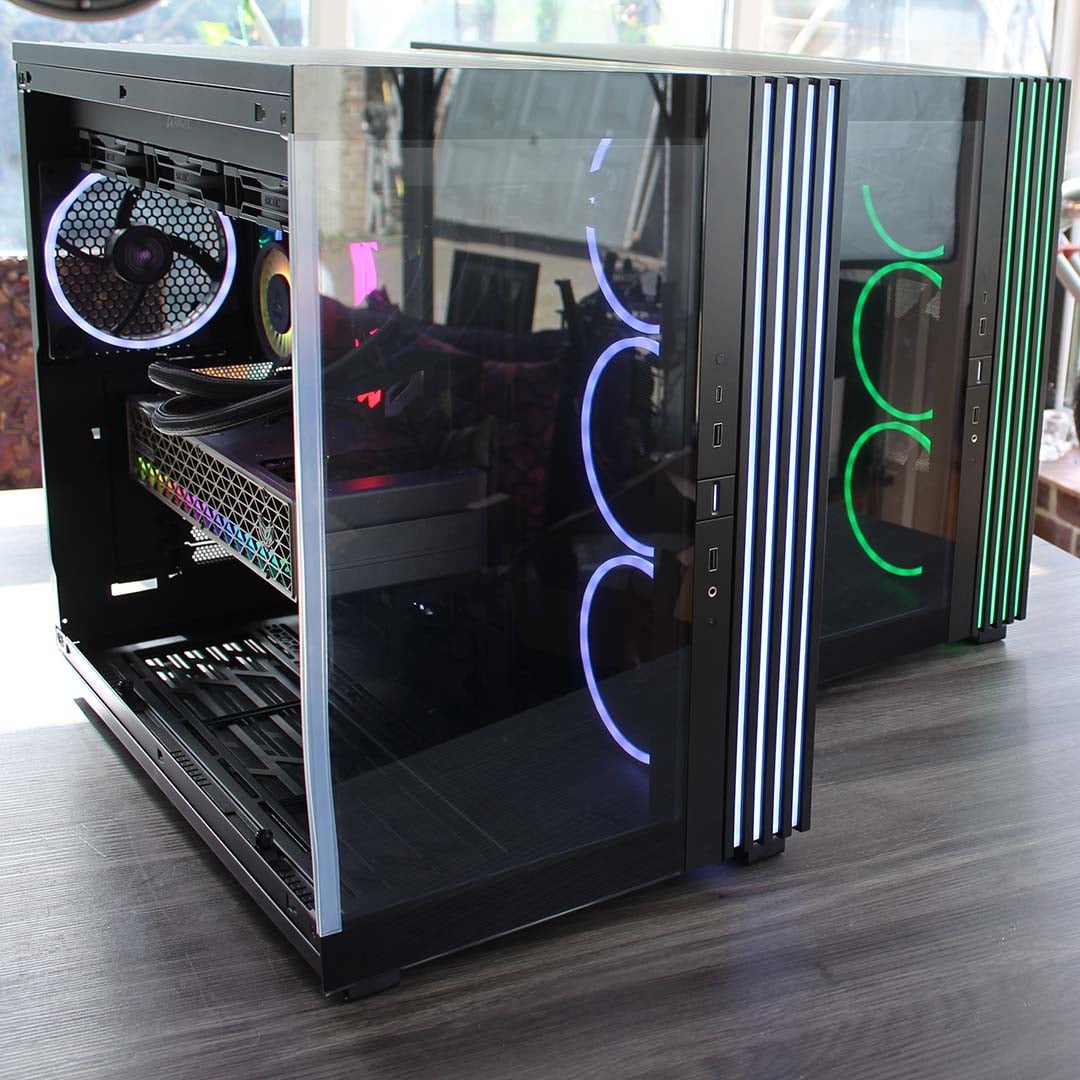
Our 9950X3D Test PCs
Club386 carefully chooses each component in a test bench to best suit the review at hand. When you view our benchmarks, you’re not just getting an opinion, but the results of rigorous testing carried out using hardware we trust.
Shop Club386 test platform components:
CPU: AMD Ryzen 9 9950X3D
Motherboard: MSI MEG X870E Ace Max
Cooler: Arctic Liquid Freezer III 420 Pro ARGB
GPU: Sapphire Nitro+ Radeon RX 9070 XT
Memory: 64GB Kingston Fury Renegade DDR5
Storage: 4TB Sandisk Optimus GX Pro 8100
PSU: be quiet! Dark Power 14 1,200W
Chassis: be quiet! Light Base 900 FX
Both these CPUs were also tested in the same timeframe, rather than relying on historical results for the older chip, so the results are directly comparable. The only change we’ve made to the usual spec list above is the graphics card, as we’re swapping out our Radeon RX 9070 XT for an Nvidia GeForce RTX 5090. While we’re aware that most people thinking of buying a 7700X3D likely won’t be pairing it with such an expensive graphics card, using this GPU means this CPU can stretch its legs as far as possible, showing peak potential performance.
Read on to see all our benchmark graphs and analysis below, which encompass both application and game performance. For the latter, all the results were recorded at a FHD (1920×1080) resolution, using each game’s High graphics preset, without any upscaling or frame generation tech.
App performance
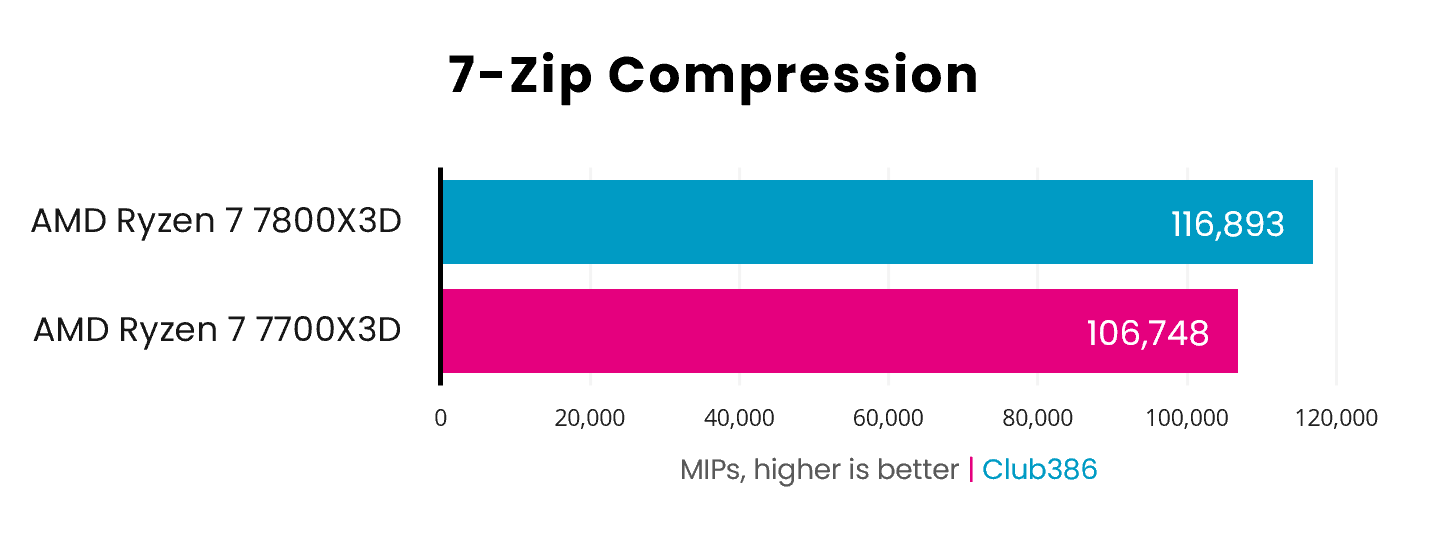
While these two CPUs look very similar on paper, there’s a definite impact of reducing the clock speed so far. While games undoubtedly benefit from all the extra cache on offer, frequency remains a key metric for application software. That’s clearly demonstrated here in 7-Zip, where file compression performance is reduced by 8.7% when moving from a 7800X3D to the cheaper 7700X3D.
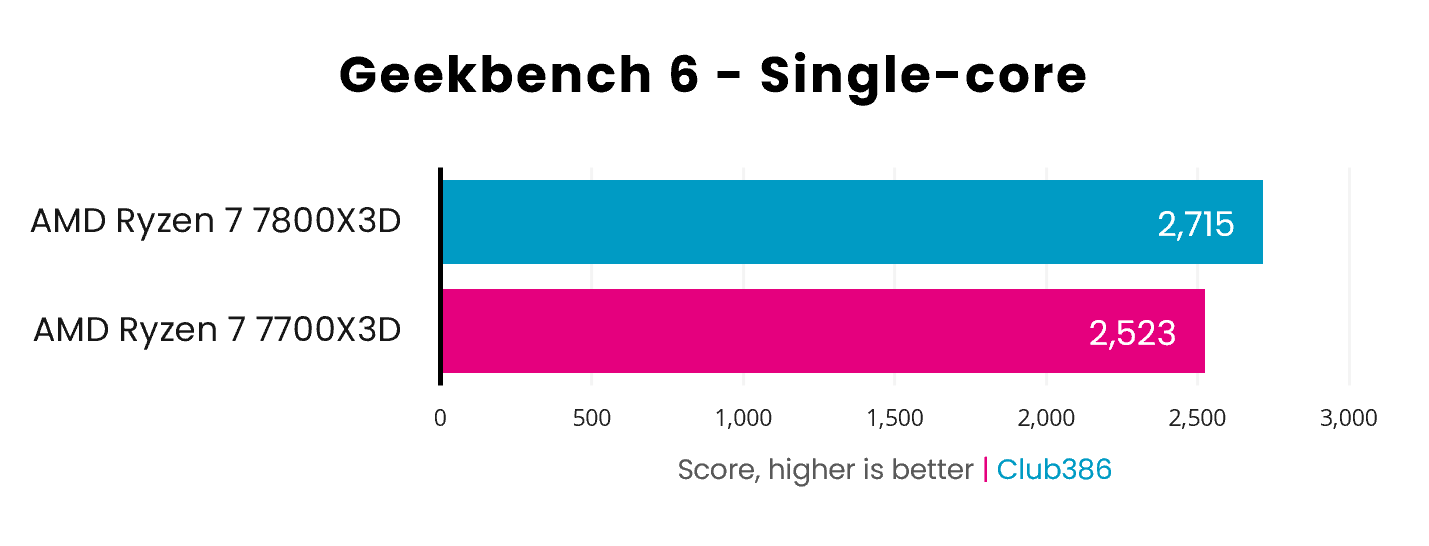
There’s a similar, though not quite as pronounced, fall in Geekbench’s single-core test, which is again very reliant on clock speed when you’re comparing chips with the same architecture. The 7800X3D is 7.6% faster than the 7700X3D here.
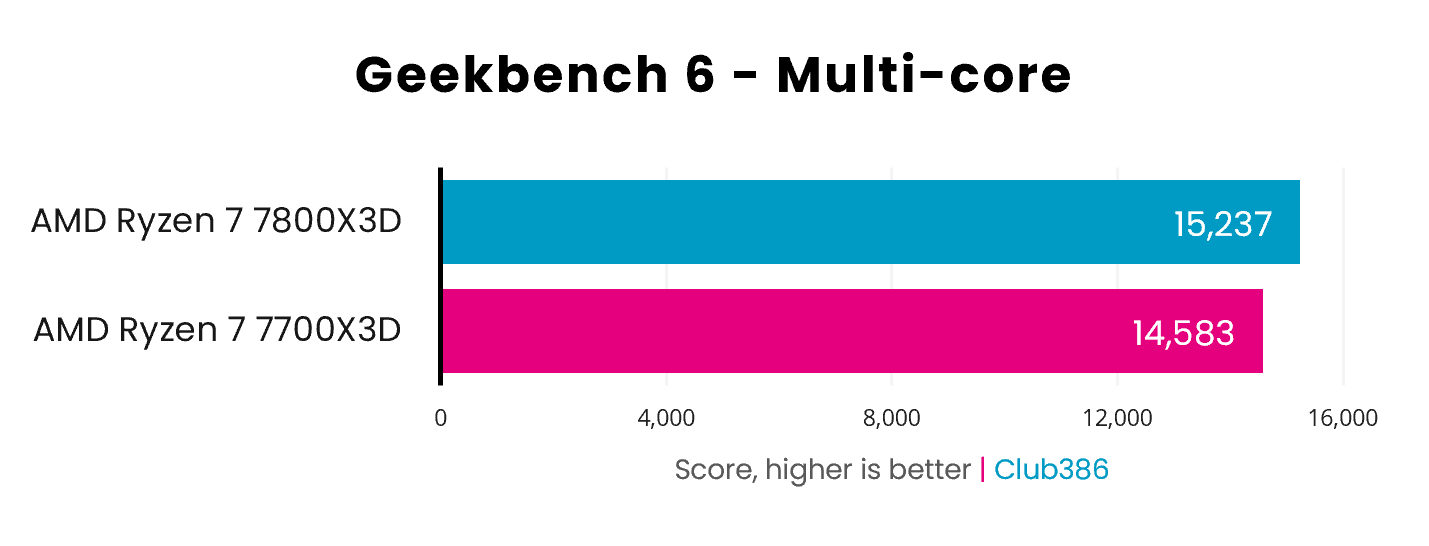
The performance difference between these two CPUs starts to shrink when multiple cores are employed. Clock speed is still a factor here, but the key to performance in heavily multi-threaded tests is the number of cores. As both the 7800X3D and 7700X3D have eight Zen 4 cores, we’re only looking at a 4.3% performance drop by choosing the 7700X3D over a 7800X3D.
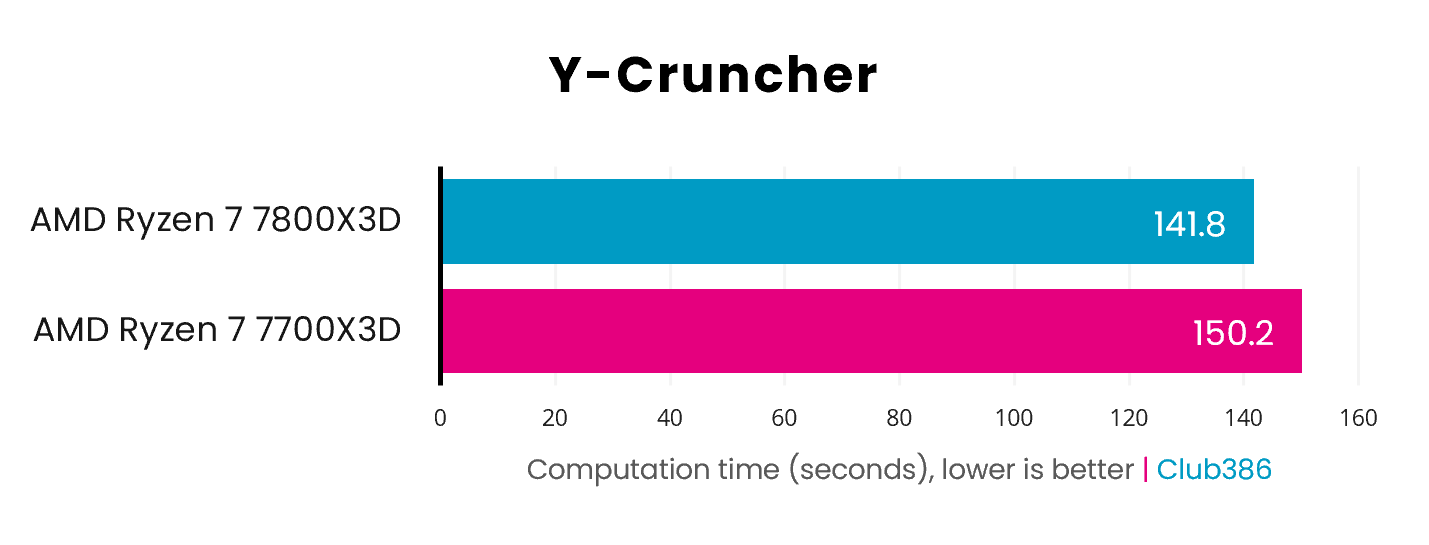
There’s a small difference between the two chips when calculating Pi to five billion digits. The 7700X3D takes 8.4 seconds longer than the 7800X3D to perform this feat, equating to a performance drop of 5.6%.
Content creation
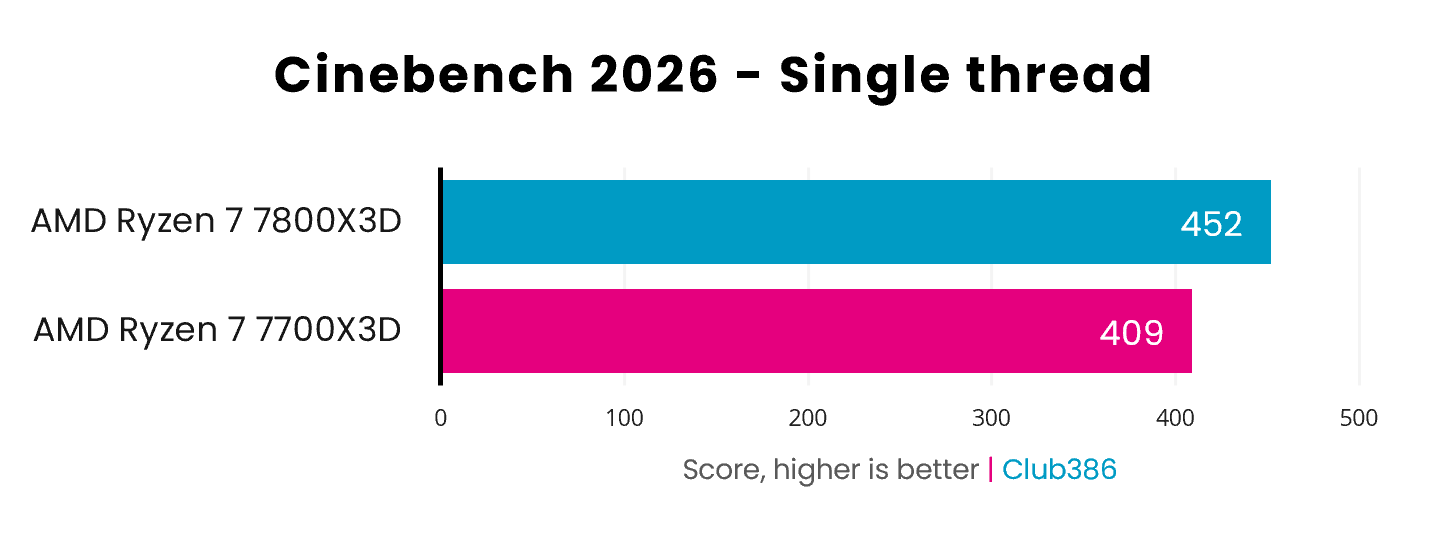
3D rendering via Maxon Cinebench 2026 shows a straight correlation between clock speed and performance on these two chips. The 7700X3D’s 10% frequency deficit directly translates into a 9.5% drop in performance relative to the 7800X3D.
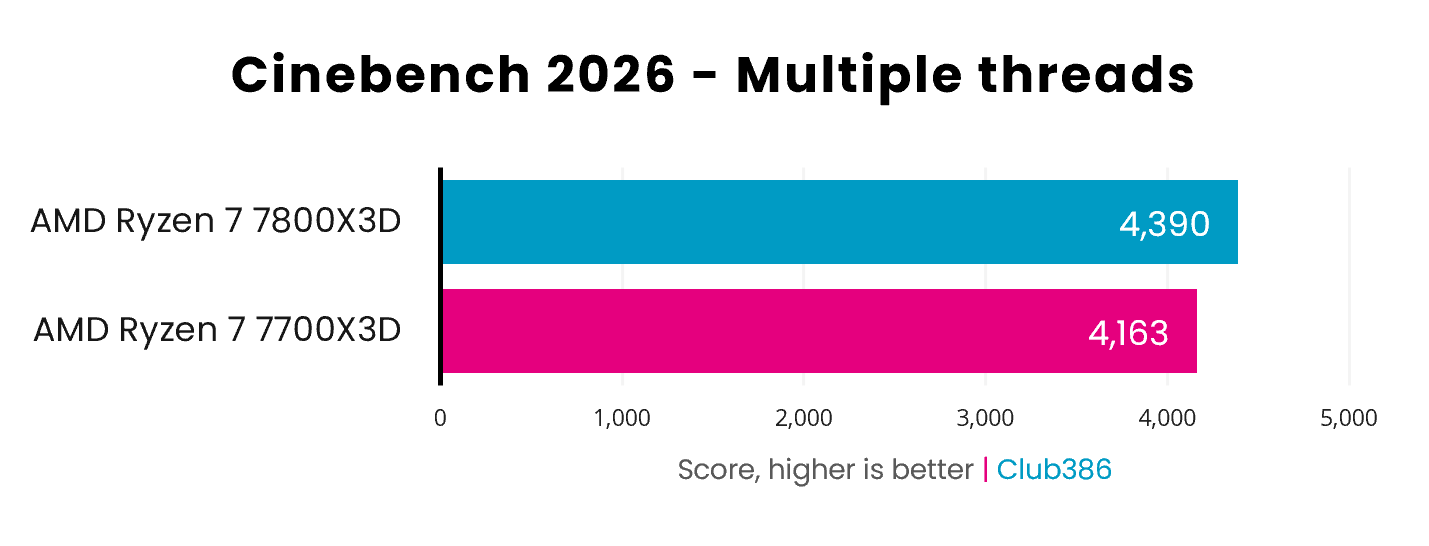
Just as we saw with Geekbench, while single-threaded performance is heavily affected by clock frequency, multi-threaded pace is much more dependent on how many cores you have at your disposal. With both these chips having eight cores, there’s only a 5.2% performance drop when swapping from a 7800X3D to the 7700X3D.
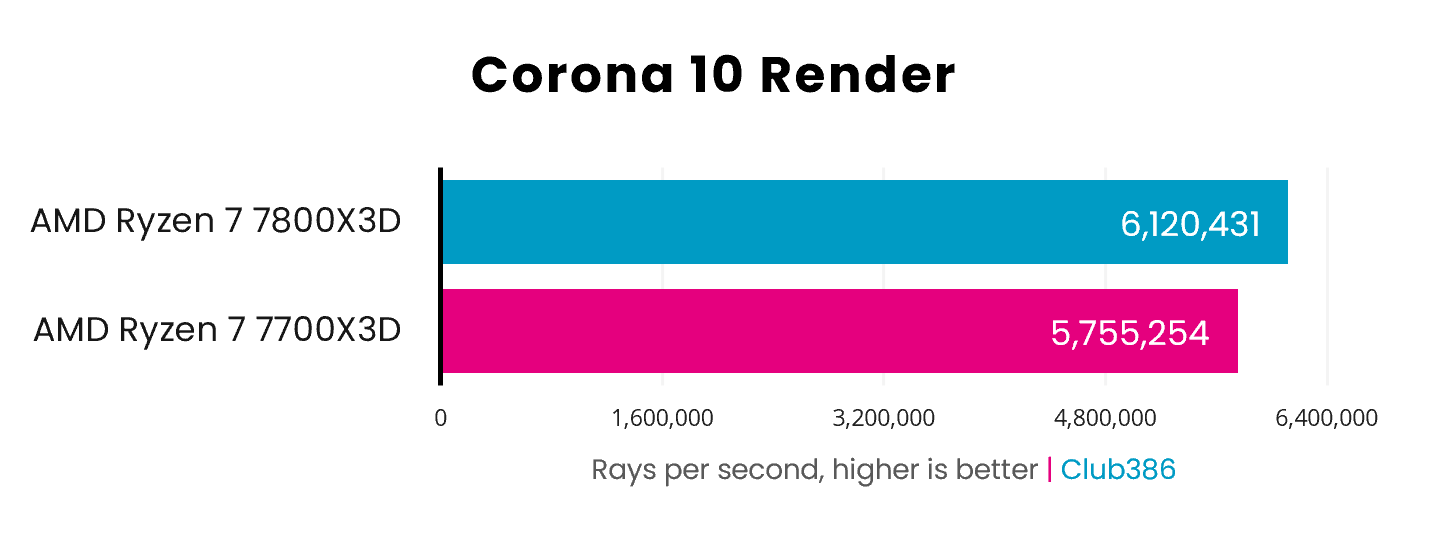
Corona 10 shows the 7700X3D falling 5.9% behind AMD’s older chip, calculating 5,755,254 rays per second, compared to 6,120,431 on the 7800X3D. Like Cinebench’s multi-threaded test, this benchmark is mainly reliant on the number of cores available, so there’s not a huge performance difference here. However, the 7700X3D’s lack of clock speed still definitely puts it at a disadvantage.
Gaming
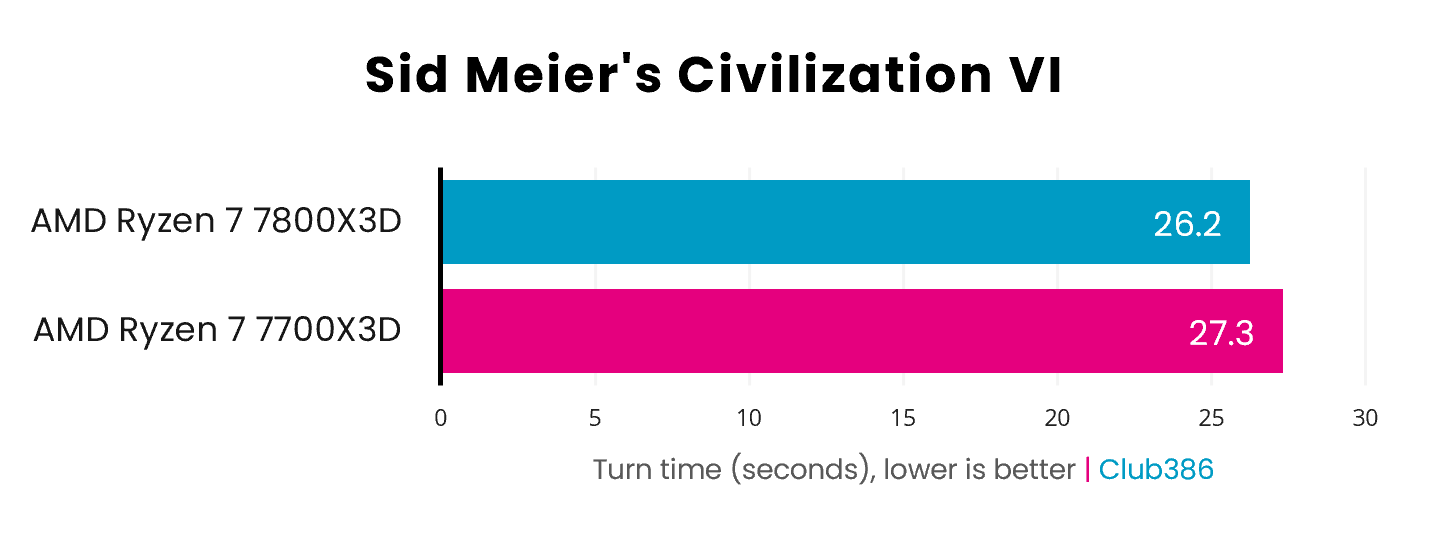
Running the Gathering Storm update for Civ VI, we see the 7700X3D taking just over a second long to calculate a turn than the 7800X3D. This game responds much more to clock speed and instructions per clock than cache and core counts, hurting the 7700X3D’s performance in this test.
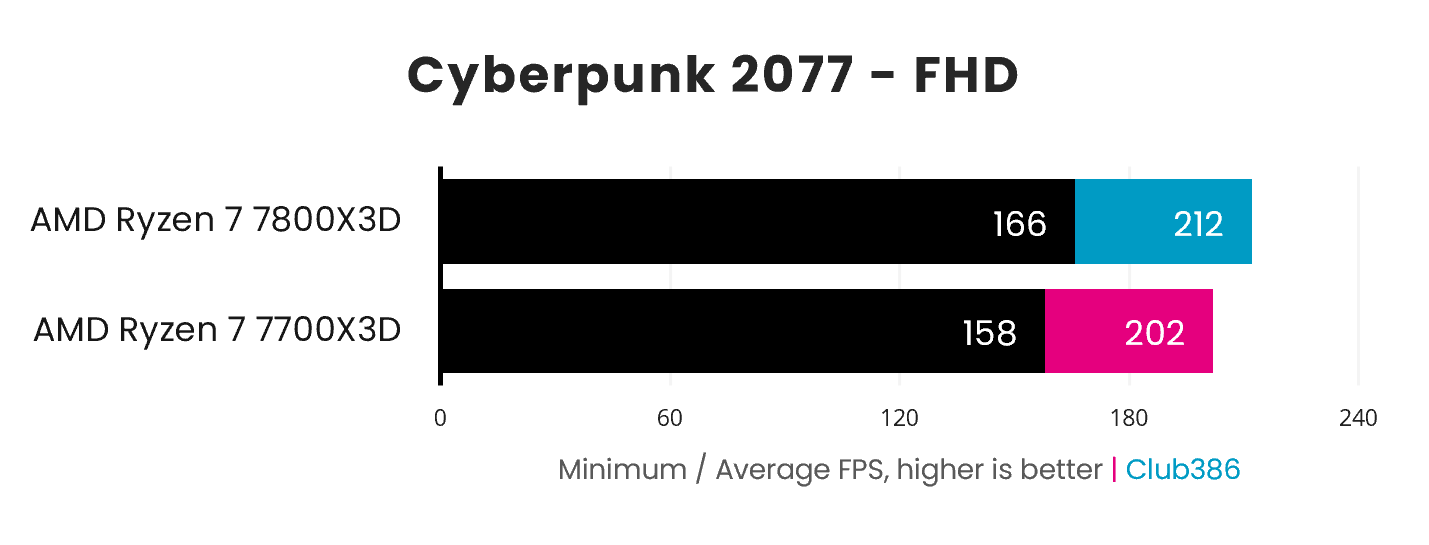
While having loads of cache on hand undoubtedly helps the Ryzen 7 7700X3D in games such as Cyberpunk 2077, clock speed still clearly plays an important role, particularly when it’s so heavily reduced. Moving up to the 7800X3D nets you a 10fps higher average, and an 8fps improvement in minimum frame rate, over the 7700X3D. The latter chip is 5% slower here.
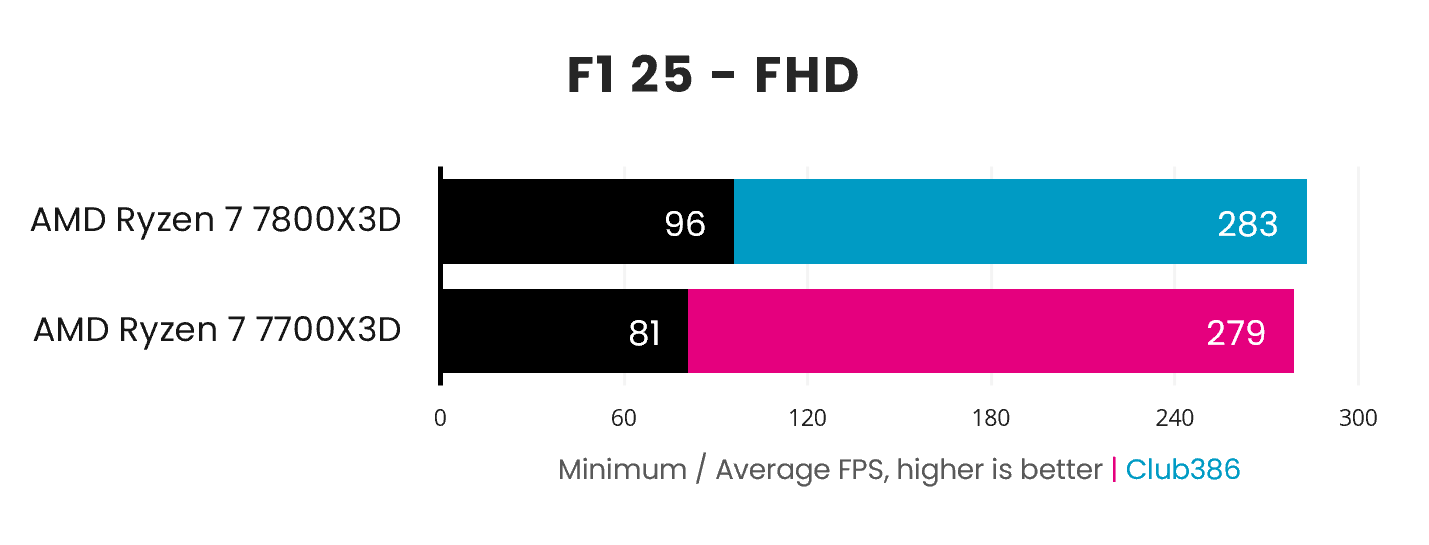
F1 25 is a good showcase for AMD’s 3D V-Cache tech, and the 7700X3D holds up well here with a 279fps average – just 4fps behind the 7800X3D. Again, though, that 500MHz clock speed deficit hurts it, particularly when it comes to the minimum frame rate.
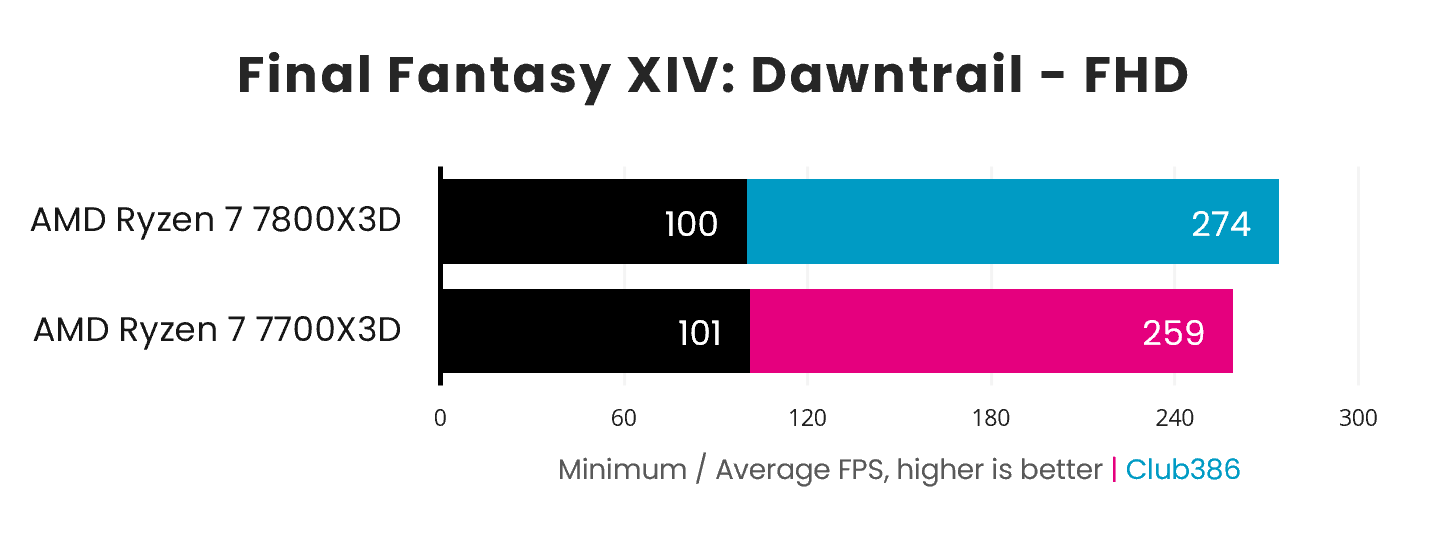
3D V-Cache does a good job of bolstering the minimum frame rate in Final Fantasy XIV Dawntrail on the 7700X3D – it’s 1fps higher, but that’s within the margin of error – the two CPUs basically perform the same on this metric. However, that 10% cut in clock speed still hurts this chip’s average frame rate, as you get a 5.8% performance boost from the 7800X3D.
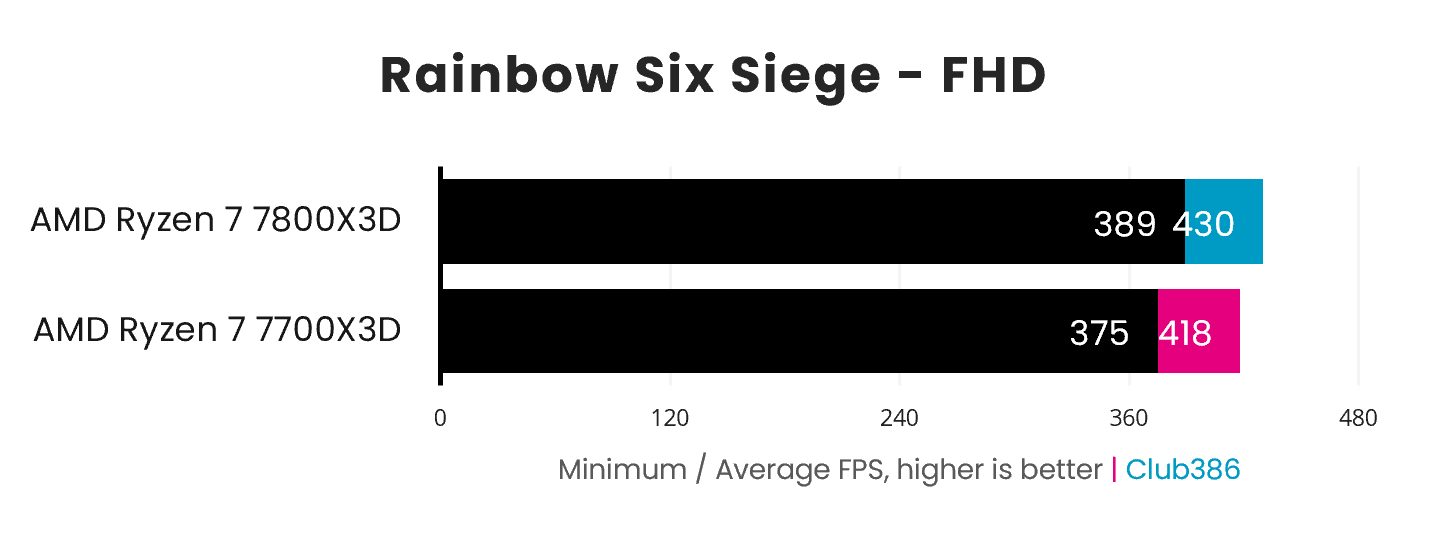
Rainbow Six Siege allows frame rates to fly high, and while there’s a definite difference between the 7700X3D and 7800X3D here, it’s minimal. With just 12fps separating these two CPUs, you get a 2.9% performance boost by opting for the older chip.
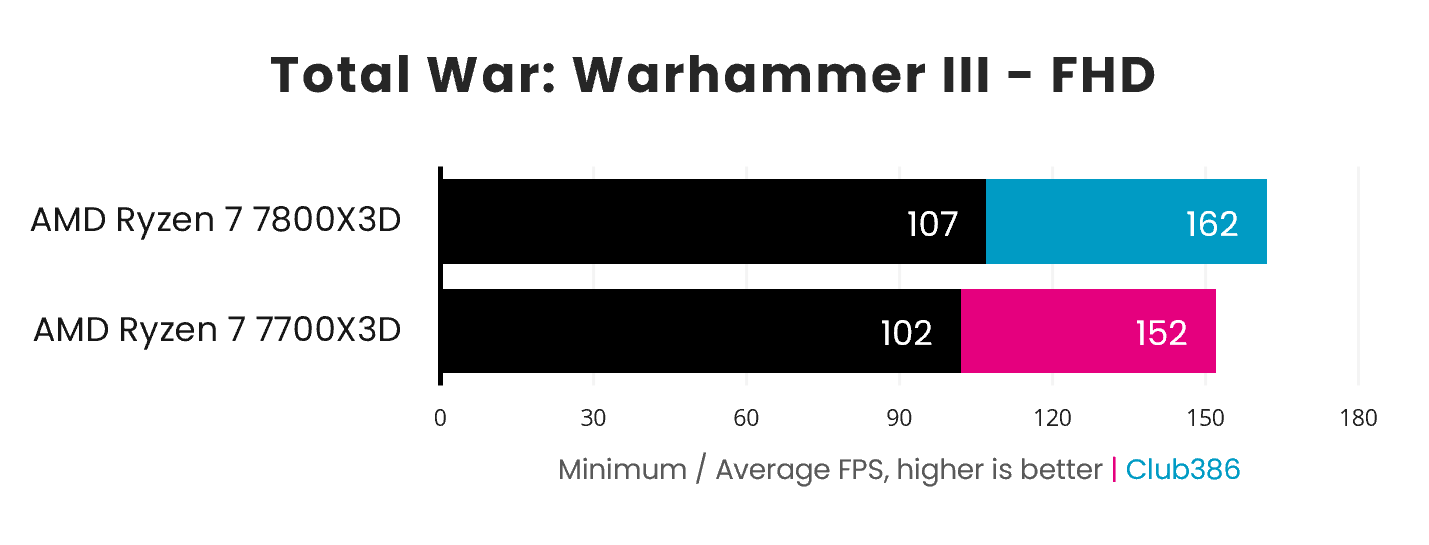
Finally, performance in Total War: Warhammer III is usually dominated by X3D CPUs, particularly the latest Zen 5 models. However, with only a 4.5GHz boost clock available to it, the 7700X3D can’t keep up with the 7800X3D, with its average falling 10fps behind – a drop of 6.2%.
Power and temperatures
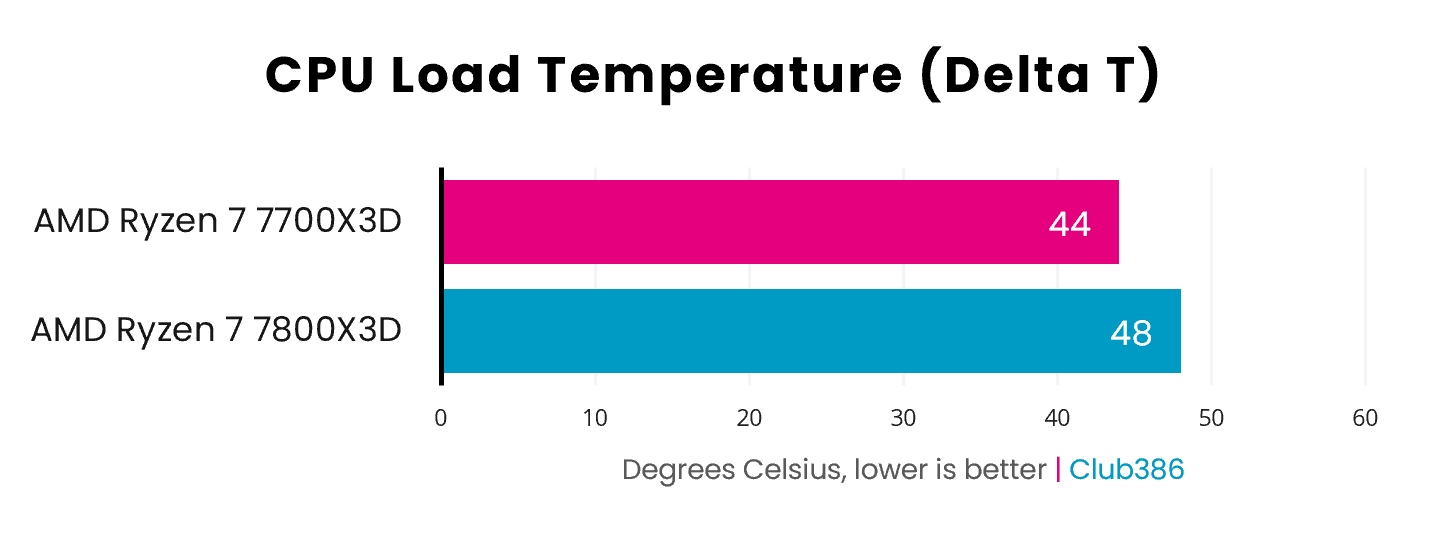
Before we start discussing temperatures, it’s worth clarifying how we arrive at the results in the graph above. We take the core temperature of the CPU at load, and then subtract the ambient room temperature from this figure to give us a Delta T. This approach enables us to compare temperature results in a lab that isn’t thermally controlled, but it does mean the actual core temperatures are higher than the figures listed in the graph.
Anyway, we’re looking at a 4°C difference between these two chips, with the lower clock speed enabling the Ryzen 7 770X3D to run comparatively cool.
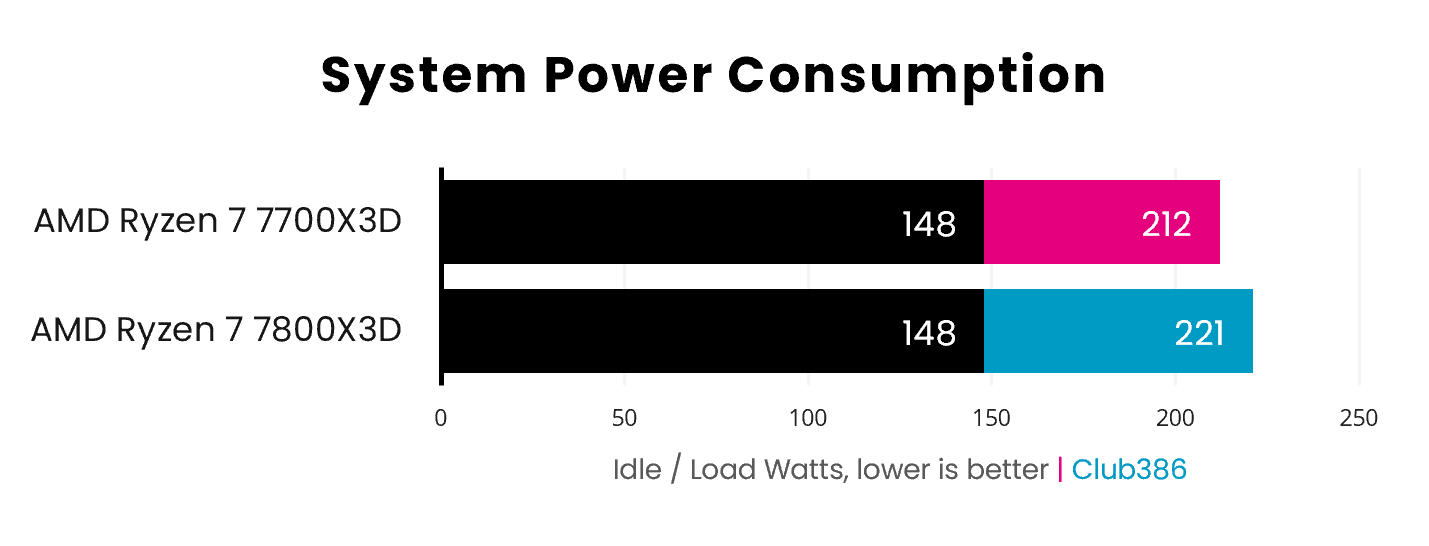
Idle power draw from our system is identical with either of these chips installed, but there’s a small (9W) difference when they’re running flat out. As you would expect, with its 500MHz clock speed deficit, the 7700X3D draws less power, but there’s not much in it.
Value ratings
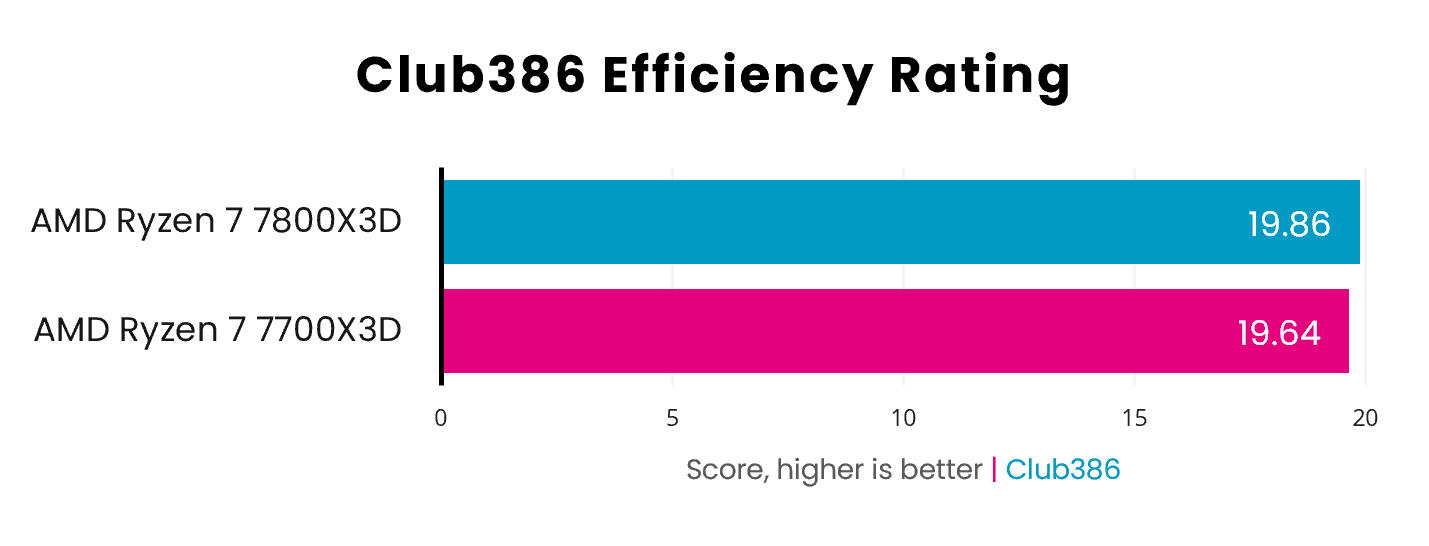
Our Club386 efficiency rating is calculated by dividing the 7700X3D’s multi-threaded Cinebench score (4,163) by its peak total system power consumption (212), giving us a figure of 19.64. As you can see, the 7800X3D offers more performance per watt, as there’s only a 9W difference, but there’s not a huge amount in it.
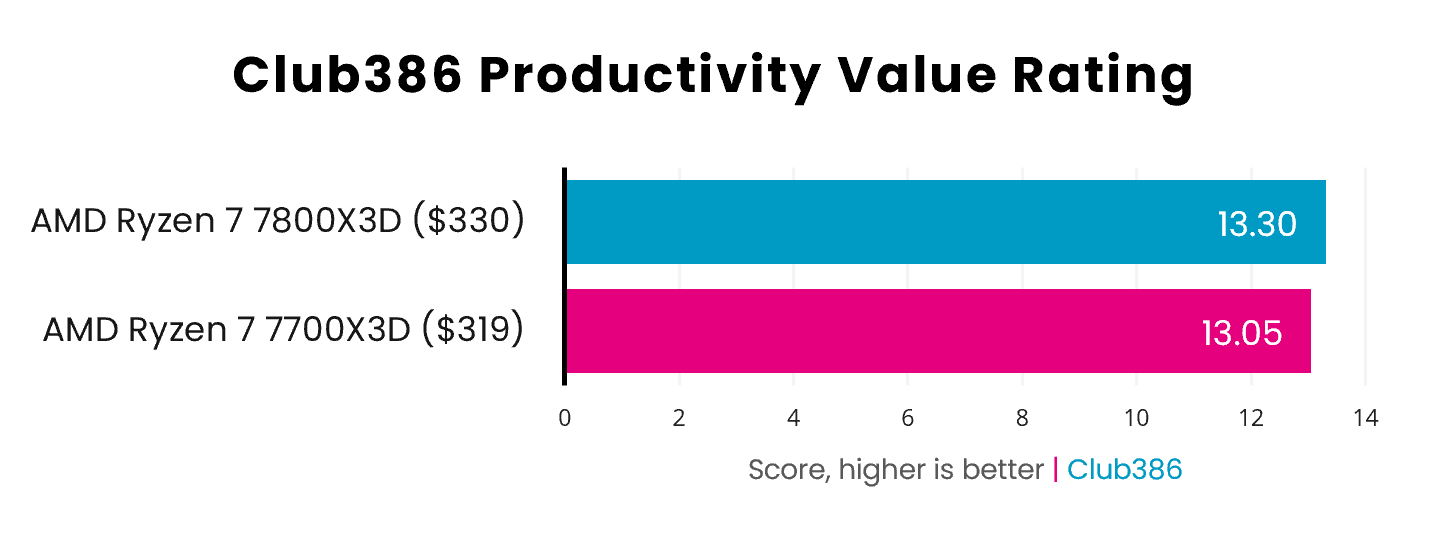
Taking that same Cinebench 2026 multi-threaded score from earlier, but this time dividing it by current retail prices, brings us our Club386 Productivity Value Rating. Again, the Ryzen 7 7800X3D wins out here. It might be more expensive, but it’s worth paying that small premium for the extra performance.
Conclusion
Thanks to AMD’s nonsensical Ryzen 7 7700X3D launch price, this one is a straight slam dunk – you should buy the Ryzen 7 7800X3D. The price difference between these two chips is so small it’s barely worth mentioning. In fact, in some cases, such as the UK at the time of writing, the 7800X3D is actually a cheaper chip.
Pricing aside, there’s also a significant performance gap between these two 8-core CPUs, thanks to the 7800X3Ds extra half a gigahertz of clock frequency. Yes, the 7700X3D still has eight cores and loads of cache, and it is a decent gaming CPU, but there’s simply no point to it when you can get a solid performance boost for barely any more money by purchasing the 7800X3D instead.
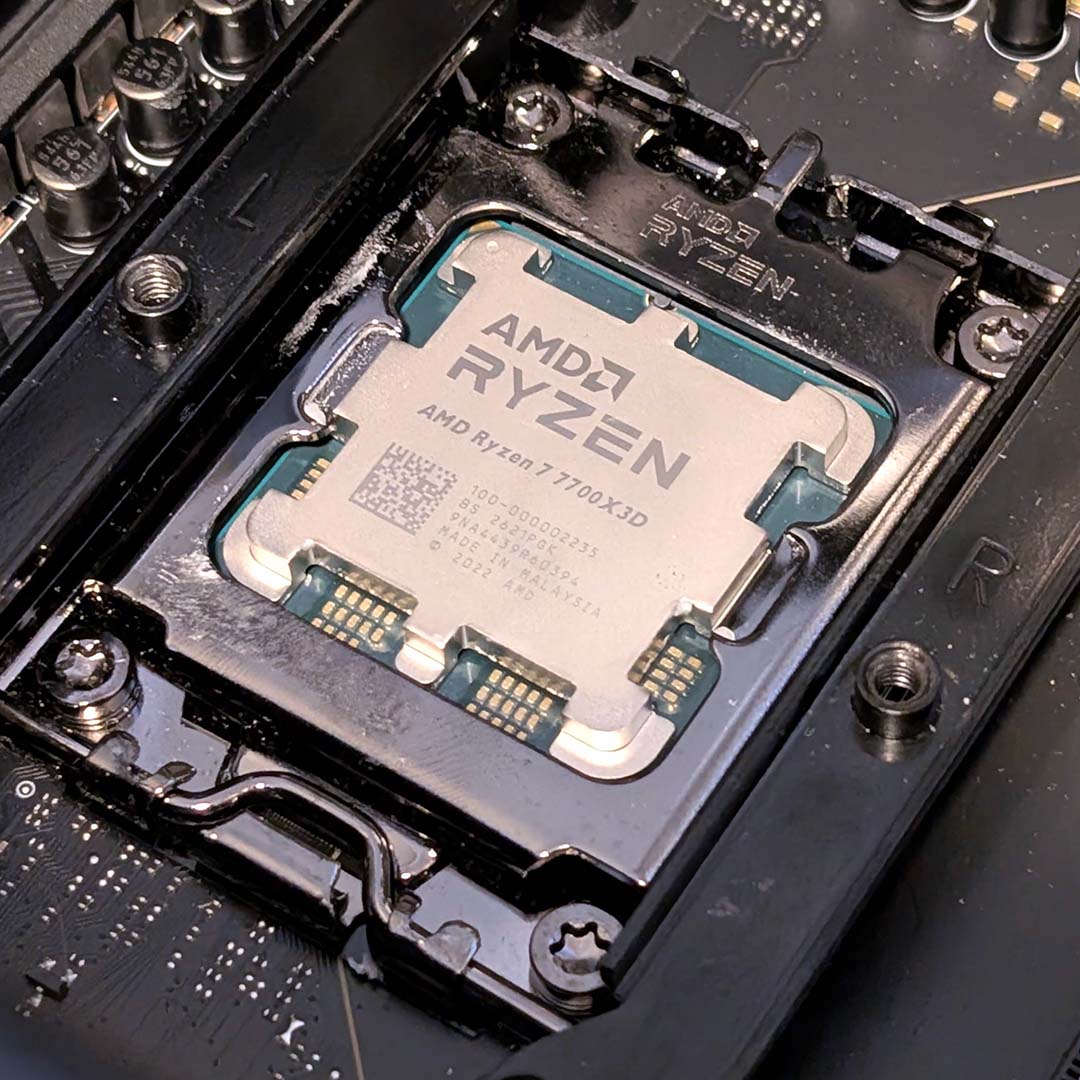
AMD Ryzen 7 7700X3D
Loads of cache helps bolster gaming frame rates, but the price really needs to come down to justify that 500MHz clock speed deficit. Read our review.
A part of the problem here is undoubtedly the mismatch between the 7800X3D’s launch MSRP, and its actual real-world street price today. At its launch cost of $449, the 7800X3D would represent a significant premium over the 7700X3D. However, now that AMD’s Zen 5 X3D chips have been doing the rounds for a while, 7800X3D prices have plummeted, making the 7700X3D look like a bit of a curiosity.
AMD needed to do a better job of factoring this situation into its 7700X3D pricing calculations. There’s definitely room in the market for an 8-core, budget-friendly chip with 3D V-Cache that’s cheaper than a 7800X3D. However, if it’s going to be 500MHz slower, it really needs to be at least $50 cheaper.
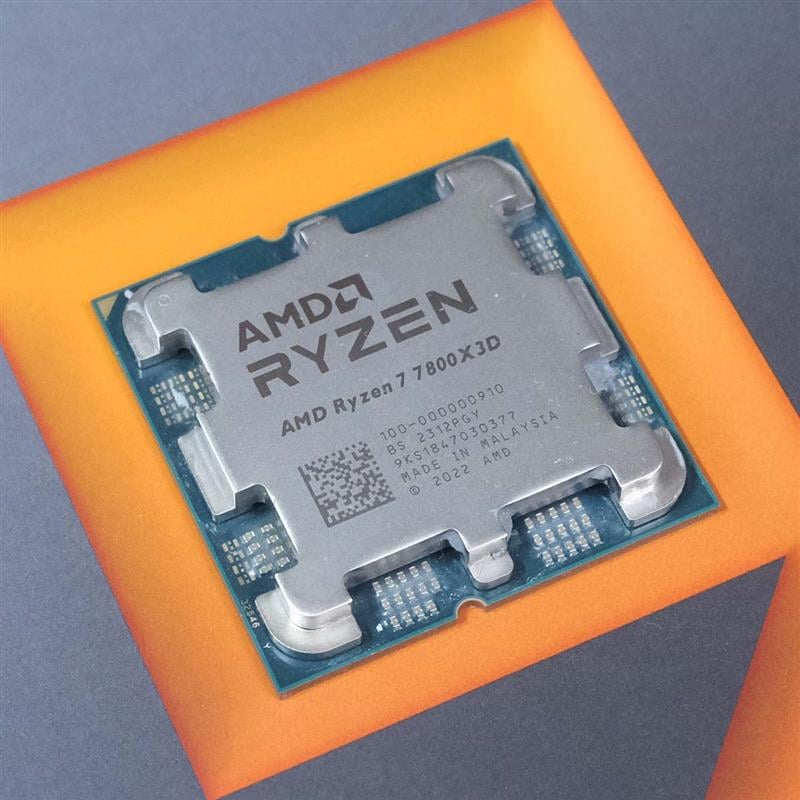
AMD Ryzen 7 7800X3D
A great gaming CPU at today’s prices, with loads of cache and a half-decent 5GHz boost clock. Read our review.
If the AMD Ryzen 7 7700X3D gets a significant price cut in future, or a decent discount in a deal, then it will be worth considering. There is a decent gaming CPU under that heatspreader, with loads of cache to bolster gaming frame rates, but at current pricing you’d be much better off buying the 7800X3D instead.
For more processor advice, check out our guide to buying the best CPU for your needs, where we take you through all our current top picks.