
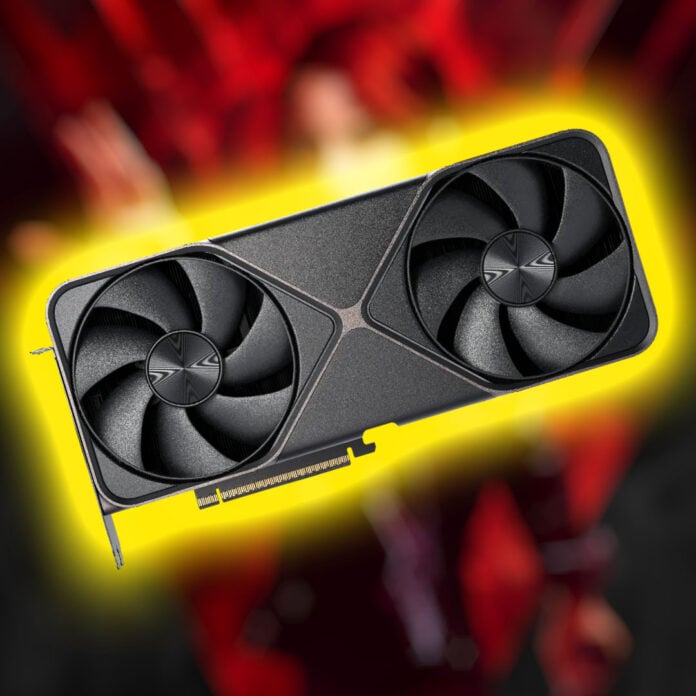
The pleasure of neural rendering via Nvidia DLSS 5 not only requires making a substantial sacrifice when it comes to frame rates, but also your electricity bill. That’s according to recent testing of the feature’s leaked DLL, with benchmarks spanning a variety of games running on both the Founders Edition and MSI Lightning Z models of the GeForce RTX 5090.
For those out of the loop, Nvidia DLSS 5 will officially launch on 3 September, but the technology made its way into the wild much earlier via early access builds of NBA 2K27. Since then, modders have injected neural rendering into a wide array of games. This approach isn’t entirely reflective of how the feature will look or perform in these games, owing to a lack of developer intent, but gives us a taste of its potential impact on visuals, as well as performance and power draw.
The folks at Tom’s Hardware set about exploring the latter two categories, emerging with concerning results that will undoubtedly put a dampener on the appeal of Nvidia DLSS 5. Using the two aforementioned RTX 5090 graphics cards, they found frame rates could fall by a whopping 48% with DLSS 5 enabled, while raising power draw on the MSI Lightning Z by up to 50% and pushing the Founders Edition card to its absolute power limits.
These huge frame rate swings come from Hogwarts Legacy, running at 4K with DLSS Super Resolution Performance and maximum settings enabled, including every ray-traced effect. Both cards were able to run the game at these settings at a comfortable 121-124fps average sans Nvidia DLSS 5. However, once neural rendering enters the picture, performance collapses to 63fps on the Founders Edition and 73fps on the Lightning Z.
It’s important to note that the Lightning Z runs with a much higher boost clock of 2,775MHz, relative to the Founders Edition’s 2,407MHz. While both cards can go beyond these frequencies via GPU Boost, the former design can run faster, thanks to its water-cooling system freeing up some thermal headroom, and its pair of 12V-2×6 connectors feeding it up to 1,000W, compared to the reference design’s 575W.
Surprisingly, running Nvidia DLSS 5 in combination with path tracing took less of a toll on performance and power draw, but the cost to each remains substantial. In the case of Control, average frame rates dropped by 42% on the Lightning Z and Founders Edition. Meanwhile, MSI’s card called on 13% more watts from the wall, reaching 802W total, while Nvidia’s cooler hit its 575W brick wall.
The results are much the same in Cyberpunk 2077, with 39% and 42% drops in average frame rates. However power consumption rises by 14% and 25% across the two cards, with the Lightning Z seeing the largest increase.
It’s important to stress that none of these results reflect official implementations of Nvidia DLSS 5. We’ll need to wait and see how NBA 2K27 shapes up in terms of performance and power before making any true assessments of the technology, but these modded implementations certainly aren’t a fantastic sign.
I maintain that Nvidia DLSS 5 has potential, with some footage of Assetto Corsa looking particularly swish, but the testing above gives further food for thought beyond photorealism. Any apprehensions I had about the look of the technology grow all the more intense at the suggestion they come at massive performance and power costs. Neural rendering? No, real rendering. Thanks.
For more on Nvidia’s latest tech, check out our Nvidia DLSS 4.5 Ray Reconstruction hands-on complete with quality and performance analysis.