
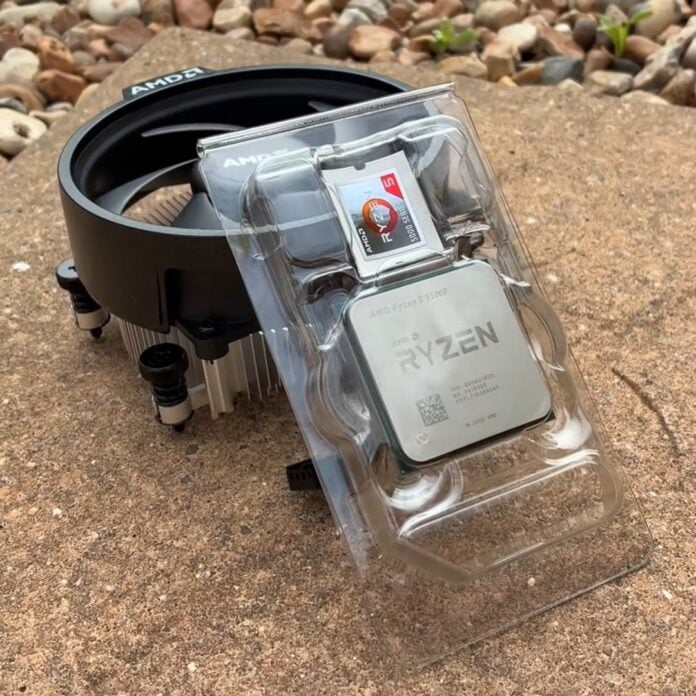
The first AMD Ryzen 5 5500F gaming benchmarks have started surfacing, putting the new £88 AM4 CPU 3-16% ahead of its closest sibling, the Ryzen 5 5500. According to tests conducted by RandomGaminginHD on YouTube, AMD’s DDR4-friendly chip can deliver playable frame rates even on modern games, but performance is limited by its small L3 cache.
For these benchmarks, the Ryzen 5 5500F was paired with a mid-range AMD Radeon RX 9060 XT 16GB graphics. This combo’s average frame rate in Battlefield 6 was 16% higher on the new chip than the older one, hitting 106fps at 1080p. Likewise, average frame rates saw a 10.9% boost in Cyberpunk 2077, 8% in Counter-Strike 2, and 8.8% in GTA V Enhanced.
Meanwhile, some games, such as Crimson Desert and Red Dead Redemption 2 gained just a small 3.7% increase to their average frame rates, but 1% and 0.1% low figures improved across the line, resulting in a smoother experience compared to the Ryzen 5 5500. That said, this advantage doesn’t apply to all games. For instance, Forza Horizon 6 didn’t see any difference moving from one CPU to the other.
These results also reveal that, in CPU-heavy games, the Ryzen 5 5500F left some performance on the table despite being paired with just a mid-range GPU. It seems that its 16MB of L3 cache can really hold it back. Comparatively, the more expensive Ryzen 5 5600X has 32MB of L3 cache, while the newly rereleased 5800X3D has a massive 96MB to help bolster frame rates.
At first glance, the Ryzen 5 5500F and Ryzen 5 5500 non-F seem similar, but the former boasts some very important upgrades. While both carry the same count of six Zen 3 cores without integrated graphics, the Ryzen 5 5500 uses a monolithic design based on the Zen 3 Cezanne architecture, which only offers PCIe 3.0 support, whereas the Ryzen 5 5500F uses a chiplet design based on Vermeer, which features PCIe 4.0. The higher 4.4GHz boost frequency, compared to 4.2GHz on the 5500, is also helping the Ryzen 5 5500F pull ahead.
The takeaway here is that the Ryzen 5 5500F looks like a solid budget choice for those planning to build a new entry-level gaming machine. At $99 / £88, it’s reasonably priced, more so considering that it supports DDR4 memory, so you don’t have to fork out for DDR5 RAM.