

Microsoft has published a preview of DirectX Raytracing (DXR) Clustered Geometry and Partitioned Top-Level Acceleration Structures (PTLAS), offering great performance gains and memory savings relative to existing pipelines. These features promise to dramatically improve the performance and efficiency of ray tracing, with huge ramifications to video memory requirements.
Unlike rasterised rendering, where the GPU processes every triangle individually, ray tracing requires further calculation as to how millions of light rights mix and intersect with triangles. To reduce computational costs, game engines use Bounding Volume Hierarchy (BVH), which nests small objects in larger volumes. Take for example, a teacup inside a box, inside a truck: the ray test hits the larger truck, then the smaller box inside, until it hits the precise triangle of the teacup.
Traditionally, DXR splits this into two tiers: Bottom-Level Acceleration Structure (BLAS), which defines the geometry of a single object (e.g., a character model), and Top-Level Acceleration Structure (TLAS), which defines where all those objects sit in the virtual world. The GPU must rebuild or update both every time an object moves or animates. Suffice it to say, in today’s massive open worlds, using this top-level acceleration structure (TLAS) can lead to massive VRAM and compute demands.
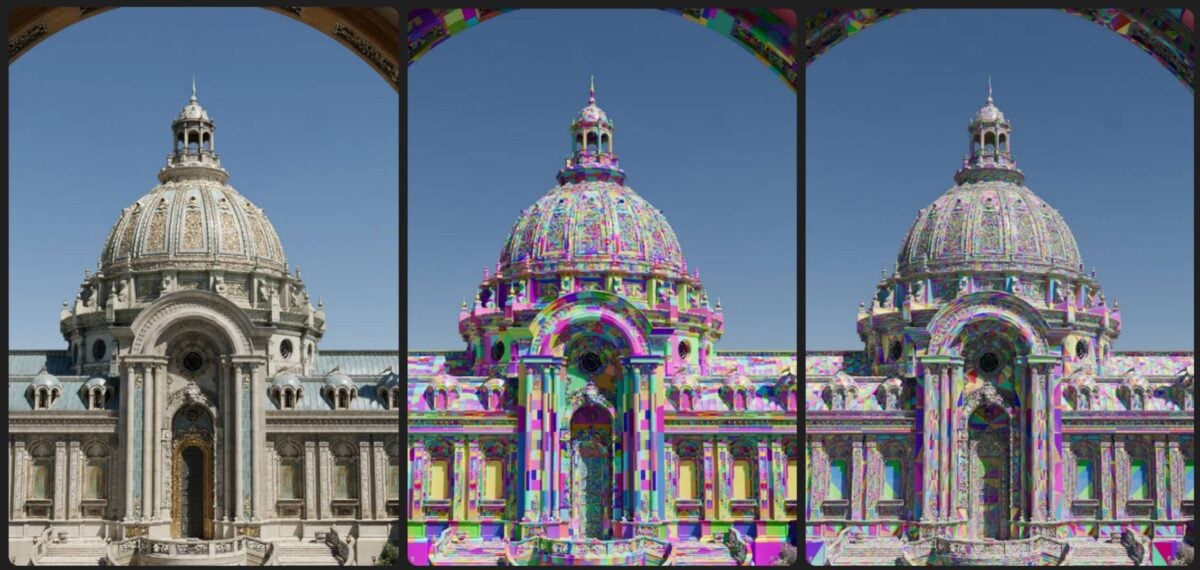
To address this problem, Microsoft is introducing partitioned TLAS (PTLAS) into its DXR API, allowing ray tracing to focus on changes in a specific region while retaining acceleration-structure data elsewhere. PTLAS breaks the game world into distinct zones, so if a change happens in one, the GPU only recalculates and overwrites the data for that specific area.
Microsoft is also introducing Clustered Geometry to solve the BLAS bottleneck, which should reduce VRAM waste. The feature allows the game engine to reuse the same pre-build clusters of a model, rather than duplicating data for high-detail and low-detail (LOD) versions. In doing so, Microsoft claims to reduce VRAM usage by up to a staggering 90%.
To be clear, we are not talking about overall game VRAM usage, this is purely related to ray tracing. Nonetheless, this is an impressive optimisation. Better still, Clustered Geometry and PTLAS can work in unison or separately, with no limitations.
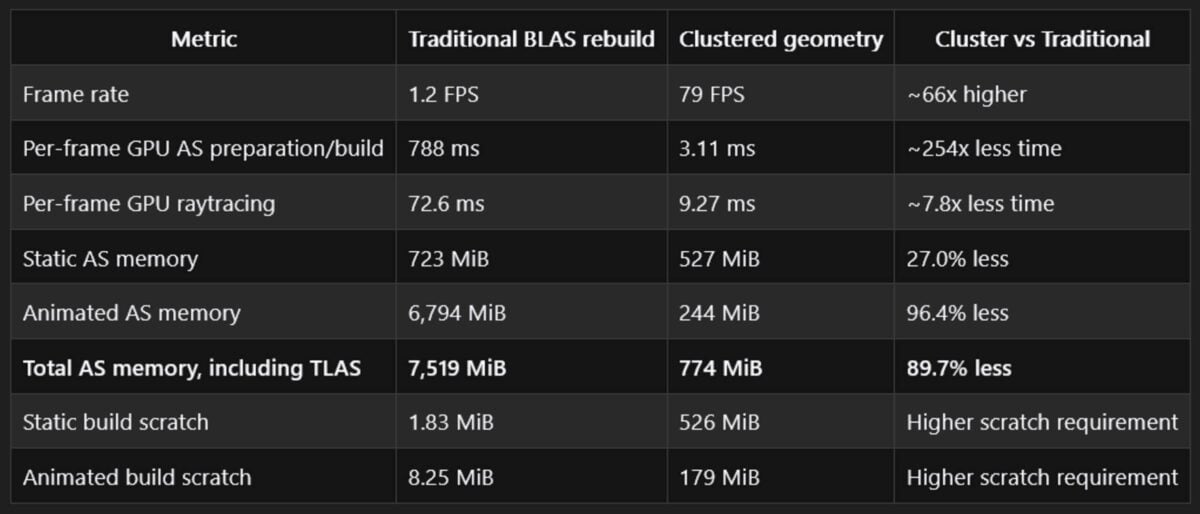
To put all of this into numbers, Microsoft demonstrated a test scene on an AMD Radeon RX 9070 where enabling Clustered Geometry and PTLAS dropped build time to just 3.11ms, down from 788ms. That’s about 254x less time, not bad. As a result, frame rate jumped from 1.2fps to a whopping 79fps, i.e. a 66x boost. At the same time, VRAM usage fell by 89.7%, shrinking from 774MiB to 7,519MiB.
And the best part in all this is that Clustered Geometry and Partitioned Top-Level Acceleration Structures (PTLAS) are compatible with current GPUs. According to Microsoft, Nvidia GeForce RTX 50 series, AMD Radeon RX 9000 series, Intel Arc B-series, Intel Core Ultra processors (200V series and Series 3), and Qualcomm Snapdragon SoCs will all support these features following subsequent drivers.