

AMD has demonstrated its latest ray tracing rendering technology, which it says is capable of reducing the memory and compute load of complex geometry. Dubbed Tetrahedral Cages, AMD says this tech cuts BVH memory use by 47x, while speeding up BVH updates by 90x.
Before presenting a ray-traced (RT) scene, the GPU needs to calculate where simulated light rays hit the object. So, to avoid having to test every single triangle individually, which would make real-time RT practically impossible on consumer hardware, the GPU uses a tree-like structure of boxes wrapped around objects called a BVH (bounding volume hierarchy).
Modern GPUs use these BVHs to identify which triangles intersect with a ray to efficiently render realistic lighting, shadows, and reflections in real time. Even so, animated geometry such as trees and bushes remain a difficult workload for ray tracing, due to their moving vertices, which can require the associated Bottom-Level Acceleration Structure (BLAS) to be updated or rebuilt. This consumes a lot of GPU time, memory, and bandwidth.
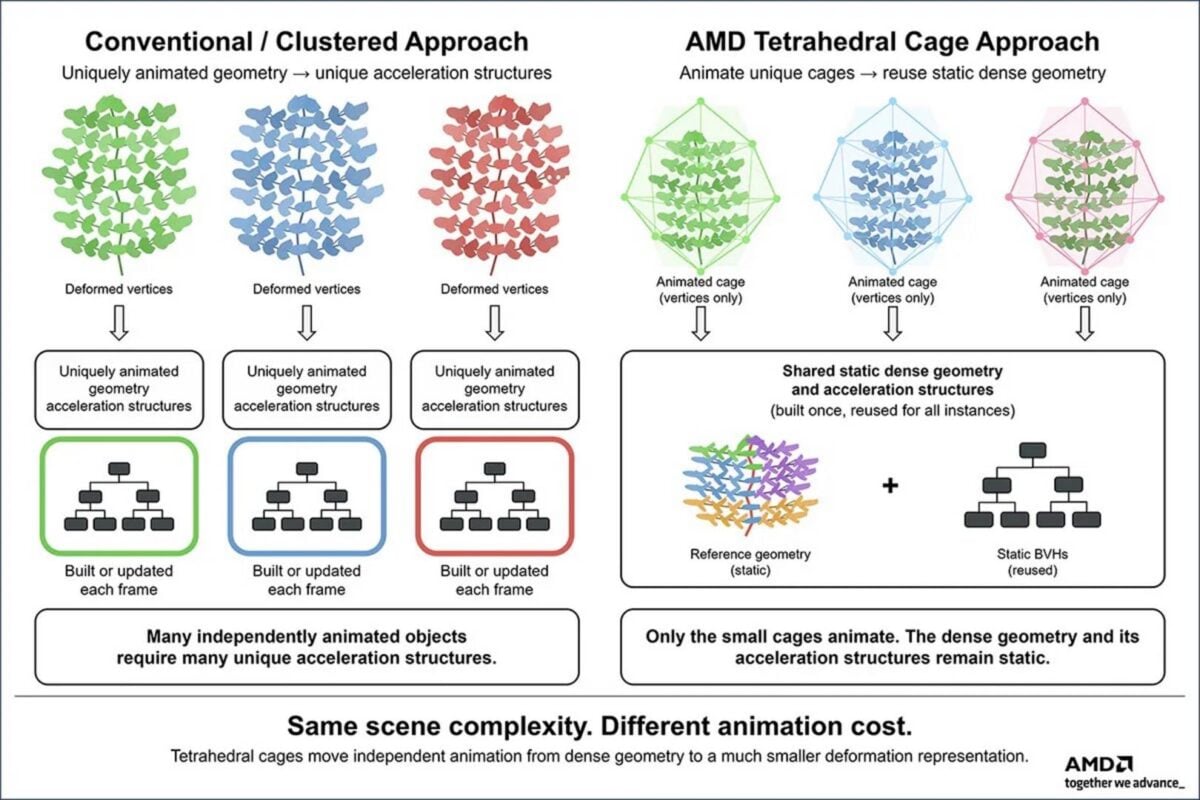
AMD’s Tetrahedral Cages aim to fix this performance block by wrapping these dense meshes in a simpler deformable cage, keeping the geometry and its BVH static and reusable, while only animating these cages. When a ray enters an animated tetrahedral cage, the rendering engine transforms the ray into the geometry’s original rest-pose space, in order to perform intersection testing against static data.
This allows the compute cost to scale with cage complexity instead of triangle count. The downside is that by only animating the cages, you lose per-vertex animation, which would break the illusion/effect on fast-changing or individually detailed objects.
As a result, AMD is targeting this technology at tree, grass, and foliage rendering, where losing some animation control isn’t detrimental to the final result, not to mention being less visible to the user.
AMD claims its Tetrahedral Cages allow its Radeon RX 9070 XT GPU to render a large scene containing 25,000 independently animated plants above 60fps at 1080p. Furthermore, AMD indicates that, when using traditional methods, this demo would have required 80GB of VRAM and over 300ms per frame for BVH updates.
For reference, the RX 9070 XT only has 16GB of VRAM, and 300ms per frame is basically 3fps, and that’s assuming the rest of the rendering pipeline was lightning fast. With Tetrahedral Cages, VRAM usage fell to just 1.7GB, while frame time cost dropped to 3.3ms, according to AMD.
Considering all of this, Tetrahedral Cages look ideal for ray tracing slow-moving vegetation, such as trees bending in the wind or grass swaying, as you might see in The Witcher 3 or Black Desert.