
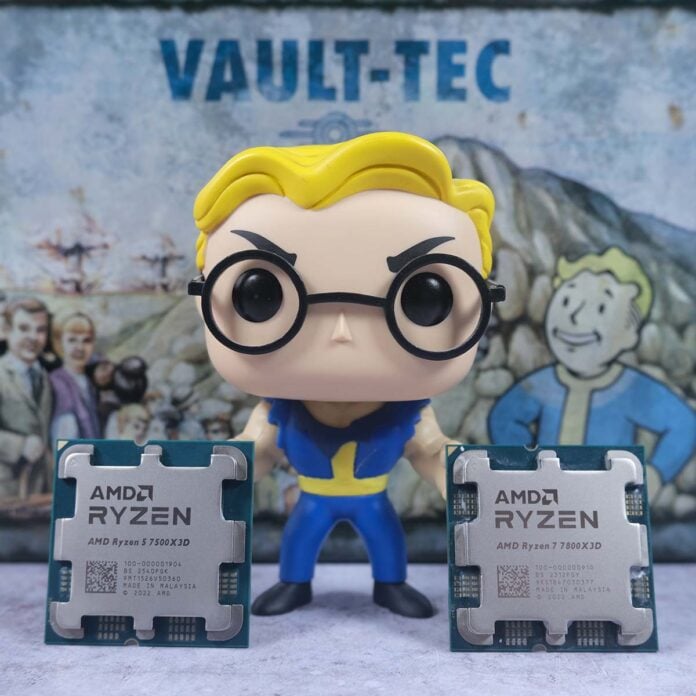
I’m over the moon to see AMD launch the Ryzen 5 7500X3D, an AM5 CPU with 3D V-Cache that’s more affordable than the 7800X3D, and widely available to boot. With a very tempting price of just $270 / £245, the 7500X3D looks potentially perfect for a budget gaming build, but is it worth saving your pennies to get the 8-core 7800X3D instead? Keen to explore this conundrum, it’s time for a drag race between these two chips.
Below you’ll find detailed analysis on the difference between each CPU’s specifications, as well as benchmark results across apps and games. Digesting all this data, it will become readily apparent which processor is the right fit for your system.
Specs
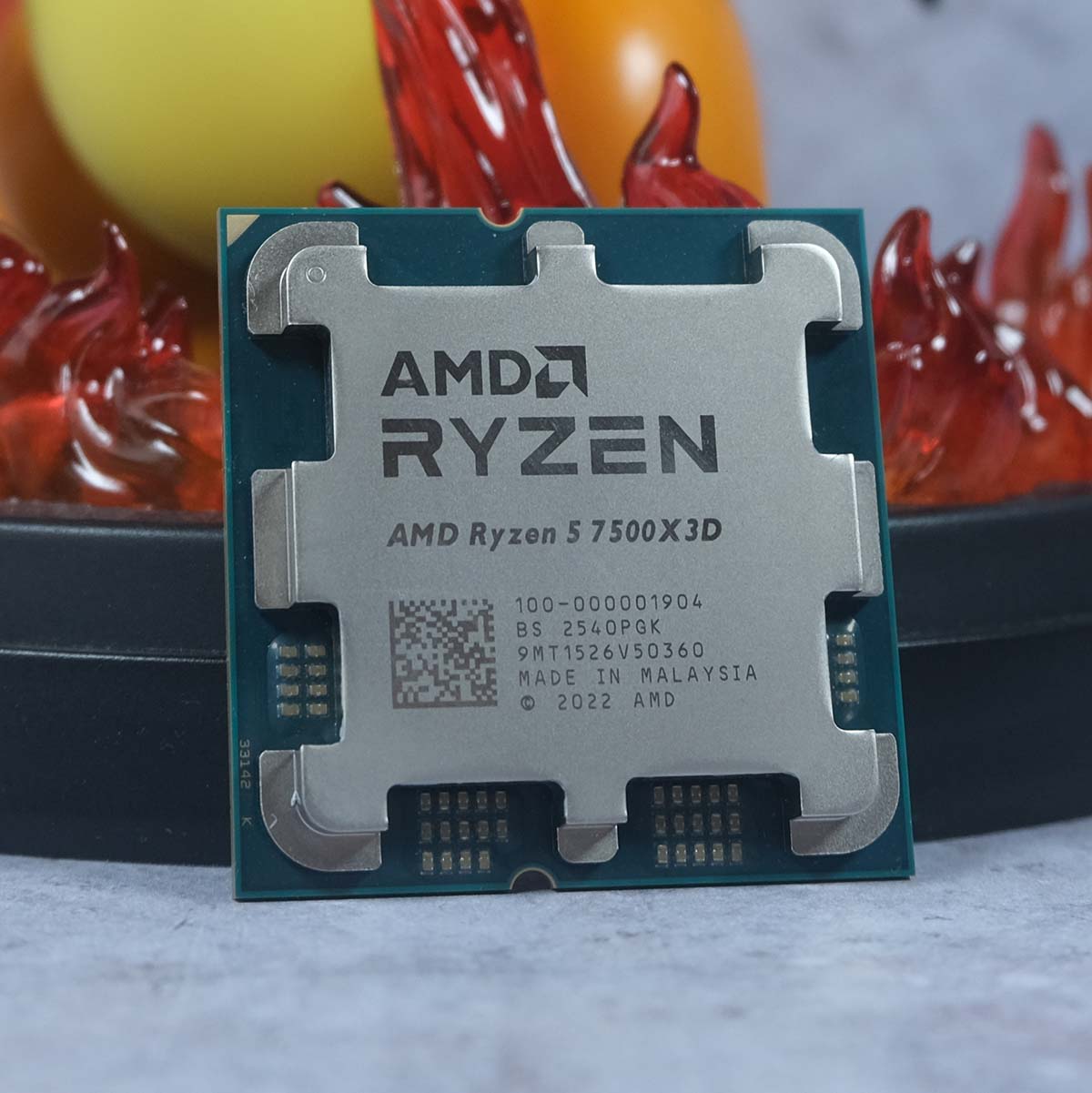
AMD’s 7800X3D and 7500X3D have a lot in common. They’re both based on AMD’s last-gen Zen 4 architecture for a start, which means they’re comparatively slower than AMD’s Zen 5 chips in terms of instructions per clock (IPC), but the difference here won’t be huge. Both chips also have the same 64MB stack of 3D V-Cache cache on top of their core chiplet dies (CCDs), as well as 32MB of on-die L3 cache, making for a colossal total of 96MB.
| Ryzen 5 7500X3D | Ryzen 7 7800X3D | |
|---|---|---|
| Release date | November 2025 | April 2023 |
| Platform | AM5 | AM5 |
| Cores | 6 | 8 |
| Threads | 12 | 16 |
| TDP | 65W | 120W |
| Architecture | Zen 4 | Zen 4 |
| L2 cache | 6MB | 8MB |
| L3 cache | 96MB | 96MB |
| Base clock | 4GHz | 4.2GHz |
| Boost clock | 4.5GHz | 5GHz |
| Launch MSRP | $270 / £245 | $450 / £450 |
It’s this cache that really makes the difference to gaming performance, as it means the CPU has direct access to a big pool of data. This massively reduces the chances of cache misses, and the need to page slower system memory, meaning your CPU can focus on maintaining your frame rates.
There are two main differences between the chips. Firstly, there are only six cores in the AMD Ryzen 5 7500X3D, compared to eight in the 7800X3D. This won’t have a big impact on most games, which even now rarely stress more than six cores. However, as you’ll see in our benchmarks, there are some games where the extra cores definitely help. If you run a lot of heavily multi-threaded software, perhaps for video encoding or 3D rendering, then you’ll also find those two extra cores helpful.
The AMD Ryzen 5 7500X3D reduces clock speed significantly to just 4.5GHz
The other main difference is clock speed, and this will have an impact on performance across the board, particularly in games. The Ryzen 7 7800X3D already has a comparatively low boost clock of just 5GHz, and the 7500X3D reduces this significantly to just 4.5GHz. As a point of comparison, the acclaimed Ryzen 7 9800X3D boosts to 5.2GHz, while AMD’s non-X3D chips can boost up to 5.7GHz.
What that lower clock speed and core count does buy you, though, is lower heat output. AMD says the 7500X3D TDP is just 65W, compared to 125W for the 7800X3D. This means you can happily run this CPU without needing a hefty PSU, and you won’t need an oversized CPU cooler to keep it in check either.
How we test
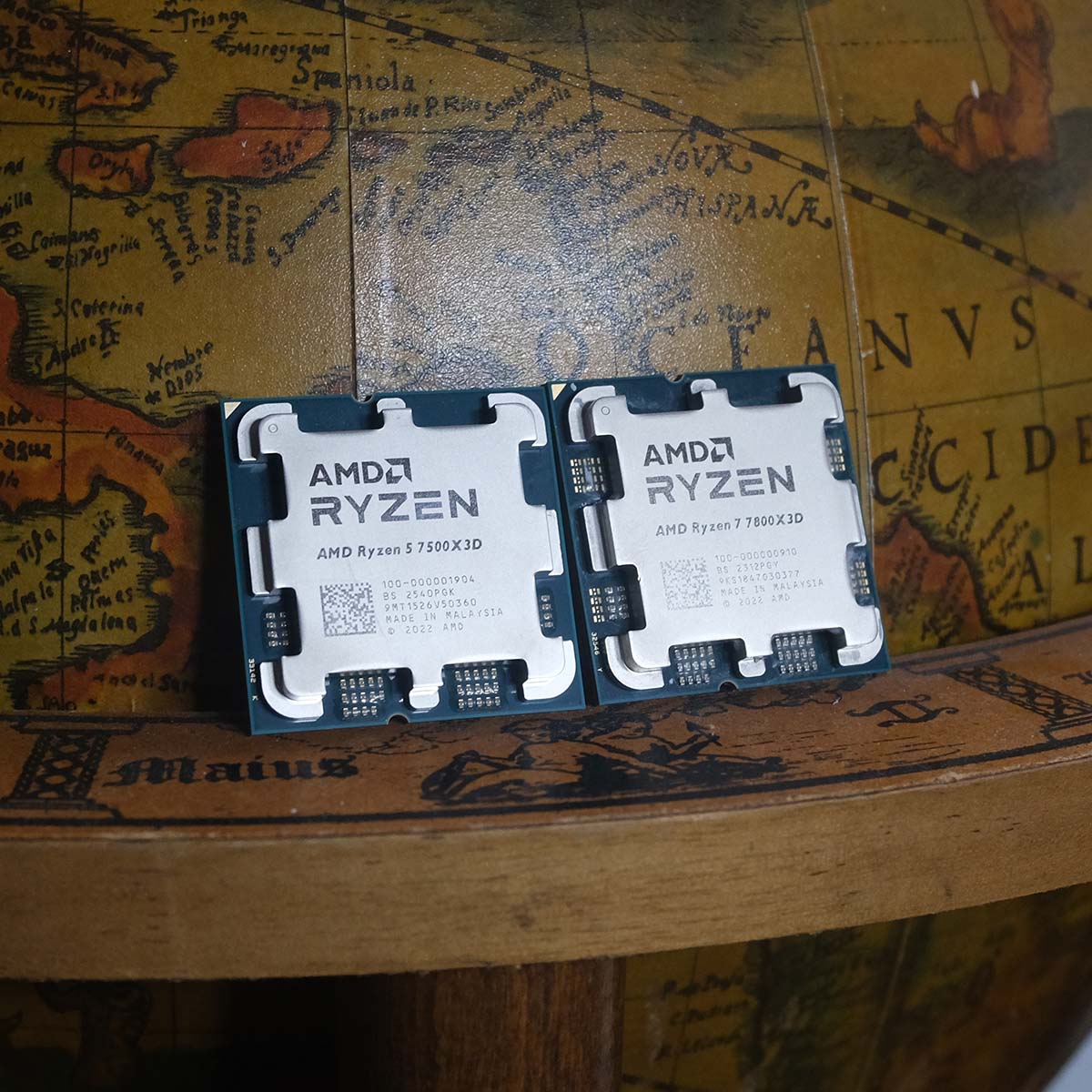
I’ve placed both processors in the hands of our Club386 test bench, the details of which you’ll find down below. Given the last time we tested the Ryzen 7 7800X3D was quite some time ago, I felt a slew of fresh results was necessary to give the chip its fairest chance against AMD’s new Ryzen 5 7500X3D.
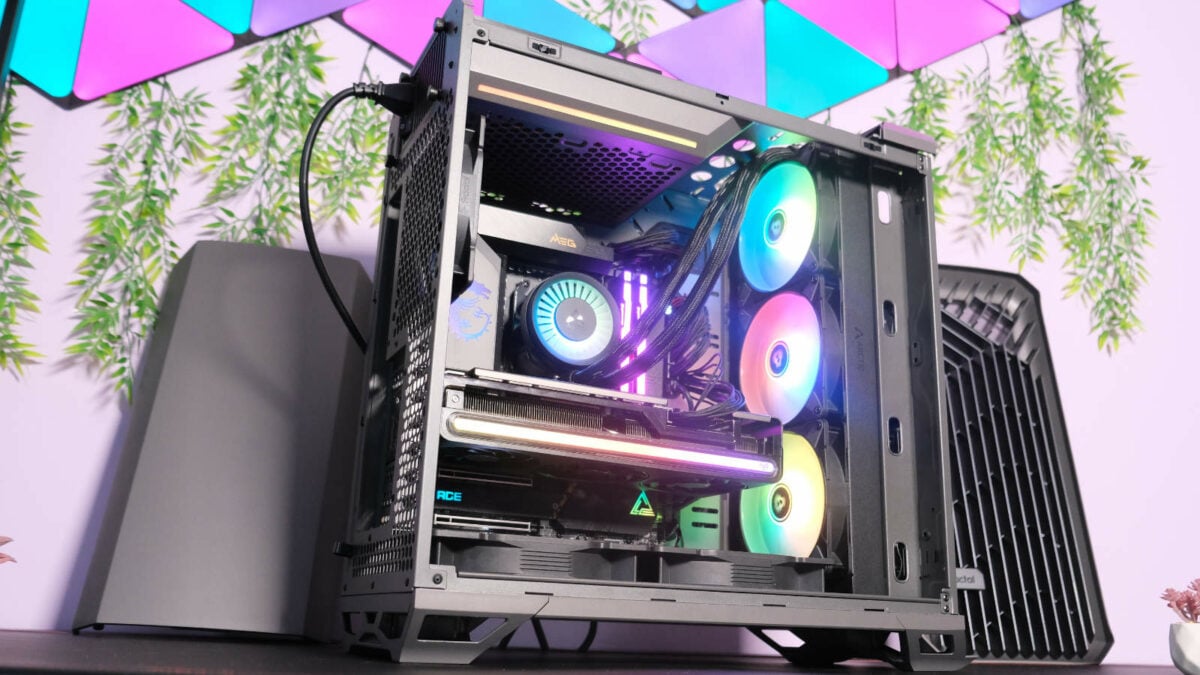
Our 7950X3D test PCs
Club386 carefully chooses each component in a test bench to best suit the review at hand. When you view our benchmarks, you’re not just getting an opinion, but the results of rigorous testing carried out using hardware we trust.
Shop Club386 test platform components:
CPU: AMD Ryzen 9 7950X3D
Motherboard: MSI MEG X670E ACE
Cooler: Arctic Liquid Freezer III 420 A-RGB
GPU: Sapphire Nitro+ Radeon RX 7800 XT
Memory: 64GB Kingston Fury Beast DDR5
Storage: 2TB WD_Black SN850X NVMe SSD
PSU: be quiet! Dark Power Pro 13 1,300W
Chassis: Fractal Design Torrent Grey
In the interest of pushing both the Ryzen 5 7500X3D and Ryzen 7 7800X3D to their limits, I’ve paired them with an Nvidia GeForce RTX 5090 Founders Edition. As the most-powerful graphics card in the world, it will demonstrate just how many frames per second make the difference between each CPU.
Apps
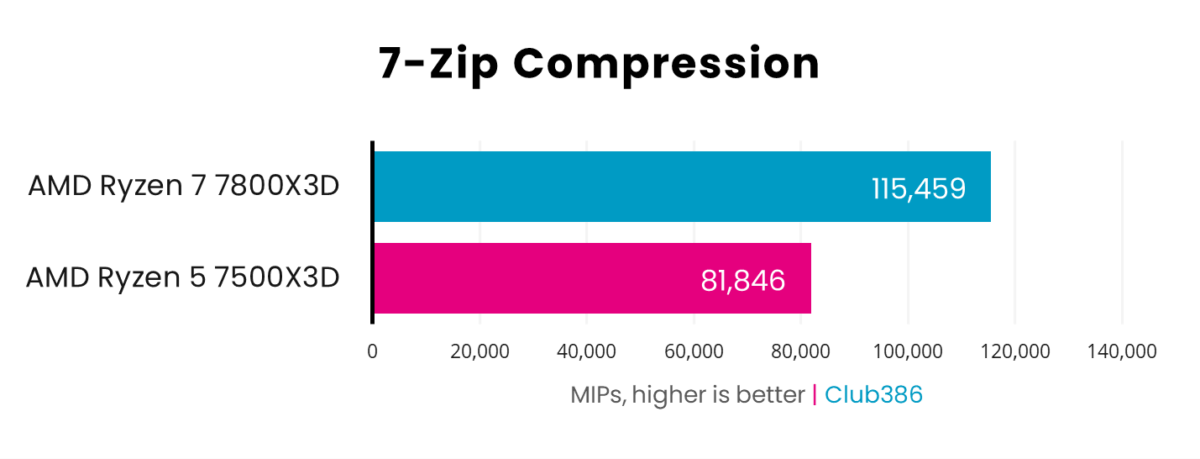
Beginning with productivity benchmarks, 7-Zip reveals the profound difference that additional cores and threads can bring to processor performance. The Ryzen 7 7800X3D is a whopping 41% faster here, processing 33,613 million instructions more than the 7500X3D per second (MIPS).
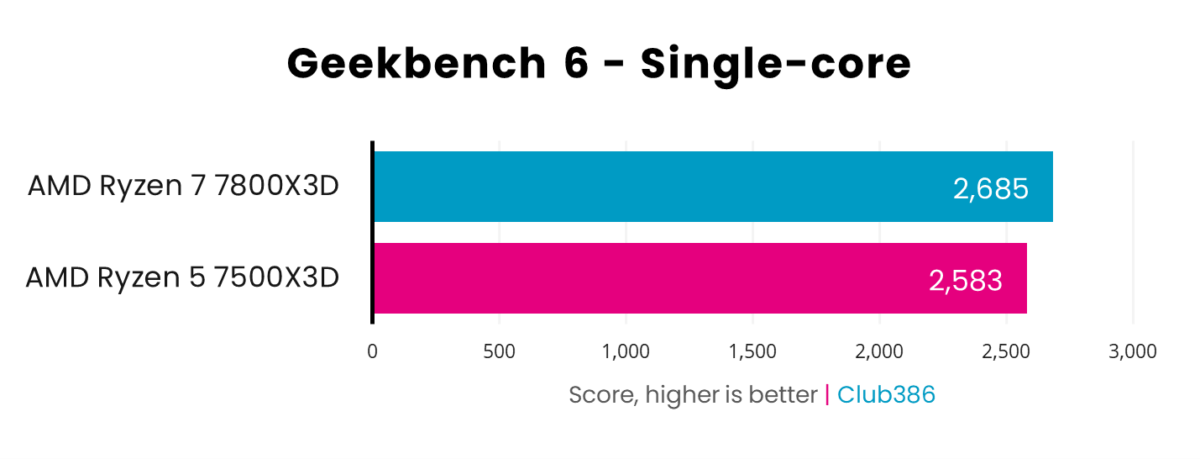
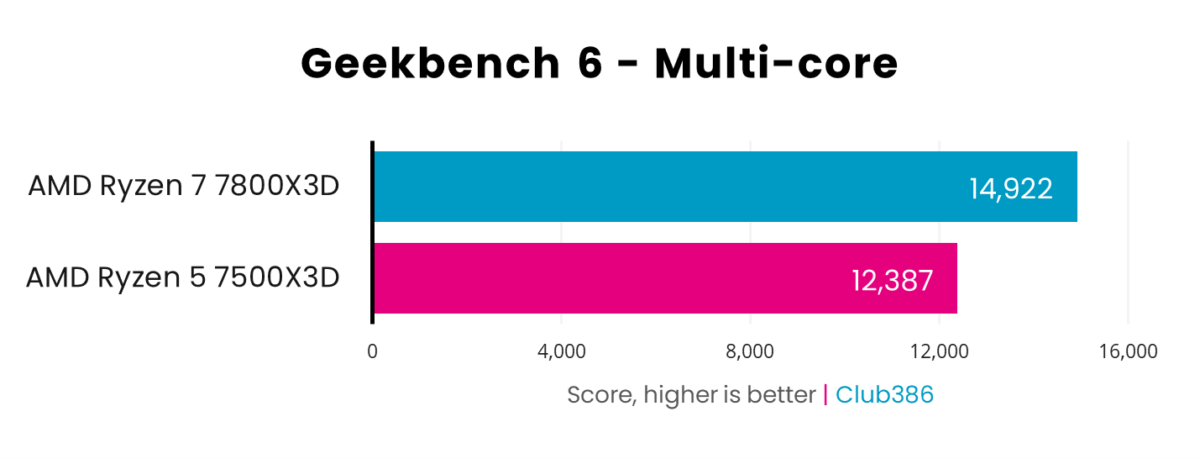
The gap between CPUs varies greatly in Geekbench 6 depending on the number of cores in play. Naturally, the largest difference between the Ryzen 5 7500X3D and Ryzen 7 7800X3D manifests in the multi-core benchmark, to the tune of 20%, thanks to the 7800X3D’s extra cores. However, once attentions turn to single-core performance, there’s a mere 4% separating the two processors.
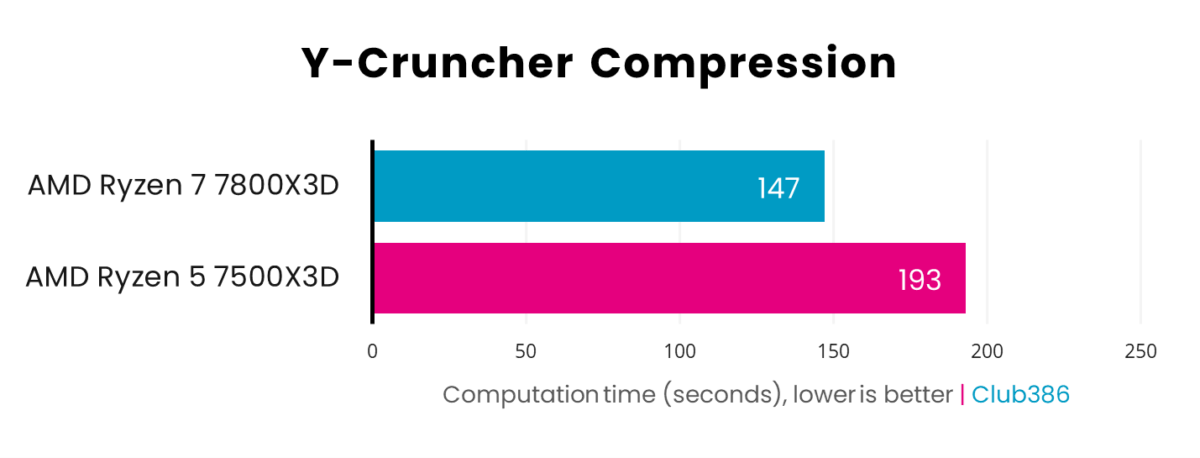
Finally, more cores once again gets you superior computational grunt while crunching numbers. It takes 147 seconds for the Ryzen 7 7800X3D to calculate Pi up to 5b digits, with AMD’s Ryzen 5 7500X3D proving far slower (+31%) at 193 seconds.
Content creation
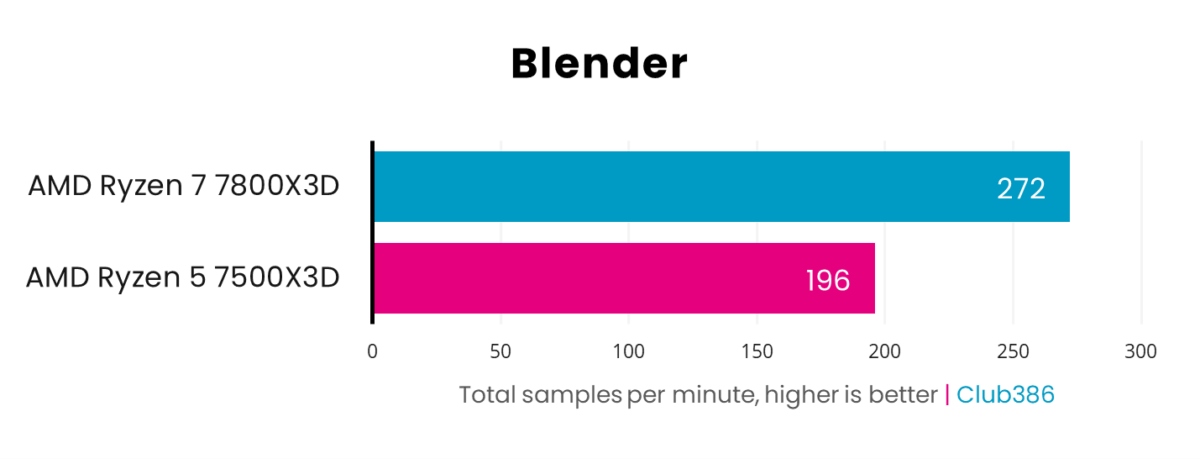
Both the Ryzen 5 7500X3D and Ryzen 7 7800X3D boast the same basic ‘AMD Radeon Graphics’ GPU, whose two graphics cores aren’t good for much else besides serving as a display output. This lack of pixel-pushing oomph reflects in both CPUs’ Blender sample counts, with even budget graphics cards like Nvidia’s GeForce RTX 5050 proving a better option for rendering with ~10x greater performance.
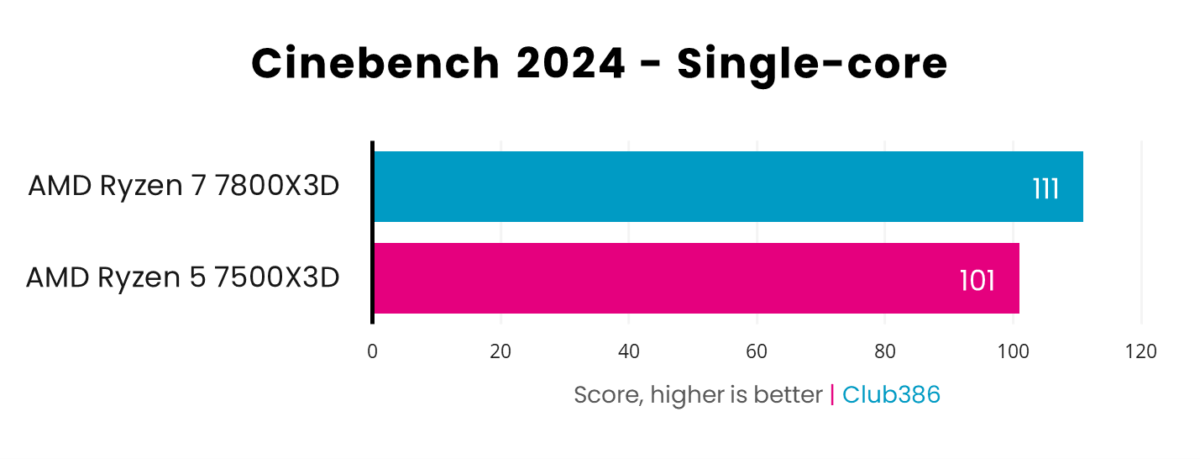
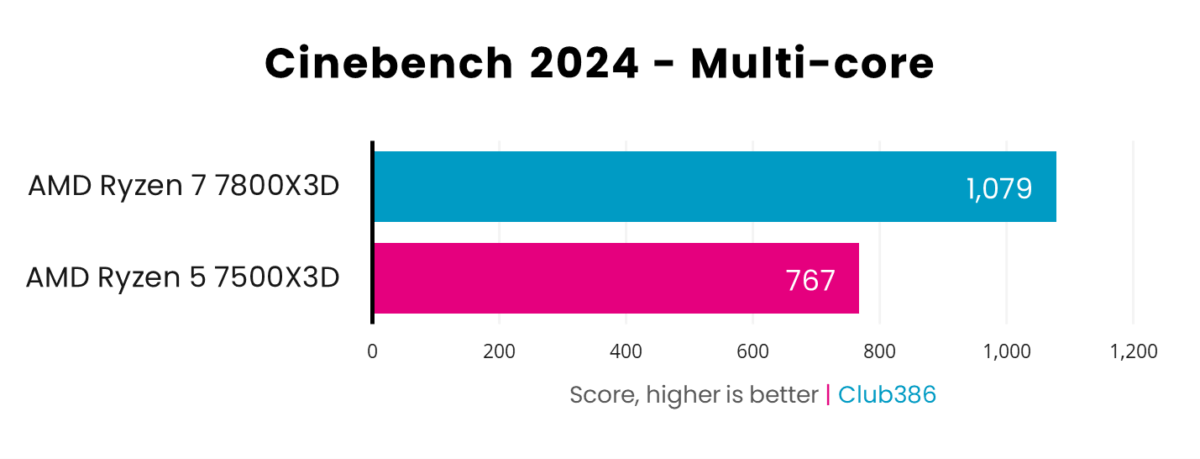
Cinebench 2024 mirrors the results of Geekbench 6, with the performance delta between AMD’s Ryzen 5 7500X3D and Ryzen 7 7800X3D being wider in the multi-core benchmark, but much closer when it comes to single-core performance. In the latter category there’s a 41% gap between the chips, shrinking to 10% in the other.
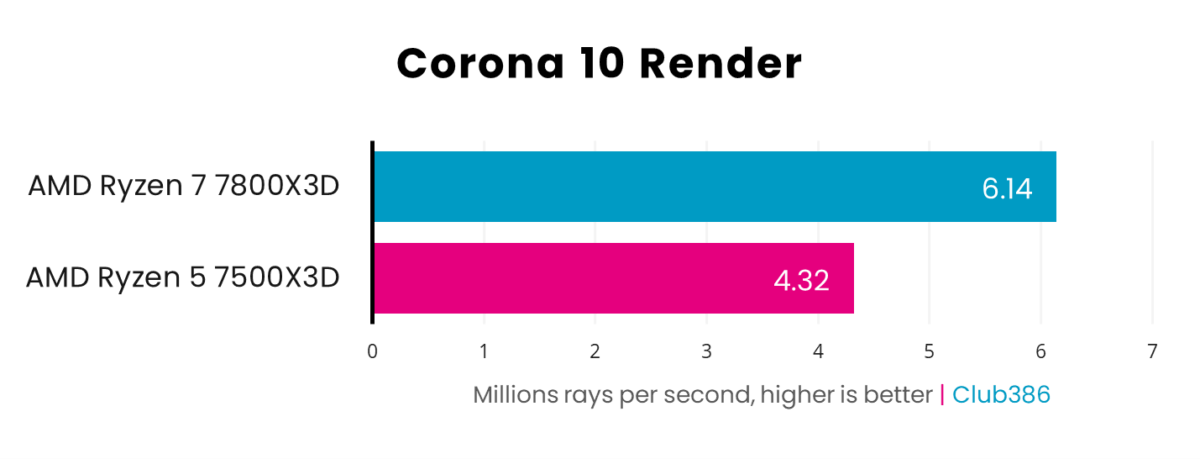
Putting both CPUs’ integrated GPUs through one final challenge, Corona 10 Render reveals a 42% gap when it comes to how many million rays each CPU can process per second.
Memory
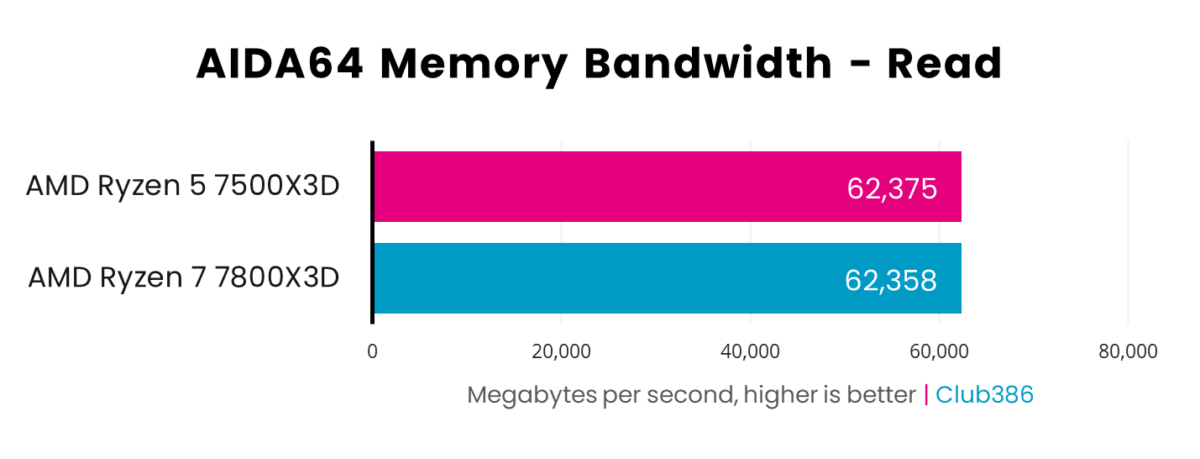
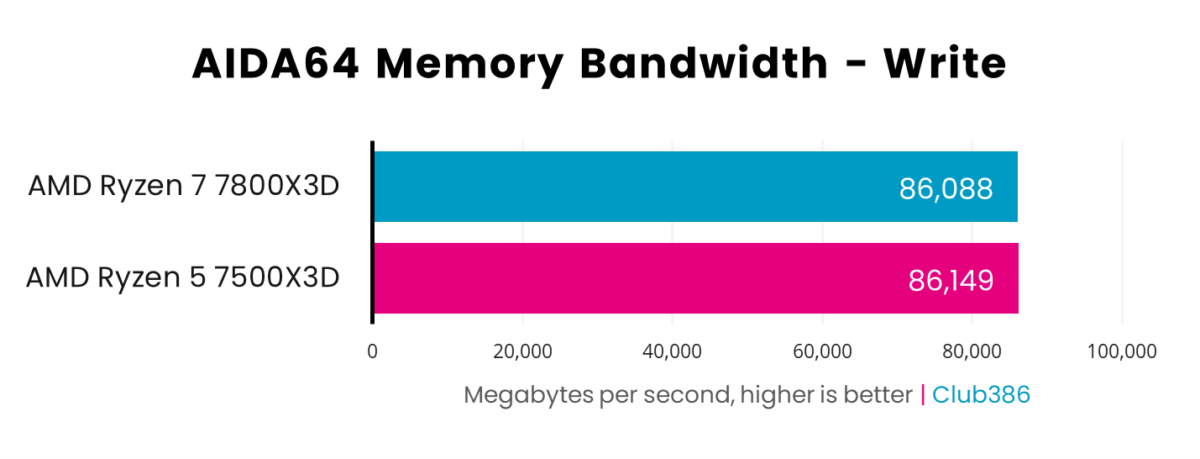
Moving on to RAM, there’s no meaningful difference in the system’s read or write performance between the Ryzen 5 7500X3D and Ryzen 7 7800X3D.
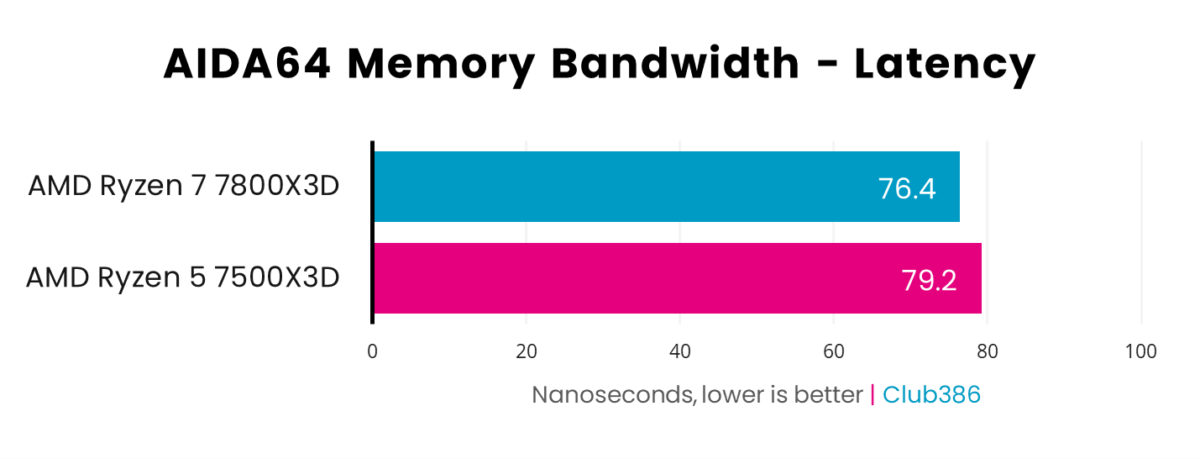
Similarly, latency is largely the same across both chips. The Ryzen 7 7800X3D comes out slightly better by 2.8ns, but such a victory is more academic than anything else.
Gaming
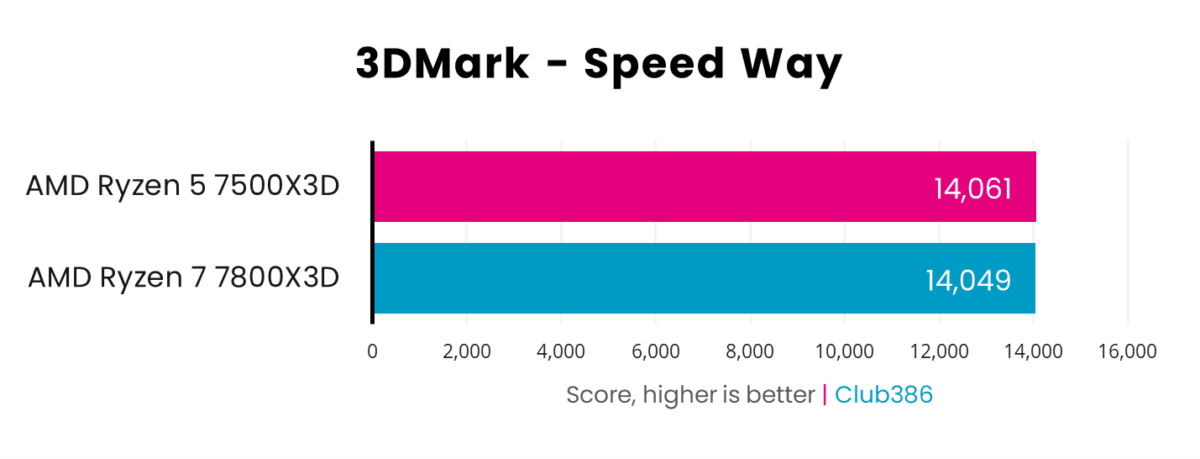
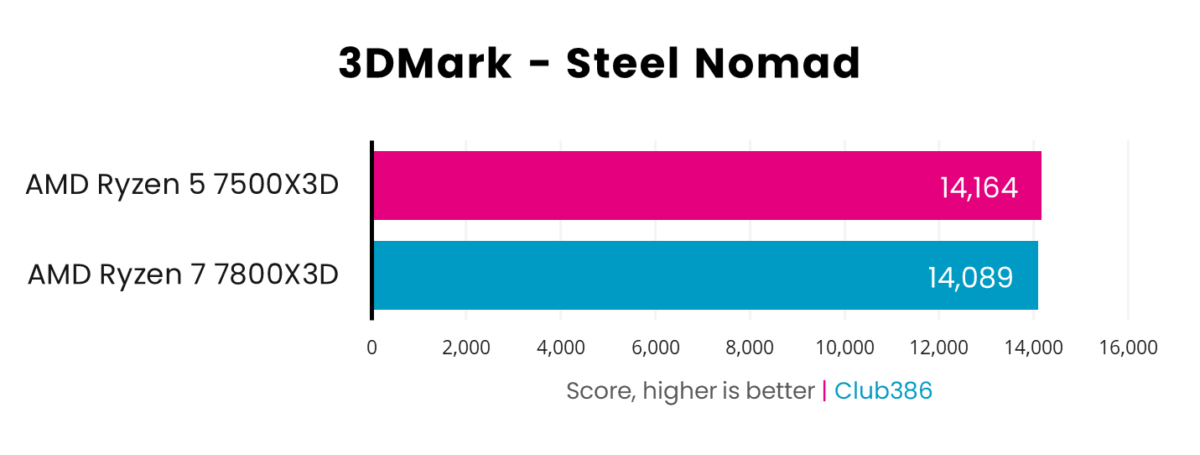
At last, we come to gaming benchmarks. Kicking off with 3DMark Speed Way and Steel Nomad, both processors are keeping pace with the GeForce RTX 5090. In scenarios like these, where the GPU is the primary bottleneck, differences between CPUs practically vanish.
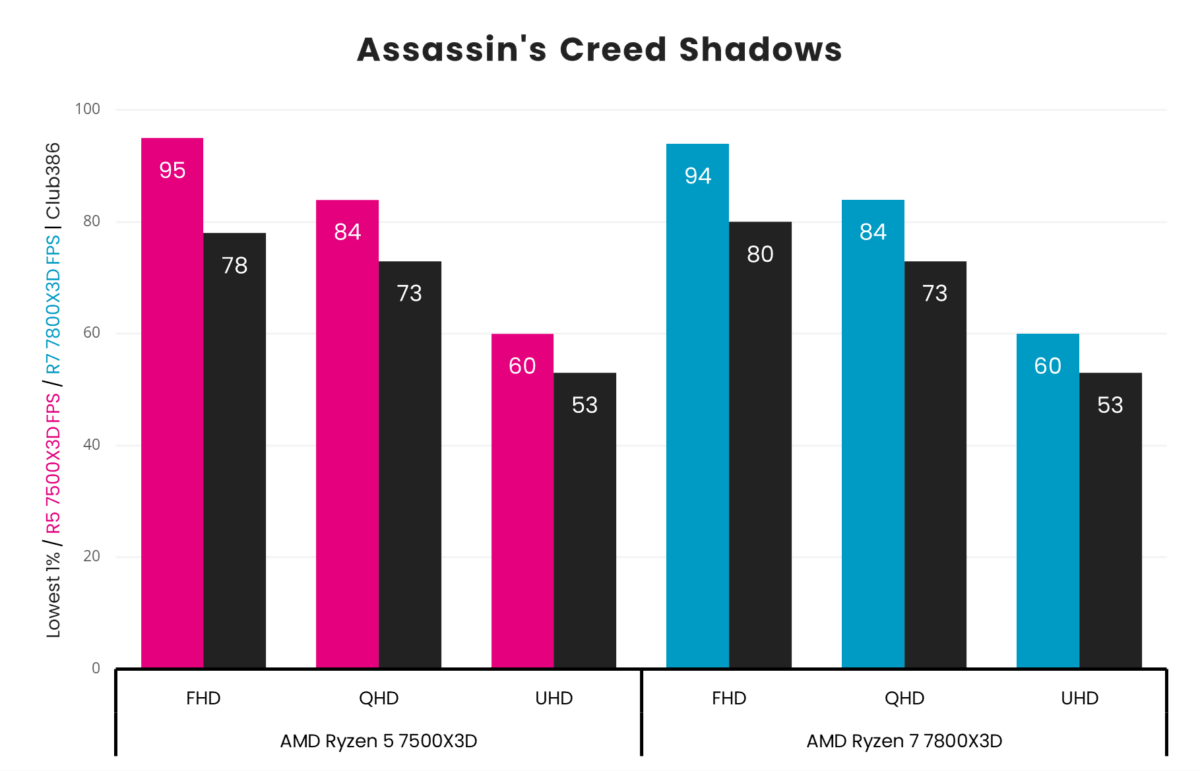
Meanwhile, the real-world ray-traced benchmark of Assassin’s Creed Shadows mirrors 3DMark’s synthetic results, as both Ryzen 5 7500X3D and Ryzen 7 7800X3D mirror one another at QHD and UHD. There is some play in performance at FHD, but differences are within the margin of error at no more than 2fps.
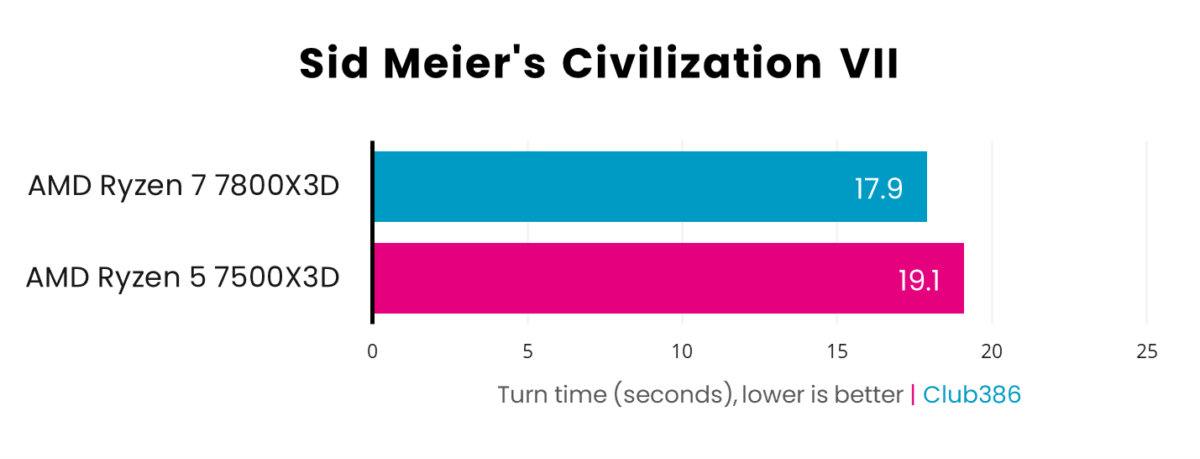
The complexities of turn-based strategy games like Sid Meier’s Civilization VII grow as games progress, requiring processors to crunch more numbers per turn as they process the AI of rivals, resources, and more. Both Ryzen 5 7500X3D and Ryzen 7 7800X3D perform admirably in this test, but the more-admirable chip emerges the most efficient by saving 1.2s of time per turn on average.
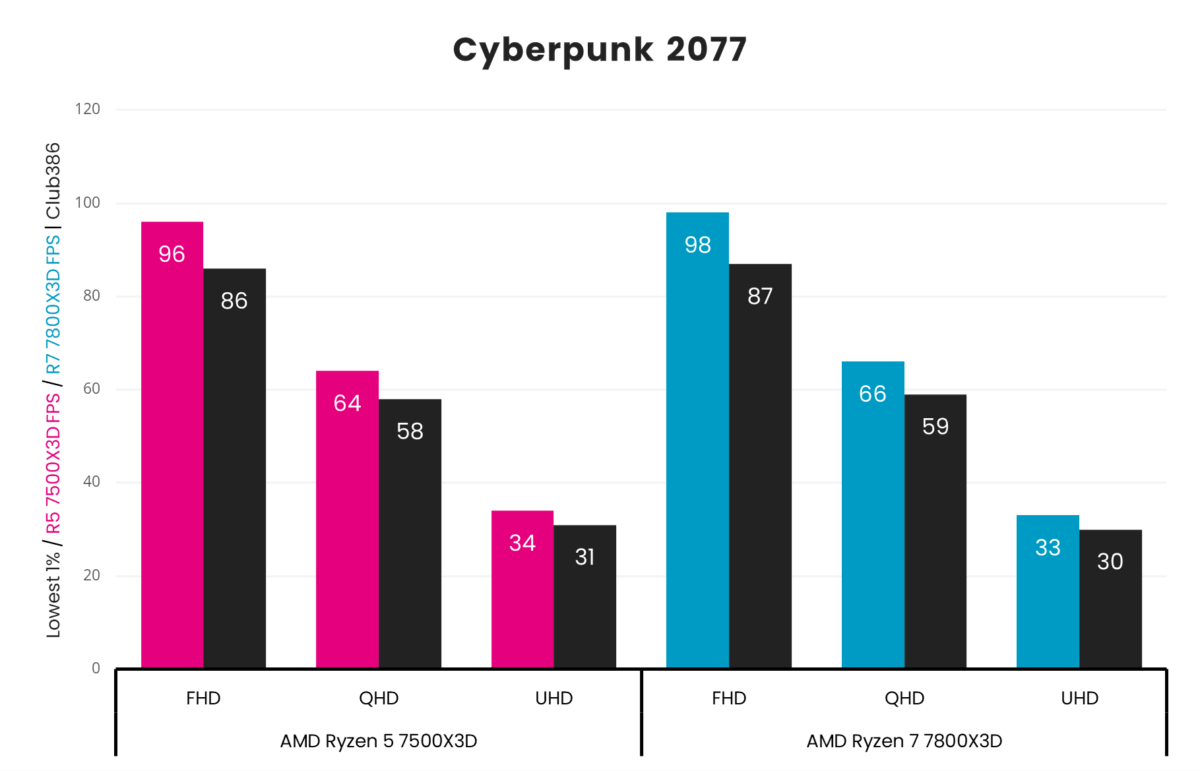
Simulating Night City requires a good deal of computational power, particularly after coating it in path-traced lighting in the Overdrive mode used for these benchmarks, with no DLSS features enabled. However, this workload is more pressing on the graphics card, resulting in a practical stalemate between these two processors across all resolutions in Cyberpunk 2077.
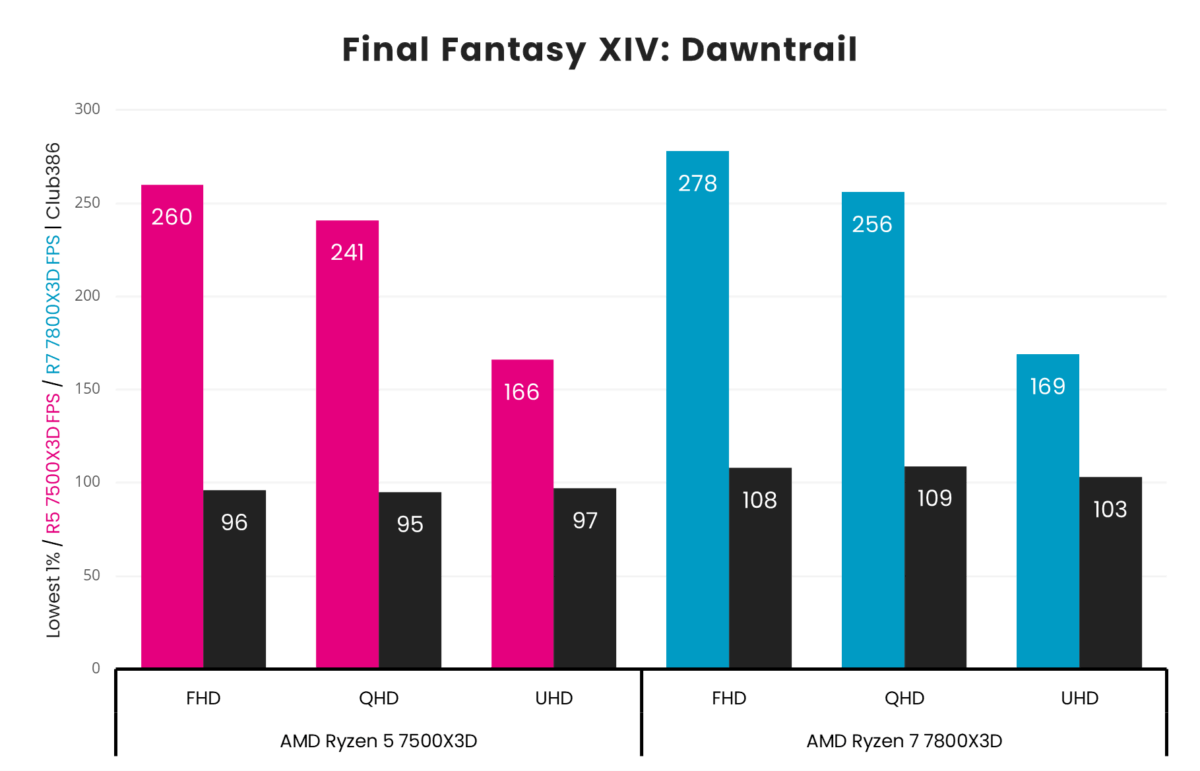
Venturing into the rasterised planes of Final Fantasy XIV: Dawntrail, we finally begin to see a tangible differences between the Ryzen 5 7500X3D and Ryzen 7 7800X3D. That said, the latter only enjoys an average frame rate lead of 7% at most, with each processor delivering suitably high performance that would please any gamer.
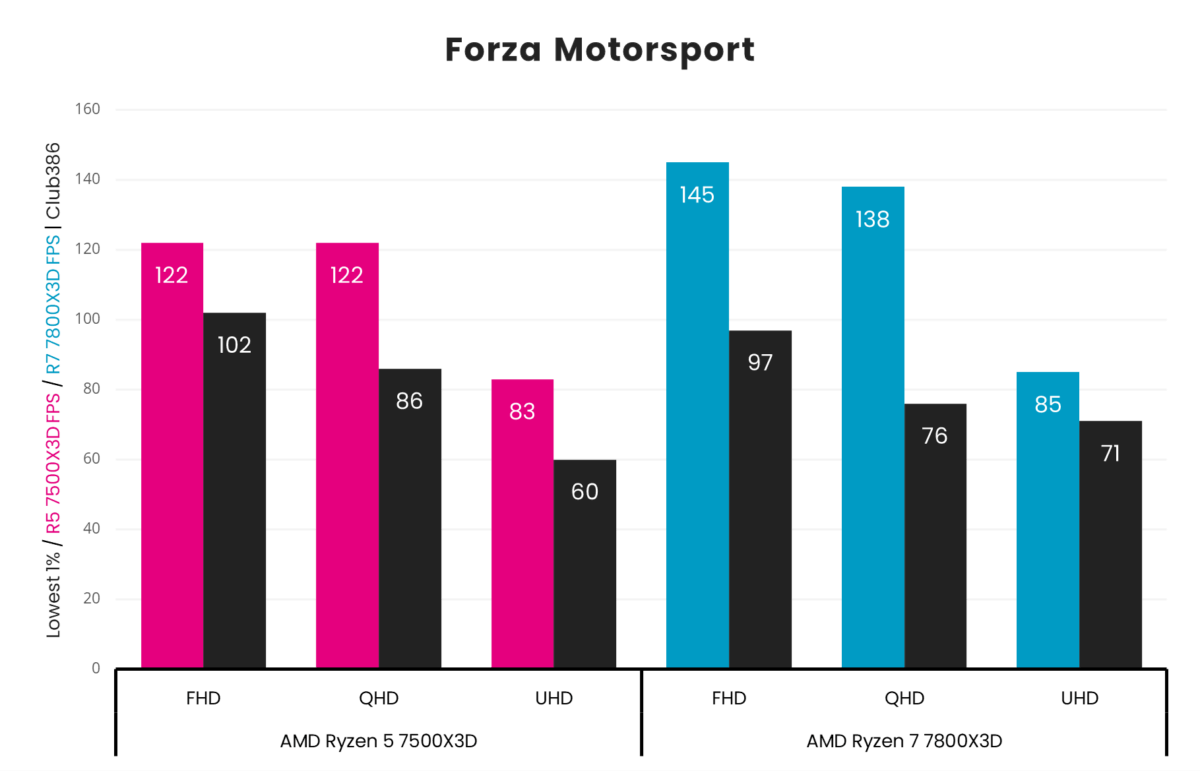
Hitting the ray-traced roads of Forza Motorsport also reveals a CPU bottleneck, despite higher pressure on the graphics card. AMD’s Ryzen 5 7500X3D is able to keep pace with the Ryzen 7 7800X3D at UHD, but falls behind at QHD and is unable to push average frame rates any higher at FHD.
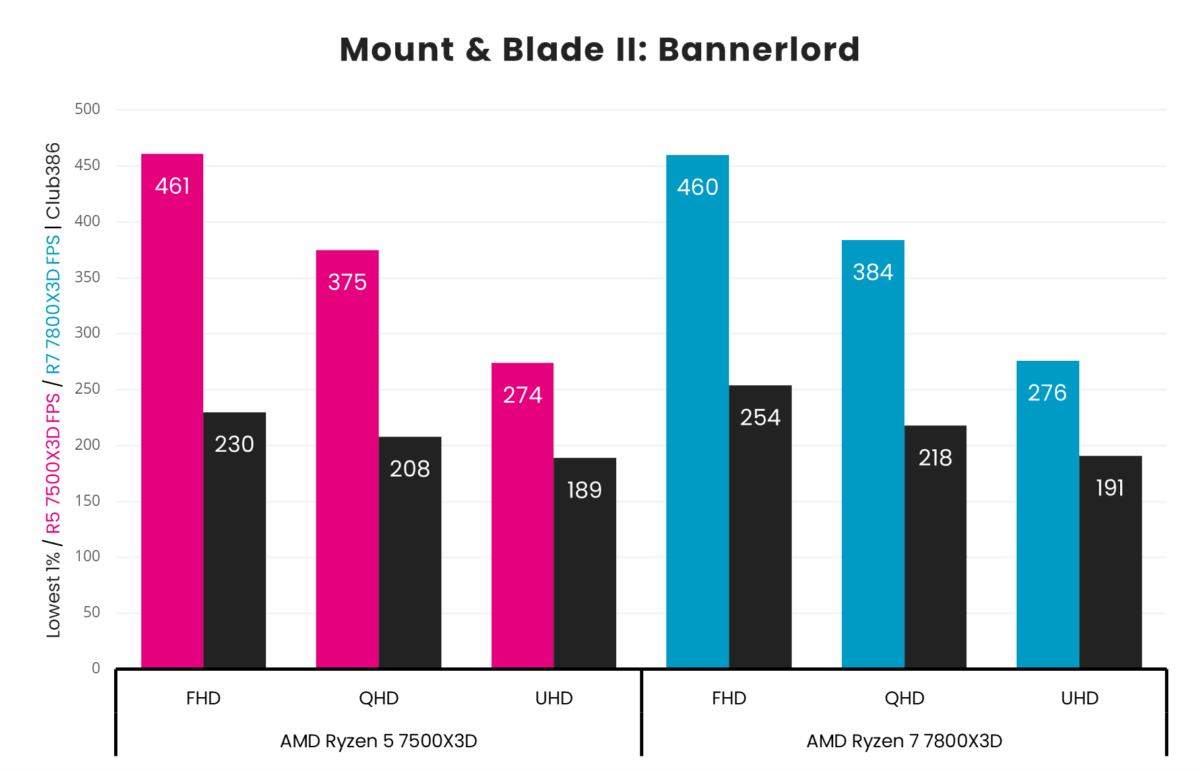
Unlike FFXIV: Dawntrail, there’s no meaningful differences in performance in the rasterised battlefields of Mount & Blade II: Bannerlord. At most, the Ryzen 5 7500X3D isn’t quite as smooth, with minimum frame rates behind those of the Ryzen 7 7800X3D, particularly at FHD.
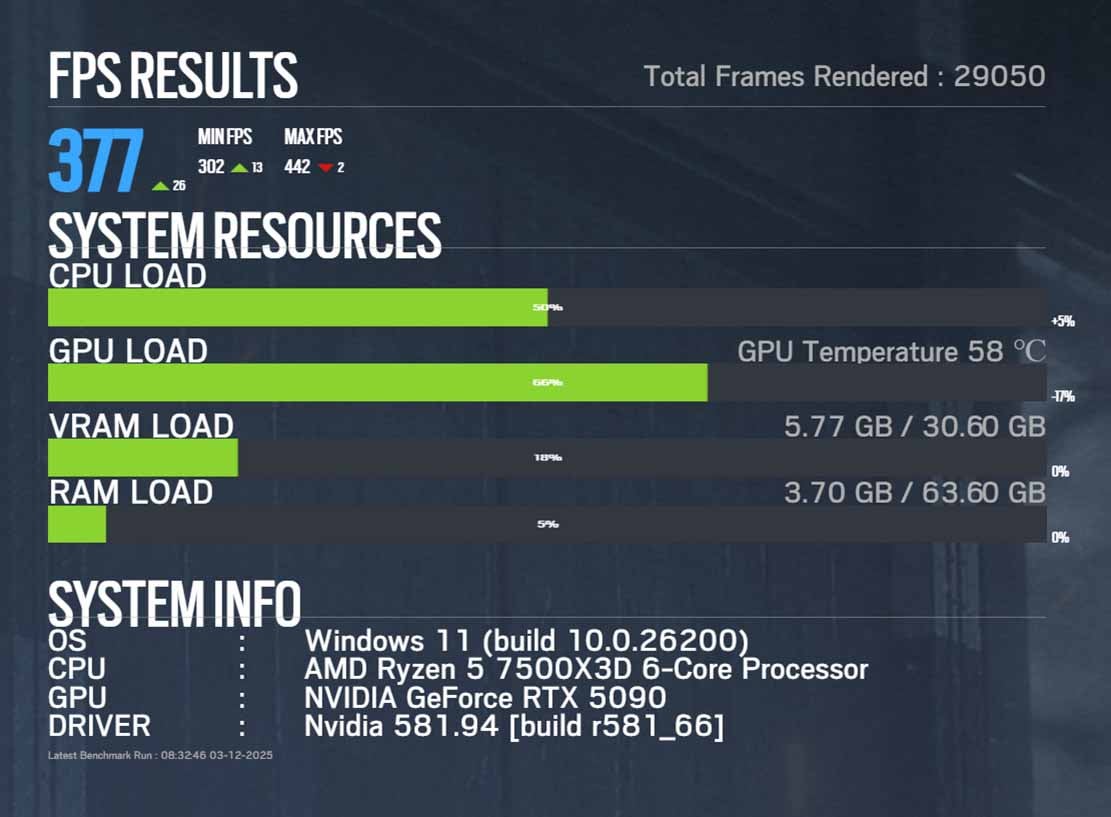
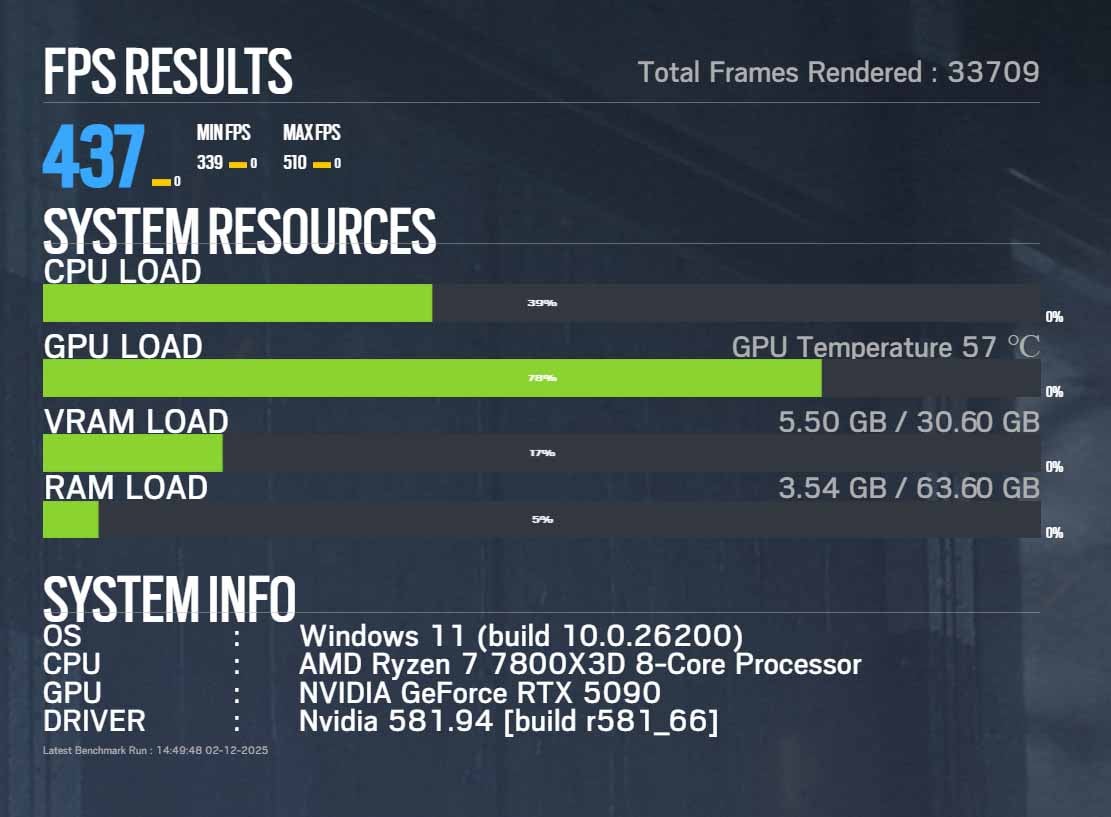
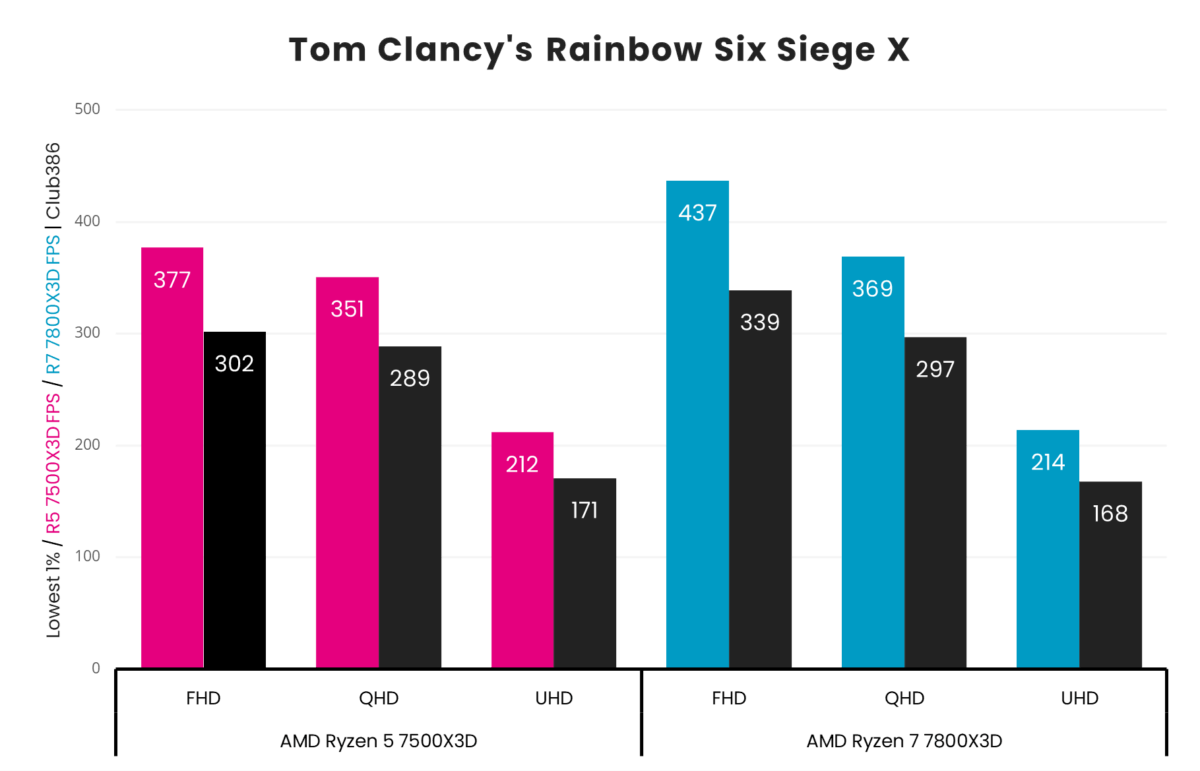
Tom Clancy’s Rainbow Six Siege X will happily gobble up any threads a system has to offer, despite many esports games typically sticking to a single thread. It’s in this first person shooter that the Ryzen 7 7800X3D enjoys a large lead of 16% at FHD, pushing average frame rates all the way to 437fps. As you can see in the benchmark summaries below, the game is putting more load on the 6-core CPU than the 8-core chip, and all six of its cores were being pushed to 4.5GHz during benchmarking.
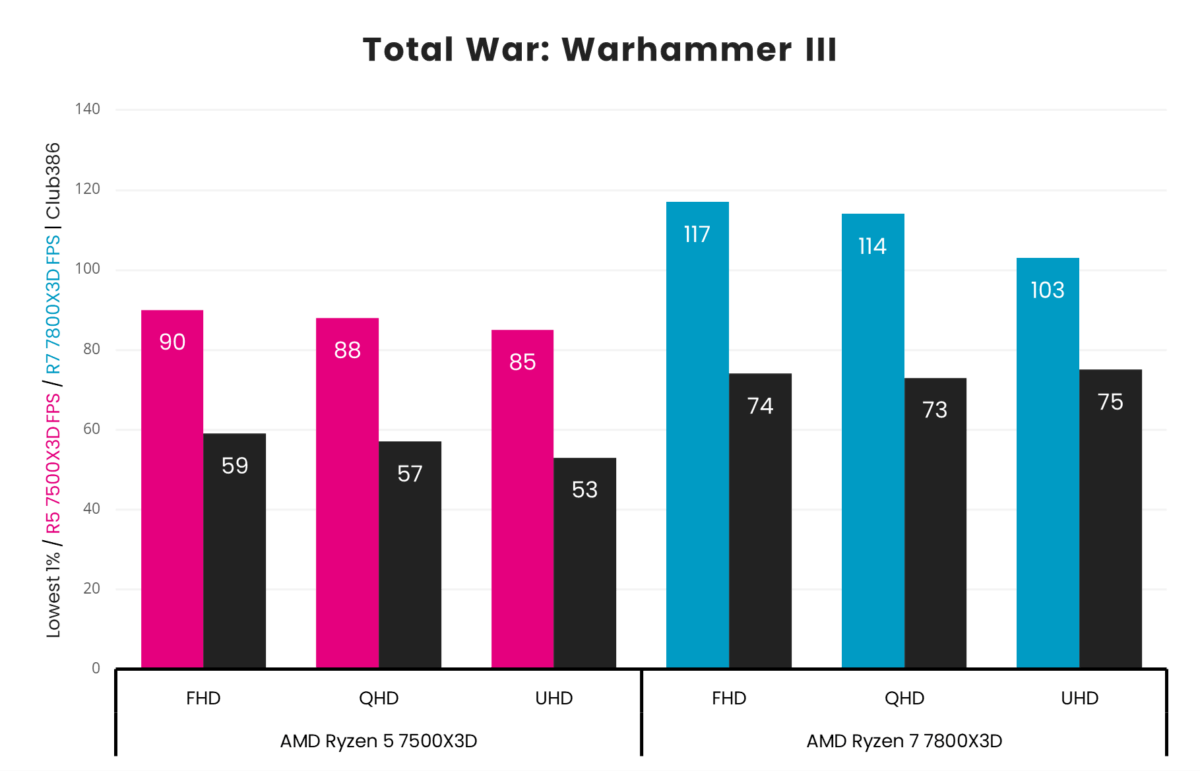
Finally, there’s simply no substitute for additional cores and threads when the going gets tough in real-time strategy games. Pushing both the Ryzen 5 7500X3D and Ryzen 7 7800X3D hard in Total War: Warhammer III’s Mirrors of Madness benchmark, a 30% difference emerges at FHD and QHD, which doesn’t shrink much at UHD (21%) either.
Vitals
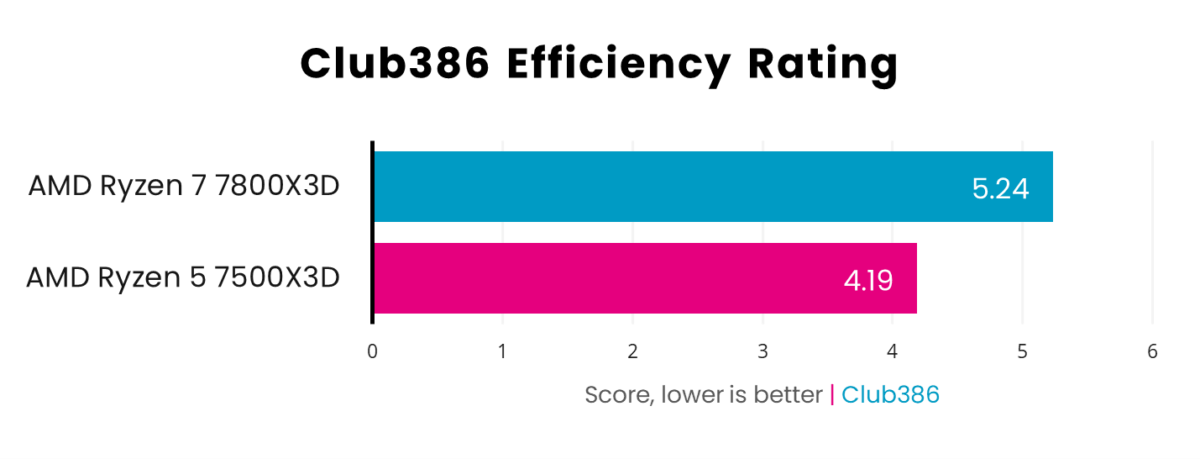
In terms of TDP, 55W separates the Ryzen 5 7500X3D (65W) and Ryzen 7 7800X3D (120W). However, this doesn’t mean the more-powerful chip will necessarily pull that much additional wattage at all times. In fact, in a Cinebench 2024 multi-core benchmark, I observed a mere 23W difference in overall system power consumption
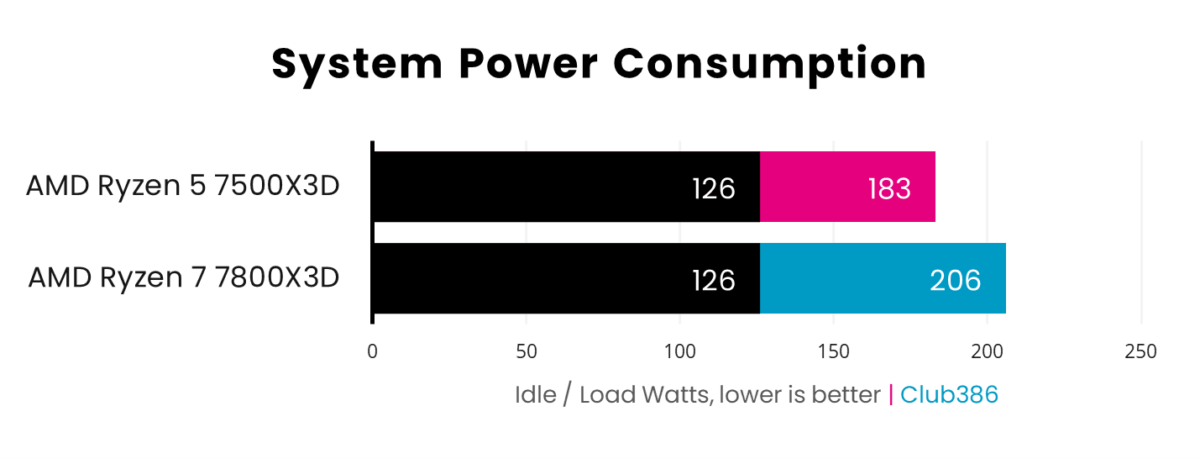
Taking each processor’s Cinebench 2024 score and dividing it by the power draw under load provides us with our Club386 Efficiency Rating. As expected, the Ryzen 7 7800X3D is comfortably clear of Ryzen 5 7500X3D in this respect, providing greater performance per watt.
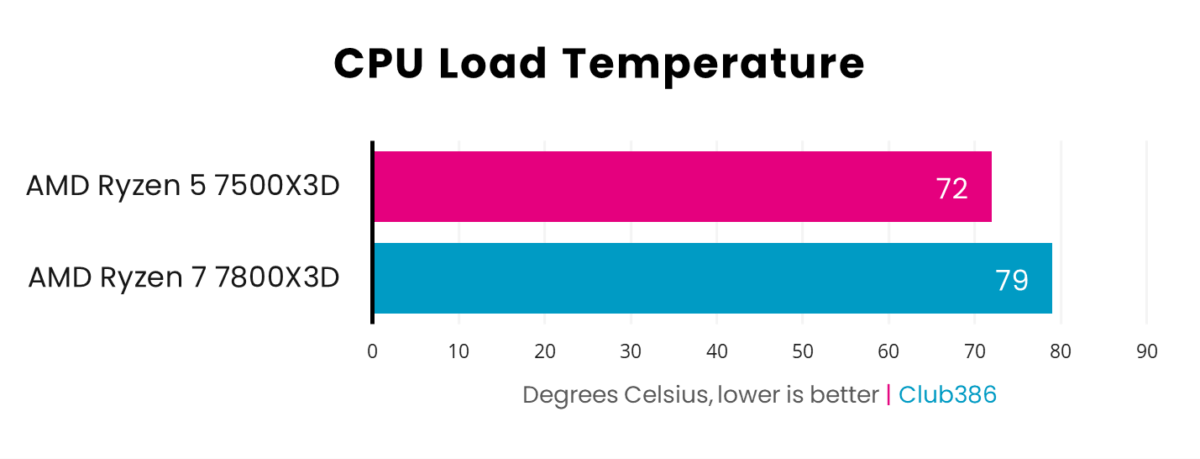
More volts means higher temperatures, meaning the Ryzen 5 7500X3D comes out the cooler of these two chips under load at 72°C. Meanwhile, the Ryzen 7 7800X3D runs at 79°C, demonstrating its need for superior cooling.
Conclusion
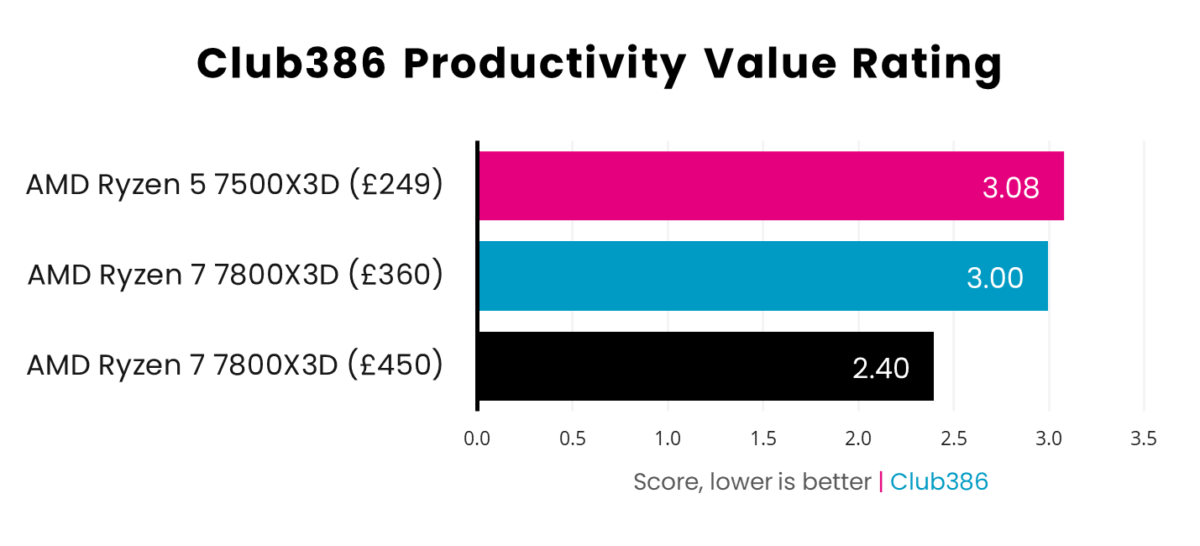
Finally, let’s talk value. I’ve provided two ratings below, focussing on the productivity and gaming performance each processor provides. The former uses our typical Club386 formula of dividing the Cinebench 2024 multi-core score by the CPU’s cost. For the other, I’ve added together the average frame rates of each game at FHD and divided them by the same variable.
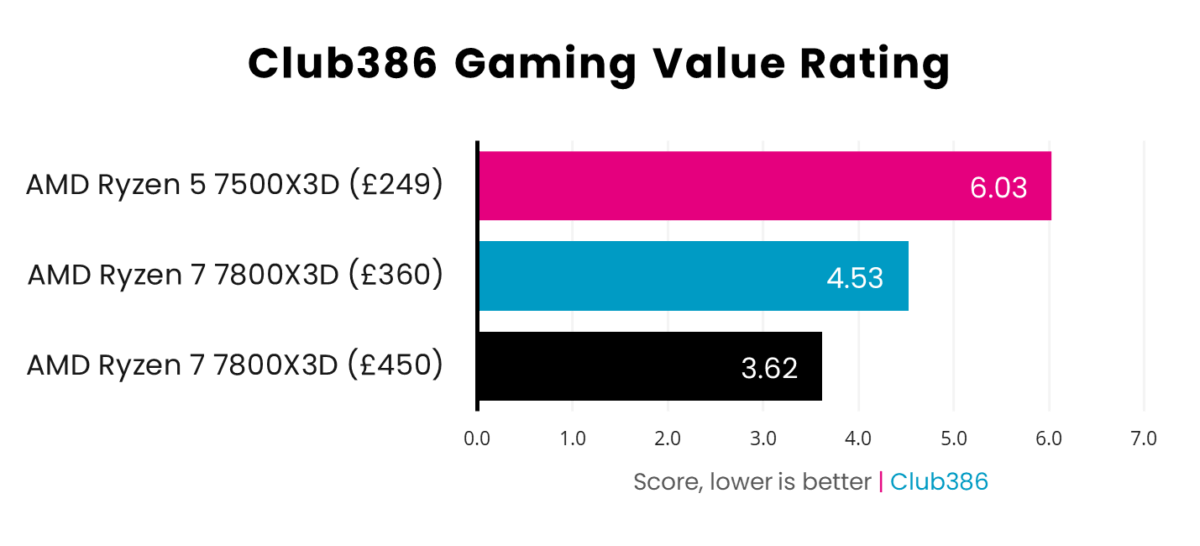
For gamers, the Ryzen 5 7500X3D undoubtedly provides the best bang for your buck. Even taking present pricing into account for the Ryzen 7 7800X3D, the less-expensive chip still offers far greater value. You will sacrifice some performance on account of this CPU’s fewer cores and threads, but the chip will provide the lion’s share of its sibling’s capabilities.
Competition is close between the Ryzen 5 7500X3D and Ryzen 7 7800X3D in terms of productivity value. If you’re strapped for cash, then AMD’s new processor will see you right, but anyone prioritising performance would do well to opt for the older 8-core chip.
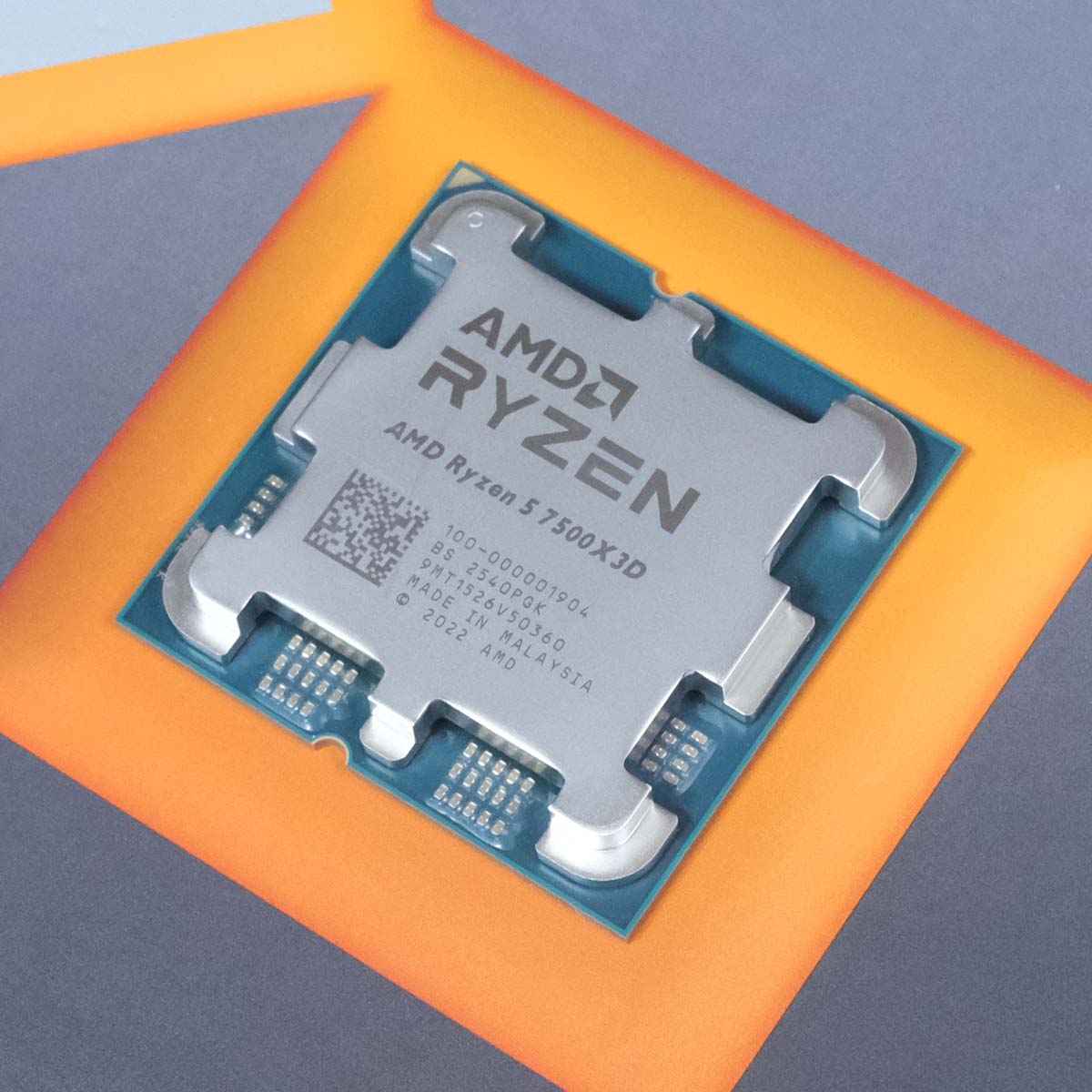
AMD Ryzen 5 7500X3D
The cheapest AM5 CPU with 3D V-cache offers great value for gamers seeking sky-high frame rates at an affordable price.
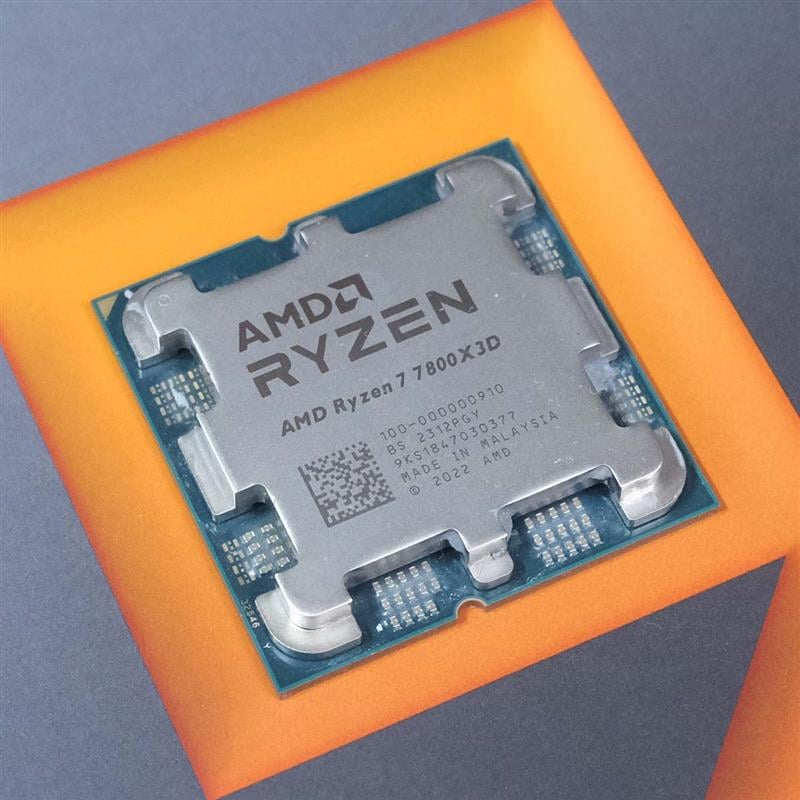
AMD Ryzen 7 7800X3D
With greater expense comes greater balance, as this processor comes complete with 3D V-Cache and superior multi-core performance.
For more analysis on processors and recommendations for builders of all budgets, check out our best CPU guide. Don’t forget to follow Club386 on Google News too for the latest developments in the processor space.