
Never a company to shy away from new cooling ideas for PCs, Noctua has announced that it’s working with Forced Physics DCT on a way to bring its JouleForce microchannel array tech to the desktop. Forced Physics describes its tech as a “third cooling path,” going beyond the “two imperfect paths” of traditional air and liquid cooling, removing up to 2,000W of thermal energy.
JouleForce is fundamentally still an air-cooling system, but it works differently to a traditional heatsink and fan combo. A stack of heatsink fins with a fan can shift a lot of heat from a chip, but a thin boundary layer of air will form in the process (where slow-moving air sticks to the heatsink), trapping heat and acting as an insulator.
That’s not an issue in most desktop PC chips, as the fans will move a lot of air, but it’s a problem in dense, high-powered rack equipment packed with hot-running chips. JouleForce is designed to eliminate this boundary layer, thanks to the use of vapour chambers, densely packed microchannels, the right amount of pressure and some clever geometry-based physics.
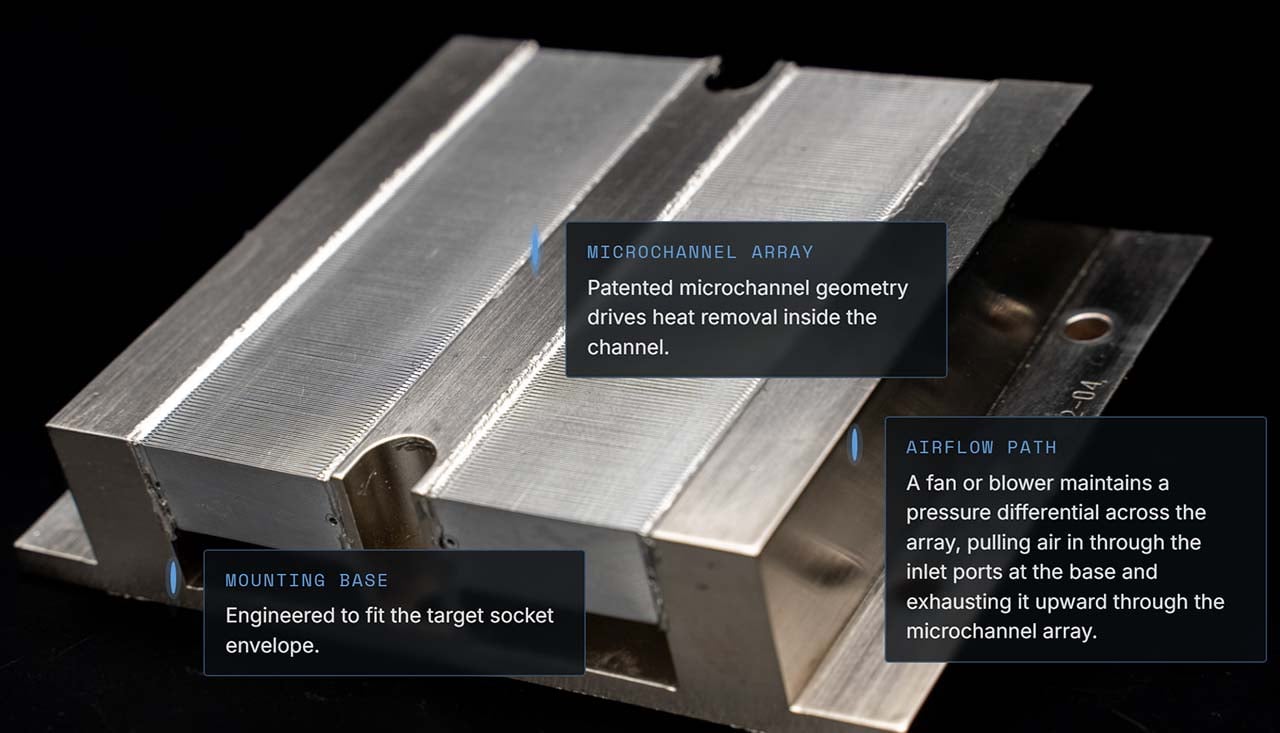
Going into this in depth is beyond the scope of a simple news story, but the gist is that you need much less airflow than a standard air cooler, and the boundary layer is eliminated. The air can then absorb more of the heat generated by your chip, and this hot air is then guided out of the cooler through an exhaust path.
That’s all great for rack devices hidden away in cabinets, but you wouldn’t want to put it in a desktop PC at the moment. Why? Because the gear you need for it makes an infernal racket, and that’s where Noctua is hoping to work its magic.
“The pressure levels this technology requires in today’s implementations are currently supplied by equipment nobody would want on or under their desk,” explains Roland Mossig, Noctua CEO, “so this is a demanding, long-term engineering task – and one that we are eager to tackle.”
Founder and CEO of Forced Physics DCT, Scott Davis, expands. “Desktop and workstation systems pose airflow challenges that differ fundamentally from our data centre deployments,” he says. “Noctua’s expertise in quiet, high-pressure air movement makes them the ideal partner to solve them with us.”
According to Noctua, the main challenge at the moment is that microchannel cooling requires “a pressure drop an order of magnitude and more above the range covered by conventional axial PC fans.” That means using “industrial blowers, high-speed centrifugal fans or vacuum pumps.” Noctua and Forced Physics are now working on a way to create the right static pressure levels within the constraints of a PC case, and without making too much noise.
Noctua hasn’t announced any specific products based on this tech, or a release date for that matter. The collaboration is simply described as “a long-term research and development effort.”
In the meantime, check out how the Noctua thermosiphon project is going at the moment. Noctua is working on lots of new cooling tech at the moment, and we love to see it.