
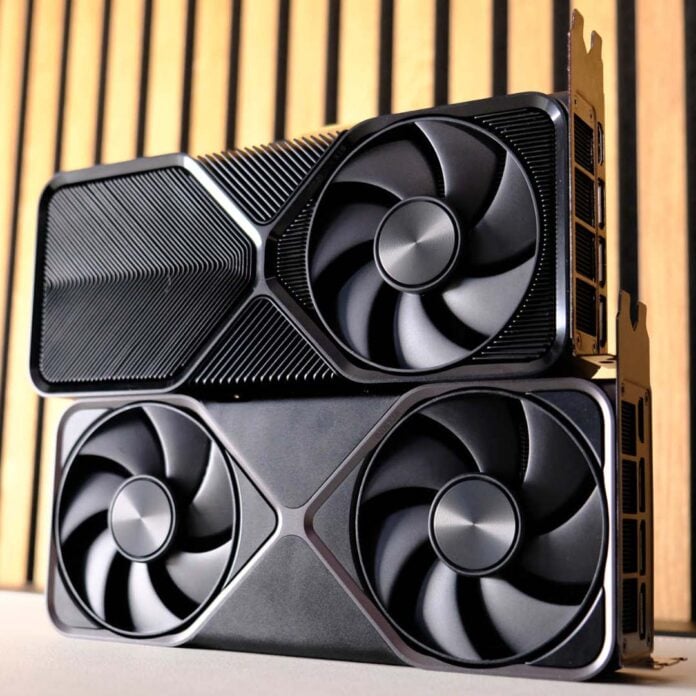
Running Nvidia DLSS 5 on a single graphics card is extremely taxing on frame rates, so one modder has smartly split up the workload across two GPUs. In passing the weight of neural rendering on to the second GPU, frame rates can improve by up to a whopping 127.5%.
This ReShade add-on, dubbed Neural Coprocessor, is available to download for free via GitHub. In addition to requiring two graphics cards, one being from Nvidia’s GeForce RTX 50 series, there are other requirements. Like other Nvidia DLSS 5 games, DirectX 12 is non-negotiable, and no other shader packs or add-ons can run simultaneously.
Most importantly, though, you’ll need to connect each GPU to its own monitor, although it’s unclear whether you can run individual cables to the same display and use different connections. The reason for this, as the GitHub page explains, is that running the neural rendering card headless (without an output) costs 33% throughput and doubles latency.
Developer Marcelo Guibout has demonstrated the results of Neural Coprocessor in both Cyberpunk 2077 and The Blood of Dawnwalker on their YouTube channel, embedded above, using two GeForce RTX 5060 Ti 16GB graphics cards. While these tests are shown using two of the same GPU, it’s important to note that it’s possible to mix and match models, with a GeForce RTX 4080 Super and RTX 5060 Ti 16GB tag team reportedly working without issue.
Sharing performance numbers for the latter game at 1080p, Guibot illustrates that running DLSS 5 on another card improved frame rates by up to 127.5%. In this case, DLSS was running in Ultra Performance mode. Running the feature on the primary card nets 69-71fps, rising to 157fps once the second card is introduced.
The performance gains are smaller using higher base pixel counts, with frame rates improving by 65% using DLSS Quality. However, this is still a welcome improvement considering how DLSS 5 tanks performance when running on a single graphics card.
While this mod could be handy for anyone lucky enough to have two GeForce graphics cards lying around, there are some notable limitations to this mod. Foremostly, it doesn’t have access to any motion vectors, depth, or masks like a native DLSS 5 integration. Instead, it serves as a post-processing effect, taking a finished frame and applying neural rendering on top of it.
This setup reminds me of PhysX accelerator cards of yore, which I remember personally using to improve cape effects in Batman: Arkham Asylum way back in 2009. I’m curious to see if Nvidia DLSS 5 leads to a resurgence of sorts in this multi-card approach, despite Nvidia leaving SLI by the wayside some time ago.
For more on Nvidia’s neural rendering tech, check out our DLSS 5 launch coverage which also serves as a short explainer of the feature. Alternatively, if you’re a Radeon user, there’s an unofficial DLSS 5 mod for you too, albeit at a high price to performance.