
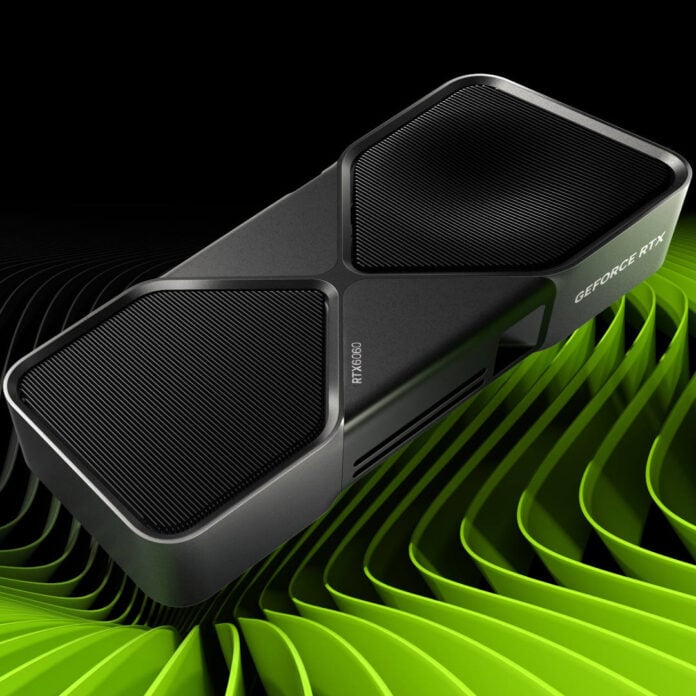
Nvidia is reportedly delaying its next-gen GeForce RTX 6060 mid-range GPU until 2029. According to regular, often reliable tech leaker Kepler_L2 on the NeoGAF forums, Nvidia is postponing the release of its lower-end next-gen cards due to supply shortages.
Today’s rumour follows earlier reports suggesting the Nvidia GeForce RTX 60 series is delayed until 2028, prolonging the expected release even further. As the leaker explains, Nvidia tends to delay lower-end GPUs when the market is tight, especially when manufacturing resources (such as TSMC silicon wafers or GDDR memory) are scarce, favouring its high-end or professional products instead.
For example, during the height of the 2020 cryptocurrency mining boom, the company focused on launching its high-end RTX 3090 and RTX 3080, leaving gamers with tight budgets waiting five months for the RTX 3060 and a whopping 16.5 months for the RTX 3050. The same scenario could repeat itself with the upcoming RTX 60 Series, where Nvidia may only launch its premium GPUs in 2028, before expanding to the lower range in 2029.

If correct, the gap between the RTX 5060 and RTX 6060 would be the largest in Nvidia’s history, leaving low-end users without a suitable replacement for at least 44 months. For comparison, Nvidia’s RTX 5060 came 23 months after the RTX 4060, with the GTX 760 holding the shortest generational gap, coming just nine months between after the GTX 660.
That said, we must keep in mind that nothing is certain until Nvidia officially announces its next-gen GPUs. Furthermore, this mainly affects the low-end range; the RTX 6090 and RTX 6080 are still expected to arrive in 2028.
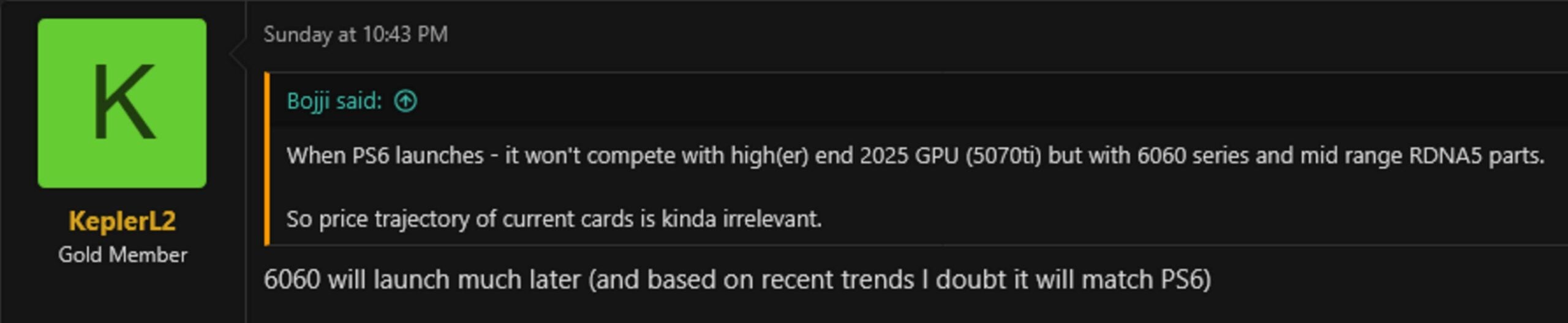
Beyond release dates, Kepler_L2 also commented on the RTX 6060’s expected performance, indicating that it’s unlikely to match Sony’s PlayStation 6 graphics pace. In a previous leak, Kepler_L2 commented that the PS6 could offer about 40 TFLOPS of peak theoretical compute power, which would put it slightly below Nvidia’s RTX 5070 Ti and far behind the RTX 5080. In other words, the RTX 6060 won’t replace the RTX 5070 Ti in terms of performance.
As usual, even if they’re accurate, these performance claims mean little when it comes to real-world performance, as driver and game optimisations, not to mention technologies and features like DLSS, can make a seemingly slow GPU run circles around old hardware. Let’s wait and see.