
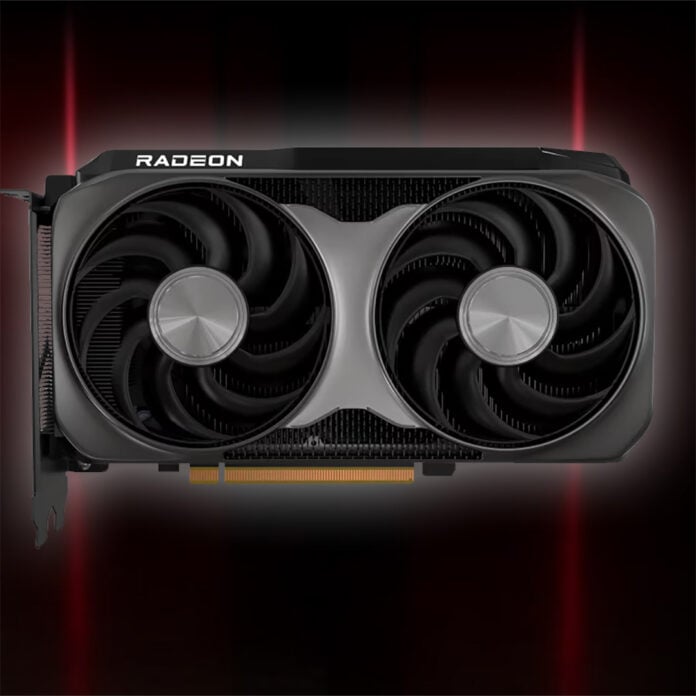
Mere days after AMD announced the Radeon RX 9050, someone’s managed to put the graphics card under the proverbial microscope and review its performance. This initial collection of third-party benchmarks are far from favourable to AMD’s new budget offering, falling up to 27% behind its closest rival, the Nvidia GeForce RTX 5050.
Japanese tech site GDM has been hands-on with the ASRock Radeon RX 9050 Challenger 8GB OC, the same model that leaked shortly before AMD’s official announcement. This is the more favourable variant of the graphics card, relative to the 4GB version. This model should illustrate the highest level of performance we can expect from GPU, as both memory bandwidth and capacity are in greater supply.
AMD gave us some idea of what kind of performance we should expect from the RX 9050 via first-party frame rates on the card’s product page. However, the firm didn’t contextualise these results against alternatives in any launch materials. Poring through GDM’s review, it’s not difficult to see why the company would shy away from comparisons.
Running through the suite of 3DMark ray traced benchmarks, the RX 9050 musters a measly 1,873pts in Speed Way and 4,531pts in Port Royal. Neither result is an inspiring score, but look all the worse next to the RTX 5050 which respectively accrues 2,520pts and 6,181pts in each test.
Switching to raster benchmarks, the gap between RX 9050 and RTX 5050 in 3DMark Steel Nomad narrows but AMD still falls behind Nvidia to the tune of 13% (1,985pts vs. 2,282pts). The race between these two cards proves similarly close in Time Spy, with Radeon trailing GeForce by 11% (9,441pts vs. 10,571pts).
Real-world results are similarly damning for the RX 9050. In Rainbow Six Siege, AMD’s contender is a whopping 15-17% slower than Nvidia’s across FHD and QHD. Meanwhile, Apex Legends isn’t any more favourable, as frame rates pale to the RTX 5050 by 21-23% at the same resolutions.
While I’d like to comment on GDM’s ray traced gaming benchmarks, the outlet has tested each graphics card with varying levels of frame generation. This is a perfectly valid difference to highlight between the RX 9050 and RTX 5050, but we’re lacking context for how they each perform using as close to the same settings as possible in these cases.
Based on these results, I doubt anyone will be hounding AMD to more broadly release the RX 9050 beyond the card’s launch territories. With an effective price of $279, you’re far better off picking up an RTX 5050 for $289 as spending that extra $10 nets far greater value in terms of performance per dollar.
For more graphics card chatter, check out our best GPU guide.