

Upcoming Intel Wildcat Lake processor specifications have been leaked, revealing the lineup configuration and segmentation. Part of the Core 300 non-Ultra series, they’re set to offer a cheaper alternative to the performance Panther Lake CPUs, making them great for low-power and industrial devices.
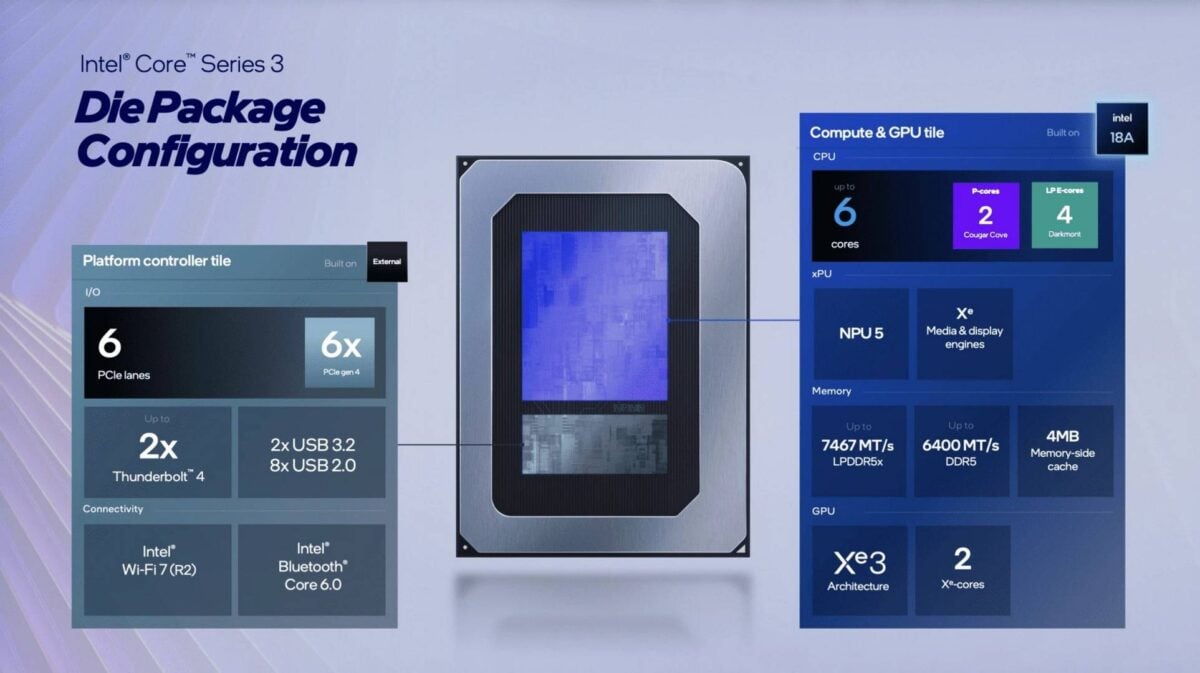
Shared by @jaykihn0 on X, the lineup includes six models, split between the Core 3, Core 5, and Core 7 tiers, and TDPs ranging between 15W base and 35W boost. Unlike Panther Lake, Wildcat Lake ditches the efficiency-focussed E cores completely, thereby concentrating only on the performance P cores and highly efficient LPE cores. Even its largest configuration calls for just two Cougar Cove P-cores plus four LPE cores, sharing 6MB of L3 cache.
The Wildcat Lake series should slot below Intel’s Core Ultra 300 mobile products, offering two main core configurations: 2P+4PLE and 1P+4PLE. The same goes for graphics, where the high-tier models get access to 2 Xe cores, while the entry makes do with just 1 Xe core. The P cores’ boost frequency reportedly ranges from 4.3GHz on the lower-end Core 3 304 up to 4.8GHz on the Core 7 360.
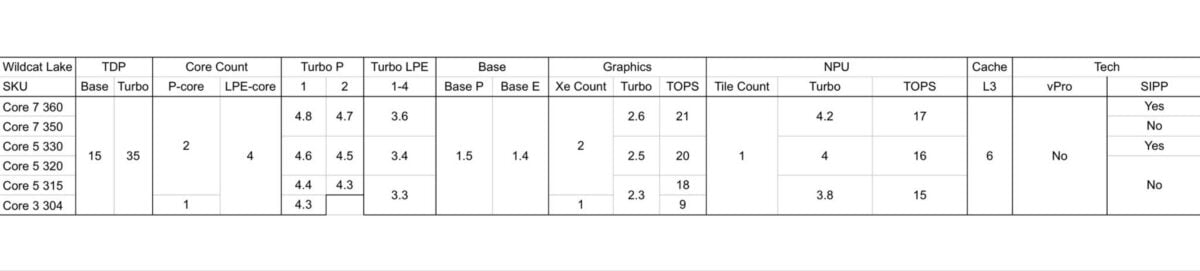
Aside from the entry Core 3 304, which houses 1 P-core, 4 PLE-cores, plus 1 Xe core, the rest is said to feature the same 2 P-core, 4 PLE-core, and 2 Xe core design. This leaves only frequency and technology support, plus NPU performance to some extent, as the main separation between them.
Speaking of technology, according to @jaykihn0, these Wildcat Lake chips do not support Intel vPro, meaning fewer security and remote manageability features, which can be a deal breaker for some applications. That said, SIPP is listed on some models, which guarantees no changes to critical hardware drivers for ~15 months. This is highly important in professional spaces that require a long-lifecycle platform, in case replacements are needed.
While neither is fast enough for gaming or GPU-accelerated 3D modelling, they should be sufficient for low-intensity tasks such as a media box, education laptops, machine automation, or a NAS storage device. With operating TDPs as low as 15W, the most logical use case seems to be inside industrial devices that require a complete seal from the outside environment and thus can’t count on active fan cooling. These are generally used to read documents or monitor machinery, which doesn’t require a lot of performance.
Overall, Wildcat Lake does indeed focus on efficiency and low-cost implementation. They will likely be paired with small amounts of RAM to power low-end mobile devices or embedded/edge machines. Panther Lake, meanwhile, will take care of the high tiers.