

AMD is working on a new way for operating systems to determine the best CPU cores to use for heavy tasks and improve resource allocation. The company has just developed an extension for its Collaborative Processor Performance Control (CPPC) framework that should improve OS (operating system) scheduling accuracy on modern Ryzen CPUs.
Called CPPC HighestFreq support, this feature should allow your OS to properly dispatch tasks, thanks to an accurate understanding of your processor’s capabilities. CPPC is used by modern AMD CPUs to communicate performance limits to the OS. This information is used by the driver to compute CPU capacity, what P-state or frequency to request, and how far to boost, which shows the OS how much work a core can do relative to others. In other words, CPPC is used by the OS scheduler to answer the question, “Which core can run the fastest if I give it this task?”
While this mechanism is already used by Windows 11/10 and Linux to determine the priority core in Ryzen CPUs, it’s not completely accurate in its current state. Currently, CPPC performance values are abstract and do not always translate cleanly into real clock speeds. This is due to the way frequency is interpolated using performance-to-frequency mapping, which isn’t linear across all cores.
The new HighestFreq feature is meant to solve this issue by directly exposing/reporting each core’s maximum frequency through firmware, removing the guesswork. As a result, the OS scheduler should become more accurate at allocating tasks based on the required performance, selecting the best cores intelligently. The feature is described by Mario Limonciello from AMD’s Client Linux team in a discussion on the Linux Kernel Mailing List (LKML), as shown in the screenshot below.
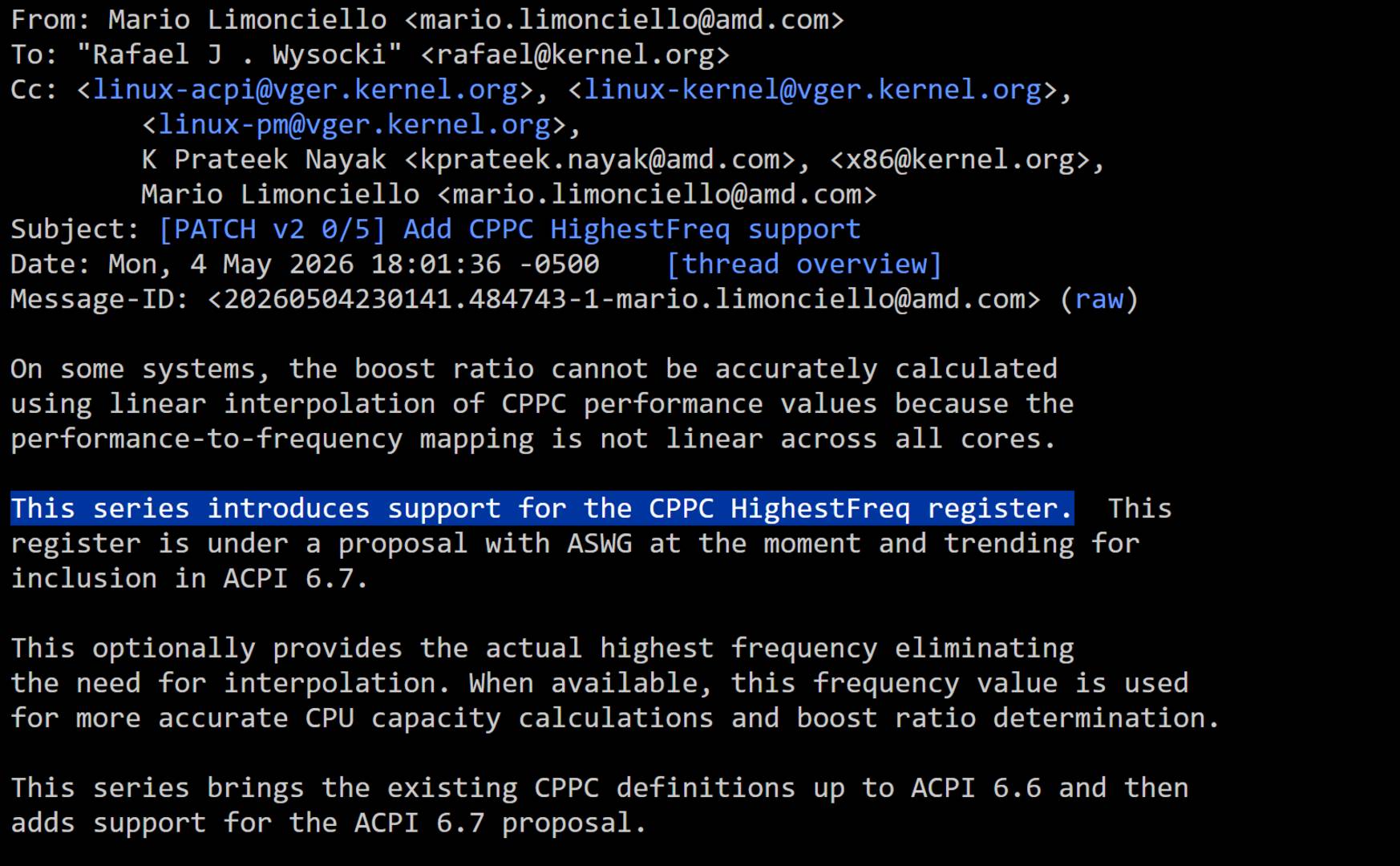
Note, however, that this change won’t make your CPU, old or new, boost to a higher clock speed. Likewise, it won’t affect how frequency is reported by monitoring apps such as HWInfo. This change is mainly targeting the schedulers in operating systems, helping them better allocate resources.
For now, this patch is targeting Linux systems, but Windows 11 should get support too at some point, as the feature is also proposed through the ACPI Specification Working Group and is pending inclusion in ACPI 6.7. Windows relies on the ACPI specification to describe platform hardware and power management features, so we will likely see it whenever ACPI 6.7 is ratified. Perhaps just in time for the Zen 6 release.