
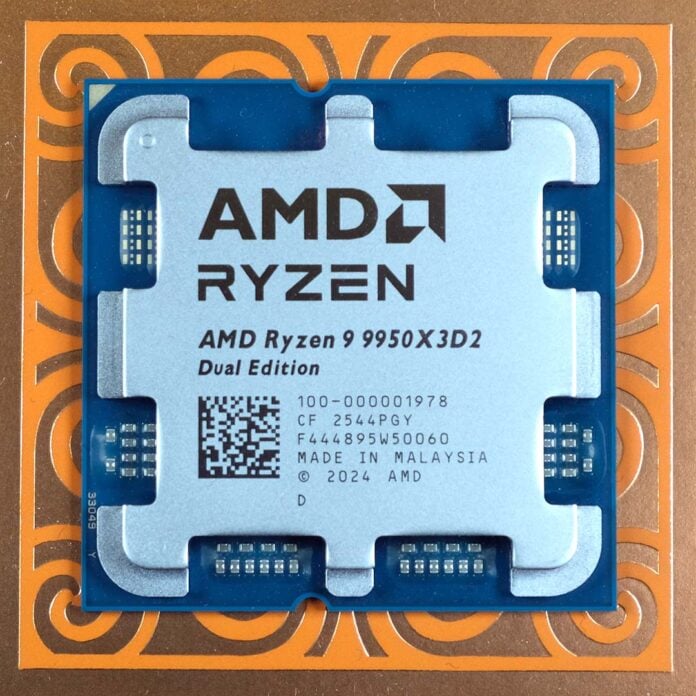
3D V-Cache has finally escaped the confines of single 8-core chiplets via the Ryzen 9 9950X3D2 Dual Edition, a CPU AMD touts as “the ultimate processor for the developers and creators,” thanks to this breakthrough. While there’s some truth in the firm’s marketing pitch, diving deeper into the chip’s capabilities feels less like experiencing a true watershed product and more the result of self indulgence.
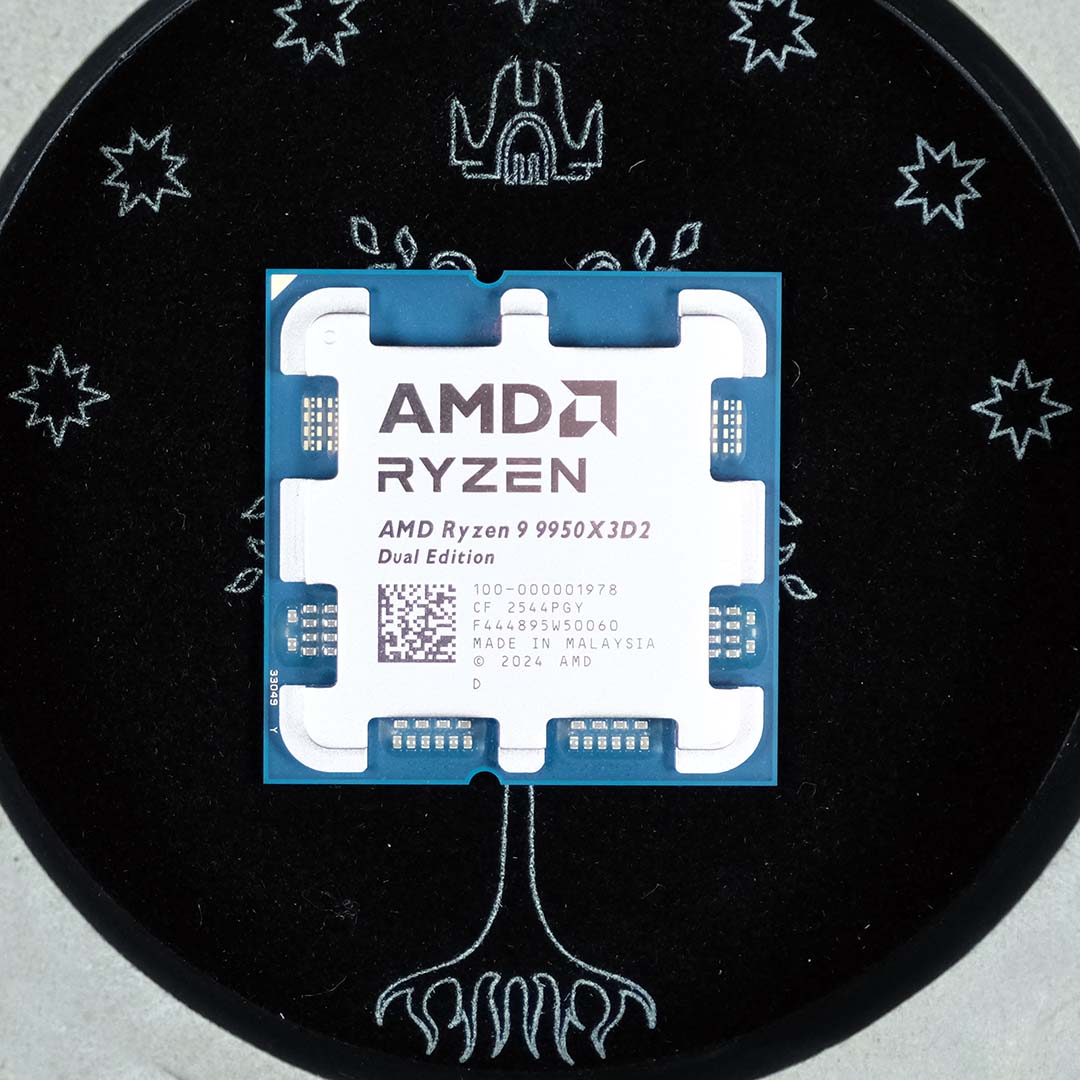

AMD Ryzen 9 9950X3D2 Dual Edition
£799 / $899
Pros
- Excellent multi-core pace
- Solid efficiency
- Drop-in AM5 upgrade
Cons
- Minor uplifts over 9950X3D
- Relatively poor value
- High operating temperatures
Club386 may earn an affiliate commission when you purchase products through links on our site.
How we test and review products.
Hitting store shelves for £799 / $899, the 9950X3D2 is the most-expensive desktop Ryzen CPU ever by a significant margin. This places great pressure on the processor’s dual 3D V-Cache to deliver an advantage, as the chip has little else in the way of differentiating features. While this extra L3 cache does provide some extra performance, though, the uplift sadly isn’t remote close to being properly enticing.
Specifications
As is tradition, I’ve summoned the Club386 Table of DoomTM to help contextualise where the Ryzen 9 9950X3D2 sits within the broader AM5 ecosystem. You can glean almost everything you need to know about the CPU from the specifications listed there, but I’ll go into further detail below.
| Model | Cores / threads | TDP | L3 cache | Base clock | Boost clock | MSRP |
|---|---|---|---|---|---|---|
| 9000 Series | ||||||
| Ryzen 9 9950X3D2 | 16 / 32 | 200W | 192MB | 4.3GHz | 5.6GHz | $899 |
| Ryzen 9 9950X3D | 16 / 32 | 170W | 128MB | 4.3GHz | 5.7GHz | $699 |
| Ryzen 9 9950X | 16 / 32 | 170W | 64MB | 4.3GHz | 5.7GHz | $649 |
| Ryzen 9 9900X3D | 12 / 24 | 120W | 128MB | 4.4GHz | 5.5GHz | $599 |
| Ryzen 9 9900X | 12 / 24 | 120W | 64MB | 4.4GHz | 5.6GHz | $499 |
| Ryzen 7 9850X3D | 8 / 16 | 120W | 96MB | 4.7GHz | 5.6GHz | $499 |
| Ryzen 7 9800X3D | 8 / 16 | 120W | 96MB | 4.7GHz | 5.2GHz | $479 |
| Ryzen 7 9700X | 8 / 16 | 65W | 32MB | 3.8GHz | 5.5GHz | $359 |
| Ryzen 5 9600X | 6 / 12 | 65W | 32MB | 3.9GHz | 5.4GHz | $279 |
| 7000 Series | ||||||
| Ryzen 9 7950X3D | 16 / 32 | 120W | 128MB | 4.2GHz | 5.7GHz | $699 |
| Ryzen 9 7950X | 16 / 32 | 170W | 64MB | 4.7GHz | 5.7GHz | $699 |
| Ryzen 9 7900X3D | 12 / 24 | 120W | 128MB | 4.4GHz | 5.6GHz | $599 |
| Ryzen 9 7900X | 12 / 24 | 170W | 64MB | 4.7GHz | 5.6GHz | $549 |
| Ryzen 7 7800X3D | 8 / 16 | 120W | 96MB | 4.2GHz | 5.0GHz | $449 |
| Ryzen 7 7700X | 8 / 16 | 105W | 32MB | 4.5GHz | 5.4GHz | $399 |
| Ryzen 5 7600X3D | 6 / 12 | 65W | 96MB | 4.1GHz | 4.7GHz | $299 |
| Ryzen 5 7600X | 6 / 12 | 105W | 32MB | 4.7GHz | 5.3GHz | $299 |
| Ryzen 5 7500X3D | 6 / 12 | 65W | 96MB | 4.0GHz | 4.5GHz | $269 |
At its core, the 9950X3D2 is much the same as AMD’s Ryzen 9 9950X3D. The CPU arrives with 16 Zen 5 cores spread evenly across two CCDs (Core Complex Dies), complete with simultaneous multithreading (SMT) for a total of 32 threads. That’s plenty of processing power to tackle modern consumer computing workloads, much as I’d like to see AMD push its core counts in response to Intel’s recent output.
Dual 3D V-Cache is the 9950X3D2’s biggest differentiator, bringing the processor’s total L3 cache pool up to 192MB. That’s a 64MB (+50%) improvement over 9950X3D in terms of total capacity, but it’s important to remember that this cache is spread is across two chiplets rather than being a shared resource. The primary advantage of this approach is removing the need to direct workloads that benefit from more cache to specific CCDs, as both now have 96MB of L3 at their disposal, rather than the previous 32:96MB split.
However, applying 3D V-Cache to both chiplets isn’t strictly a net benefit. Maximum boost clock speeds take a knock to 5.6GHz, falling by 100MHz relative to the 9950X3D. The 9950X3D2 also arrives with a higher 200W TDP, giving the CPU 30W more power than its forebear. AMD has also raised PPT limits to 270W, an increase of 70W. These changes help plug the frequency gap but do hamper efficiency and demand more powerful cooling.
All these specification tweaks come together to offer average performance improvements of 3-7%, primarily across rendering and simulation workloads. As AMD is keen to stress, the 9950X3D2 is “for a very specific user who needs top performance for multi-threaded latency-sensitive workloads.” As such, gaming isn’t the focus of this processor, but there are frame rate improvements to uncover in 3D V-Cache-sensitive titles as well.
Test methodology
I’m putting the Ryzen 9 9950X3D2 through our 2026 CPU test suite, which we debuted just under a month ago during our Core Ultra 200S Plus reviews. Luckily for AMD’s chip, this includes additional creative and productivity applications compared to previous years, as well as several games that happily gobble up 3D V-Cache to help maintain higher frame rates.
Ryzen 9 9950X3D2 test PC
Club386 carefully chooses each component in a test bench to best suit the review at hand. When you view our benchmarks, you’re not just getting an opinion, but the results of rigorous testing carried out using hardware we trust.
Shop Club386 test platform components:
CPU: AMD Ryzen 9 9950X3D2
Cooler: Arctic Liquid Freezer III Pro 420 A-RGB
Motherboard: MSI MEG X870E Ace Max
GPU: Nvidia GeForce RTX 5090 Founders Edition
Memory: 32GB DDR5-6000 CL32 G.Skill Trident Z5 RGB
Storage: 2TB WD_Black SN8100 NVMe SSD
PSU: 1,200W be quiet! Dark Power 14
Chassis: be quiet! Light Base 900 FX
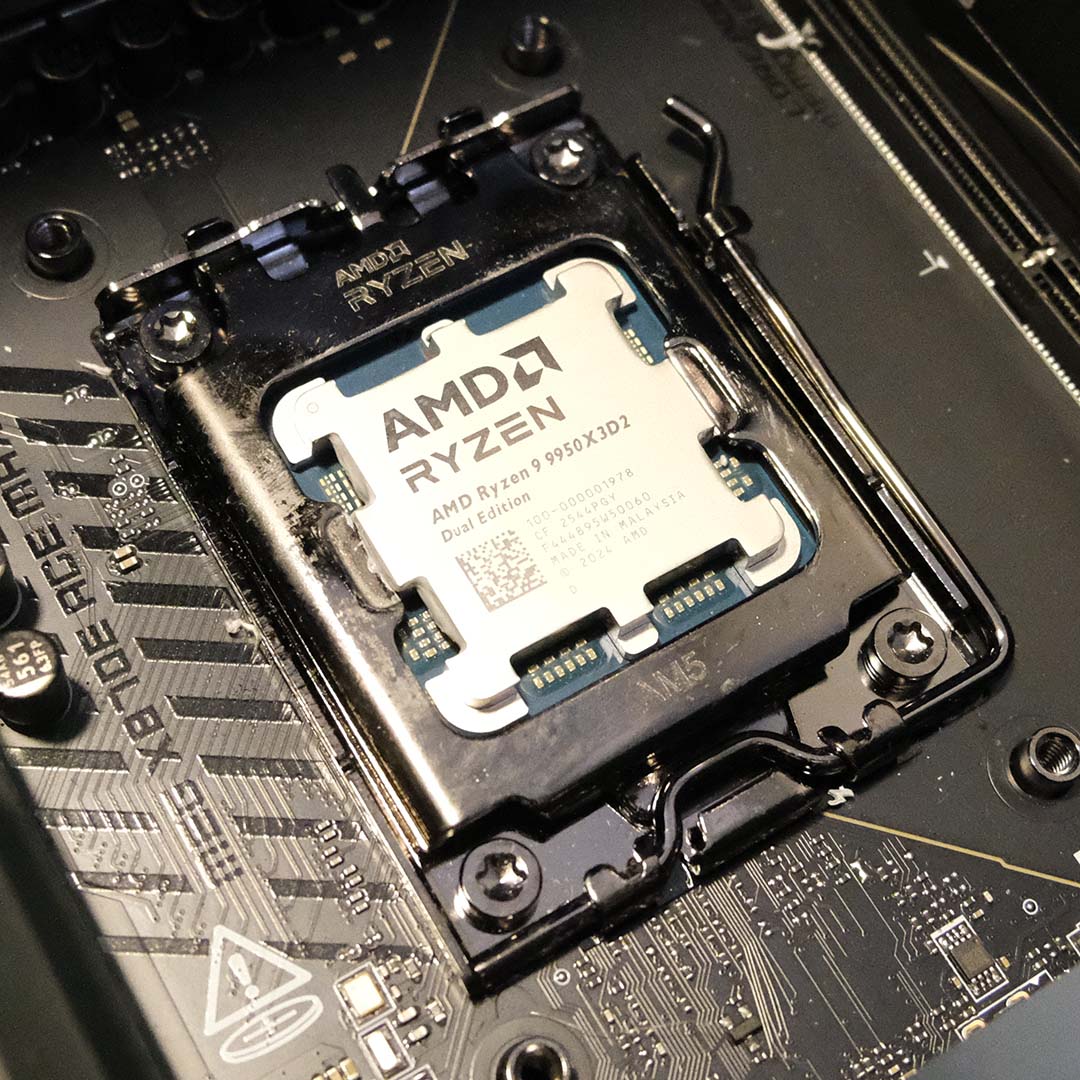
As usual, I’m calling upon the services of our Nvidia GeForce RTX 5090 Founders Edition to give our CPU as much room to run as possible, eliminating any potential GPU bottlenecks. This is also the calibre of graphics card I would expect to pair with a 9950X3D2 in a gaming rig, as one good flagship deserves another. Aside from this change, our Ryzen 9 9950X3D test bench remains unchanged.
I’ve captured gaming performance data at 1080p (FHD), using High presets without upscaling where possible, in order to place maximum pressure on the processor. Meanwhile, I ran productivity applications using standard parameters unless stated otherwise.
App performance
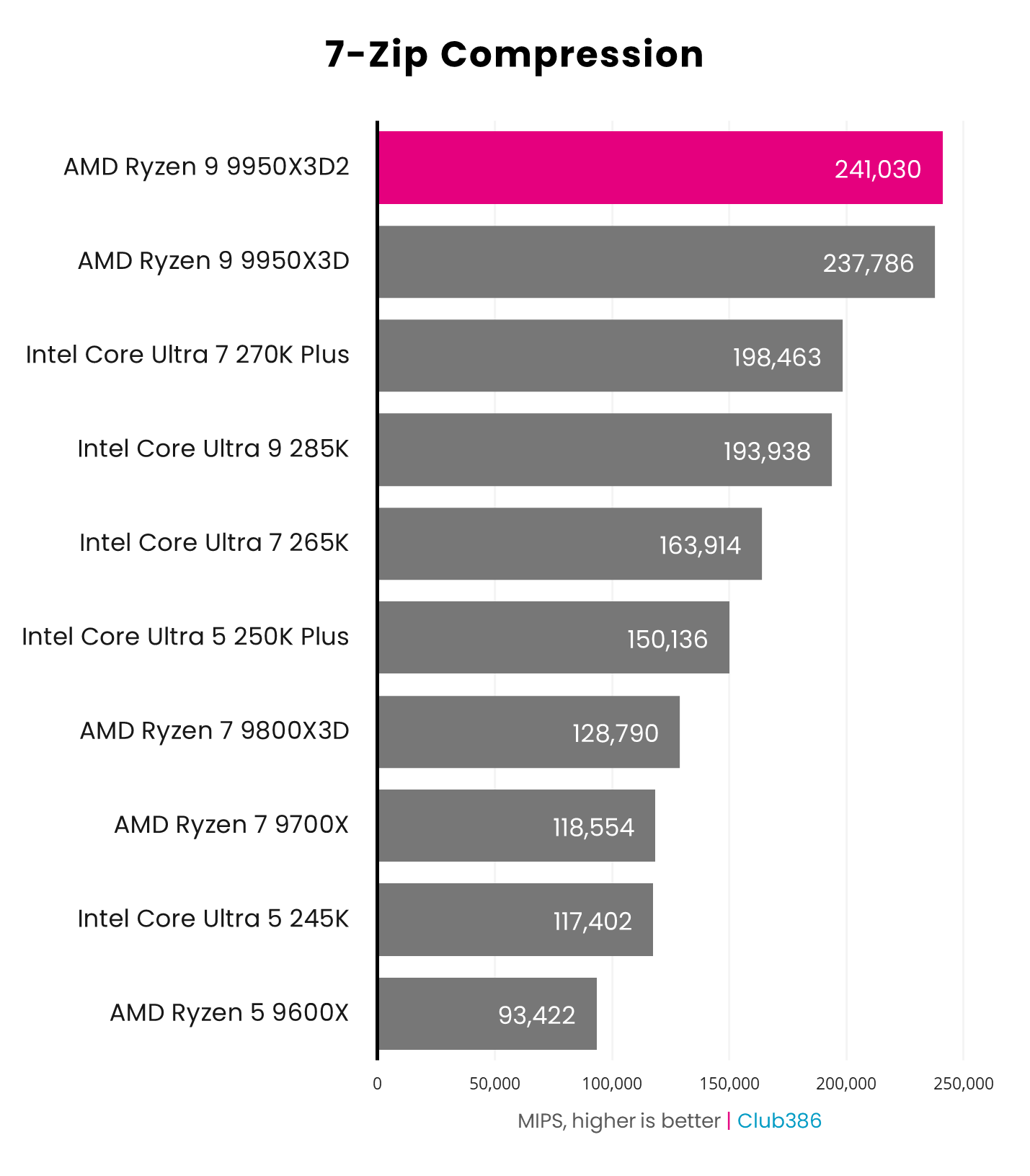
The Ryzen 9 9950X3D2 wastes no time in securing its first victory over all other CPUs in our chart this first benchmark. There’s a sizeable gap in performance between the Ryzen 9 X3D processors and the rest of the chip stack, effectively making this 7-Zip Compression showdown a two horse race. The Ryzen 9 9950X3D isn’t far behind its successor, with the latter enjoying a minute 1% advantage.
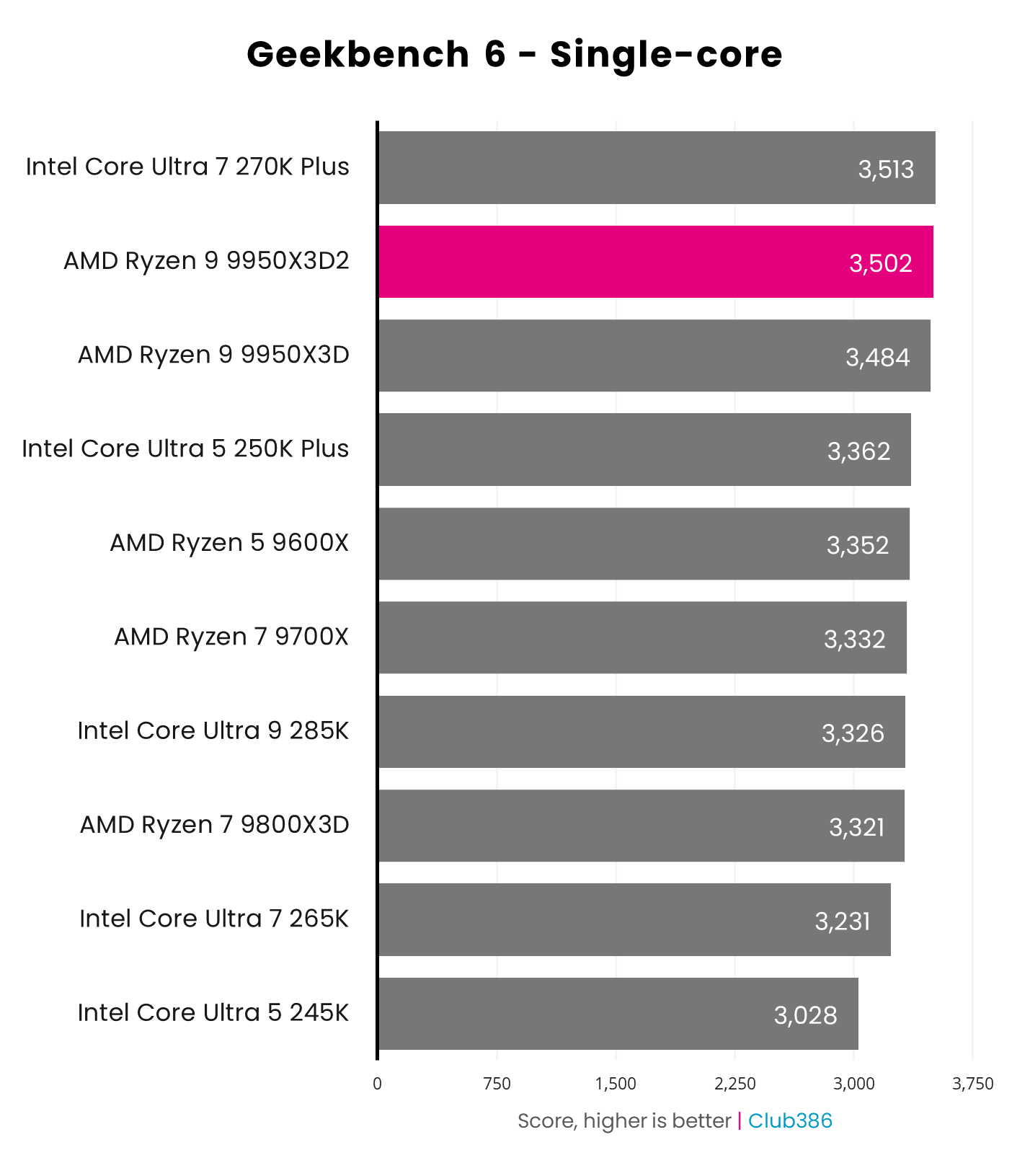
Despite the Ryzen 9 9950X3D2 arriving with a maximum boost clock 100MHz behind the Ryzen 9 9950X3D, this dual 3D V-Cache processor still manages to claw ahead of its forebear in our Geekbench 6 single-core test results. However, that extra L3 cache and higher power budget is only providing a 1% lead rounding upwards, placing this win squarely within margin-of-error territory. This same technicality applies to the Core Ultra 7 270K Plus, which leads the pack in terms of points.
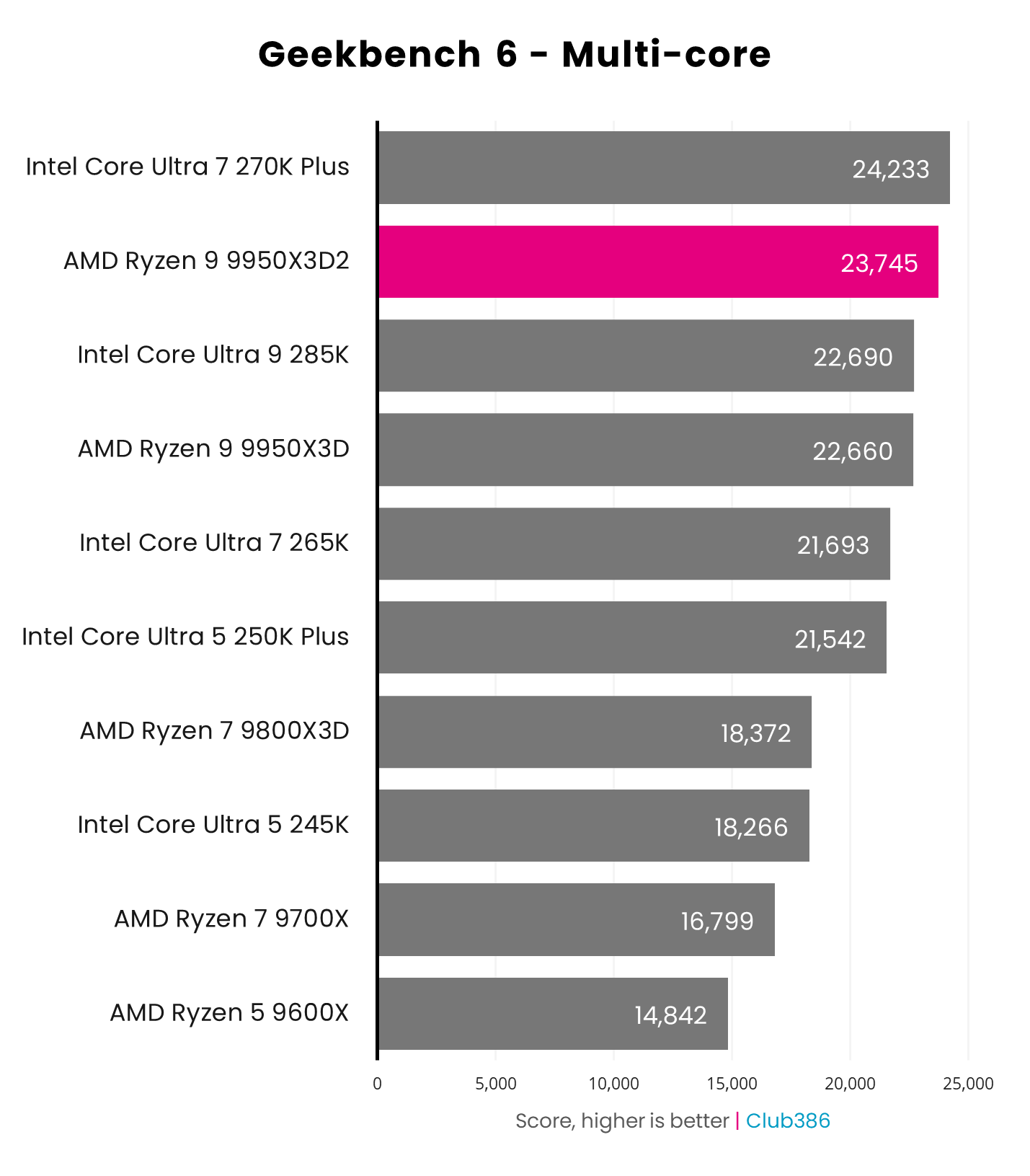
Geekbench 6 ‘s multi-core test proves more favourable to the Ryzen 9 9950X3D2 than the single-core one when it comes to points, with a 5% faster result than the Ryzen 9 9950X3D. That’s not a seismic shift in performance for the price, but an improvement nonetheless. Again, though, this uplift isn’t enough to dethrone the Core Ultra 7 270K Plus from its throne in this benchmark, which maintains a 2% edge.
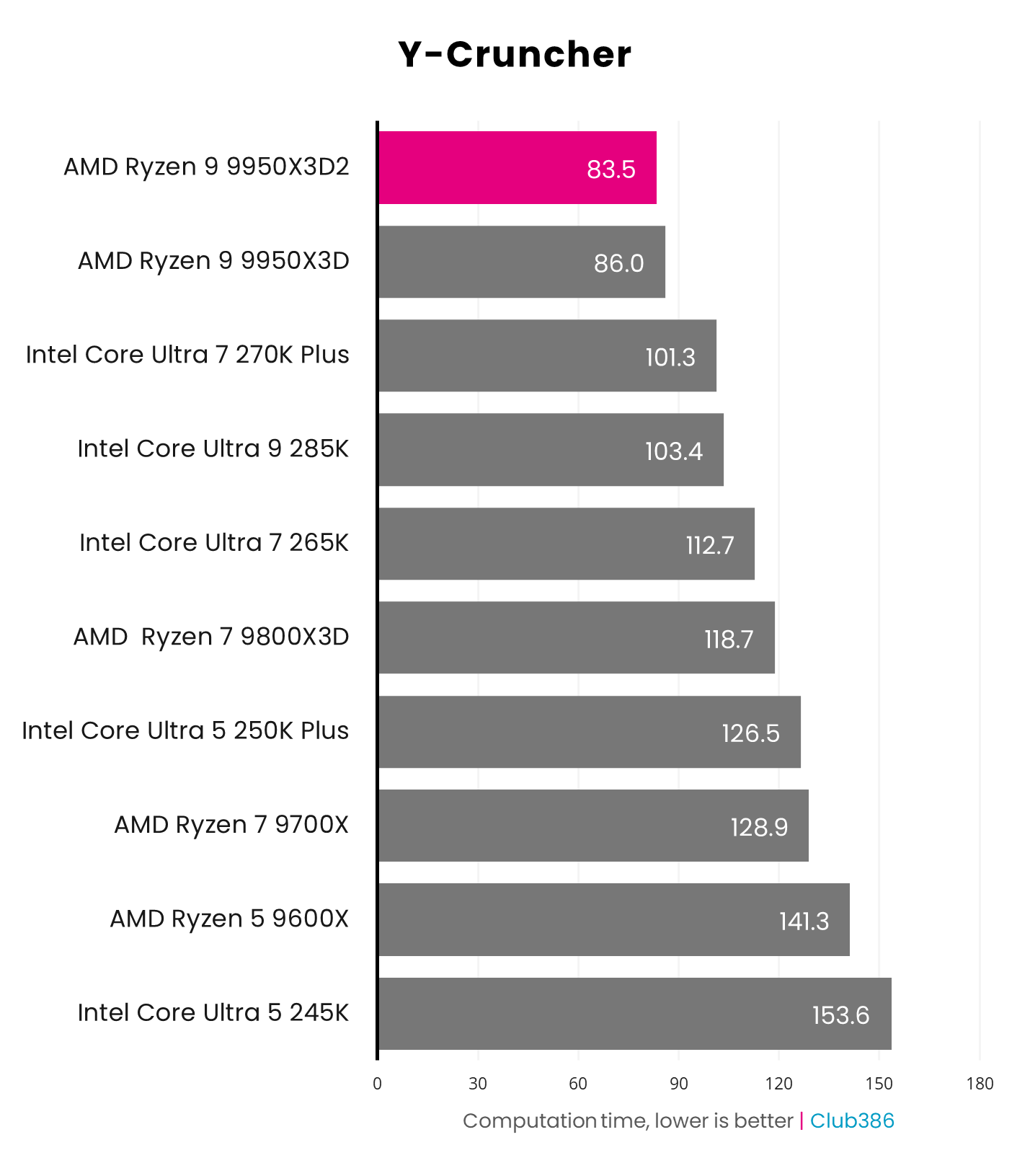
Given the task of calculating Pi to five-billion digits, the Ryzen 9 9950X3D2 finishes fastest of all CPUs at 83.5 seconds. That’s 3% quicker than the Ryzen 9 9950X3D, or 2.5 seconds in real terms. While time is money in the world of number crunching, it’s difficult not to view this improvement as anything but minor at best.
Content creation
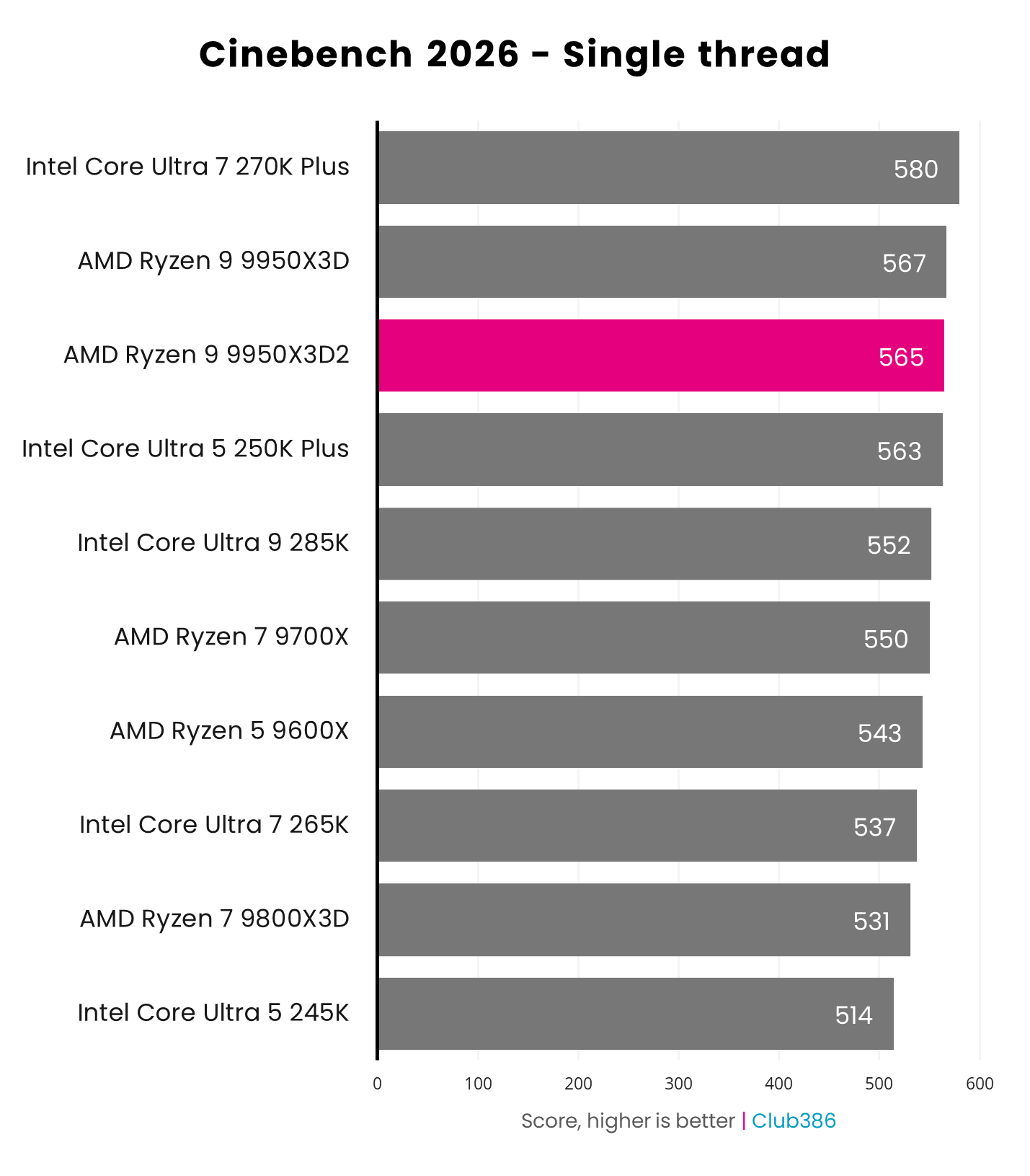
Firing up the Cinebench 2026 single thread benchmark, AMD’s Ryzen 9 9950X3D2 earns a proverbial bronze medal. That’s disappointing, as the cheaper 9950X is faster, albeit only by two points. Meanwhile, Intel again takes the win with its Core Ultra 7 270K Plus – this $300 chip offers a fantastic value here.
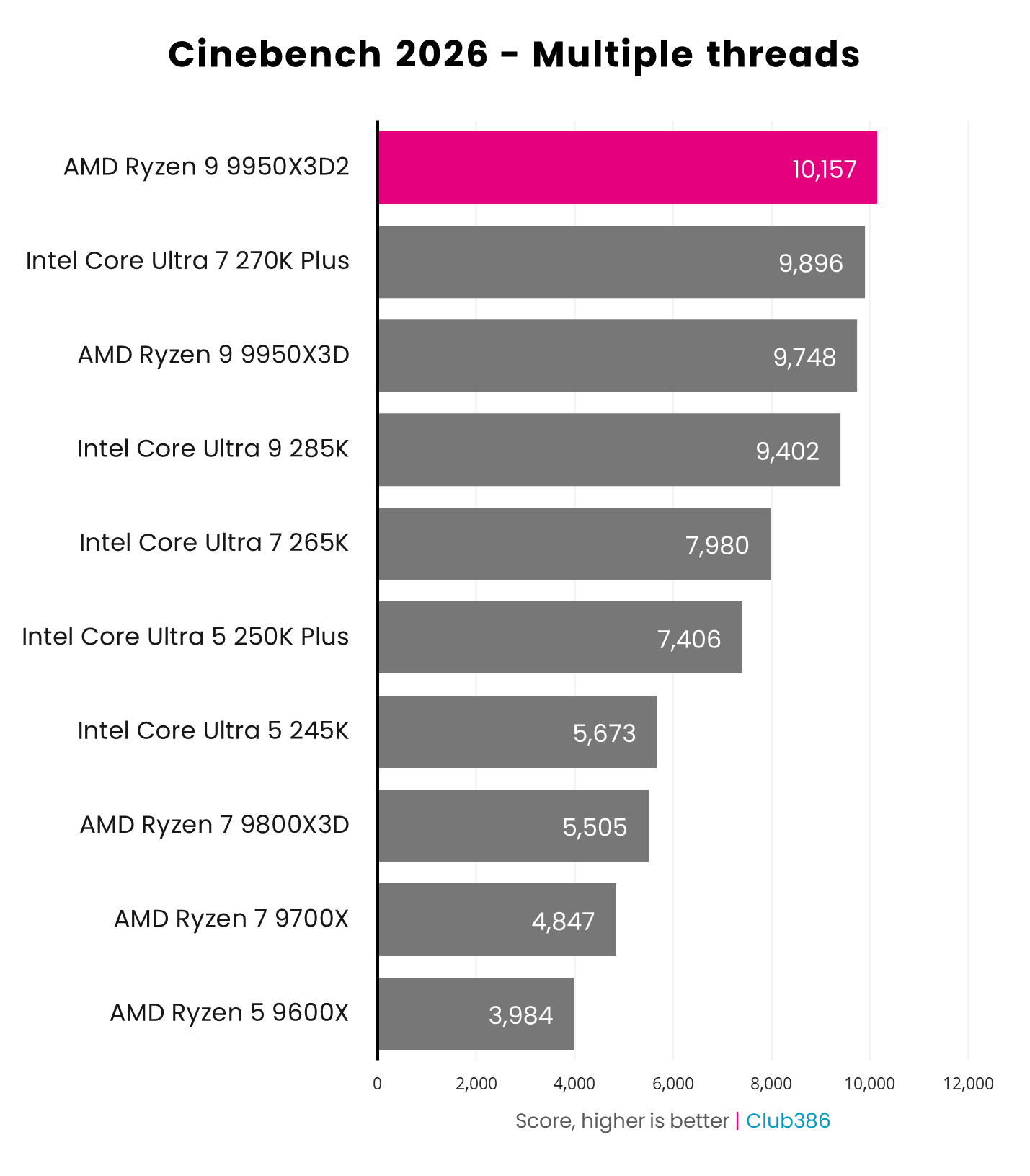
Opening up the field to multiple threads, the Ryzen 9 9950X3D2 scores a stylish win with a rare five-digit point total. As ever, though, both the Ryzen 9 9950X3D and Core Ultra 7 270K Plus aren’t far behind, with the dual 3D V-Cache flagship only pulling ahead by 3-4%. While that’s enough to secure this performance win, that’s not a big benefit when you consider its much higher price.
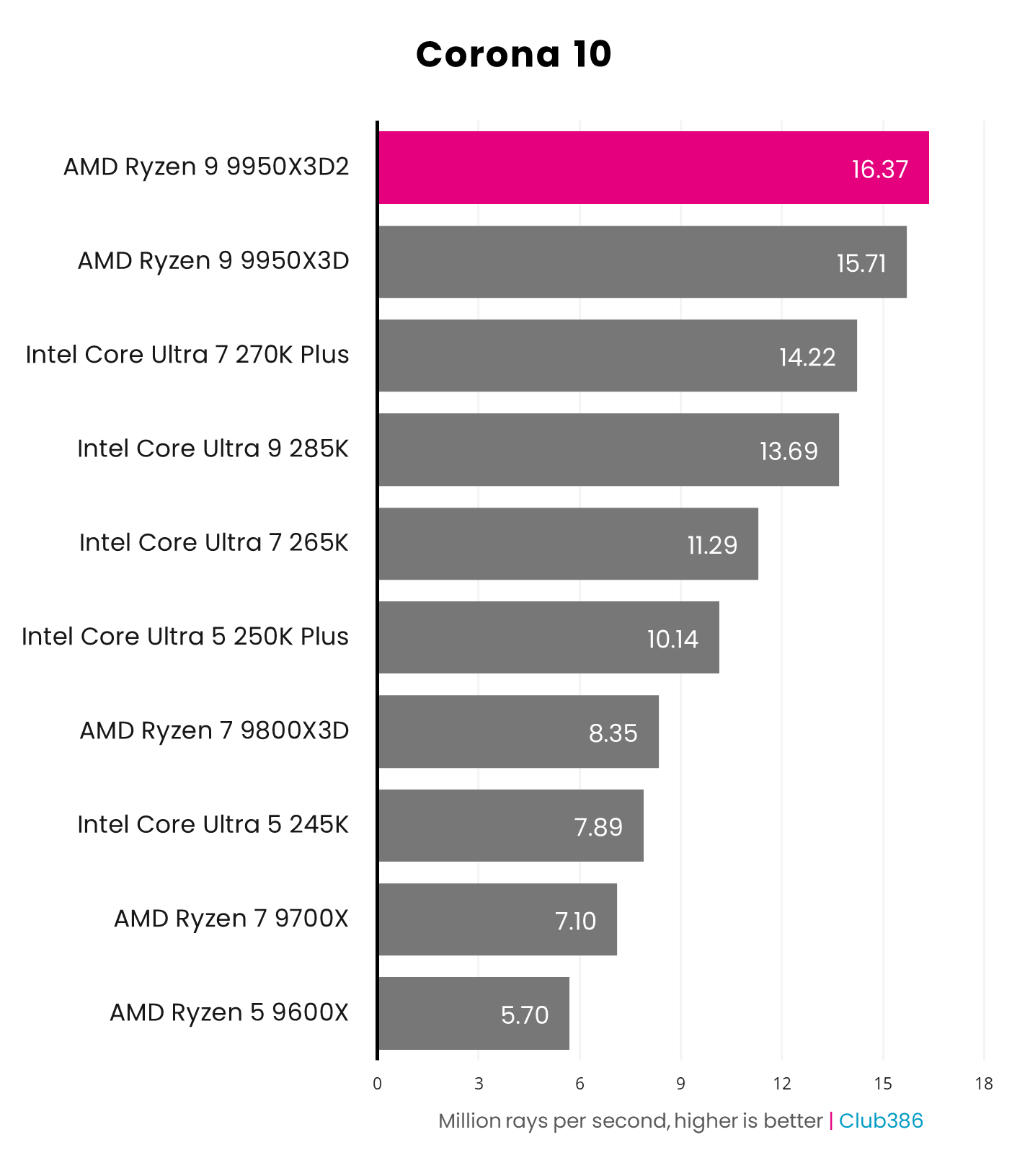
Sticking with rendering workloads, the Ryzen 9 9950X3D2 chalks up another roost to rule in Corona 10 Render. As is now par for the course, the Ryzen 9 9950X3D follows close behind, falling shy of the new chip’s performance by just 4%.
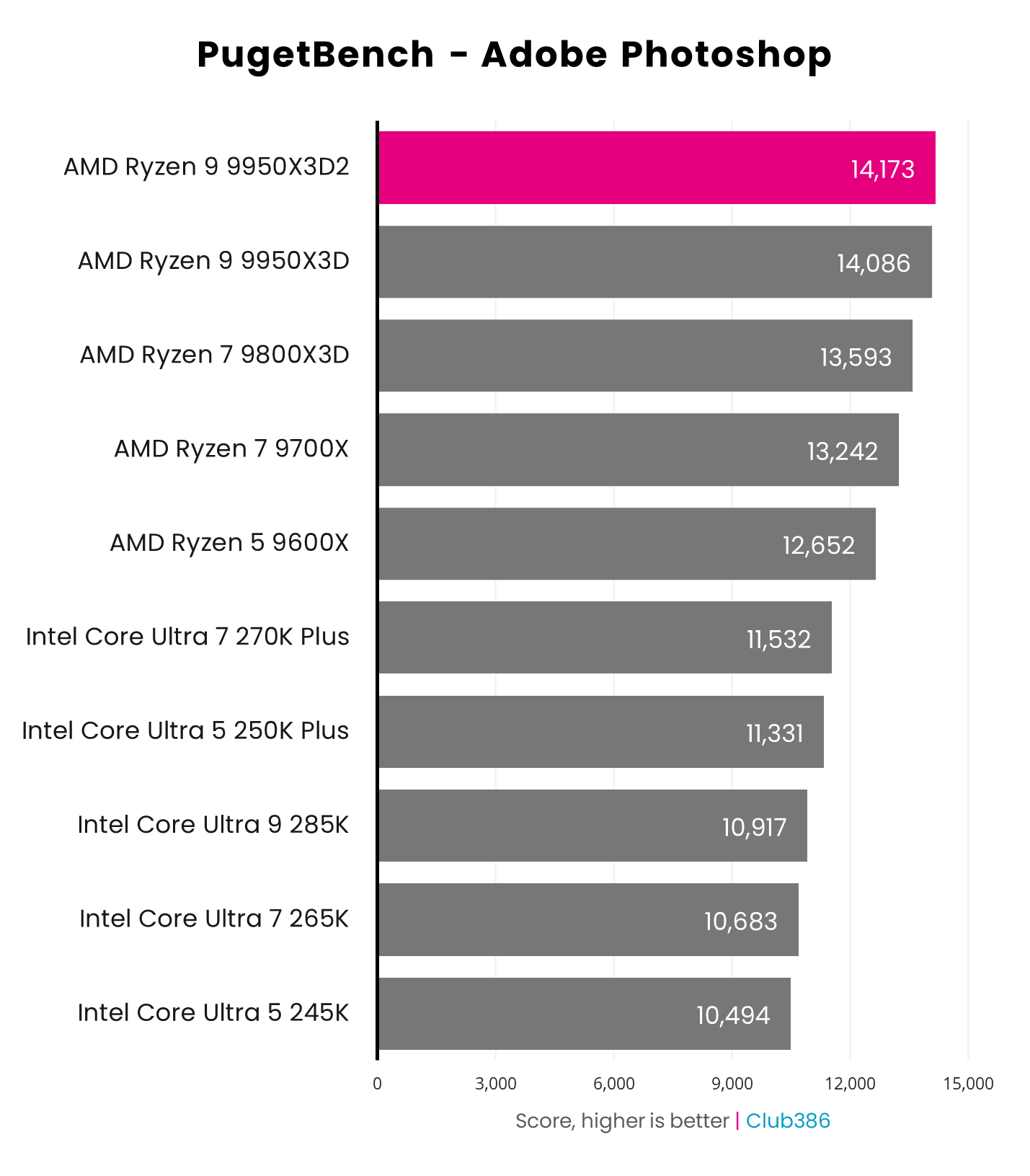
Adobe Photoshop looks more favourably on Ryzen 9000-series processors than Intel’s Core Ultra 200 series, and the Ryzen 9 9950X3D2 is no exception. AMD’s new CPU sits pretty at number one on the chart, albeit thanks to a slim 1% lead over the Ryzen 9 9950X3D.
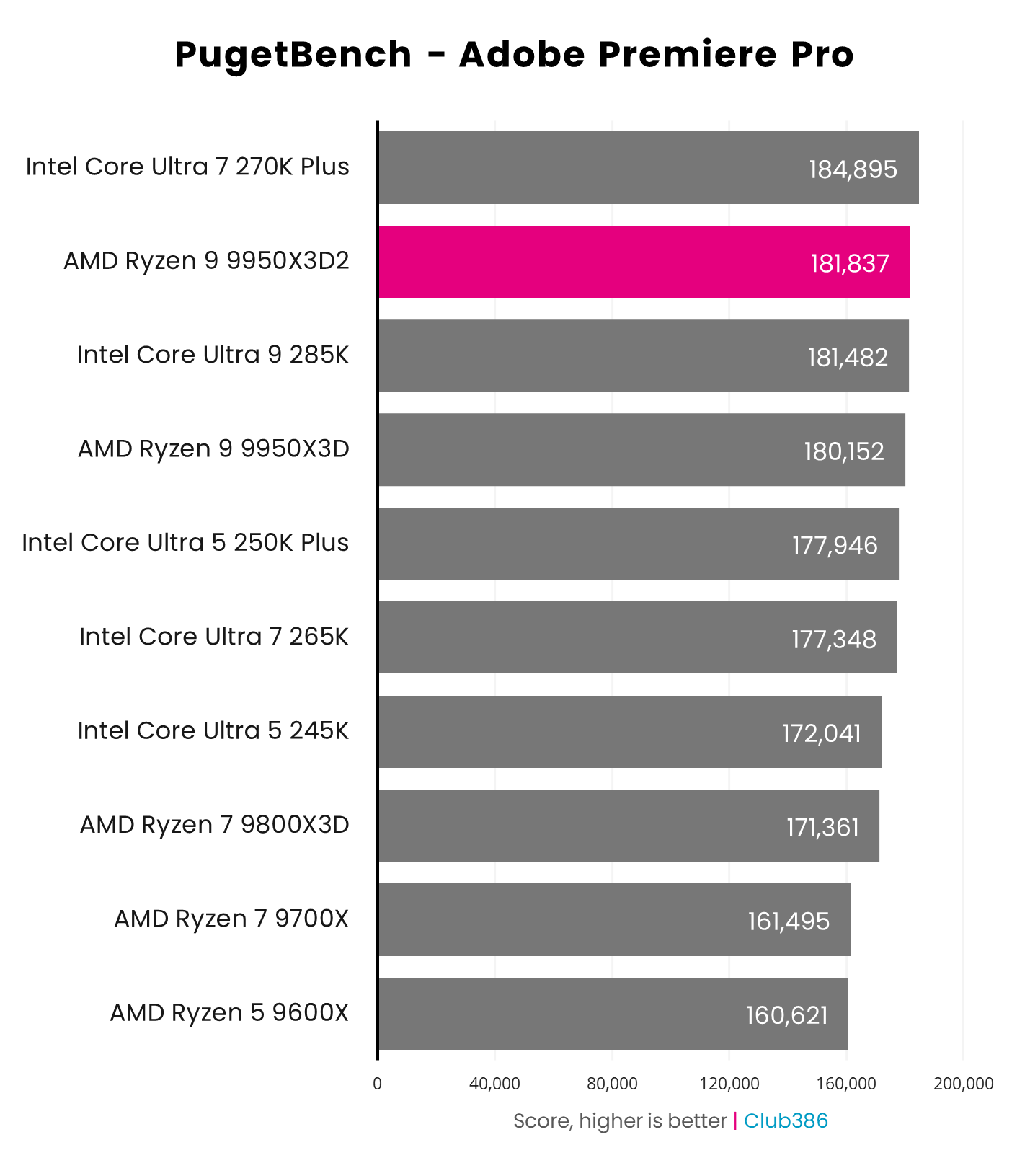
Premiere Pro shows a closer run between AMD and Intel, with the Core Ultra 7 270K Plus proving the best of our processing bunch. The Ryzen 9 9950X3D2 emerges second from the front, 2% behind Intel’s new poster boy and 1% ahead of the Ryzen 9 9950X3D yet again.
Memory
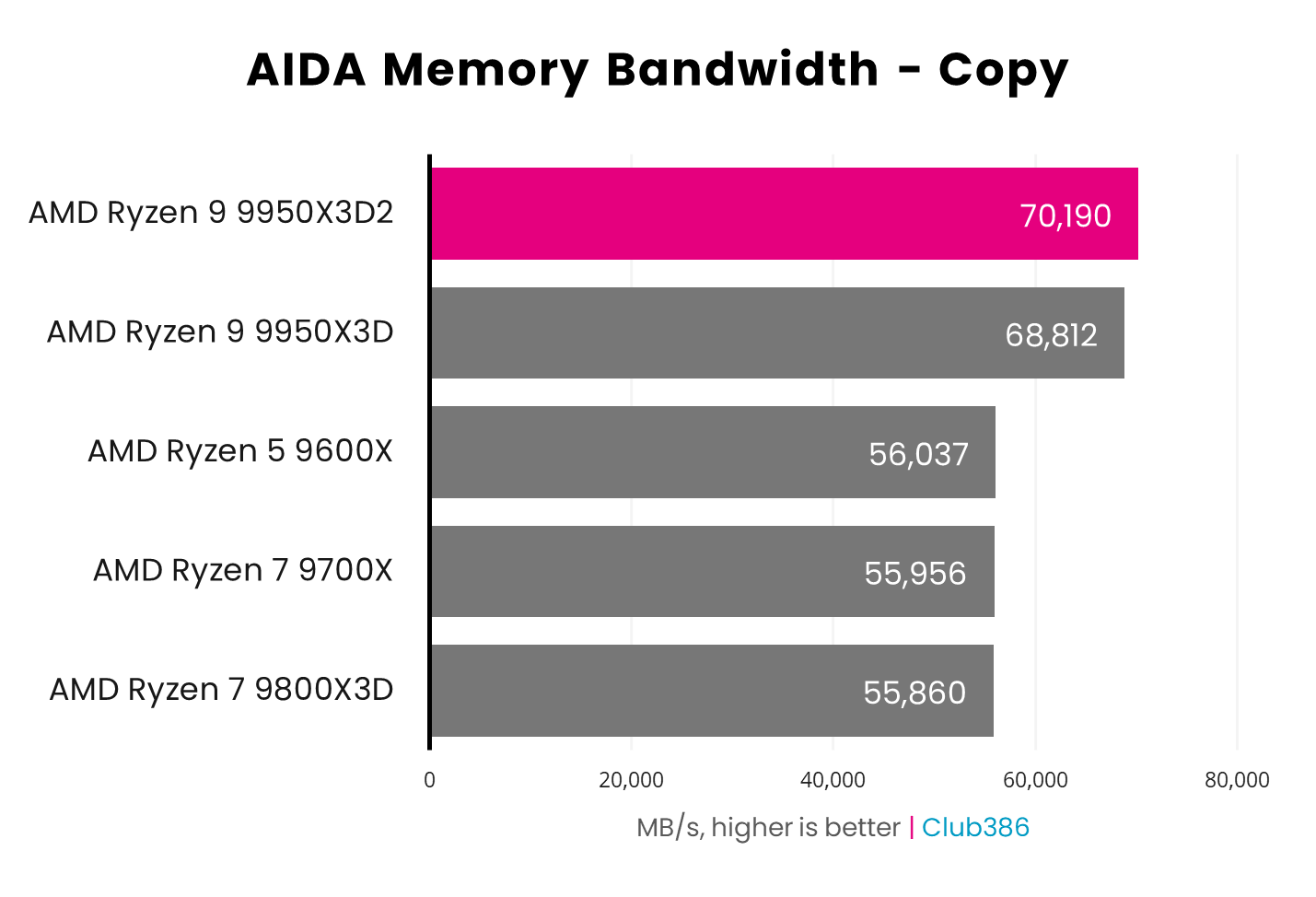
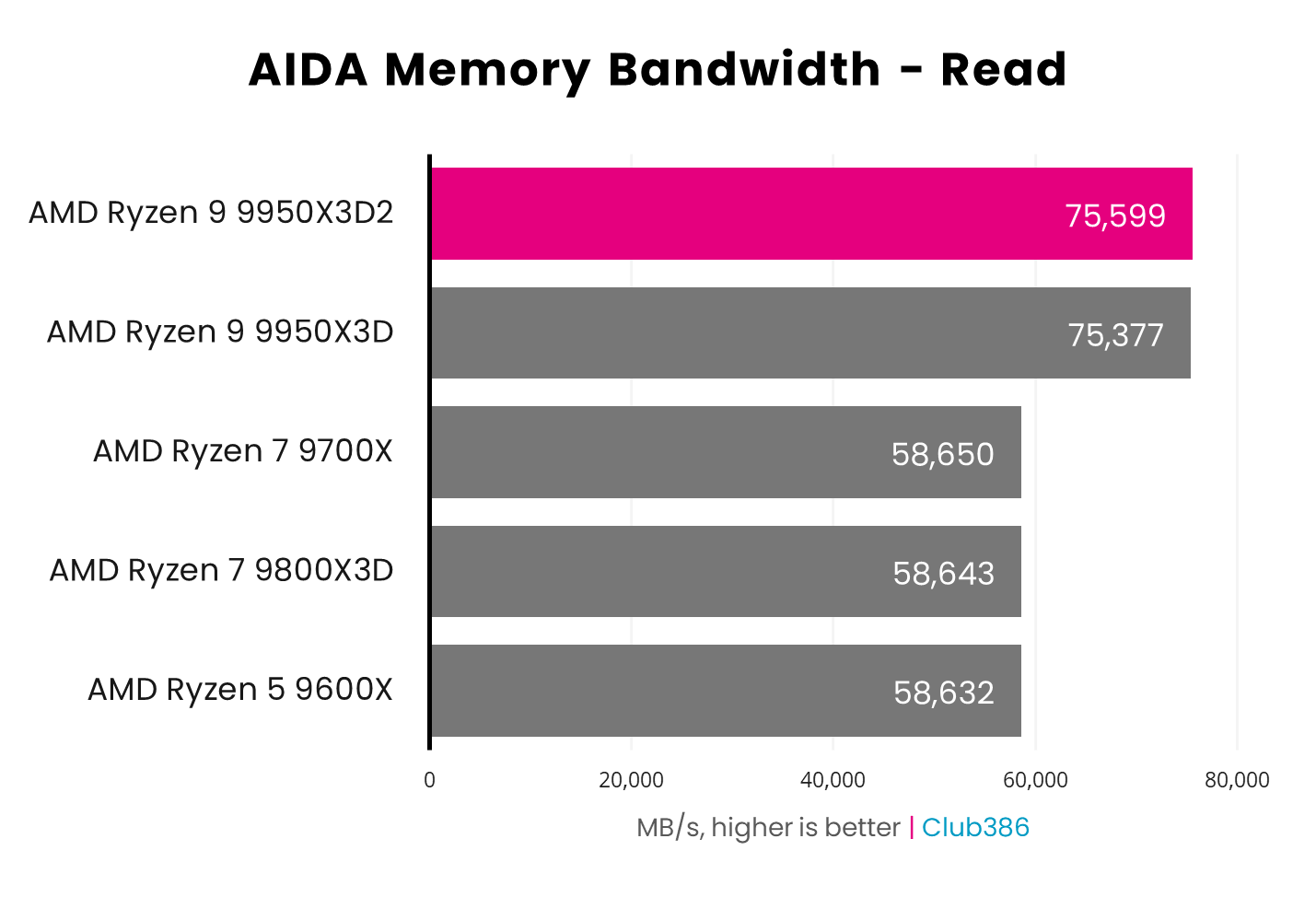
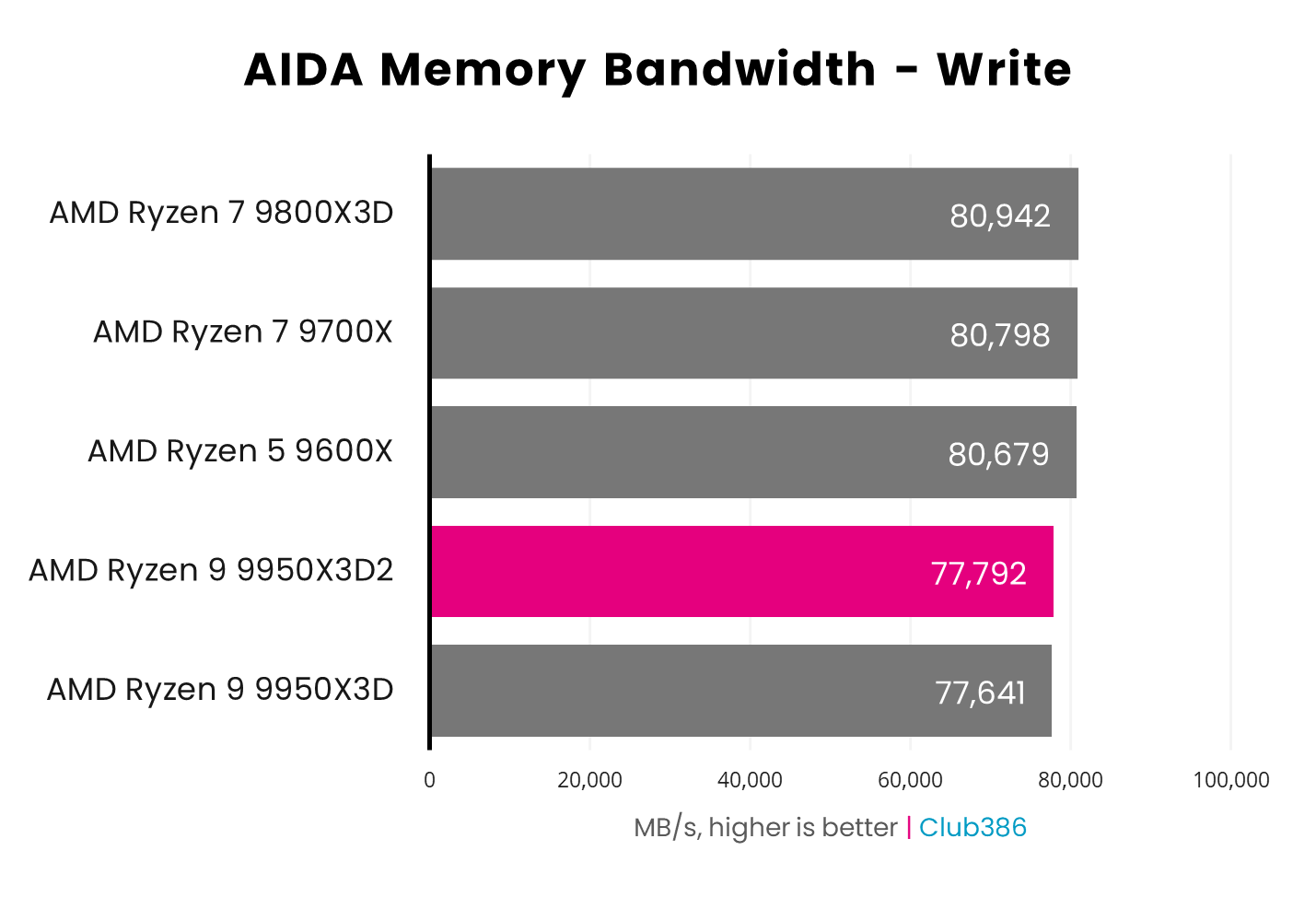
Memory performance is practically identical between the Ryzen 9 9950X3D2 and 9950X3D. At most, the newer CPU pulls ahead by a paltry 2% in terms of copy bandwidth, while read and write benchmarks demonstrate no meaningful changes.
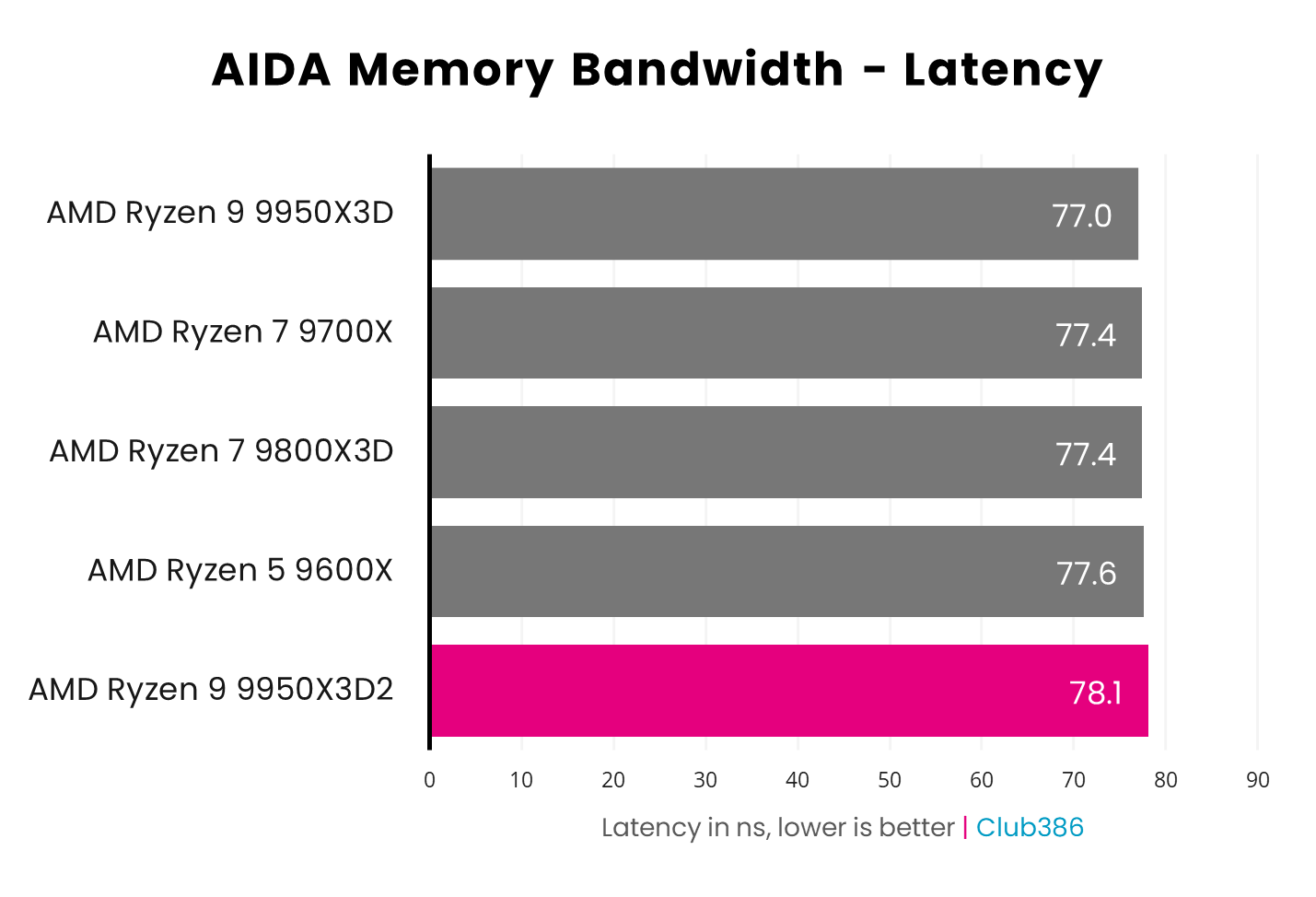
Likewise, the Ryzen 9 9950X3D2’s memory latency shows no departure from expectations, deviating from the Ryzen 9 9950X3D by 1%.
Gaming
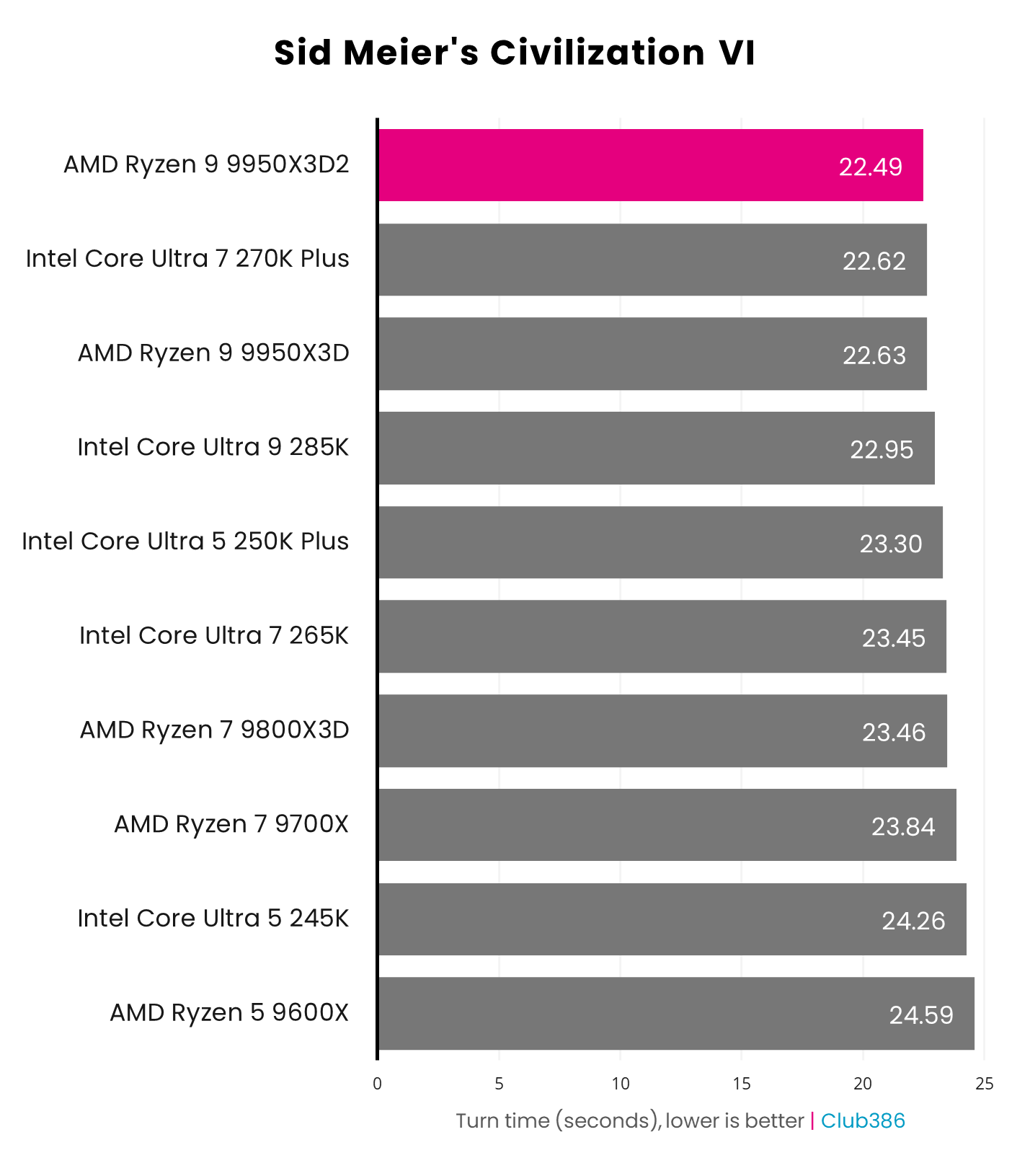
Faced with managing the many calculations of Sid Meier’s Civilization VI Gathering Storm AI benchmark, AMD’s Ryzen 9 9950X3D2 pips past every processor with the fastest average turn times. This scientific victory in the 4X game is close, though, with fractions of a second separating this new CPU from the 9950X3D and Core Ultra 7 270K Plus.
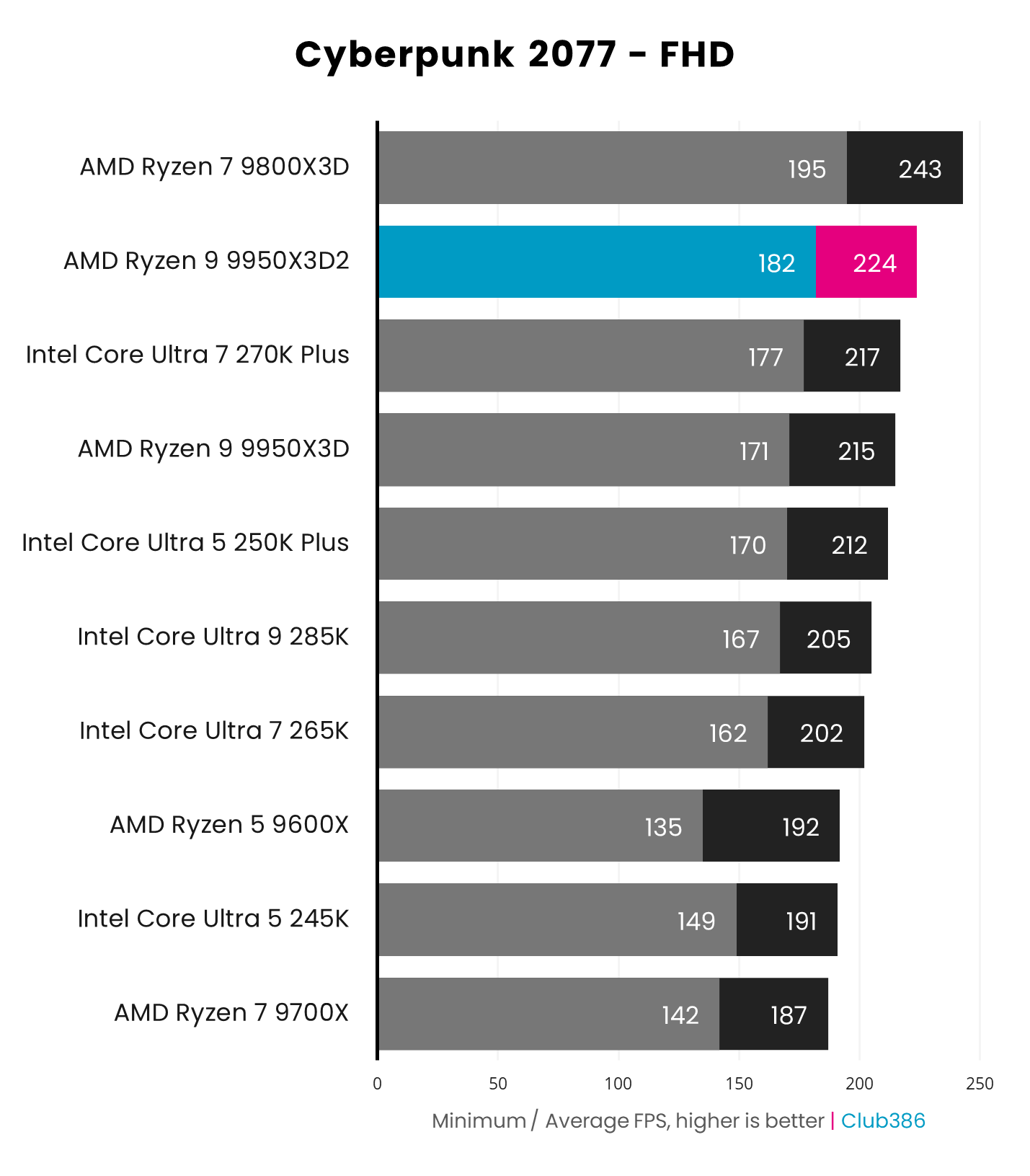
Cyberpunk 2077 serves up our first Ryzen 9 9950X3D2 gaming frame rates, and the CPU manages to squeeze ahead of the Ryzen 9 9950X3D by 4-6% across minimum and average results. However, the chip is still 7-8% behind this sci-fi RPG’s favourite processor, the Ryzen 7 9800X3D, which manages to break the 240fps barrier.
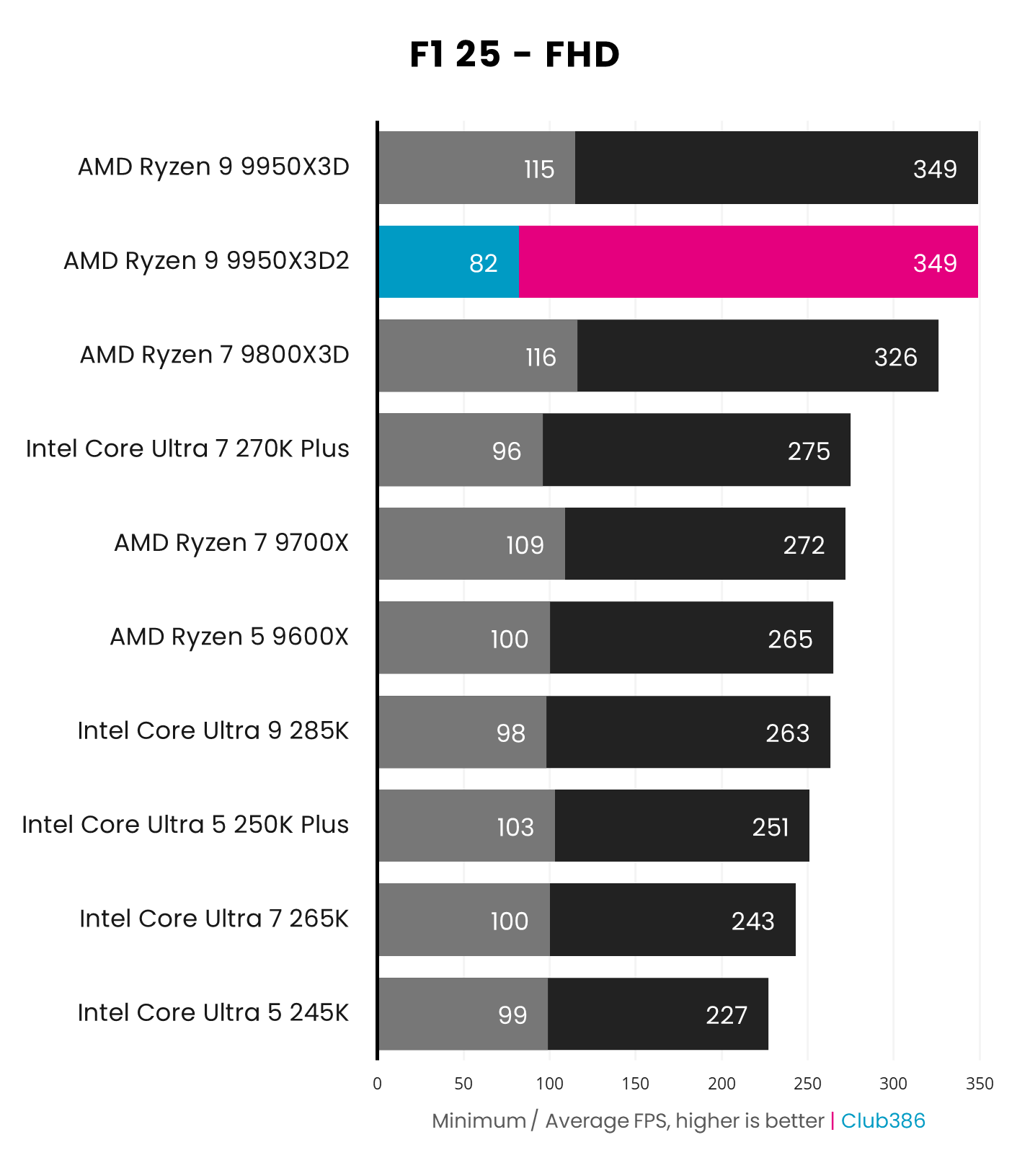
F1 25 delivers our first draw across the benchmark suite between the Ryzen 9 9950X3D2 and Ryzen 9 9950X3D, with both processors outputting a 349fps average. Curiously, the new chip isn’t as stable in terms of minimum frame rates, stumbling by 28% in this regard relative to its forebear. This is a repeatable but nonetheless exceptional difference in performance between the two processors, and it shows there’s some optimisation to be done in this game.
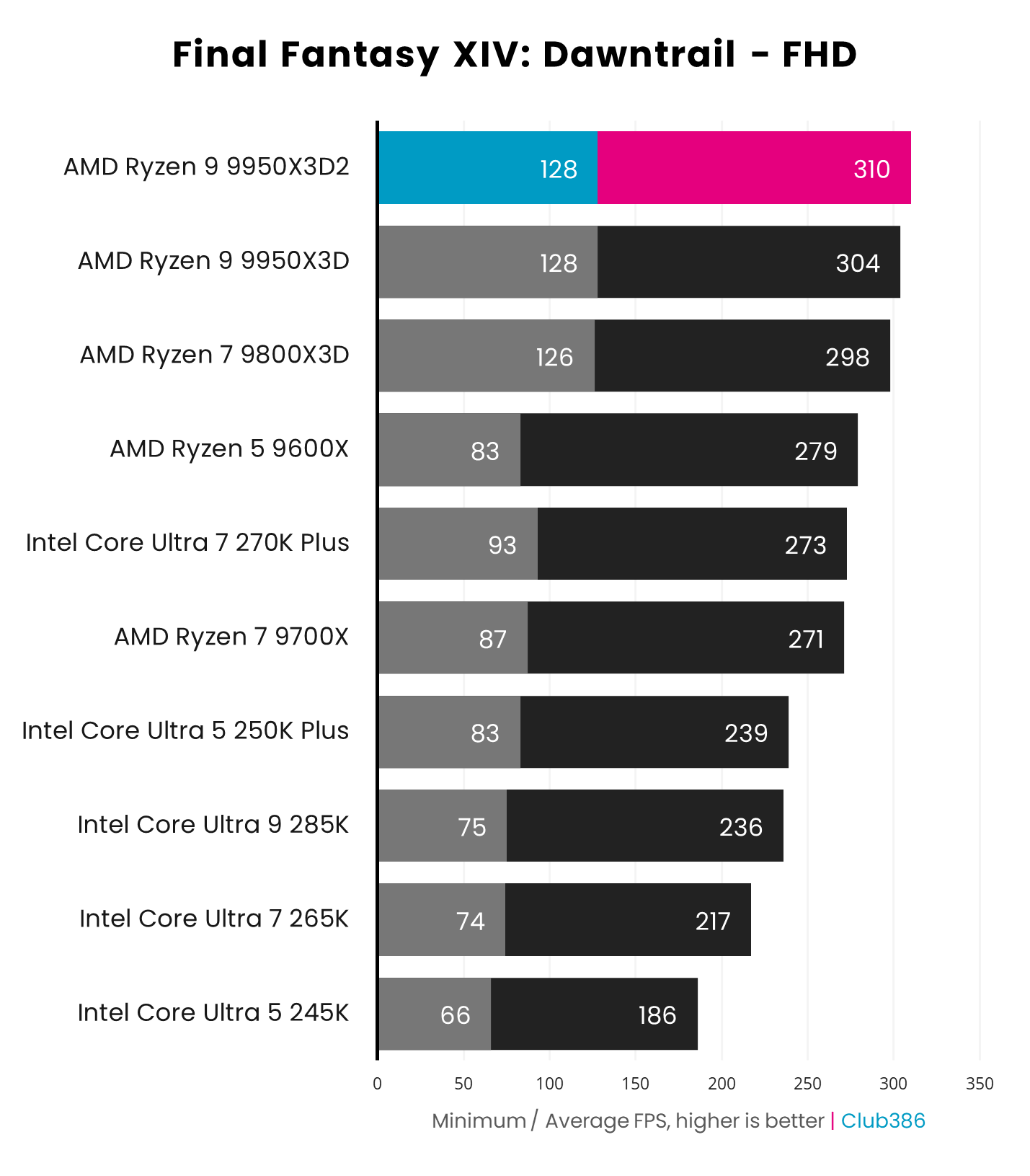
Final Fantasy XIV: Dawntrail runs noticeably better on CPUs with 3D V-Cache, as the difference between AMD’s Ryzen 7 9700X and 9800X3D illustrate. The Ryzen 9 9950X3D is able to push performance in this MMORPG further, albeit by 6fps (+2%), with the Ryzen 9 9950X3D2’s additional 3D V-Cache and power limits pushing frame rates further still by another 6fps (+2%).
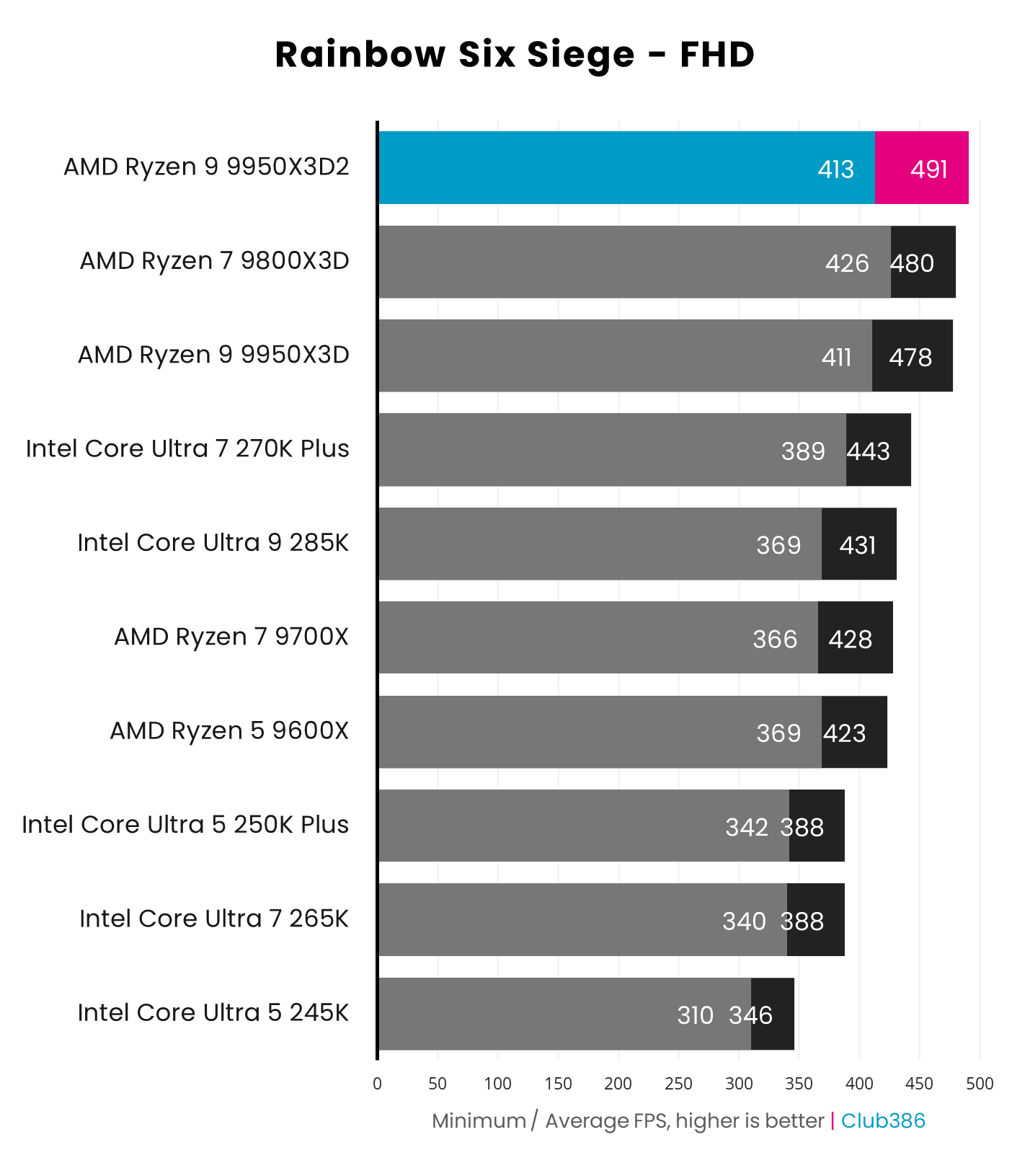
Rainbow Six Siege performance similarly improves with 3D V-Cache in play, and it’s in this competitive FPS that AMD’s Ryzen 9 9950X3D2 pushes the frame rate ceiling to new heights. While the Ryzen 9 9950X3D and Ryzen 7 9800X3D perform similarly, AMD’s new top dog kicks out a 2-3% improvement over its siblings.
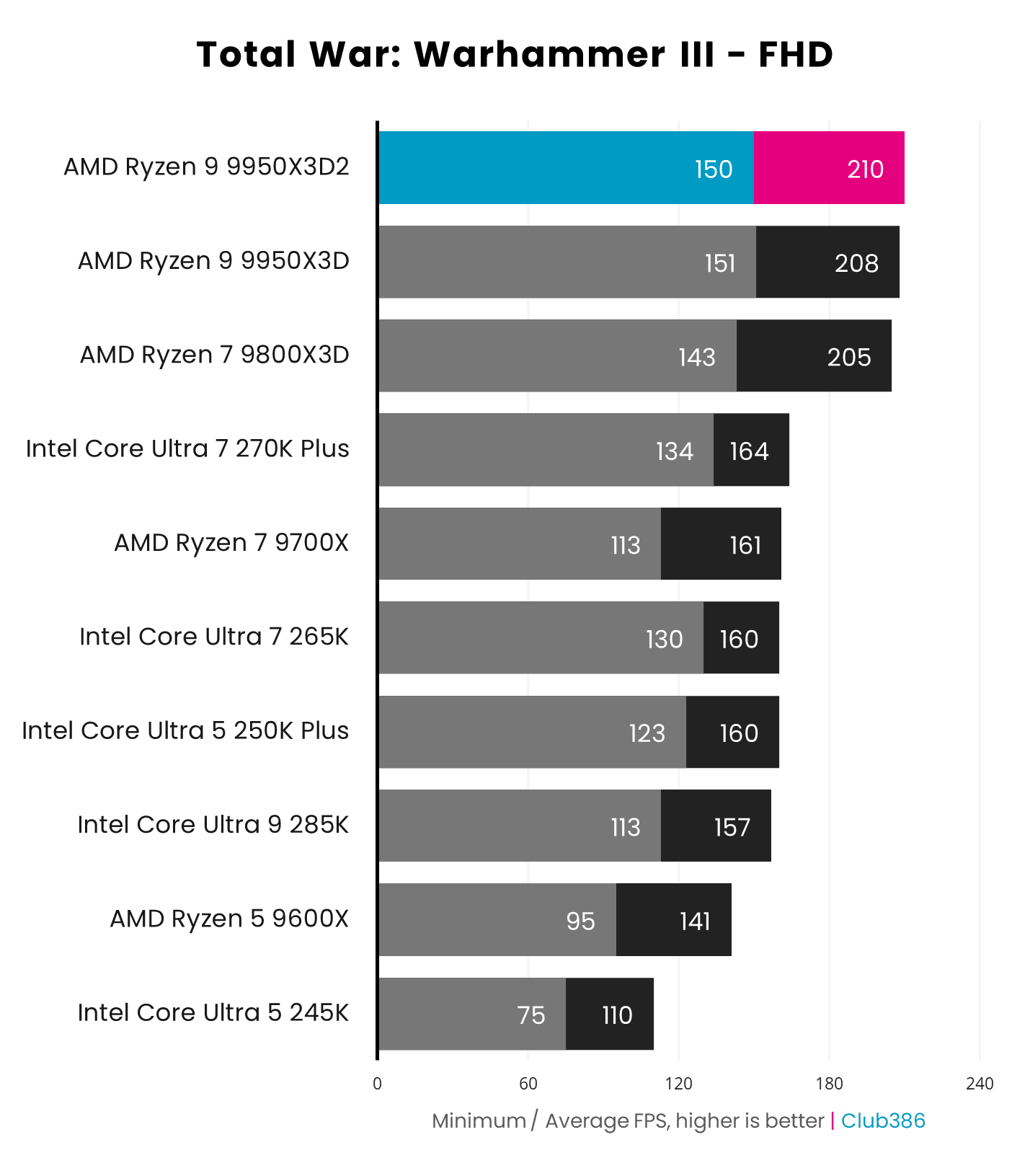
Total War: Warhammer III closes our gaming suite with another 3D V-Cache showdown; all other processors on the board sit in an entirely different performance class. While AMD’s Ryzen 7 9800X3D slots in behind the Ryzen 9 9950X3D2 and 9950X3D, this 8-core chip still offers the lion’s share of their frame rate at a substantially lower cost.
Power and Temperature
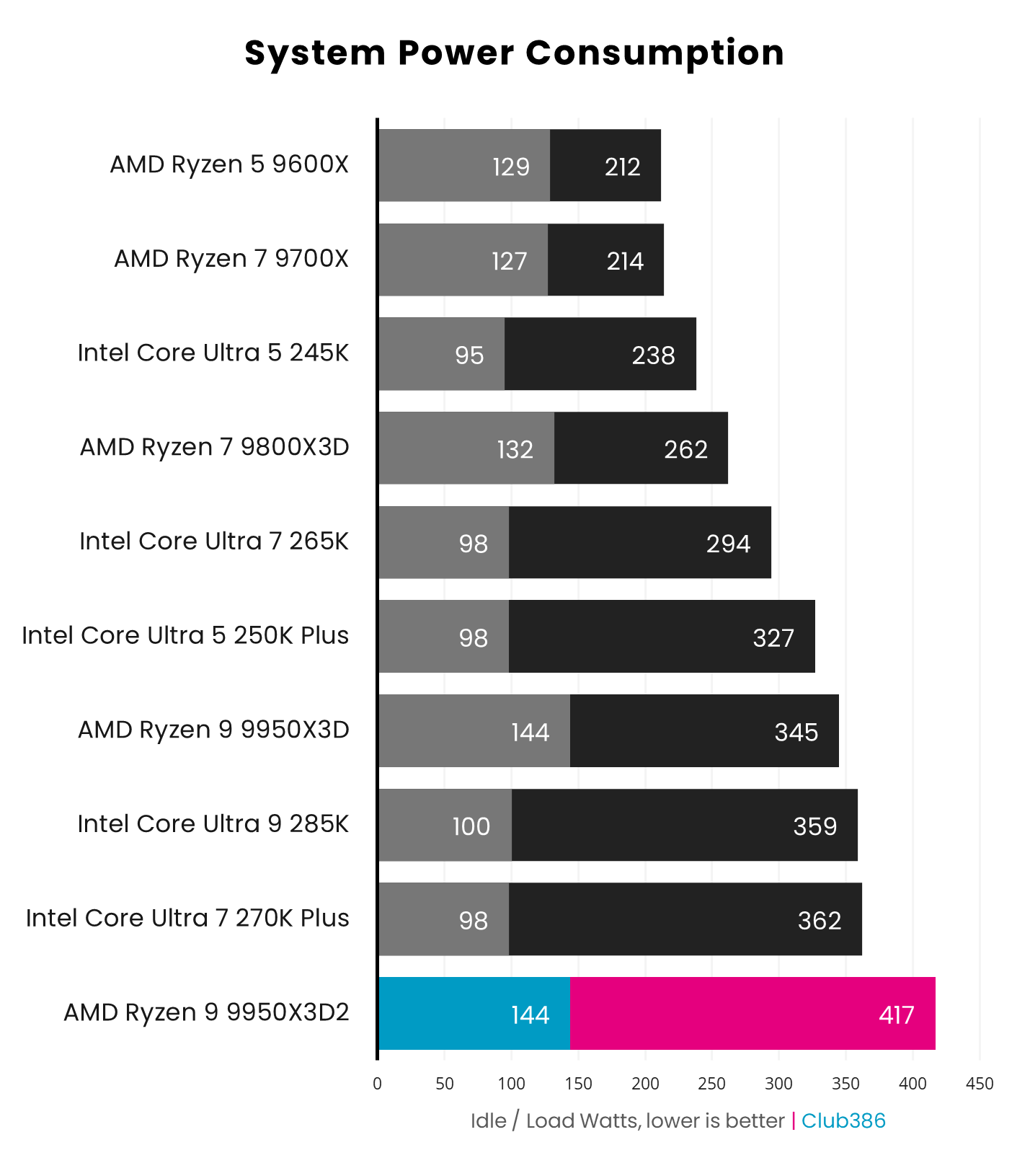
With the Ryzen 9 9950X3D2 in its socket, our test system pulls 417W from the wall while running the Cinebench 2026 multi-thread benchmark. That’s a new record for our modern test suite, beating the Core Ultra 7 270K Plus by 55W (+15%) and the Ryzen 9 9950X3D by a whopping 72W (+21%).
For context, we haven’t seen power consumption on this level since the days of the Core i9-14900K. Hopefully the 9950X3D2 isn’t a sign of power limits to come when Zen 6 arrives, as I’d rather AMD didn’t pick up Intel’s long-dormant mantle and return to such high wattages.
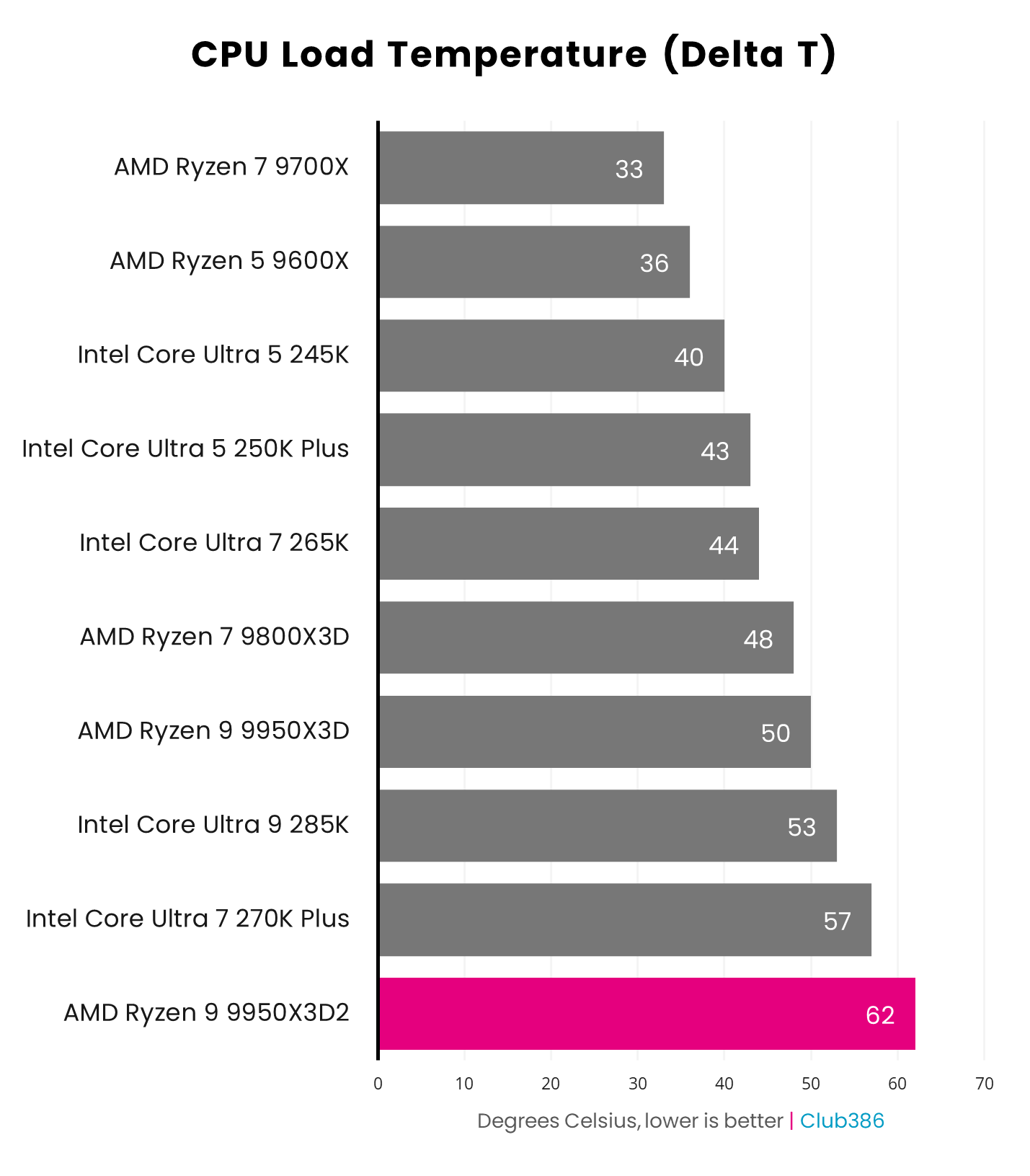
With so much electricity flowing through the system, particularly the processor, it comes as no surprise that the Ryzen 9 9950X3D2 emerges as the hottest current-generation CPU we’ve tested. The chip’s a sizzling 12°C (+24%) warmer under load than the Ryzen 9 9950X3D, but only 5°C (+9%) toastier than the Core Ultra 7 270K Plus. Bear in mind that the results above are Delta Ts, where we subtract the ambient room temperature from the peak CPU core temperature to maintain consistency across our results – the CPU temp itself is considerably higher.
As a reminder, these values reflect cooling from a 420mm AIO water cooler. It’s no wonder the higher power limits of the 9950X3D2 have prompted AMD to recommend a 360mm radiator at minimum on this chip, up from 240/280mm on the 9950X3D.
Value ratings
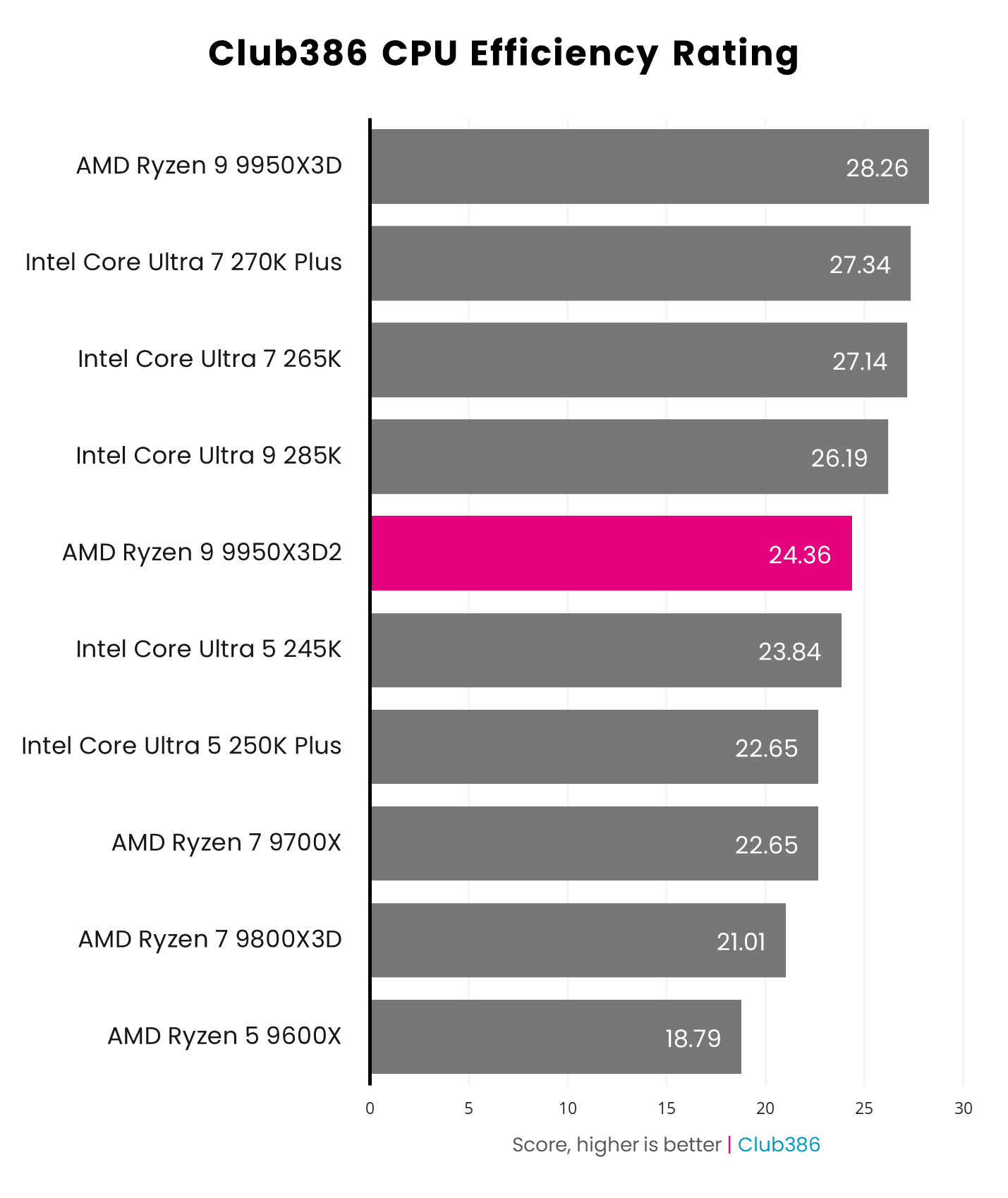
Dividing the Ryzen 9 9950X3D2’s Cinebench 2026 multi-thread score (10,157pts) by peak system power consumption (417W), we arrive at the Club386 CPU Efficiency Rating of 24.36 (10,157/417=24.36), illustrating this processor’s performance per watt. This isn’t a flattering result for the chip, falling 14% short of the Ryzen 9 9950X3D and behind Intel’s Core Ultra 7 and 9 stack.
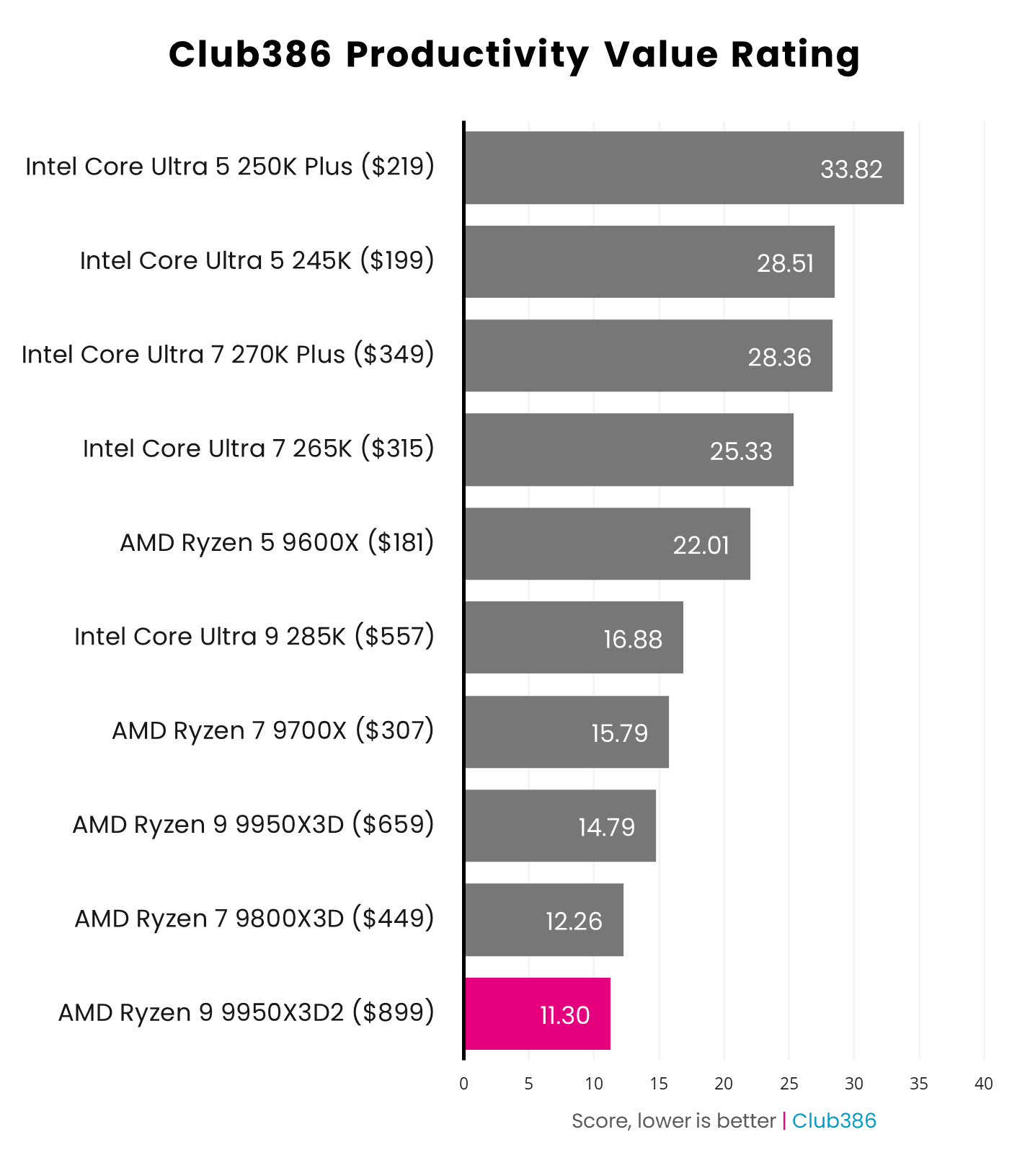
Using the same equation, but replacing power consumption with price, results in the Club386 Productivity Value Rating, providing an indication of the Ryzen 9 9950X3D2’s performance per dollar (10,157/899=11.30). For the rest of the chart, I’ve used live Amazon pricing as of April 20, 2026.
Despite boasting the highest Cinebench score on the board, this CPU’s massively expensive price demolishes its value, sitting 24% below the Ryzen 9 9950X3D, which you’ll find on store shelves for $659 at the time of writing. The rest of AMD’s product stack has also seen a healthy drop in cost, but it’s Intel that’s offering the best multi-threaded bang per buck these days.
Conclusion
The Ryzen 9 9950X3D2 is too much of a good thing, namely 3D V-Cache. While this technology continues to prove itself an undeniable boon, the additional cache on this chip typically nets small performance improvements. Such uplifts are disappointing but still beneficial to some degree if the price is right. Unfortunately, a 29% premium relative to the Ryzen 9 9950X3D is simply too large and severely hampers the appeal of AMD’s new Zen 5 flagship.
Credit where it’s due, AMD hasn’t made attempts to unnecessarily broaden the 9950X3D2’s appeal beyond the realms of developers and creators with deep pockets. Without beating around the bush, anyone outside of those audiences has no business seeking out this processor, and even those who fall within those niches will do well to confirm whether their workflows benefit from dual 3D V-Cache. This chip is effectively a specialist tool, whose capabilities require due expertise rather than a layman’s touch.
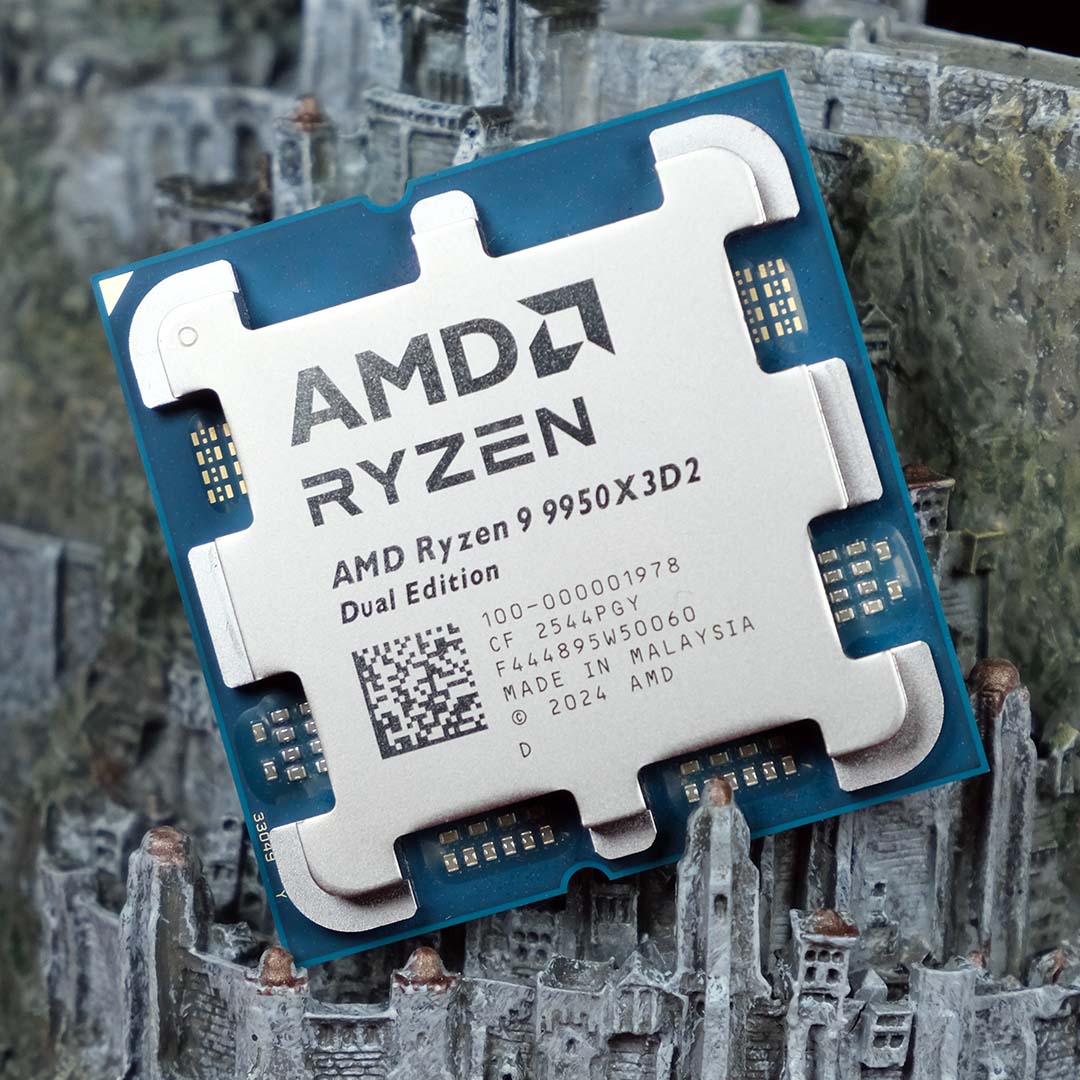
I admire what the 9950X3D2 represents, as the engineering required to manifest dual 3D V-Cache is years in the making. However, assessing the CPU as a product, I can’t help but give into my inner Jeff Goldblum with snarky proclamation that AMD was so preoccupied with whether it could make this processor, it didn’t stop to think if it should.
Pleasing as it is to see the performance needle move, however slightly, the 9950X3D2 will do little to shake up the CPU market. Those after the best gaming performance should stick with the Ryzen 7 9800X3D or 9850X3D, while the 9950X3D will serve most creators’ needs at considerably less expense. As such, I hope the innovation this dual 3D V-Cache chip encapsulates serves as a stepping stone to something altogether greater in the long term, particularly with Zen 6 just over the horizon.