

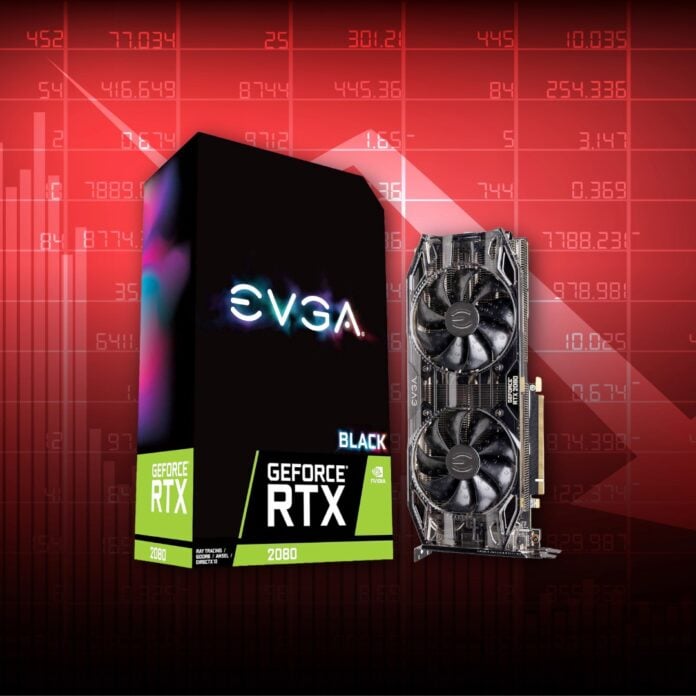
EVGA had to sell its most popular Nvidia GeForce RTX Series graphics cards as loss leaders, according to a former manager at the board partner. In a lengthy blog post, Brendon Ray Hedrick, who you may remember from EVGA’s YouTube channel, outlined several issues with Nvidia’s relationship with board partners when it comes to pricing.
“We were required to offer a model at Nvidia’s advertised starting price.”
“As I understood the arrangement, we were required to offer a model at Nvidia’s advertised starting price,” says Hedrick. That was $699 for an Nvidia GeForce RTX 2080 card, for example, with Nvidia selling its Founders Edition version for an extra $100.
If the company didn’t offer a card for this price, says Hedrick, “Nvidia could reduce our allocation of GPUs, and it could be difficult to tell whether a reduction was a response to our pricing. We needed to keep a loss leader – a card we sold at a loss – to keep Nvidia happy and protect our access to the chips.”
Starting price = loss leader
For a company whose main source of revenue was Nvidia graphics cards, that meant EVGA basically had no choice – it had to sell those cards at a loss. The problem is that a graphics card isn’t a loss leader in the same way as a supermarket discount on a tin of beans, where you tempt people into the shop with a cheap product and hope they buy lots of other stuff while they’re there. Once you’ve bought your graphics card, that’s it.
Unsurprisingly, the starting price cards were also the most popular models by far. “I remember the loss leaders being sold out almost continuously,” says Hedrick. “The cards closest to the price customers had been promised were the hardest to find, leaving the more expensive models to carry the sale. That did not help us move those cards through to customers, either.”
“We needed to keep a loss leader – a card we sold at a loss – to keep Nvidia happy.”
EVGA needed to make a profit on those other cards, which meant they were considerably more expensive than the starting price models. “The models on which we did not lose money had better circuit boards and cooling of our own, but they also carried a substantial premium,” explains Hedrick.
“To a customer comparing them with the advertised starting price, it could look as though EVGA was charging an enormous amount just for those additions. The loss leader set the expectation; the cards with room for us to make money had to justify the gap.”
The split
EVGA eventually split from Nvidia before the RTX 40 Series was launched. Hedrick left EVGA before the RTX 30 series was released, but he makes reference to reports from JayzTwoCents and Gamers Nexus about reported figures revealed in a meeting between these YouTubers and EVGA. The company told JayzTwoCents “it was losing money on a $1,399 RTX 3090 Ti FTW3, while Nvidia’s Founders Edition was selling for $1,099,” points out Hedrick.
“It was losing money on a $1,399 RTX 3090 Ti FTW3, while Nvidia’s Founders Edition was selling for $1,099.”
This made it really difficult for EVGA to turn a profit from its main source of revenue, graphics cards, prompting the company to look to areas such as power supplies to actually turn a profit. Hedrick refers to later (2022) reporting on the split, which stated that roughly 78% of EVGA’s revenue came from graphics cards, but the margins on powers supplies were “much healthier.”
These figures “echoed the imbalance that had worried me during my time there,” says Hedrick. “Graphics cards defined EVGA’s identity and drove an enormous share of its revenue, yet I understood power supplies to be doing much of the work of sustaining profitability.”
Nvidia starts selling Founders Editions
The first signs of tension go back before this time. Nvidia’s first Founders Editions had also put the wind up board partners when they were first announced with the preceding Pascal GTX 10 series. “We were used to selling Nvidia’s reference designs with our name on them,” says Hedrick. “Nvidia had sold its own cards before, but this was when the tension became clear to me: the company supplying our GPUs was also making a prominent pitch to sell finished cards directly to our customers.”
“At that launch, the GTX 1080 Founders Edition carried a premium over the announced starting price for partner cards. The concern was the relationship itself. We depended on Nvidia while competing with it for the same buyers.”
Hedrick ends with a call to Nvidia CEO Jensen Huang. “With all the success Nvidia has had since then, do you see what happened any differently? Is there anything you wish you had handled with more generosity, humility, or maturity? I would like to hear your answer.”
It’s well worth reading Hedrick’s full blog about why he left EVGA for more insight into the situation, as well as some fun recollections of EVGA’s history of customer service and overclocking in the good times. If you’re looking to upgrade your graphics card, check out our guide to the best GPUs you can buy today.