
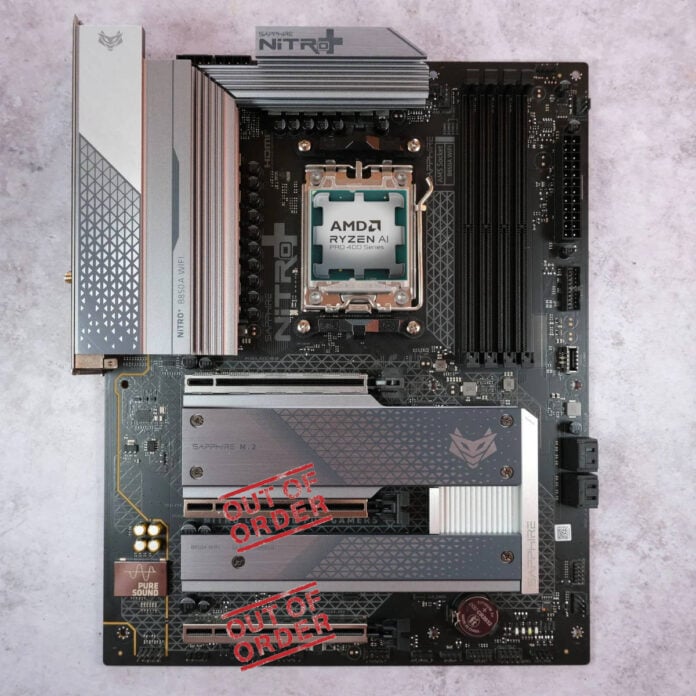
AMD has released the full specs for its new Ryzen AI 400 Series processors, revealing a limited PCIe configuration on all models. According to the product pages, even the highest model in the lineup only carries 12 usable PCIe lanes.
Following the official announcement of AMD Ryzen AI 400 and AI Pro 400 lineups, the company has updated its product pages with detailed specs for each model. Among them, we can see DDR5-5600 support, native 40Gb/s USB 4, and most notably, a limit of 12 usable PCIe 4.0 lanes out of the 16 available. This goes down even further to just 10 usable lanes out of 14 on lower-end CPUs. Even the last-gen Ryzen 8000G-series CPUs offered 16 usable lanes out of 20.
For those wondering, the four missing lanes are used to link the chipset to the CPU, enabling additional motherboard connections such as secondary M.2 slots, more USB ports, SATA ports, and even PCIe slots. As such, bear in mind that your system will get some extra PCIe lanes from its motherboard chipset, as well as the CPU, so your final total will be higher than 12.
Given the usual layouts of modern motherboards, four lanes are likely to be dedicated to the main M.2 slot for Gen 4 SSDs, leaving just eight lanes for PCIe expansion, be it to install a dedicated graphics card or an add-on adaptor. Needless to say, this is far from ideal. For instance, installing a graphics card in such a system would be equivalent to using a 16x PCIe Gen 3 platform. This becomes even worse when installing any type of add-on card on your board’s secondary PCIe slot, potentially giving you just four lanes per slot.
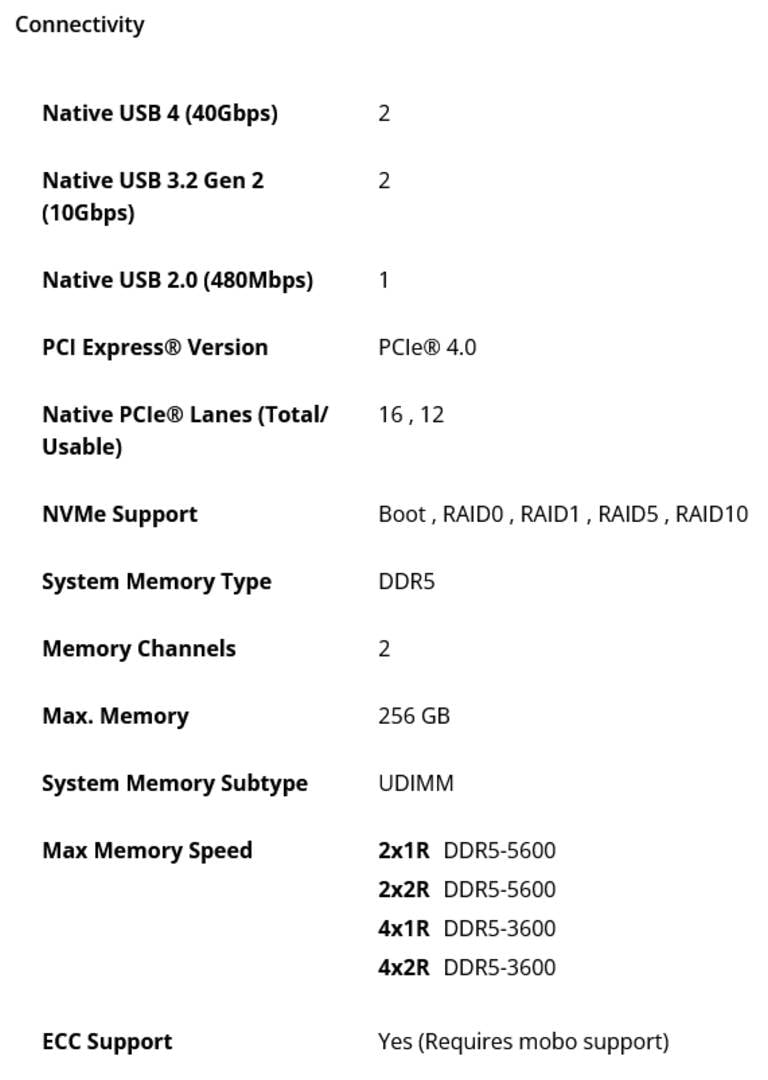
Now, while this shouldn’t cause many problems for most home users, the Ryzen AI 400 Series also includes the Pro variant, meant for enterprise and professionals. These chips have a higher chance of being paired with fast network cards, all sorts of AI and video accelerators, and even multi-M.2 adapters for high-speed data storage, thus 12 lanes may not be enough. When it comes to storage, there is always the possibility to use the additional M.2 slots via the motherboard chipset, but that comes with a latency penalty, not to forget a limited total bandwidth that is shared by all drives.
This shouldn’t be a deal breaker for a lot of users, but it’s an important fact to keep in mind for those who plan to build anything with extensive PCIe connections around these Ryzen CPUs. Opting for a regular Ryzen 7000/9000 CPU would be a better choice.