
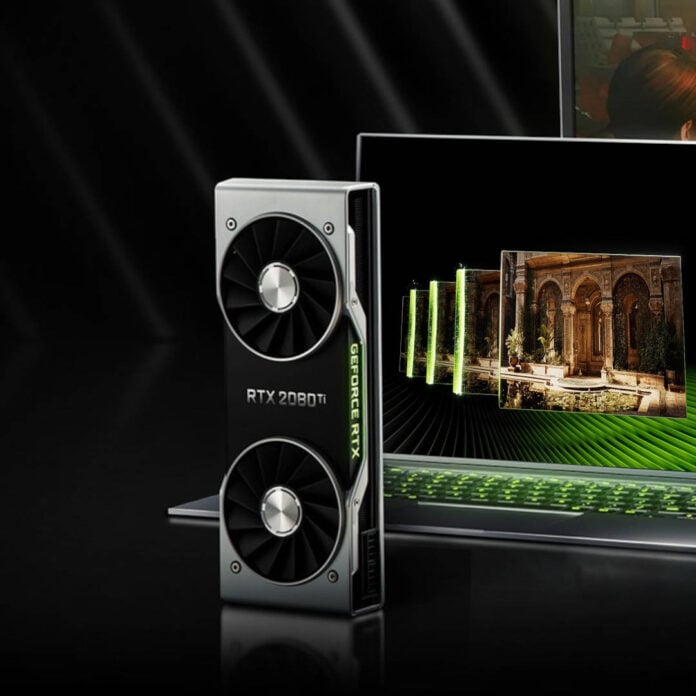
A modder has successfully enabled Nvidia’s DLSS frame generation feature on the company’s old and officially-unsupported GeForce RTX 20 Series GPUs. The mod is reportedly working on both desktop and laptop GPUs, but the implementation still needs optimisation.
This new implementation is based on the same mod that enables DLSS frame generation on RTX 30 GPUs, but tweaked to work on the vert first RTX GPUs, based on the Turing architecture. What makes this new mod special is the way it executes frame generation under the hood.
Unlike previous mods, which worked by intercepting the game’s DLSS frame generation commands and translating them to be run on AMD’s open-source FSR 3 frame generation pipeline, this new implementation actually uses Nvidia’s tech.
It forces Nvidia’s official software (the nvngx_dlssg runtime) to execute directly on the older Turing (RTX 20) GPUs, rewriting the architecture gate and the reported architecture to values that Turing accepts. In other words, the mod removes the software constraint inside the nvngx_dlssg.dll file to overcome any artificial restrictions locking DLSS frame generation to newer architectures.
This tricks the system into thinking an RTX 20 card is a modern Ada Lovelace (RTX 40) GPU, unlocking the option inside game menus. At the same time, the mod translates the software code into an older mathematical language the RTX 20’s Tensor hardware can understand.
It’s an impressive technical feat, but it’s also still in a very early development stage, which means unoptimised performance and bugs. While its creator indicates that the mod works with The Witcher 3 on an RTX 2060 Max-Q, early user reports indicate that performance is lower than with FSR frame generation. Another user also reported being unable to launch Black Flag Resynced and Dead Space (remake). Most notably, it seems that even DLSS multi-frame generation is also working, although going past the 2x level reportedly causes ghosting.
Bugs aside, this new development shows that running DLSS frame generation is possible on old hardware. Whether this will push Nvidia to officially support it is hard to say, but we wouldn’t hold our breath, given the age of Nvidia’s RTX 20 series now.