
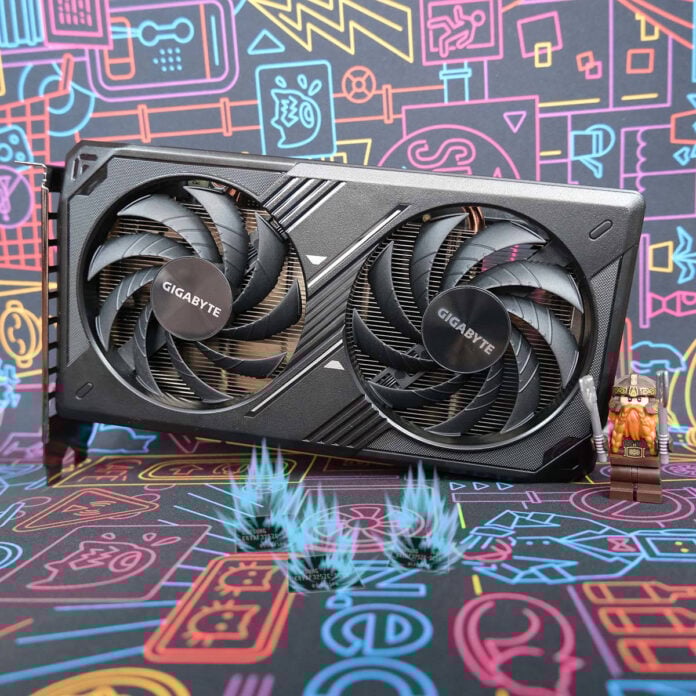
Nvidia is reportedly working on a second variant of its entry-level GeForce RTX 5050 GPU, featuring 9GB of memory. To do so, the company is said to be switching from 2GB GDDR6 modules to 3GB GDDR7 chips.
According to leaker @Zed__Wang on X, Nvidia is set to refresh its RTX 5050 by giving it more memory that runs faster. Specifically, the rumour claims the new RTX 5050 will be paired with 9GB of GDDR7 VRAM, likely using the 3GB 28Gb/s chips used throughout the RTX 50 lineup. As a reminder, the original RTX 5050 houses 8GB of GDDR6 memory using 2GB 20Gb/s chips.
Due to the difference in chip capacity, the new card will need just three 3GB GDDR7 chips to reach its 9GB goal, compared to four 2GB GDDR6 chips for the original. This means the width of the bus connecting the memory to the GPU will be reduced by 25%, from 128-bit to 96-bit.
However, despite this reduction, the overall memory bandwidth will see a slight 5% bump from 320GB/s to 336GB/s thanks to the faster 28Gb/s memory. I’ve summarised the rumoured changes, compared to the original RTX 5050, in the table below.
| RTX 5050 9GB | RTX 5050 8GB | |
| Memory capacity | 9GB | 8GB |
| Memory type | 28Gb/s GDDR7 | 20Gb/s GDDR6 |
| Memory bus | 96-bit | 128-bit |
| Bandwidth | 336GB/s | 320GB/s |
Other than memory, the GPU specifications aren’t expected to change, so RTX 5050 9GB cards should continue to be based on Nvidia’s GB207 Blackwell GPU, offering 2,560 CUDA cores. The TDP may change a bit due to the memory swap, but it shouldn’t stray too far from the original GPU’s 130W.
Now, the question you may be asking is why Nvidia would add another gigabyte of memory (12.5%) to an entry-level card at a time when memory production is under high constraints? Why not increase the capacity of the RTX 5070 instead, or focus on shipping more RTX 5060 Ti 16GB cards? Unfortunately, we have no answers for now. Perhaps 3GB GDDR7 chips have become cheaper to produce, or Nvidia has a large stock. Besides, this rumour may never materialise.
Assuming this card ends up being a real thing, it’s unlikely to change the RTX 5050’s performance much compared to the original design. An extra 1GB of memory gives you a little bit more headroom, but the GPU itself is already pretty underpowered. If it has a similar price, though, it’s worth having a little memory upgrade.
The leaker also shared some insight on a potential revision of Nvidia’s RTX 5060, claiming that a future version may transition to the larger GB205 chip – used by RTX 5070 cards – instead of the current GB206 chip. This would result in this GPU being cut down from 6,144 CUDA cores to 3,840 in order to comply with the RTX 5060’s specs.
We would expect the memory bus on these GPUs to shrink from 192-bit to 128-bit as well, unless Nvidia plans a different VRAM configuration. A 12GB RTX 5060 would at least make more sense than a 9GB RTX 5050. The leaker adds that board partners will need to adopt a new PCB design to fit the different-sized GPU, which would resemble an RTX 5070 PCB but with an 8-pin power connector.
Hopefully, these are just China-exclusive designs. With the previously rumoured RTX 50 Super refresh now absent, these cards could offer acceptable alternatives for those looking for an upgrade, assuming pricing remains under control.