
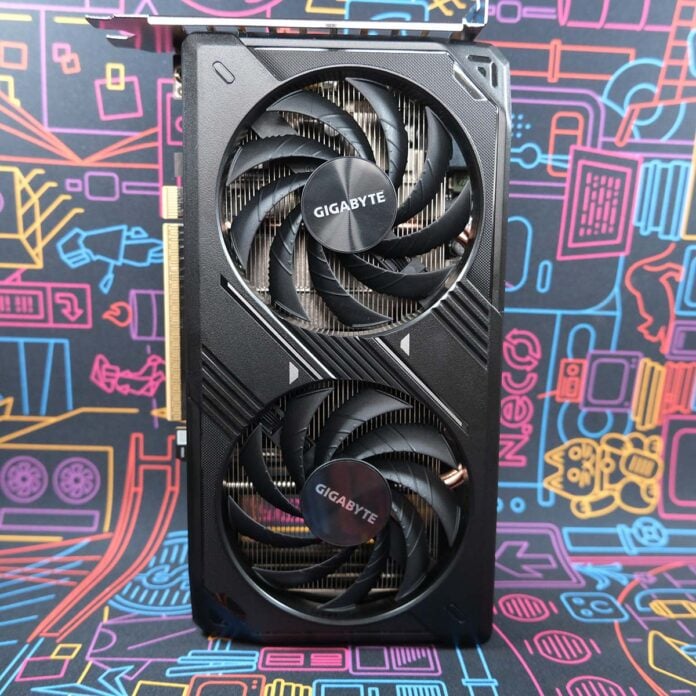
Nvidia GeForce RTX 5050 9GB cards will reportedly be based on the RTX 5060’s GB206 GPU, according to the latest specs leak. Regular (and often accurate) tech leaker @kopite7kimi has shared some more insight on Nvidia’s upcoming GeForce RTX 5050 refresh on X. New details shared by the leaker include the GPU model, CUDA core count, and power budget.
The new design appears to mainly boost the memory capacity and bandwidth, while leaving the rest of the 5050 spec as before. According to @kopite7kimi, the new RTX 5050 will maintain the same 130W TDP and 2,560 CUDA cores as the original RTX 5050, but using a cut-down version of the GB206 GPU instead of the GB207 found used for the original.
As a reminder, the GB206 is the same chip powering Nvidia’s higher-tier RTX 5060 and RTX 5060 Ti models. The reason behind this change is likely due to the different memory standard (GDDR7), which Nvidia is reportedly using to expand the capacity to 9GB.
But that’s not all. Due to the GPU swap, the refreshed RTX 5050 will reportedly be based on a different PCB too. The new card now apparently uses the PG152 PCB design, which is shared by Nvidia’s RTX 5060 and RTX 5060 Ti. This makes the new RTX 5050 pretty much a cut-down RTX 5060.
The card will apparently also maintain its trusty 8-pin power connector, which offers more than enough juice for its reportedly unchanged 130W TGP. Assuming all this is correct, the only remaining unknowns are the GPU frequency and price. I’ve put the rumoured specs compared to an 8GB RTX 5050 in the table below.
| RTX 5050 9GB (rumoured) | RTX 5050 8GB | |
| GPU | GB206 | GB207 |
| CUDA Cores | 2,560 | 2,560 |
| Memory capacity | 9GB | 8GB |
| Memory type | 28Gb/s GDDR7 | 20Gb/s GDDR6 |
| Memory bus | 96-bit | 128-bit |
| Bandwidth | 336GB/s | 320GB/s |
| TGP | 130W | 130W |
As we mentioned in our initial RTX 5050 9GB coverage, this new GPU is expected to use three 28Gb/s GDDR7 memory chips to achieve its goal, instead of four 2GB 20Gb/s GDDR6 chips. This means the memory bus would shrink by 25%, dropping from 128-bit to 96-bit. However, the faster GDDR7 speed should compensate for this tighter bus width, giving the new model a 5% bandwidth boost to 336GB/s.
As for the reason why Nvidia has chosen GDDR7, it’s likely due to current memory supply constraints. Perhaps the company managed to score a better deal for this newer memory standard as it replaces GDDR6 on production lines. Another explanation could be that ordering more GDDR7 chips from Samsung, Micron, or SK Hynix comes cheaper than getting a small batch of GDDR6 chips just to build one GeForce model. Alternatively, Nvidia might simply have a limited supply of GDDR6 memory, which it wants to save for the RTX 3060 relaunch.
Either way, we don’t expect this refreshed RTX 5050 to bring any ground-breaking performance gains. However, as long as pricing stays reasonable, it could be a nice option for budget gamers who don’t want to deal with second-hand GPUs. We’re hoping to get more answers around or at Computex 2026.