
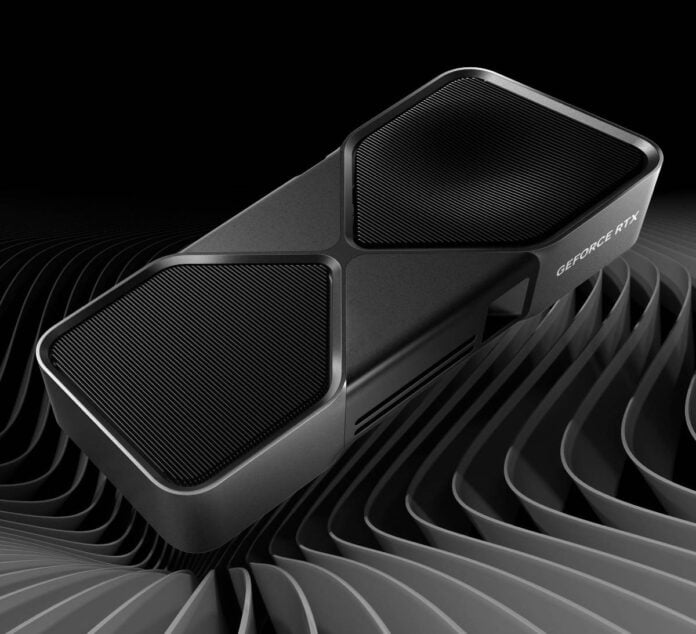
Nvidia is reportedly planning a massive improvement in ray-tracing performance with its next-gen GeForce RTX 60 Series gaming GPUs. According to a leak from YouTuber RedGamingTech, the GeForce RTX 60 Series could offer double the ray tracing performance of the current 50 Series, while also boosting rasterisation pace.
As always with leaks and rumours, bear in mind that none of this has been confirmed by Nvidia, and tech site Videocardz has also now waded into this discussion, with its sources saying that Nvidia hasn’t actually “disclosed performance targets for its next-generation gaming GPUs.” The site also says that detailed specs and clock speeds are unknown. As such, take this all with a pinch of salt.
RedGamingTech says Nvidia is planning to improve ray tracing (RT) and path tracing (PT) capabilities with its next-gen GeForce RTX 60 Series GPUs by at least two times compared to the RTX 50 Series, thanks to its new 6th-gen Tensor Cores and 5th-gen RT Cores. While it is unclear if these estimates include performance-enhancing features such as DLSS, overall, ray tracing should become less of a burden on future graphics cards, with Nvidia perhaps aiming for a level where enabling it would no longer be a big performance trade-off.
Considering that next-gen consoles are also rumoured to feature better RT capabilities, we expect future games to call for more ray-traced effects. Based on the Rubin architecture, the RTX 60 Series GPUs will reportedly carry the BG20x naming, manufactured using TSMC’s 3nm node. This combination of manufacturing and architectural improvements is said to bring a 30-35% uplift in rasterised performance, which would be the equivalent of moving from an RTX 4090 to an RTX 5090. That would be a big deal if it happens further down the range as well, though, as Nvidia’s 50-series GPUs below the 5090 didn’t offer much of a boost in rasterisation performance compared to the 40 Series.
Regarding specs, RedGamingTech claims that Nvidia will be using its GR202 silicon to power its flagship RTX 6090, packing 192 Stream Multiprocessor (SM) units. This represents a 12.9% increase over the RTX 5090’s 170 SMs. As with the RTX 5090, the RTX 6090 is unlikely to use a fully-enabled GR202 chip. This GPU is reportedly targeting a frequency range between high-2GHz and low-3GHz. The card is also expected to feature 32GB of memory, likely to be GDDR7, linked via a large 512-bit bus. Depending on the memory speed, this could result in a whopping 2TB/s of bandwidth.
Going down the stack, we find the RTX 6080 and RTX 6070, which RedGamingTech says will feature larger 320-bit and 256-bit memory buses than their 50 Series counterparts. These represent a 64-bit upgrade over their predecessors, which should allow the installation of more memory, specifically 20GB on the RTX 6080 and 16GB on the RTX 6070, as well as greater bandwidth. Hopefully, this trickles down to the lower tier and sets 12GB as the minimum. While Nvidia could use denser GDDR7 chips to further increase memory capacity without requiring a wider bus, it’s unlikely in current market conditions. However, if AMD’s RDNA 5 cards end up offering strong competition, Nvidia may be forced to react.
If this rumour is correct, Nvidia’s RTX 60 Series looks set to be quite potent, especially in ray tracing. A doubling in RT performance would drastically reduce this feature’s impact on performance, encouraging more players to enable it and more developers to implement it. As always with rumours, though, take this with a pinch of salt for now, as Nvidia hasn’t released any official information about these GPUs.