

Primate Labs Inc, the entity behind the popular Geekbench benchmarking software, has published an investigation regarding Intel’s Binary Optimisation Tool (BOT), revealing worrying optimisations that could skew performance comparisons between brands. The situation was severe enough that Geekbench is now flagging tests that have BOT enabled.
Released alongside the Core Ultra 5 250K Plus and Core Ultra 7 270K Plus Arrow Lake Refresh processors, Intel Binary Optimisation is a runtime binary optimiser that sits between the OS loader and the CPU’s execution. It modifies instruction sequences in executables to improve performance, but can only be used with a handful of approved applications, such as Geekbench 6. Considering the high positive impact on the test results of the latter, Primate Labs opened an investigation to look for potential targeted optimisations that could give Intel an unfair advantage.
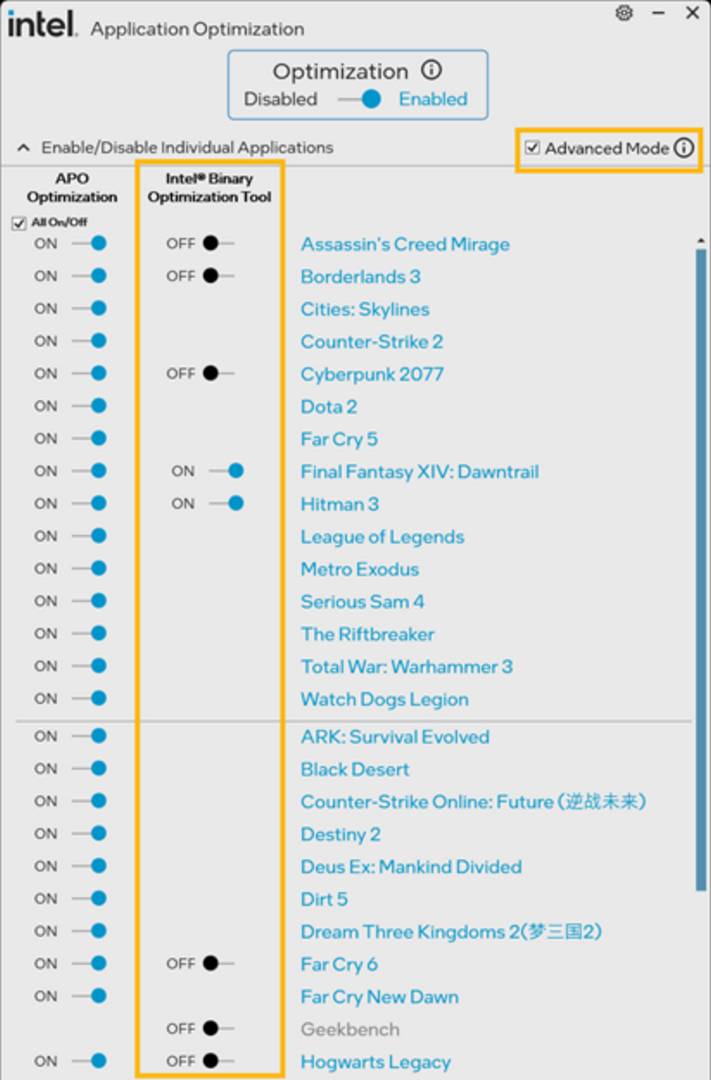
Intel positions BOT as an optional feature under its Application Optimisation’s advanced mode and is therefore not available for all applications. The company’s official presentation describes BOT as a performance feature for select games and applications that can improve native performance even on software tuned for another x86 processor or earlier architectures.
| Geekbench 6.3 | BOT Disabled | BOT Enabled | Difference |
| Single-Core | 2,955 | 3,119 | +5.5% |
| Multi-Core | 16,786 | 17,705 | +5.5% |
Primate Labs tested Intel BOT using a Core i9 386H-equipped MSI Prestige 16 AI+ laptop and found that in Geekbench 6.3, enabling BOT increased both single-core and multi-core scores by 5.5%. In some workloads, the score increase was even higher, reaching up to 30% in tasks such as Object Remover and HDR. That said, this performance boost comes at the cost of startup speed, as the first launch of the app required 40 seconds, before dropping to about 2 seconds in subsequent runs.
Furthermore, BOT was also found to reduce the number of instructions needed to finish a task by 14%, turning inefficient code into vectorised instructions that are processed more efficiently on Intel CPUs.
| Geekbench 6.7 | BOT Disabled | BOT Enabled | Difference |
| Single-Core | 2,938 | 2,937 | +0.0% |
| Multi-Core | 16,892 | 17,045 | +0.9% |
Interestingly, Geekbench 6.7 single-threaded and multi-threaded scores remained roughly the same regardless of the BOT status. In other words, BOT only optimises specific versions of Geekbench, suggesting that it identifies and targets specific binaries to optimise.
As a result, real-world performance will vary substantially from one app to the next. And since Geekbench is designed to give users an idea about the CPU performance in general, having this kind of optimisation could lead them to think Intel CPUs are better than their competitors. Primate Labs wants Geekbench to remain a gold standard by which to evaluate CPUs by, so any optimisations that aren’t carried over to all apps begin to look problematic for a true apples-to-apples comparison.
In its current state, then, according to Primate Labs, BOT may paint a marginally unrealistic and positive picture of how a certain Intel CPU performs. To be clear, the benefits within supported apps are real; it’s just the potential user confusion that is causing worry here.
To avoid this, Primate Labs has indicated that from now on, it will flag BOT-optimised results in the Geekbench database, so users can be aware when comparing products. A good solution that should keep things fair for Intel without misleading users.