
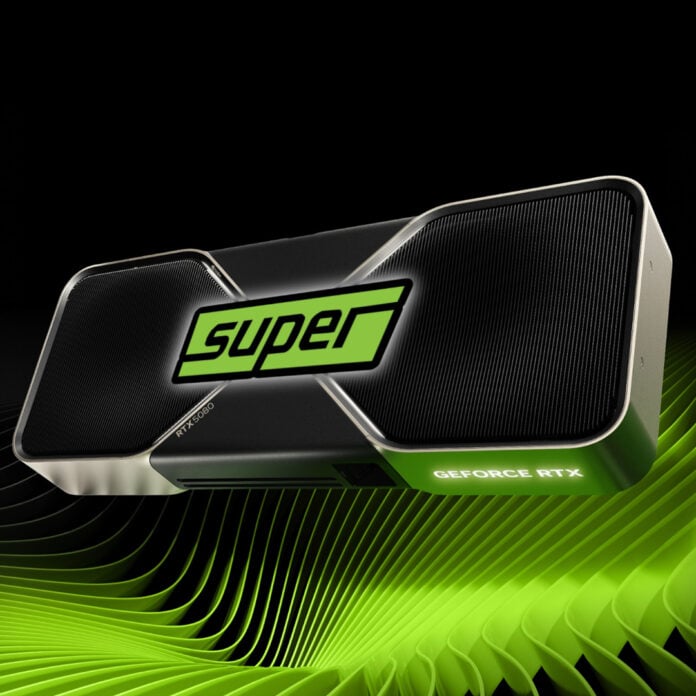
The Internet is abuzz with whispers of a forthcoming GeForce RTX 5080 Super, which could serve as the new flagship graphics card in Nvidia’s line up following the reported discontinuation of the RTX 5090. If the latest rumours are correct, this card could have 50% more memory than the standard RTX 5080.
However, it’s important to stress that Nvidia has never officially acknowledged the existence of a GeForce RTX 50 Super series, as much as the prevalence of leaks and rumours suggest the graphics cards do indeed exist. We’ve weeded out any outdated or likely false information regarding the RTX 5080 Super, but nonetheless recommend taking everything below with a healthy pinch of salt.
Release date rumours
The latest leaks state Nvidia plans to release the RTX 5080 Super during Q1 2027. This is according to Chinese PC hardware outlet Benchlife, which made the claim in the wake of recent rumours that GeForce RTX 5090 production has ended.
If true, then CES 2027 would make for a potential launch platform for the GPU. Nvidia debuted the first GeForce RTX 50 series graphics cards at the trade show in 2025, revealing its GeForce RTX 40 Super series the year prior.
https://t.co/JYQl6jWGFP:
“另一方面,NVIDIA 計畫在 2027 年第一季推出 GeForce RTX 5080 24GB GDDR7 顯示卡,其目的是為了取代現行的 GeForce RTX 5080 16GB GDDR7,只是到目前為止,AIC 合作夥伴都未收到任何開發資料,僅獲得口頭上的告知相關產品的開發資料將會在近期給出。”— Ruby_Rapids (@RubyRapids) October 10, 2026
In May 2025, initial RTX 5080 Super launch rumours said the card would arrive before the end of 2025. However, the year came to a close without any official acknowledgement or announcement, with CES 2026 proving similarly devoid of any nod from Nvidia. Following the trade show, new rumours emerged that the firm had place its entire GeForce RTX 50 Super series on indefinite hold.
Leaker Zed__Wang provided some hope in June that the RTX 5080 Super could launch in 2026, alongside the rest of the refresh. However, it didn’t take long before reports emerged in the following month claiming the graphics cards were on hold once again, this time owing to ballooning GDDR7 prices.
If the rumoured Q1 2027 window holds, this would mean the RTX 5080 Super would launch a full two years after the original RTX 5080. Meanwhile, a true GeForce RTX 60 series successor probably won’t see the light of the day until 2028, following an apparent postponement.
Specifications rumours
Current rumours predict that the RTX 5080 Super will arrive with specifications very similar to those of the RTX 5080, albeit with a greater amount of memory running at faster speeds. There have been no leaks or whispers pertaining to clock speeds, but it’s entirely possible that Nvidia could increase operating frequencies with this refresh.
The first mention of an RTX 5080 Super claimed that the graphics card would sport 24GB of GDDR7 VRAM. This would mark a 50% increase over the standard RTX 5080 (16GB), with 3GB memory modules replacing the existing array of eight 2GB chips.
| RTX 5080 Super* | RTX 5080 | Ratio | |
|---|---|---|---|
| GPU | GB203 | GB203 | – |
| Transistors | 45.6B | 45.6B | 1.00 |
| Die size | 378mm2 | 378mm2 | 1.00 |
| CUDA cores | 10,752 | 10,752 | 1.00 |
| SM count | 84 | 84 | 1.00 |
| RT cores | 84 (4th Gen.) | 84 (4th Gen.) | 1.00 |
| Tensor cores | 336 (5th Gen.) | 336 (5th Gen.) | 1.00 |
| Memory | 24GB GDDR7 | 16GB GDDR7 | 1.50 |
| Mem. clock | 32Gbps | 30Gbps | 1.07 |
| Mem. interface | 256-bits | 256-bits | 1.00 |
| Mem. bandwidth | 1,024GB/s | 960GB/s | 1.07 |
| Board power | 415W | 360W | 1.15 |
Further reports detailing alleged RTX 5080 Super specs indicate that this extra capacity will also come part and parcel with a memory speed boost, increasing from 30Gbps to 32Gbps, and bringing total bandwidth to 1,024GB/s.
As the RTX 5080 already uses a complete GB203 GPU die, there’s no room for Nvidia to increase the number of CUDA, RT, or Tensor cores, at least not without using a cutdown GB202 GPU instead, and that’s extremely unlikely given this chip’s popularity for pro hardware.
This means the only way to push performance further would be via adjustments to clock speeds, but that’s unlikely to result in any major differences. After all, the RTX 4080 Super barely managed to move the needle past the RTX 4080, despite having a 5% bump in the number of CUDA cores under its belt.
Seasonic’s PSU calculator leak suggests the RTX 5080 Super TDP will sit at 415W, a whopping 15% above the original RTX 5080. The higher-capacity memory modules go some way to explaining this difference, but also may indicate higher operating frequencies too.
Price rumours
The RTX 5080 Super would probably be more expensive than the RTX 5080 at release, meaning an MSRP substantially north of $999. Since Nvidia released its current generation of graphics cards, the price of memory has skyrocketed, impacting production costs for the firm and its board partners, resulting in higher pricing on store shelves.
At the time of writing, the starting price of an RTX 5080 has increased to £1,292 / $1,699, a massive 42-70% above launch costs. The primary driver of this rise comes down to the ongoing memory shortage. In the wake of these new market conditions, Nvidia has reportedly passed the buck down the chain to graphics card manufacturers and consumers, by increasing the cost of GDDR7 module bundles it provides.
With that information in mind, any initial RTX 5080 price estimates that suggested a match for the RTX 5080’s MRSP seem unlikely to pass. Given that this model will apparently feature even more VRAM, we’d expect the graphics card to cost closer to ~£1,500 / ~$2,000, at the very least, particularly if this refresh is meant as a replacement rather than an accompaniment to existing stock.
Performance rumours
No benchmarks for the RTX 5080 Super have leaked, nor have any rumourmongers made claims regarding its performance. If Nvidia proceeds with launching the card, we’d expect test results to emerge closer to release.
As we covered earlier, there’s little room for Nvidia to give the RTX 5080 Super a notable performance uplift over the RTX 5080 as the latter model already uses a full-fat GB203 GPU. Higher clock speeds could create some differences between the two revisions, but are unlikely to massively set either graphics card apart.
The larger and faster pool of GDDR7 VRAM could open up more settings in demanding games, however. For example, Indiana Jones and the Great Circle falls over at 4K with path tracing enabled on a 16GB card, but 24GB could give the RTX 5080 Super a fighting chance.
That memory could prove beneficial to AI and professional workloads as well. Rising from 16GB to 24GB opens the door to locally running larger LLM models, as well the ability to more easily handle high-resolution 8K footage in a video editing timeline.
While we wait to see how the RTX 5080 Super shapes up, give our best graphics card guide a read to learn which pixel pushers we recommend grabbing in these trying times.