

Testing of Nvidia DLSS 5 Neural Rendering via an unofficial mod shows that this new tech can put a huge load on GeForce RTX 50 Series graphics cards, increasing their power draw and temperatures. The compute demand of DLSS 5, coupled with the traditional rendering pass, also keeps these cards under load long enough for heat to build up on the 12V-2×6 connector.
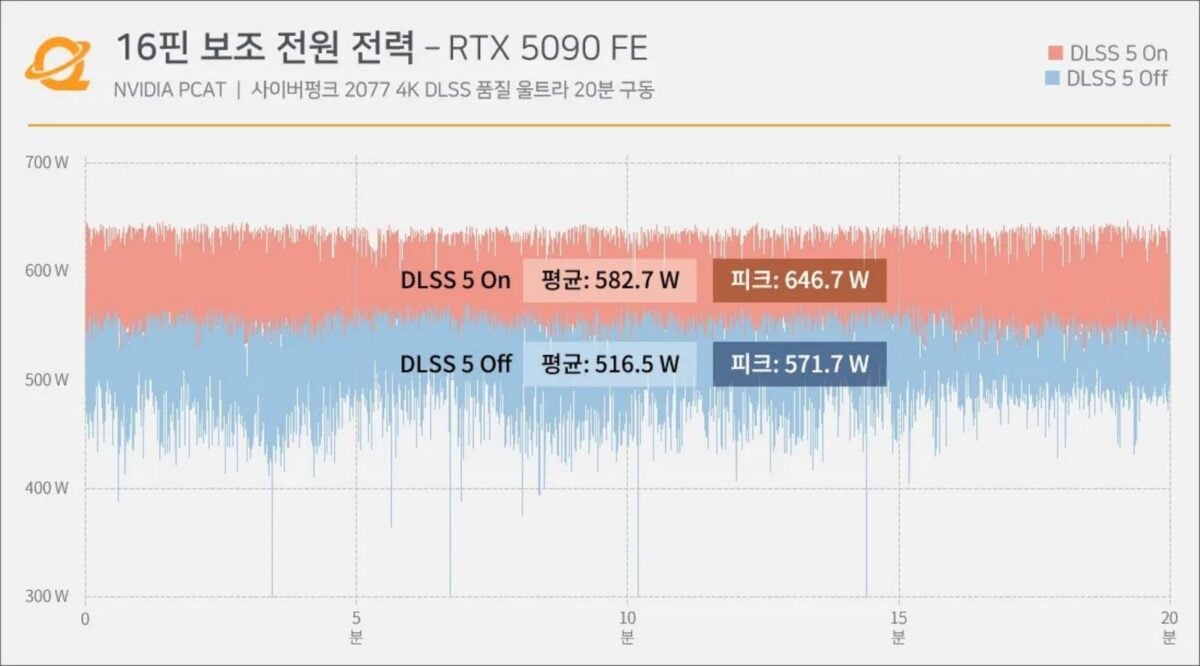
Following reports of melted 12V-2×6 power cables due to the use of Nvidia’s DLSS 5, folks at tech site QuasarZone decided to verify how much it truly affects the RTX 50 Series GPUs, specifically, the RTX 5080 and RTX 5090 Founders Edition cards. The outlet found that when enabling the DLSS 5 mod in Cyberpunk 2077 at 4K, the RTX 5090 pulled 13% more power with DLSS 5 enabled, pushing the average power draw to 582.7W and the peak to 646.7W.
The latter is especially noteworthy as it exceeds the 12V-2×6 power cable rating of 600W and the card’s 575W power limit, albeit for short bursts. For comparison, the card demanded 516.5W average and 571.7W peak with DLSS 5 off. Note however that DLSS 5 is not yet officially supported in Cyberpunk 2077; QuasarZone used a mod to enable it. As such, these results may differ compared to an official implementation, perhaps causing less strain on the card overall.
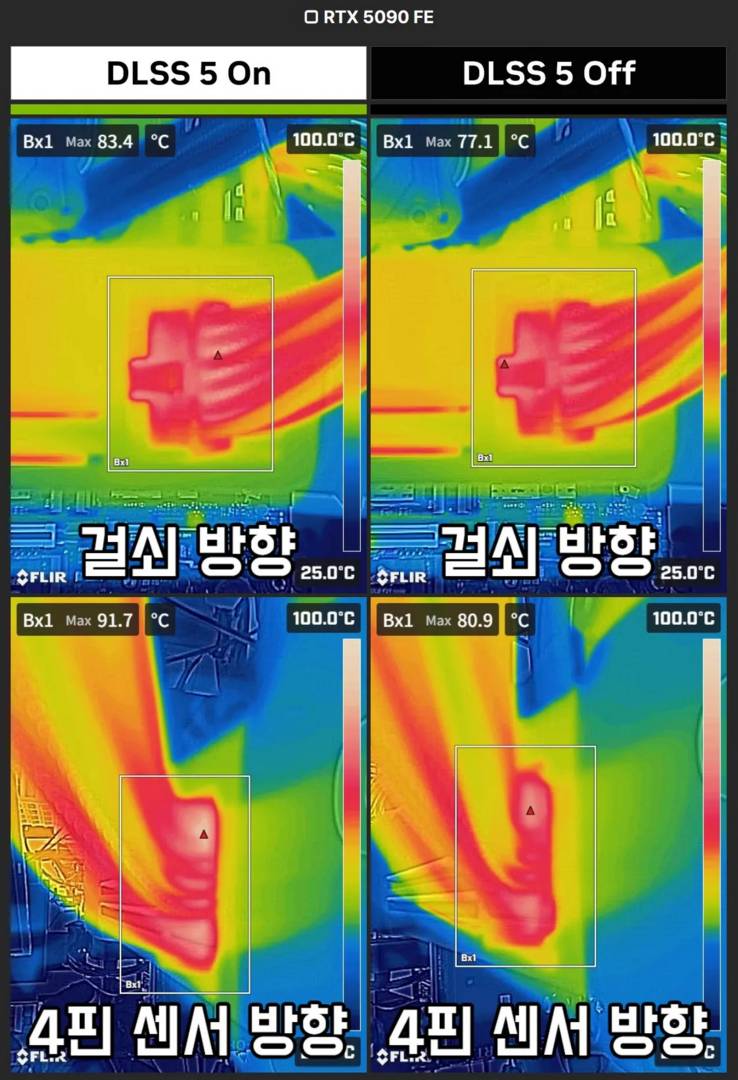
As you can guess, more power also means more heat, which is clearly shown in QuasarZone’s thermal imaging. Looking at the 12V-2×6 connector, the thermal camera recorded a 13% / 10.8°C temperature increase with DLSS 5 on, reaching 91.7°C at the hottest point compared to 80.9°C with DLSS 5 off. That temperature of 91.7°C isn’t far from the 105°C maximum rating of these kinds of connectors, so any imbalance in power (more load on one wire) could lead to cable melting and permanent damage. To be fair, the room temperature was around 27.5°C, which is higher than most reviews online, but it’s not outstanding.
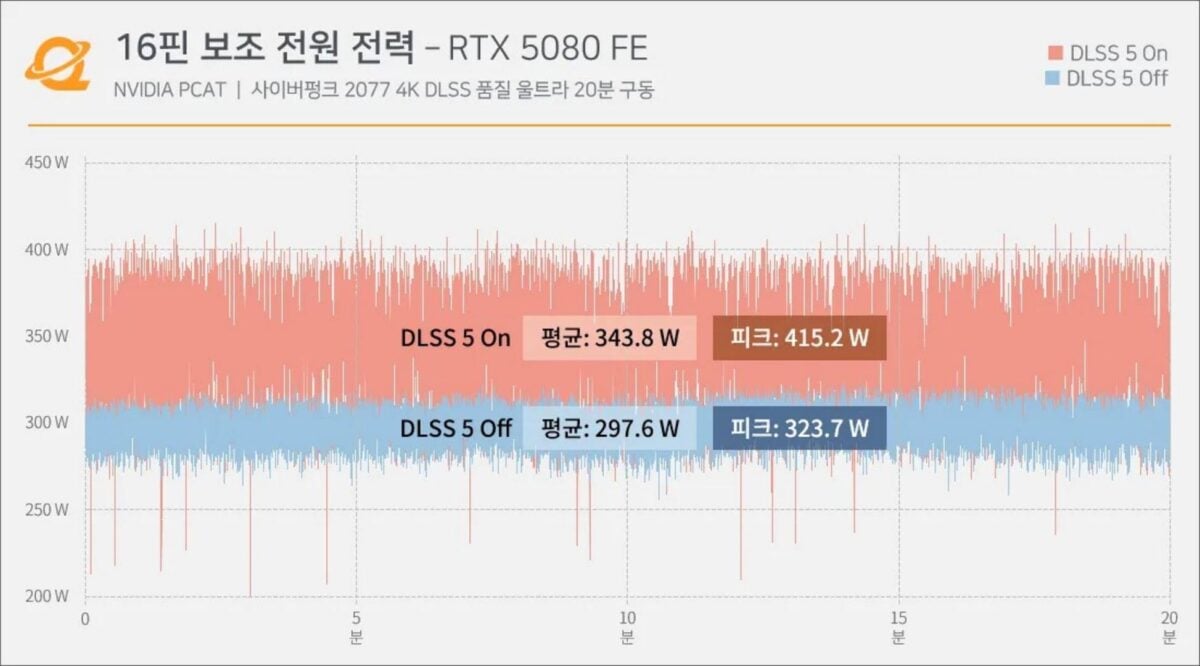
The exact same conditions were observed on an RTX 5080 card, just with less danger due to its lower 360W limit. Here, the 12V-2×6 connector reached 52.2°C at the hottest point with DLSS 5 on compared to 45.8°C with DLSS 5 off, which represents a 13.9% / 6.4°C increase. In other words, nothing to worry about on low-power GPUs.
The takeaway is that, when it’s unrestrained, DLSS 5 can hammer current GeForce GPUs, pushing them to their limits. If you’re planning to use DLSS 5 on an RTX 5090 via one of these mods, you may want to keep an eye on your temperatures.