
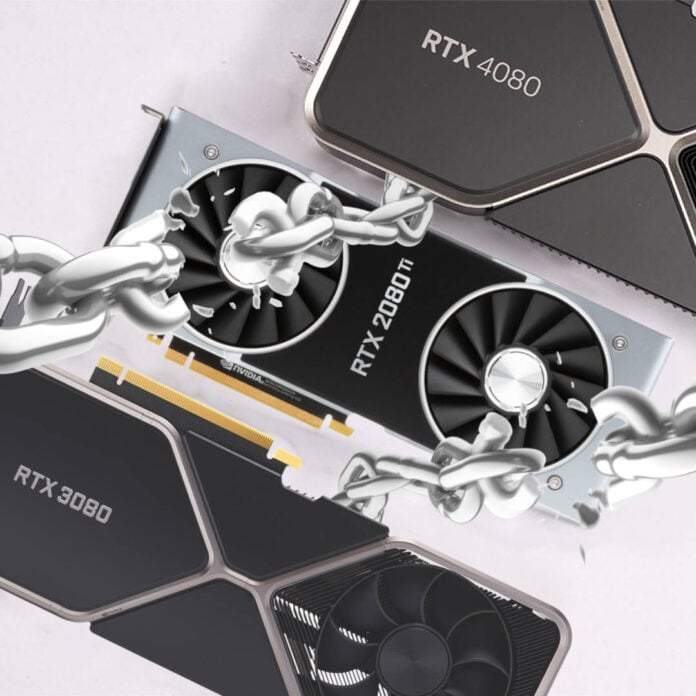
Modders have found a way to unlock the full compute potential of consumer Nvidia GeForce GPUs, including RTX 40, RTX 30, and RTX 20 graphics cards. These mods appear to drastically boost the AI performance of GeForce GPUs, although gamers won’t see any benefits.
The tool works by changing low-level configuration registers before the Nvidia driver loads, while overriding the PCIe function level reset (FLR), bypassing the software lock and unlocking each GPU’s full potential. In other words, it’s a temporary change that doesn’t modify your driver or CUDA performance, clearing after each reboot. Furthermore, there is no need for manual patching each time Nvidia releases a new driver.
This is possible mainly because Nvidia uses the same core GPUs on its consumer GeForce and professional (previously Quadro) cards, restricting compute performance on the gaming range via software. By removing this restriction, GeForce cards double their throughput at which certain Tensor Core instructions can be issued. This mainly affects FP16 and BF16 operations with FP32 accumulation, in addition to certain TF32 and FP8 workloads, on supported architectures.
Starting with RTX 30 GPUs, we have gpu-unlock, a tool claiming to boost BF16 matrix multiplication – crucial for running many neural networks – with reported boosts of up to 94% on GA102, GA103, GA104, and GA106-based cards. For example, its creator measures the following improvements on an RTX 3090 Ti.
| Input | Before | After |
| FP16 | 87.46 TFLOPS | 118.39 TFLOPS |
| BF16 | 87.50 TFLOPS | 157.41 TFLOPS |
| TF32 | 42.58 TFLOPS | 82.61 TFLOPS |
Next, we have gpu-unlock-ada for RTX 40 cards, bringing up to 100% boost to compute performance on AD102, AD103, and AD106-based cards, including FP16 and BF16 tensor throughput with FP32 accumulation. Its creator claims the following gains on an RTX 4090.
| Mode | Before | After |
| FP16 → FP32 accumulate | 165.6 TFLOPS | 331.6 TFLOPS |
| BF16 → FP32 accumulate | 165.5 TFLOPS | 330.6 TFLOPS |
Lastly, we have Turing-unlock for RTX 20 models, boosting compute performance by up to 1.99x. Below, you can see performance in different workloads.
| Workload | Locked | Unlocked | Change |
| FP16-input / FP32-accumulation MMA, FLOP/SM/clock | 511.6652 | 1022.4380 | 1.9983× |
| Same MMA, TFLOPS | 46.9361 | 93.6649 | 1.9956× |
| cuBLAS 8192 GEMM, TFLOPS | 48.1488 | 85.1705 | 1.7689× |
| FP16-input / FP16-accumulation MMA, FLOP/SM/clock | 1022.1337 | 1022.1171 | Unchanged |
While all of this is great, unfortunately, none of these improvements bring any benefits to gamers; quite the contrary. Since real-time 3D rendering and DLSS features already have access to 100% of the available resources, these compute-oriented limitations won’t impact gaming in any way.
Nvidia’s lock only exists on the compute side to prevent corporations and servers from taking advantage of cheaper gaming cards. In other words, those running compute-intensive tasks such as local LLMs should enjoy a significantly higher token throughput.
Now, with the lock broken, many professionals will be tempted by GeForce cards, which could drive prices even higher. Thankfully, most will be interested in high-VRAM models, so low-end and mid-range cards should remain safe. Currently, the mod is only available on Linux, but Windows support may come at some point.