
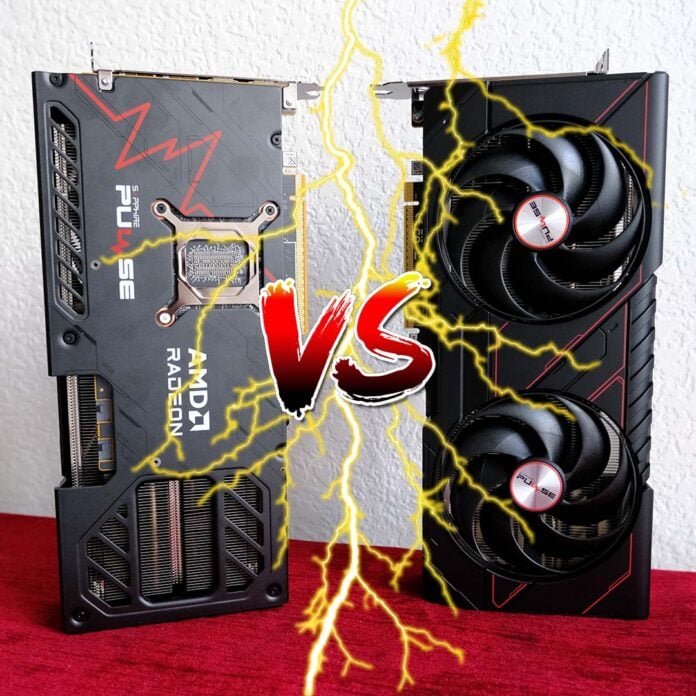
Fresh from its global debut, AMD’s Radeon RX 9070 GRE is taking over the Radeon RX 9070’s original $549 price from back in 2025. While the GRE variant is more affordable at current pricing, AMD has made several cutbacks which complicate the graphics card’s value when compared to its now more-expensive sibling.
To help you decide between which Radeon GPU is the better buy, we’ve pit both the RX 9070 GRE and RX 9070 against one another in our graphics card test suite. In this guide, you’ll find computing and gaming performance comparisons, specification analysis, and broad assessments of each GPU.
Specifications
The simplest way to describe the differences in specification between the RX 9070 GRE and RX 9070 is that the former is a cutdown version of the other. Each graphics card sports the same Navi 48 GPU, but AMD has disabled several parts, and made other cutbacks elsewhere, to lower the price in today’s climate.
| RX 9070 GRE | RX 9070 | Ratio | |
|---|---|---|---|
| Released | May 2025* | March 2025 | – |
| Codename | RDNA 4 | RDNA 4 | – |
| GPU | Navi 48 | Navi 48 | – |
| Process | TSMC N4P | TSMC N4P | – |
| Transistors | 53.9bn | 53.9bn | 1.00 |
| Die size | 357mm² | 357mm² | 1.00 |
| Stream processors | 3,072 | 3,584 | 0.86 |
| Boost clock | 2,790MHz | 2,520MHz | 1.11 |
| FP32 TFLOPS | 34 | 36 | 0.95 |
| Compute units | 48 of 64 | 56 of 64 | 0.86 |
| RT cores | 48 (3rd-gen) | 56 (3rd-gen) | 0.86 |
| AI cores | 96 (2nd-gen) | 112 (2nd-gen) | 0.86 |
| ROPs | 96 | 128 | 0.75 |
| Memory | 12GB | 16GB | 0.75 |
| Mem. type | GDDR6 | GDDR6 | – |
| Mem. clock | 18Gb/s | 20Gb/s | 0.90 |
| Mem. interface | 192-bit | 256-bit | 0.75 |
| Mem. bandwidth | 432GB/s | 640GB/s | 0.68 |
| Board power | 220W | 220W | 1.00 |
| Launch MSRP | $549 | $549 | 1.00 |
The RX 9070 GRE sports 86% of the RX 9070’s compute units, which in turn means the number of stream processors, RT cores, and Matrix cores drop by the same proportion. This doesn’t necessarily mean we should expect the cheaper Radeon to always fall 14% behind its more-expensive sibling, across gaming and AI workloads, but it’s a reasonable yardstick.
With fewer subcomponents in play, AMD is able to give the RX 9070 GRE a higher boost clock relative to the RX 9070. This seemingly comes at no additional cost to wattage, with both graphics cards rocking a 220W total board power rating. However, a 270MHz increase in frequency won’t shift the performance needle much.
Memory bandwidth takes the biggest hit of all, falling by 32% to 432GB/s from 640GB/s on the RX 9070. This decrease stems from a reduction in GDDR6 module speed, to 18Gb/s from 20Gb/s, as well as a narrowing in the memory bus from 256 bits to 192.
More pressingly, VRAM capacity is lower too, dropping from 16GB to 12GB. While that’s still enough for most FHD and QHD games, this smaller buffer size does limit the RX 9070 GRE’s ability to stretch to 4K despite having a GPU that’s capable of handling such a resolution in some titles. FSR goes some way to plugging this shortfall by reducing rendering resolution, but the tech isn’t a silver bullet.
AMD is launching the RX 9070 GRE at $549, matching the launch price of the RX 9070, which now retails for at least $599. A price difference of $50 doesn’t provide much space for either graphics card to distinguish itself, and it feels like an unfortunate repeat of the RX 9070 XT launch upon further analysis.
Test methodology
To give these graphics cards a level playing field, we’ve benchmarked both the RX 9070 GRE and RX 9070 in our Ryzen 9 9950X3D test PCs. This means we’ve remove all potential bottlenecks, so we can see how fast these GPUs can perform when they’re able to stretch their legs.
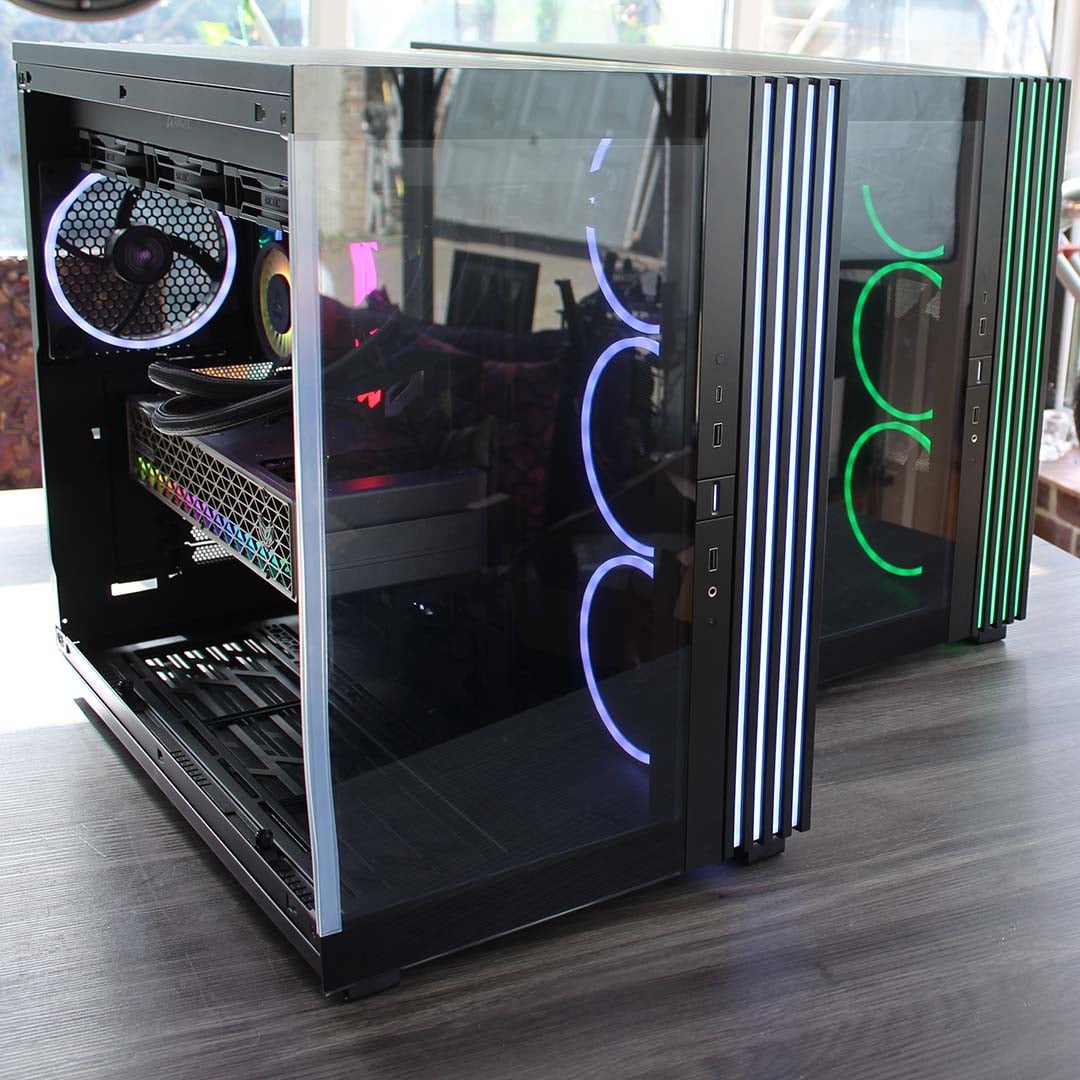
Our 9950X3D Test PCs
Club386 carefully chooses each component in a test bench to best suit the review at hand. When you view our benchmarks, you’re not just getting an opinion, but the results of rigorous testing carried out using hardware we trust.
Shop Club386 test platform components:
CPU: AMD Ryzen 9 9950X3D
Motherboard: MSI MEG X870E Ace Max
Cooler: Arctic Liquid Freezer III 420 Pro ARGB
GPU: Sapphire Nitro+ Radeon RX 9070 XT
Memory: 64GB Kingston Fury Renegade DDR5
Storage: 4TB Sandisk Optimus GX Pro 8100
PSU: be quiet! Dark Power 14 1,200W
Chassis: be quiet! Light Base 900 FX
I’ve captured 1080p (FHD) and 1440p (QHD) frame rates on both the RX 9070 GRE and RX 9070. However, the latter graphics card is capable of comfortably playing some games at 4K (UHD) thanks to its larger 16GB buffer.
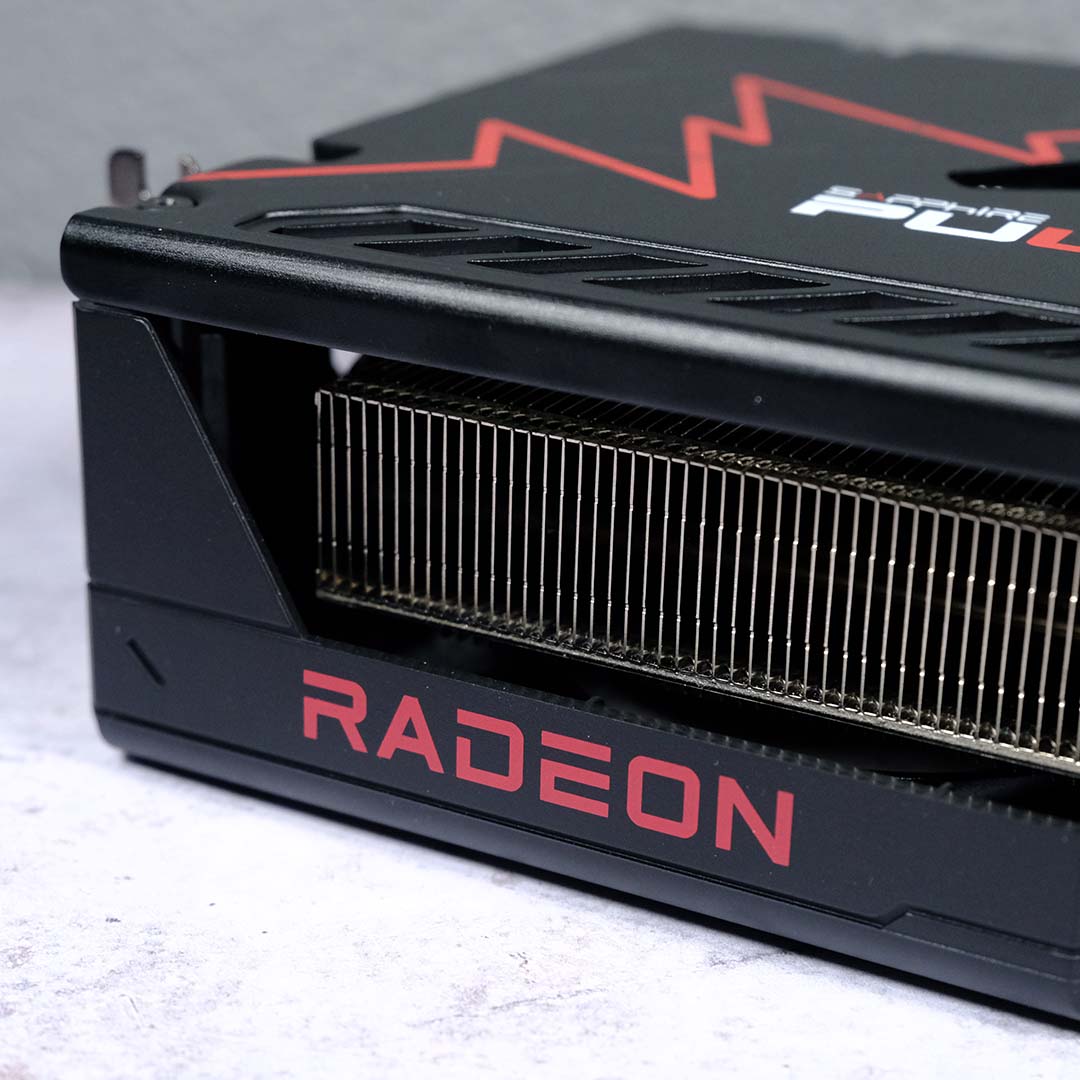
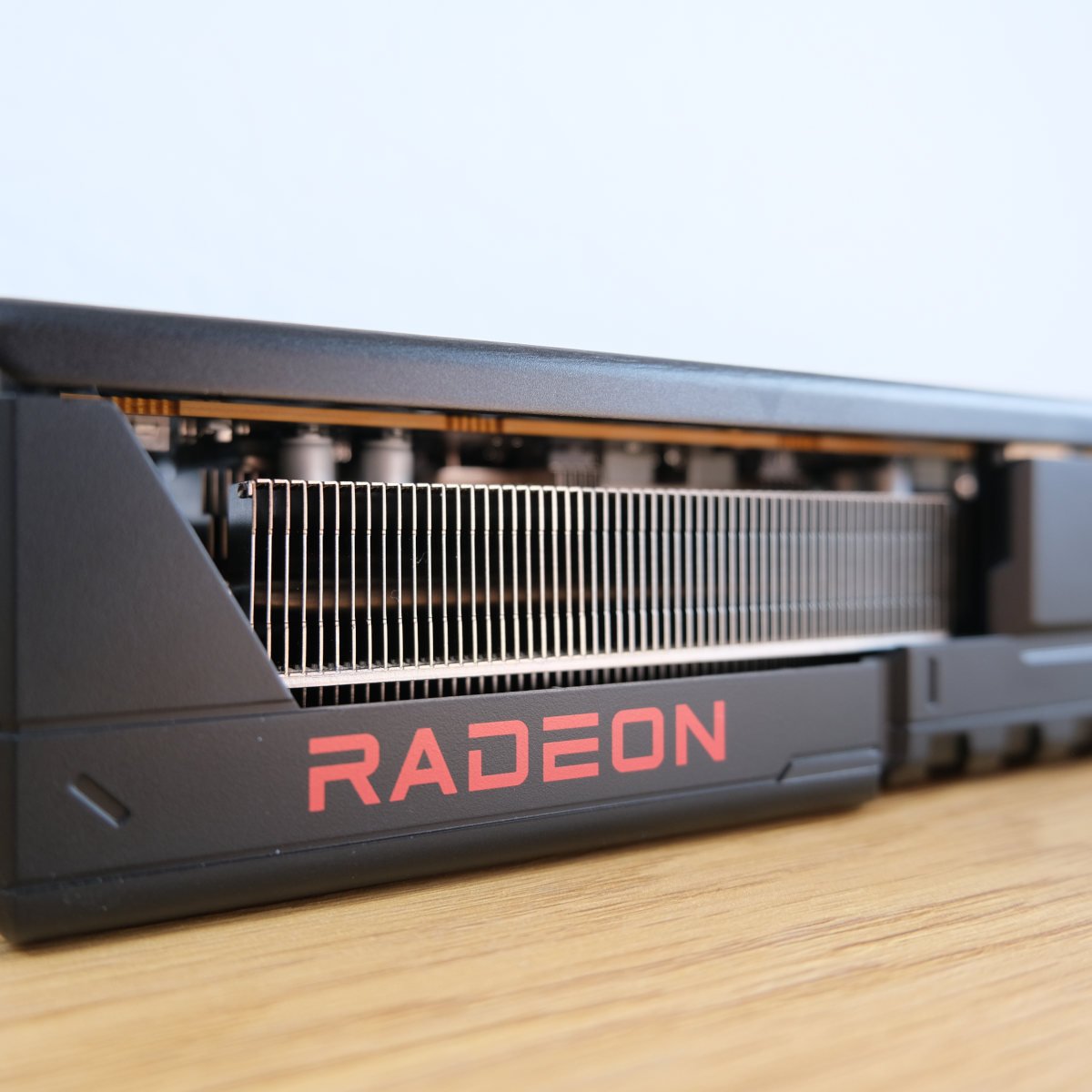
As there’s no MBA (Made By AMD) cooler design available for either RX 9070 GRE or RX 9070, we’re using the Sapphire Pulse variant for both. This does introduce a small 130MHz overclock on the GRE, but this higher frequency won’t influence results much beyond non-OC cards. This overclocked Sapphire GRE card is also readily available at the entry-level $549.99 price.
Apps
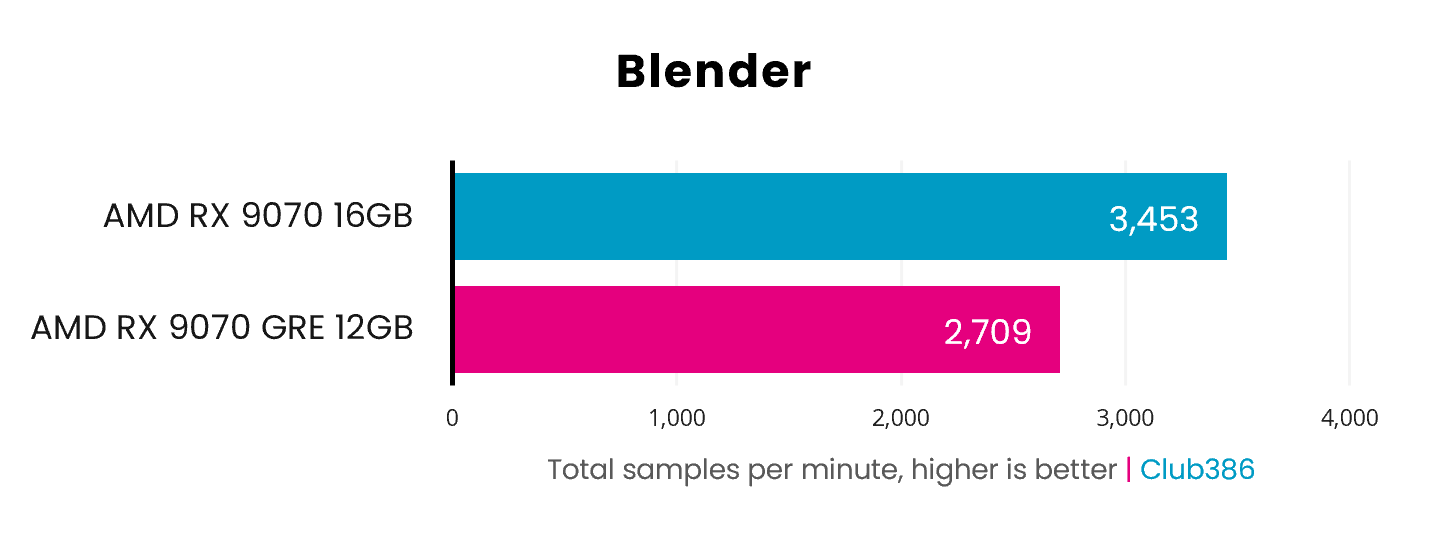
As the more-powerful graphics card, it comes as no surprise that the RX 9070 boasts greater total samples per minute in Blender relative to the RX 9070 GRE. However, the 27% advantage is stark.
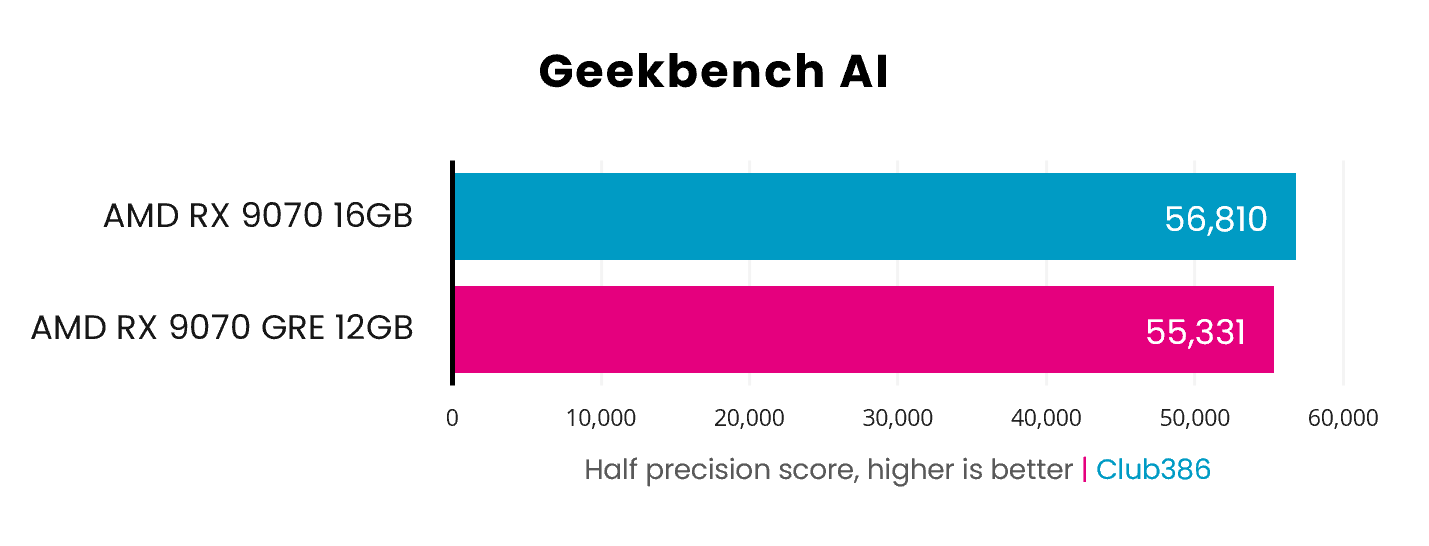
Despite boasting 17% more Matrix cores, the RX 9070 only comes out 3% ahead of the RX 9070 GRE in FP16 performance. For DirectML workloads, there’s little difference between these two cards.
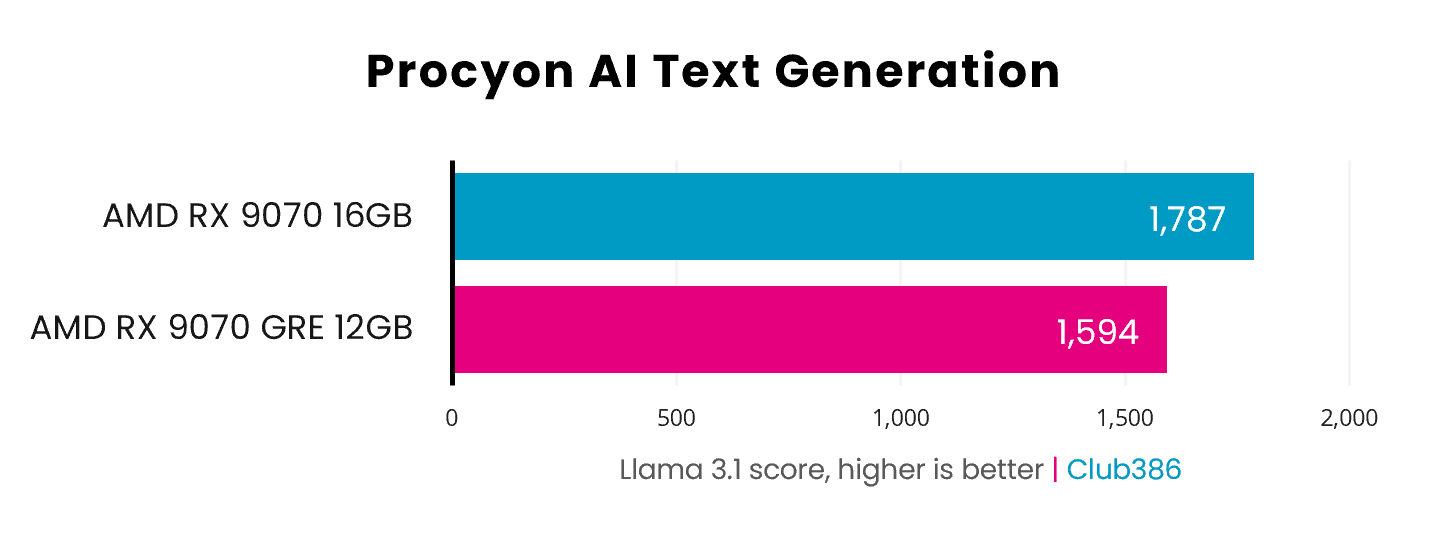
Running a Llama 3.1 LLM locally, the RX 9070 is able to process more tokens per second, scoring 12% higher than the RX 9070 GRE in Procyon’s benchmark. While that’s not a massive lead, it does make the pricier card the better-value buy.
Gaming
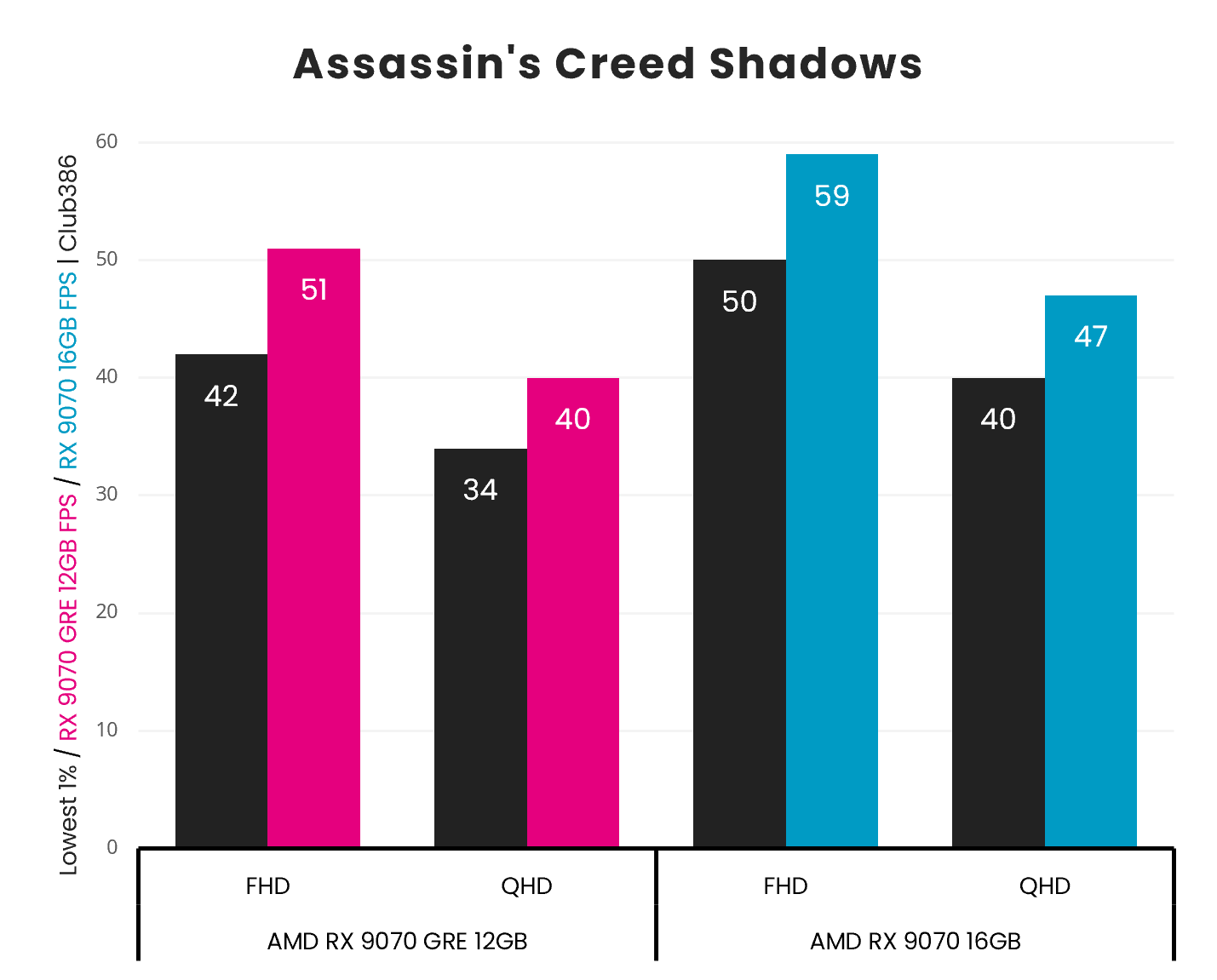
Assassin’s Creed Shadows at the Ultra High preset, complete with global illumination set to Diffuse + Specular Everywhere, kicks off gaming benchmarks with a decisive winner. The RX 9070’s average frame rates leap 16-18% ahead of those of the RX 9070 GRE.
As a reminder, the RX 9070 is just 9% more expensive than the GRE. You’re actually getting better value in terms of performance by spending the extra cash on the standard 9070 here.
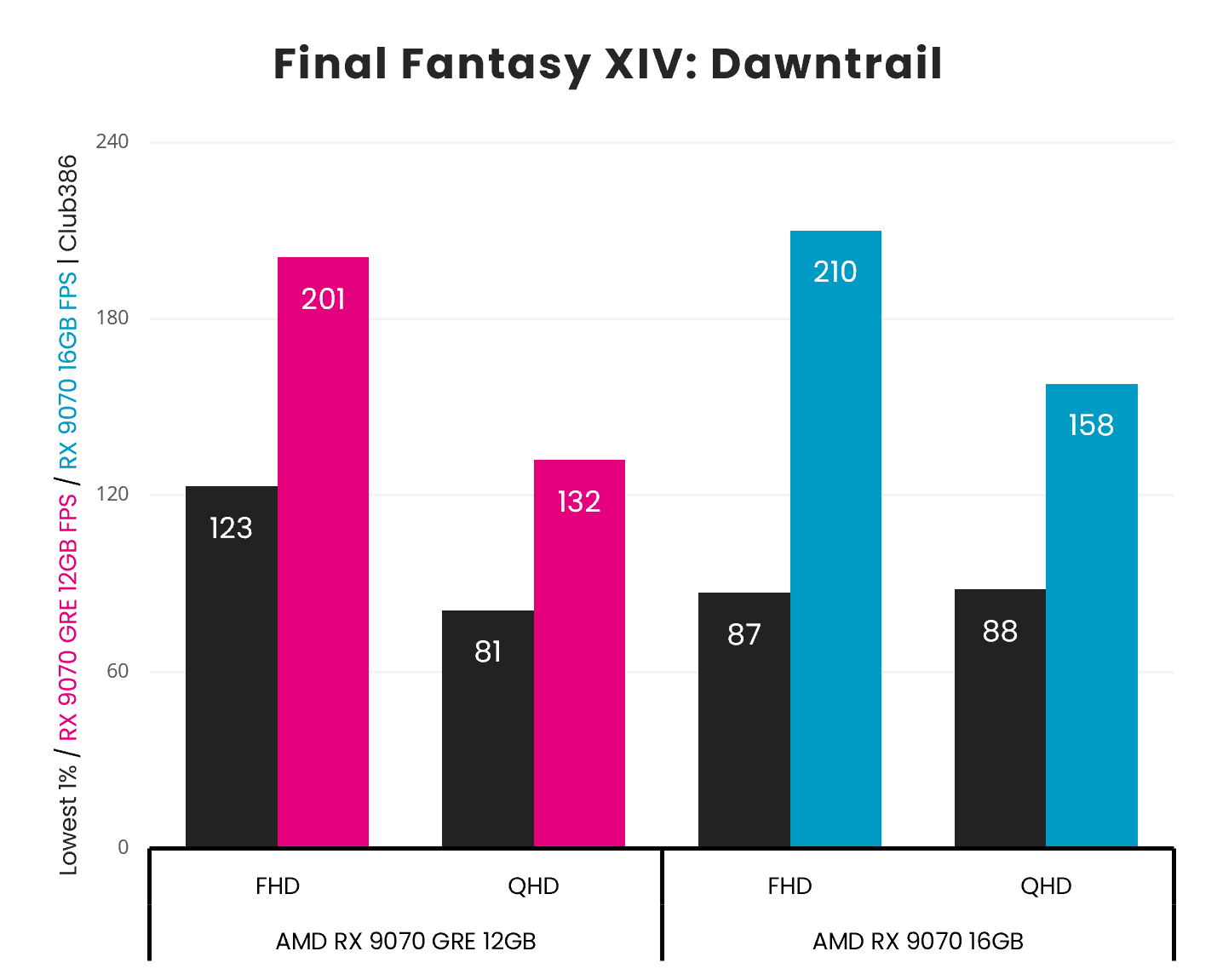
A 5% (9fps) advantage doesn’t give the RX 9070 much to scream about at FHD in Final Fantasy XIV: Dawntrail. However, moving to QHD widens the gap relative to the RX 9070 GRE to a massive 20% (26fps). If you’re playing at 2560×1440, the 9070 is a significantly better card here.
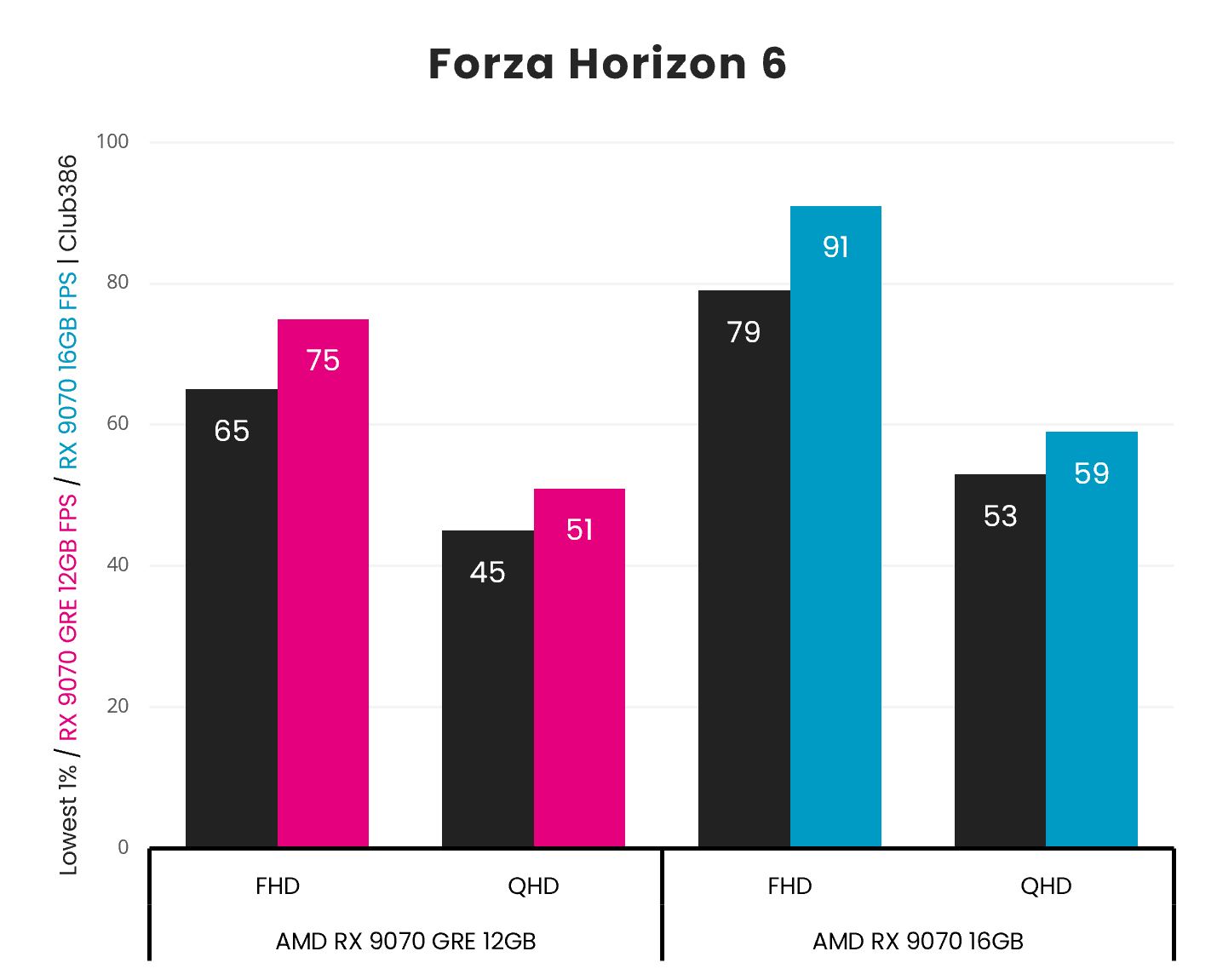
The double-digit leads keep on coming as the RX 9070 GRE and RX 9070 face off in Forza Horizon 6 at max settings with the Extreme+RT preset. Finishing this ray-traced benchmark with 16-21% higher average frame rates, there’s no denying the standard 9070 is much faster than the GRE.
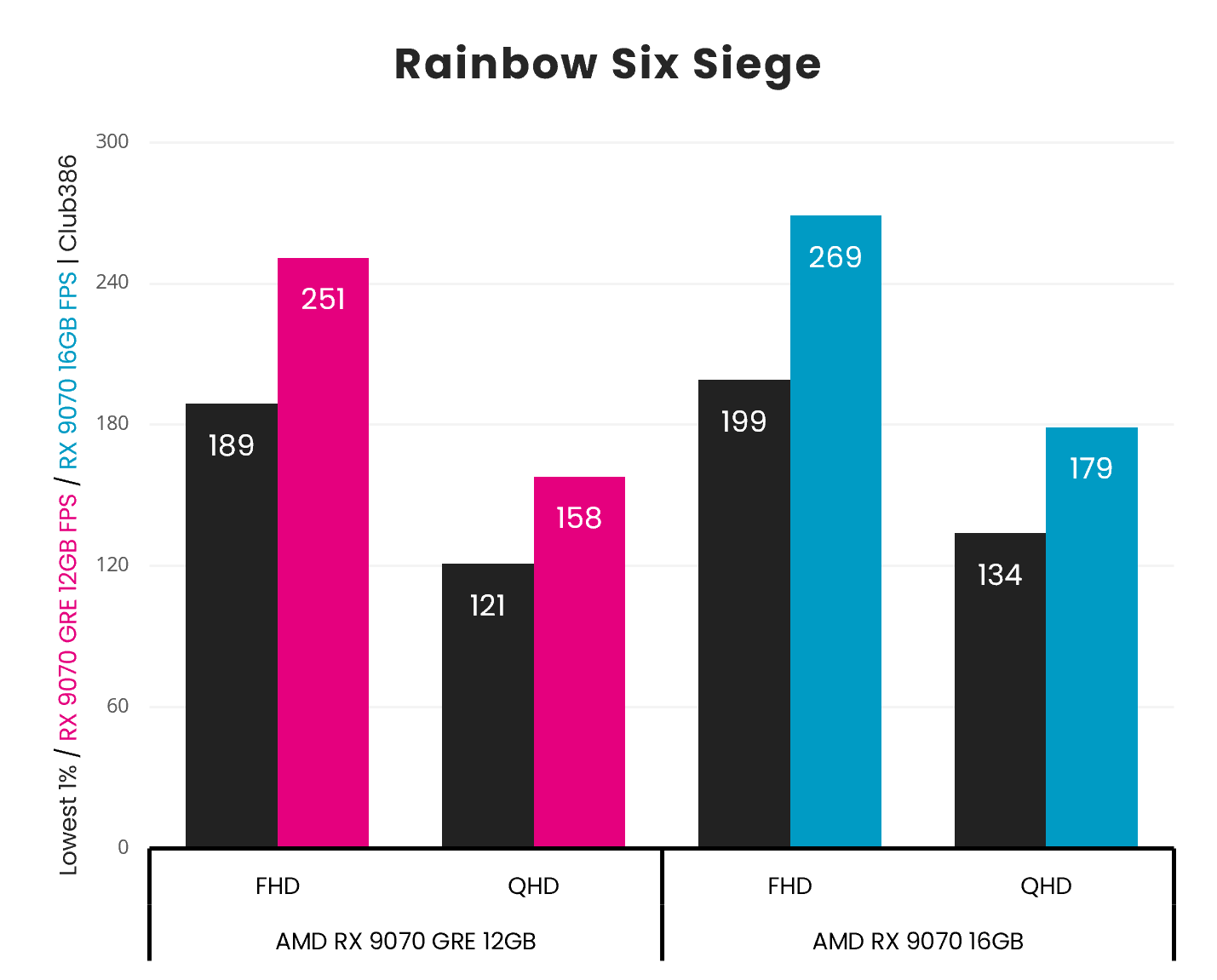
Both the RX 9070 GRE and RX 9070 deliver fantastic frame rates in Rainbow Six Siege at FHD and QHD resolutions. However, the more-expensive graphics card does provide notably faster performance, to the tune of a 7-13% improvement.
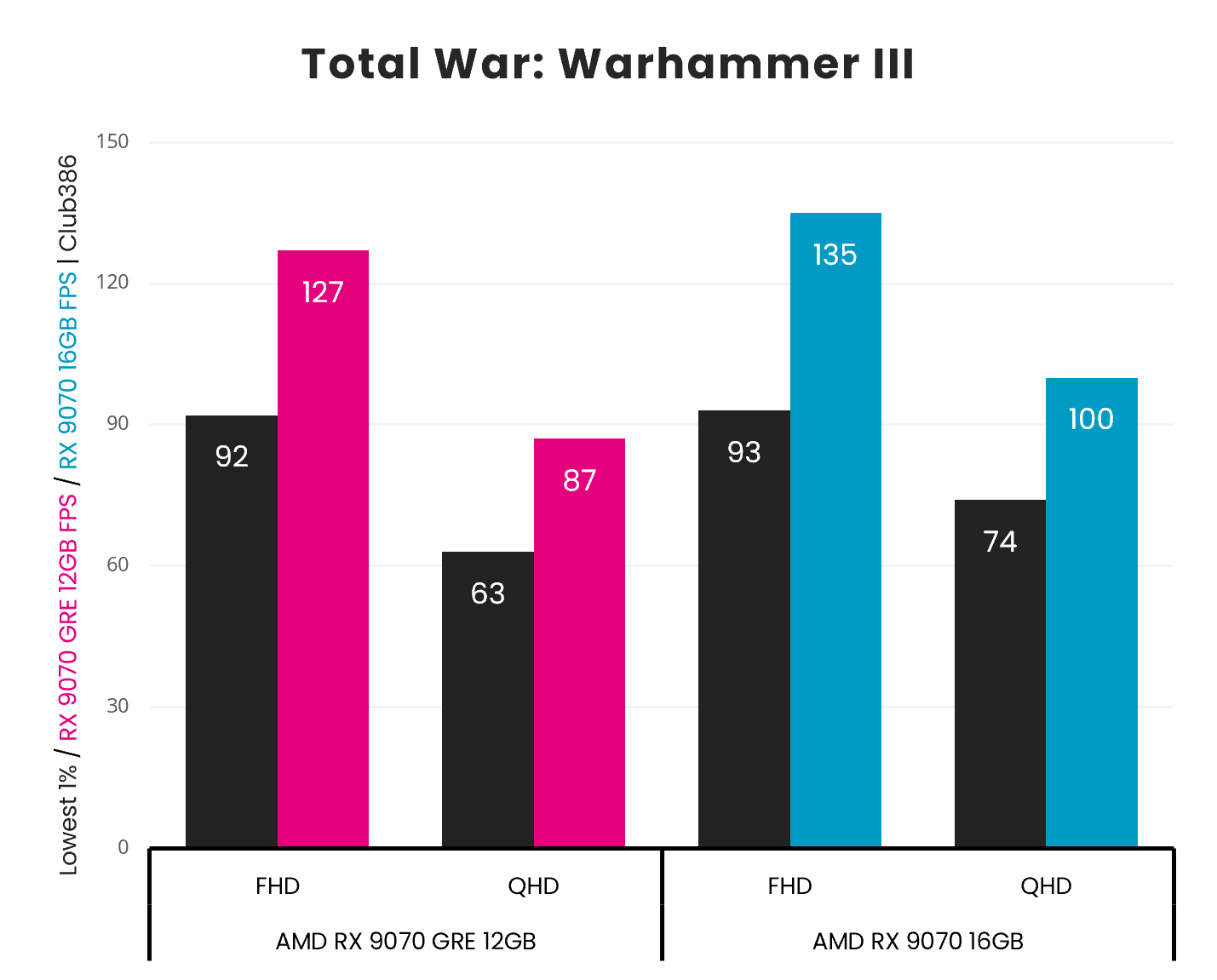
Jumping into the battlefield of Total War: Warhammer III, the RX 9070 enjoys a close victory over the RX 9070 GRE at FHD, with a 7% lead. Crank up the resolution to QHD, though, and the win grows more decisive with a 15% advantage.
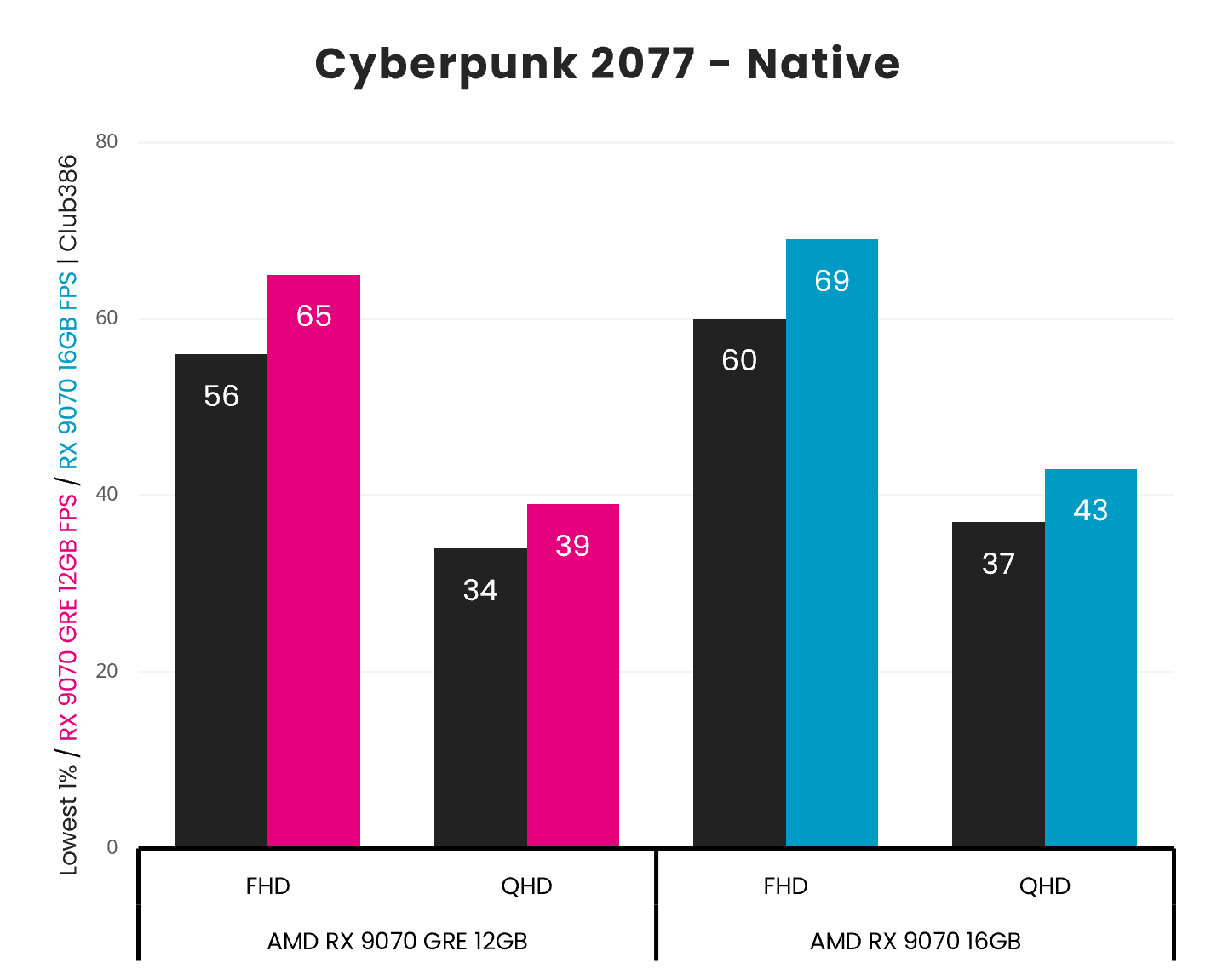
Hitting the ray-traced streets of Night City at the Ultra preset, the RX 9070 once again trumps the RX 9070 GRE but only by 6-10% across FHD and QHD resolutions. Both graphics cards manage a 60fps+ average at the lower resolution, but fall short of this threshold once the pixel count increases.
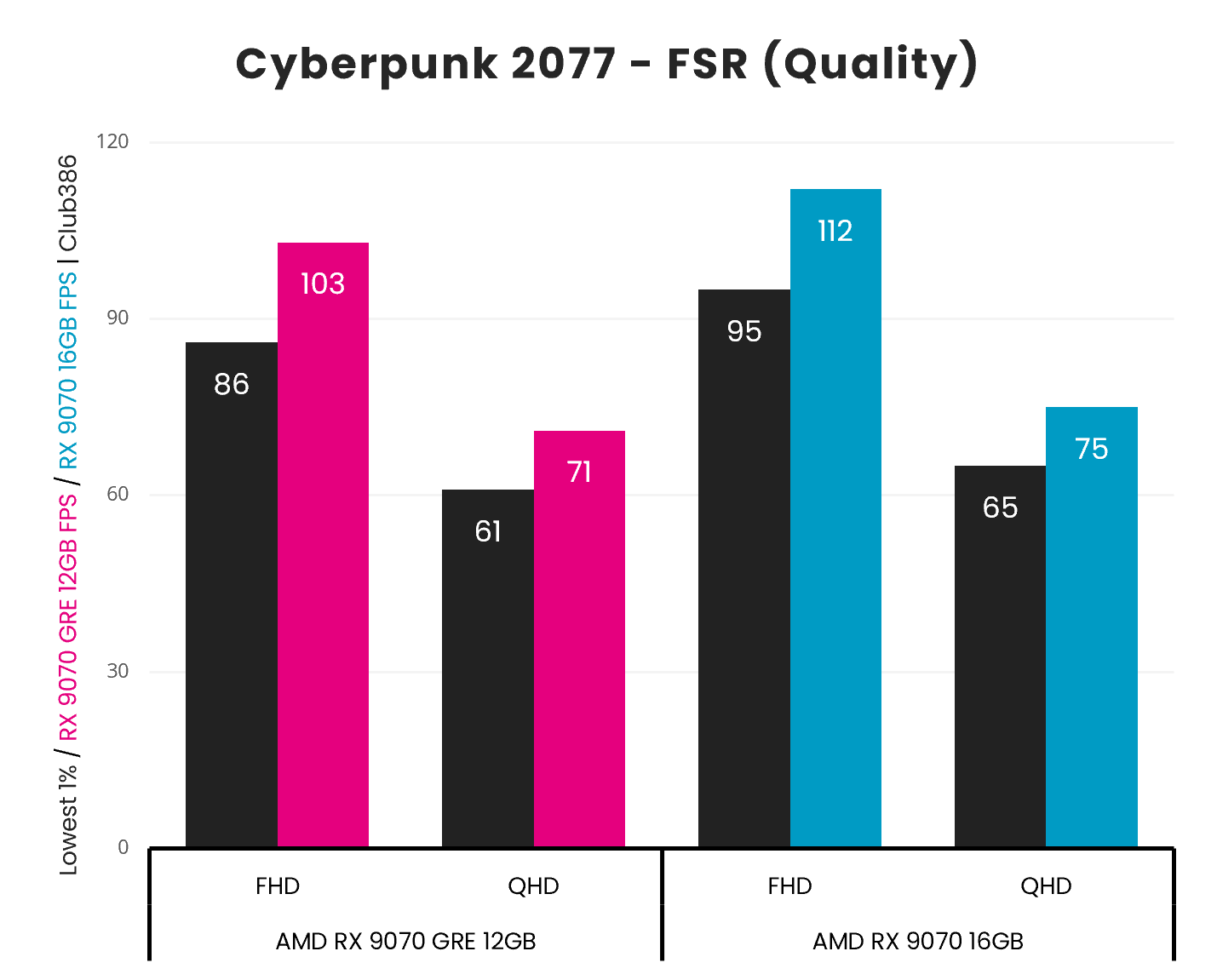
Turning on FSR 4 in Quality mode doesn’t close the gap much, as the RX 9070 still maintains a 6-9% advantage over the RX 9070 GRE. Regardless, performance is expectedly much better on both GPUs, with average frame rates north of 100fps at FHD and 60fps at QHD.
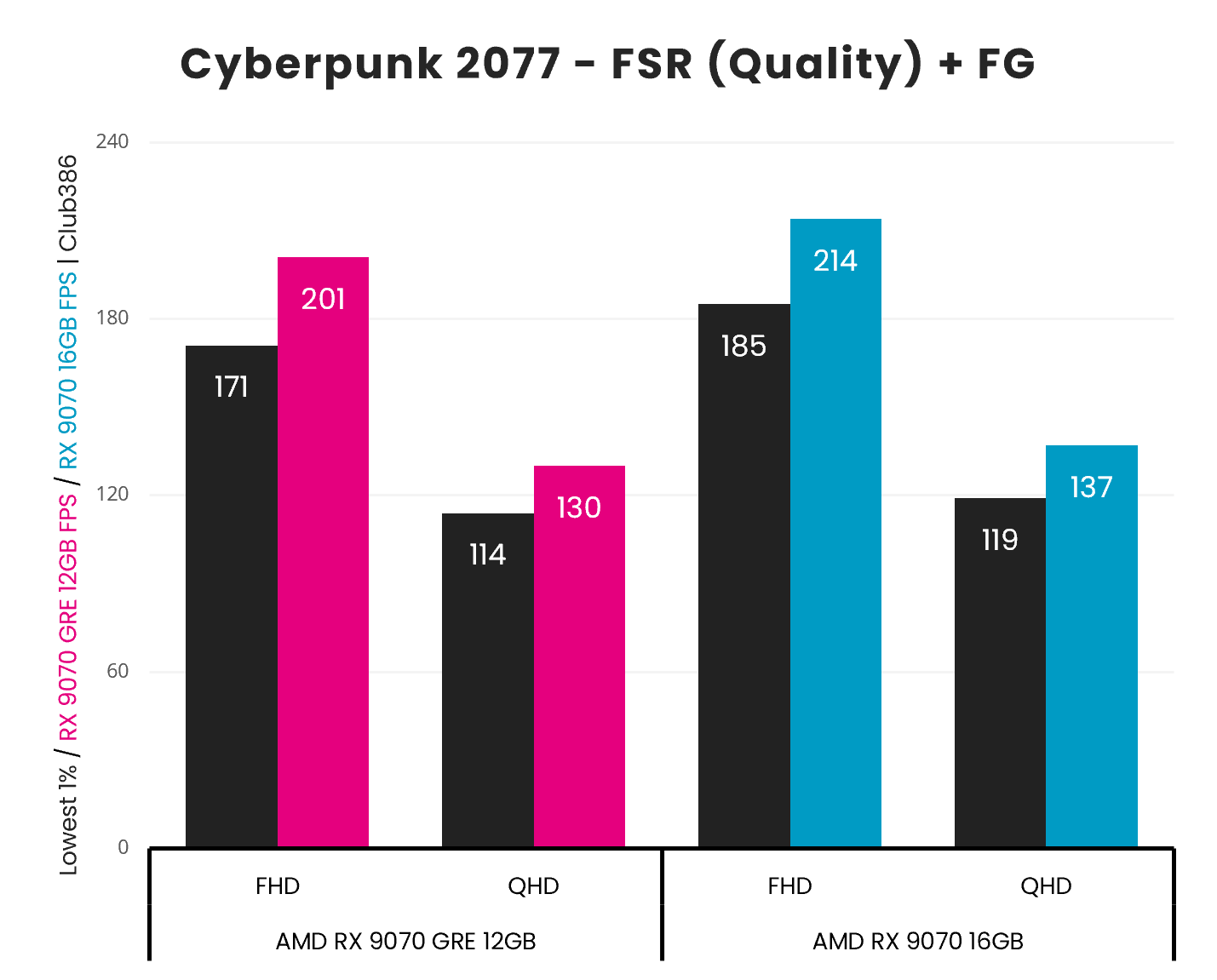
Engaging frame generation sees the RX 9070 continue to maintain a decent lead over the RX 9070 GRE, but its advantage shrinks slightly once more, now down to 6-7%.
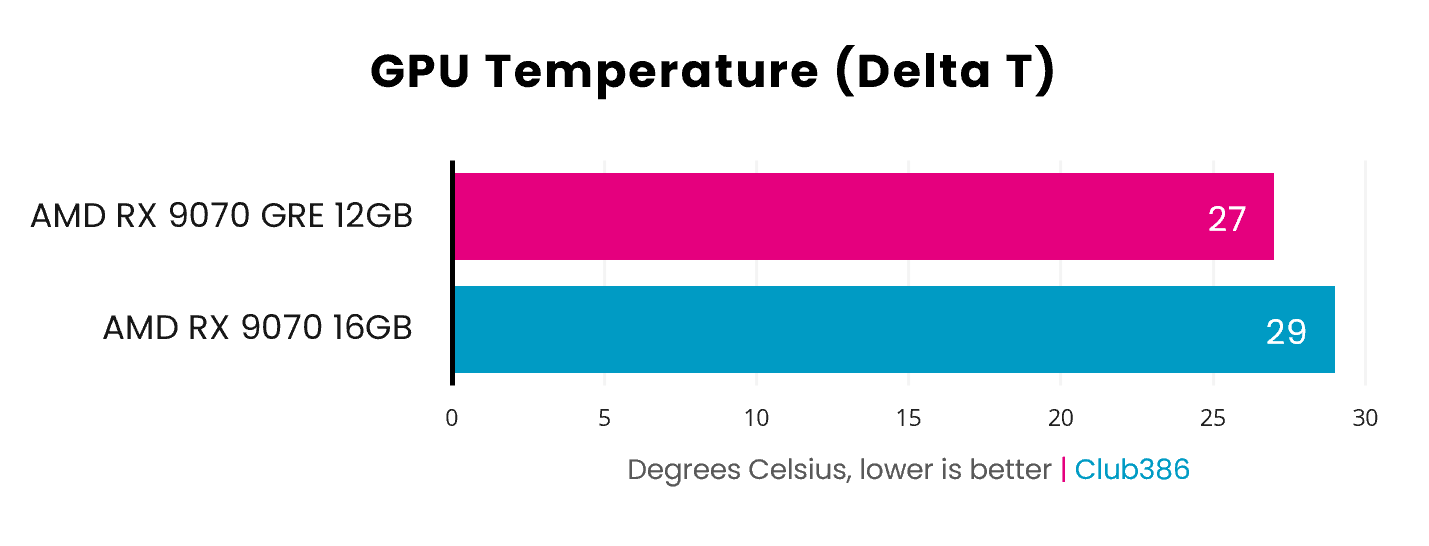
While measuring Cyberpunk 2077 upscaling and frame generation performance, I take note of each graphics card’s operating temperature. Subtracting the ambient temperature of my office (26-27°C), results in the Delta T values in the chart above. To be clear, these are not raw GPU thermals.
Sapphire’s Pulse cooler does an excellent job of keeping both graphics cards cool, delivering expectedly similar performance across the RX 9070 GRE and RX 9070. To be more specific, there’s a mere 2°C separating them.
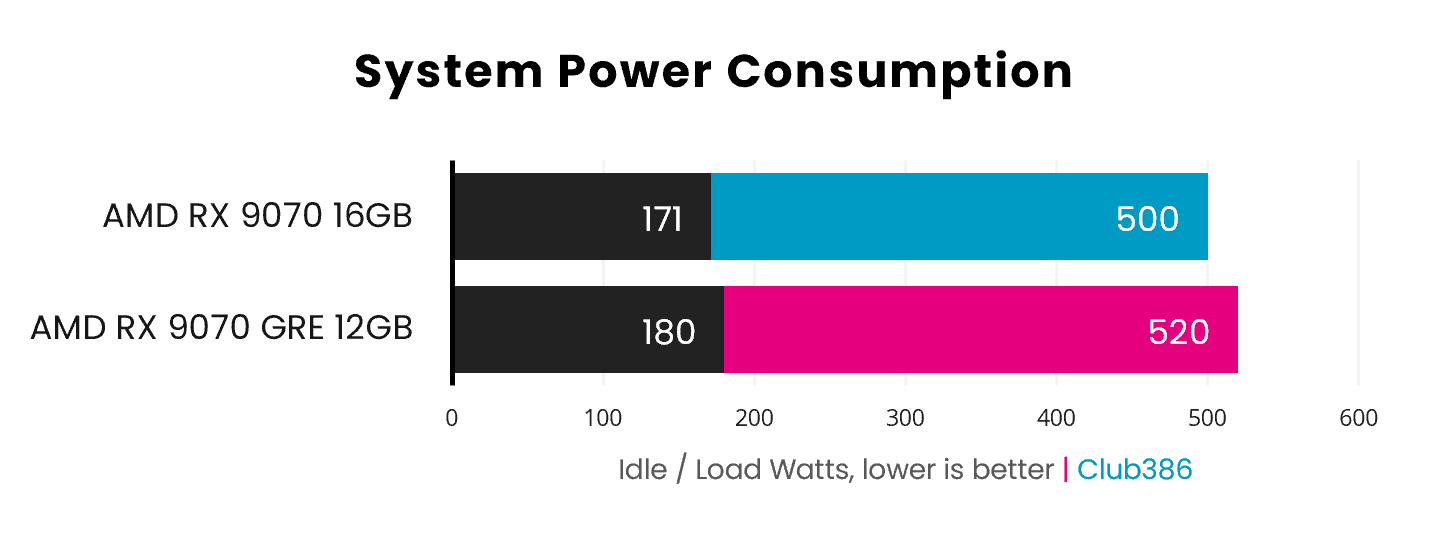
Given both the RX 9070 GRE and RX 9070 carry the same 220W total board power rating, system power consumption is near-identical across both cards. The GRE does pull more watts from the wall during our testing, but only by 9-20W.
Conclusion
While it might be tempting to save $50 and go with the RX 9070 GRE, the smarter play is to spend a little extra and cop the RX 9070. While this graphics card does cost 9% more right now, it also delivers 11-16% more performance once you average our gaming results, delivering more bang for your buck.
AMD Radeon RX 9070 GRE
$50 cheaper than the RX 9070, but that affordability doesn’t translate into better performance per dollar. Read our review.
AMD Radeon RX 9070
More-expensive than the RX 9070 GRE but up to 16% faster on average, providing superior overall value. Read our review.
Of course, this is all assumes you can find the RX 9070 GRE at $549 and RX 9070 for $599. The memory crisis continue to wreak havoc on graphics card pricing, so make sure you factor in any price changes that occur beyond the time of writing.
Check out our 9070 GRE vs RTX 5070 head-to-head for more comparisons between AMD’s latest GPU and the immediate competition. Don’t forget we have a best GPU guide covering a broader selection of graphics card recommendations too.